Zhongrui's High-capacity PP Packaging Belt Production Line is engineered for efficiency and high output. This innovative machine produces durable, flexible, and cost-effective PP straps, replacing traditional steel straps across various industries. Ideal for manufacturers seeking quality and sustainability.
According to many years of plastic machinery development and design experience, in the introduction of foreign advanced technology and digestion and absorption, on the basis of self-developed PE pipe production line. Has the unique structure, the design is novel, the equipment entire line layout is reasonable, the control performance is strong and so on.
The PE/PPR Pipe Production Line delivers reliable and efficient manufacturing of various pipes for water supply and drainage in agriculture and construction. Experience advanced technology and precision for high-quality production.
Discover the Highly Cost Effective PVC Pipe Production Line from Zhongrui. Engineered for durability and efficiency, this advanced production line ensures high-quality PVC pipes suitable for a variety of applications. Experience seamless operation, reduced maintenance, and significant cost savings.
The Composite Infiltration Irrigation Pipe Production Line is a high-efficiency system designed to produce drip irrigation tape for agricultural applications. With precision control, energy-saving technology, and advanced automation, it ensures superior performance in greenhouse, field crop, and water conservation irrigation systems.
Discover the PVC Hose Production Line designed for efficient, high-speed manufacturing of PVC hoses. Our advanced system ensures precision, versatility, and durability, making it an ideal choice for various industrial applications.
The PVC Imitation Marble Sheet Slab Extruder Machine Production Line is designed for producing high-quality, durable, and visually appealing marble-like PVC sheets. Offering fire resistance, water resistance, and high-temperature durability, it’s ideal for a variety of interior decoration applications. This advanced extrusion line guarantees high efficiency and stable output, making it a top choice for businesses looking to scale up production.
Zhongrui's PMMA Board Production Line is designed for precision, high-output plastic sheet manufacturing. With advanced technology including a vertical three-roll calender, Siemens motor, and ABB inverter, it ensures high plasticizing ability and energy-efficient performance. Ideal for producing PMMA, PC, and ABS sheets for construction, packaging, and automotive industries.
0
0
How to Measure PVC Pipe for Production Line Efficiency?
Views: 0 Author: Site Editor Publish Time: 2025-12-26 Origin: Site
You must measure PVC pipes very carefully to keep your production line working well. The pvc pipe production line from Qingdao Zhongrui Plastic Machinery Co., Ltd. uses new technology to help you do this. You can count on their system to give exact results.
Positioning accuracy is as close as 0.01mm, which matches tough industry rules.
Measuring correctly makes sure each pipe fits right and passes quality tests. This helps you stop waste and follow ISO, ASTM, and DIN rules.
Key Takeaways
Taking correct measurements of PVC pipes helps them fit right and meet quality rules. This cuts down on waste and saves money.
Use the best tools, like digital calipers and tape measures. These help you get exact measurements for both inside and outside diameters.
Check measurements often at different spots on each pipe. This helps you find problems early and keep the production line working well.
Follow rules from groups like ISO and ASTM. This makes sure your pipes are safe and work well, which makes customers happy.
Use inline monitoring systems to watch measurements as you work. This lets you fix problems fast and waste less material.
Why Measurement Matters in PVC Pipe Production
Impact on Production Line Efficiency
You have to measure each pipe the right way to keep your pvc pipe production line working well. When you use advanced systems from Qingdao Zhongrui Plastic Machinery Co., Ltd., you can watch important numbers that show how your line is doing. The table below shows why these numbers are important:
Metric
Importance
Overall Equipment Effectiveness (OEE)
A score above 85% is targeted for world-class manufacturing, while below 60% indicates significant capacity loss.
Production Yield Rate
A yield rate of > 98% is essential for controlling Cost of Goods Sold (COGS).
Yield Rate Threshold
Falling below 95% signals serious issues with machine calibration or material handling.
If you measure pvc pipes very carefully, you can find problems early. This lets you fix things before they cause waste or slow down your line. Measuring well also means you use less material, so you save money. Studies say that if you keep mistakes under 5%, you waste less PVC and your line works better.
Tip: Always check the center and ends of each pipe to make sure your measurements are correct.
Quality Control and Standards
You need to follow strict rules when making pvc pipes. These rules come from standards like ISO, ASTM, and DIN. The pvc pipe production line from Qingdao Zhongrui Plastic Machinery Co., Ltd. checks every pipe as it is made to help you meet these standards.
Meeting ASTM standards means your pipes are the right size and strong enough.
If your pipes have NSF certification, people trust them for drinking water.
Good quality control stops cracks or pipes that do not fit, so you can sell more.
When you measure every pipe the right way, your products are safe and work well. This makes your customers happy and helps your business do better.
Essential Tools to Measure PVC Pipes
You must use the right tools to measure pvc pipes. The best tools help you keep each pipe the right size. This matters for quality and safety. It is very important when making white pvc pipes for water or electric use.
Digital Calipers and Tape Measures
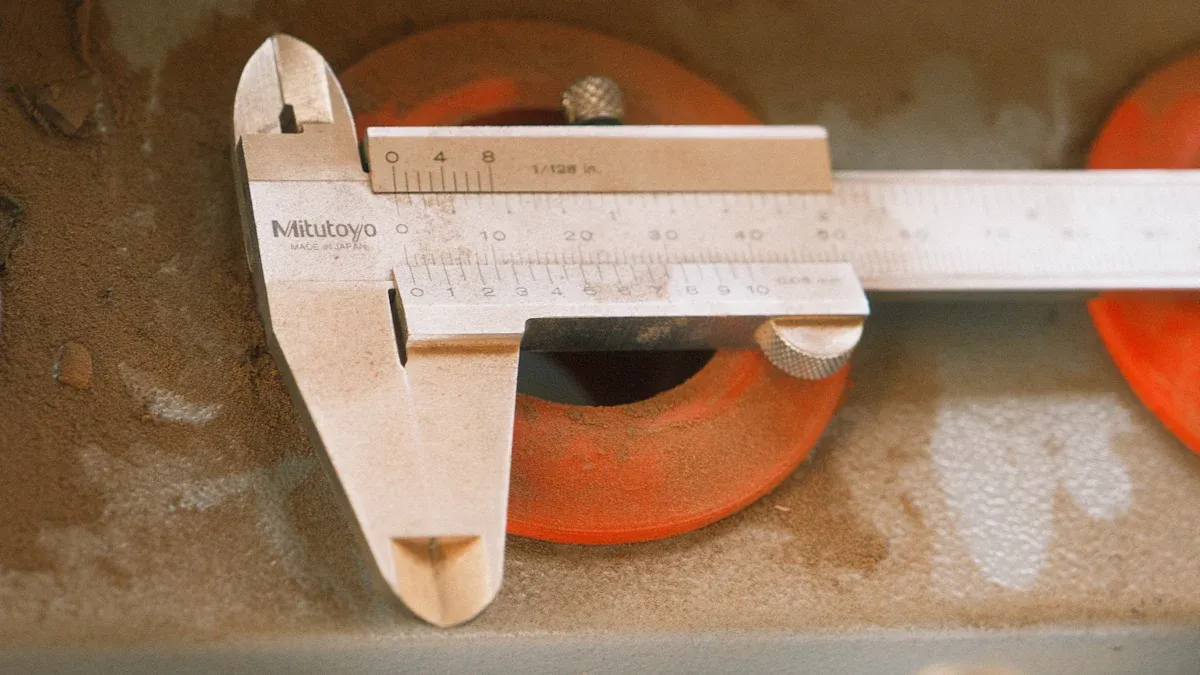
Digital calipers and tape measures help you check pipe size. Digital calipers give very exact numbers. They are great for measuring the inside diameter of white pvc pipes. Tape measures are good for quick checks. But they might miss small changes in wall thickness.
Measurement Tool
Accuracy Level
Notes
Digital Calipers
Accurate to 0.001 inches
Best for precision, especially for inside diameter.
Tape Measures
Varies, generally less precise
Good for fast checks but may miss wall thickness.
Tip: Clean the surface of white pvc pipes before you measure. This helps you get the best results.
Pipe Gauges and Specialty Tools
Pipe gauges and special tools check diameter and wall thickness. Diameter gauges help you find small size changes early. This stops problems before they get worse. Wall thickness gauges give more exact numbers than just looking. These tools help you make sure every pipe is safe and strong.
Inline Monitoring Systems
Modern pvc pipe production lines use inline monitoring systems. These systems check each pipe as it moves down the line. You see live data on a dashboard. If a pipe uses too much material or is not the right size, you can fix it fast. The system shows problems so you can keep all pvc pipes, even white pvc pipes, within the right limits. This keeps your line fast and your products high quality.
Note: Inline systems help you find mistakes before they get big. This saves time and cuts down on waste.
How to Measure PVC Pipe Size
Measuring Inside and Outside Diameter
You need to measure the diameter of pvc pipes to make sure they fit and work well. Follow these steps to get accurate results:
Clean the pipe. Remove dust or debris from the surface.
Use a tape measure or caliper to measure the outside diameter. Wrap the tape around the pipe and check the number where it meets. If you use a caliper, place the jaws around the pipe and close them until they touch both sides. Read the measurement.
For the inside diameter, use a caliper. Insert the jaws into the pipe. Close them until they touch the inside walls. Read the number on the caliper.
Measure at the center and both ends of the pipe. This helps you find any changes in diameter.
Write down your measurements. Compare them to standard sizing charts to see if the pipe matches industry sizes.
Tip: Ask someone to help you hold large pipes steady. This makes your measurements more accurate.
Measuring Wall Thickness
Wall thickness affects how strong and safe pvc pipes are. You can measure wall thickness in two ways:
Use a caliper. Place one jaw on the outside and the other on the inside of the pipe. Read the distance between them. Do this at several points and find the average.
Use an ultrasonic thickness gauge. This tool sends a sound wave through the pipe wall and measures how long it takes to return. It gives a quick and reliable reading without cutting the pipe.
Wall thickness controls the pressure rating of pvc pipes. Thicker walls mean the pipe can handle more pressure. For example, Schedule 40 pipes are common for homes, while Schedule 80 pipes have thicker walls for higher pressure jobs.
Note: Always check wall thickness at different spots to make sure the pipe is even and strong.
Measuring Pipe Length
You must measure the length of pvc pipes to meet order requirements and industry standards. Use a measuring tape for this job. Lay the pipe flat and stretch the tape from one end to the other. Make sure the tape is straight and tight.
Measurement Method
Description
Inside Diameter Measurement
Use calipers or a pipe gauge for the most accurate measurement of the pipe's inner diameter.
Outside Diameter Measurement
Measure the outside diameter with calipers or a tape measure and reference standard sizing charts.
Tools
Caliper, Micrometer, Measuring Tape are essential tools for accurate measurements of PVC pipes.
Industry rules allow a small error in length. For example, a 4-meter pipe can be up to 20 mm longer but not shorter.
Tip: Always measure from the very end of the pipe, not from the shoulder or fitting.
Determine Pipe Size for Fittings
You need to determine pipe size to make sure fittings connect tightly and do not leak. Most fittings use the outside diameter for sizing. Some special pipes use the inside diameter, especially copper tube size (CTS) pipes.
Check the outside diameter of your pipe.
Look at the fitting label. It should match the pipe’s size.
Remember, fittings are a bit larger than the pipe so they can slide over the end.
If you choose the wrong size, you may get loose joints or cracks. This can cause leaks or weak spots in your system.
Tip: Always round your measurements to the nearest standard size. This helps you pick the right fitting and keeps your pvc pipe production line running smoothly.
If you follow these steps, you will know how to measure pvc pipe size with confidence. Accurate measurements help you avoid mistakes and keep your production line efficient.
Common Mistakes When Measuring PVC Pipes
Measuring pvc pipes looks easy, but mistakes can happen. These mistakes can hurt your production line. You need to be careful or you might waste material. Leaks and bad pipe connections can also happen if you are not careful.
Tool Misuse and Human Error
Sometimes people use measuring tools the wrong way. If you hold a caliper at an angle, your number will be wrong. Reading a tape measure from the wrong spot also gives bad results. People make mistakes when they measure by hand. Calipers and tape measures can give different numbers each time. This is true if you measure many pvc pipes or use odd sizes. Picking the wrong material can cause problems with pressure or the fluid inside. If you read thread pitch wrong, leaks or breaks can happen.
Some common mistakes are:
Using the wrong tool for measuring
Not checking the pipe at different spots
Picking the wrong material for the job
Reading thread specs wrong
Tip: Always check your measurements twice and use the right tool.
Overlooking Fitting Shoulders
You must look at the shoulders on pvc fittings. If you measure from the wrong place, pipes may not fit. Many people forget about the extra space from fitting shoulders. This mistake can make joints loose or cause leaks. When you connect pvc pipes to fittings, measure from the real end of the pipe. Do not measure from the shoulder or any part that sticks out.
Problems you might see:
Loose pipe connections
Leaks where pipes join
Weak spots in your system
Note: Good measurements stop repairs and keep your system safe.
Not Rounding to Standard Sizes
You have to round your numbers to standard sizes. If you skip this, you might have trouble with pvc fittings. The outside of pvc pipes is usually bigger than the size on the label. If you do not match the size to the fitting, the connection will be bad. When you connect to other pipes, make sure the outside matches the inside of the fitting. This helps your system work right.
Problems from not rounding:
Fittings that are too loose
Leaks or breaks in the system
Trouble joining other types of pipes
Tip: Always use sizing charts to pick the right pvc fittings.
Types of PVC Pipes and Reference Chart
Overview of Pipe Types and Applications
You will find many types of pvc pipes in modern production lines. Each type has a special use and needs careful measurement. The PVC Pipe Production Line from Qingdao Zhongrui Plastic Machinery Co., Ltd. can make a wide range of pipes for different jobs. You can see some common types of pvc pipes in the table below:
Type of Pipe
Description
PVC Winding Pipe
Made with a double-stage decompression screw for high quality and fast production.
PVC Reinforced Pipe
Has a smooth inner wall and strong ribs for extra strength.
You also need to know how these types of pvc pipes work in real life. The next table shows where you use each type and how much precision you need when you measure them:
Type of PVC Pipe
Application Description
Measurement Precision
Schedule 40 PVC
Used in homes and small businesses for water and drains.
Thinner walls, bigger inside diameter.
Schedule 80 PVC
Used in factories and places with high pressure.
Thicker walls, smaller inside diameter.
DWV PVC
Used for drains and waste, usually white or cream.
Different from pressure pipes.
Electrical Conduit PVC
Used to protect wires, not for water.
Different from plumbing pipes.
Cellular Core PVC
Used for insulation, has foam between solid walls.
Needs special checks for wall thickness.
Note: You must measure each type of pvc pipes with the right tool to keep your products safe and strong.
Quick Reference Chart for Standard Sizes
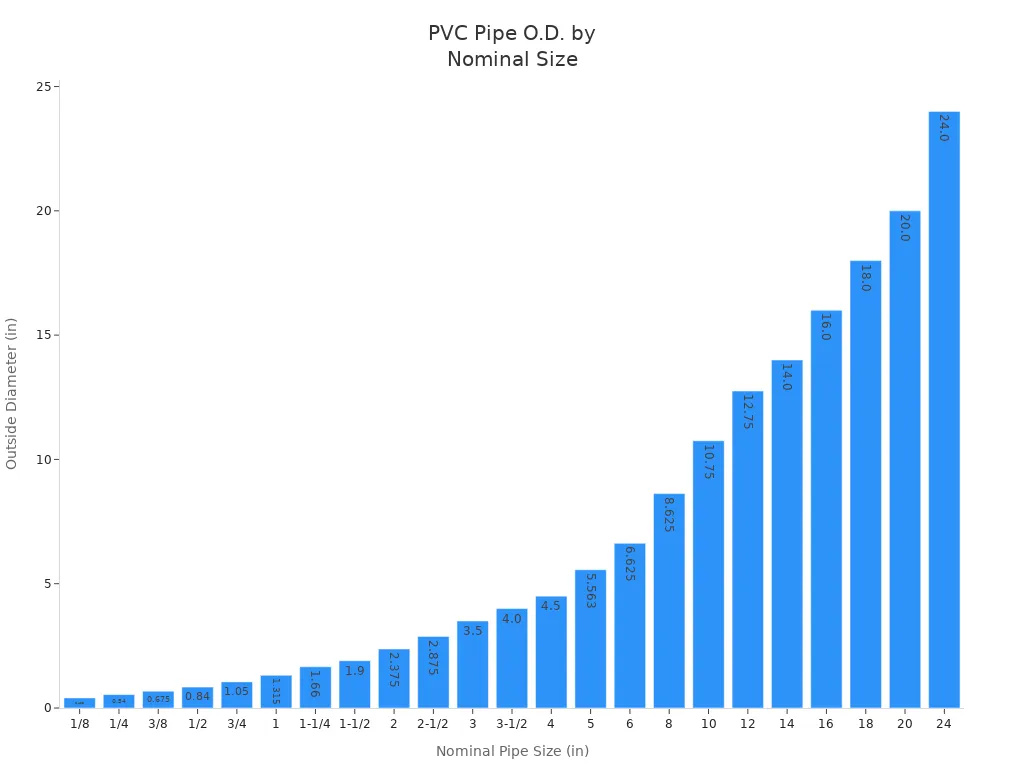
You can use a quick reference chart to pick the right pvc pipe sizes during production. This chart helps you match your measurements to the correct pipe and fitting. It saves you time and helps you avoid mistakes.
Nominal Pipe Size (in)
O.D. (in)
Average I.D. (in)
Min. Wall (in)
Nominal Wt./ft.
Maximum W.P. PSI*
1/8
0.405
0.249
0.068
0.051
810
1/4
0.540
0.344
0.088
0.086
780
3/8
0.675
0.473
0.091
0.115
620
1/2
0.840
0.602
0.109
0.170
600
3/4
1.050
0.804
0.113
0.226
480
1
1.315
1.029
0.133
0.333
450
1-1/4
1.660
1.360
0.140
0.450
370
1-1/2
1.900
1.590
0.145
0.537
330
2
2.375
2.047
0.154
0.720
280
2-1/2
2.875
2.445
0.203
1.136
300
3
3.500
3.042
0.216
1.488
260
3-1/2
4.000
3.521
0.226
1.789
240
4
4.500
3.998
0.237
2.118
220
5
5.563
5.016
0.258
2.874
190
6
6.625
6.031
0.280
3.733
180
8
8.625
7.942
0.322
5.619
160
10
10.750
9.976
0.365
7.966
140
12
12.750
11.889
0.406
10.534
130
14
14.000
13.073
0.437
12.462
130
16
16.000
14.940
0.500
16.286
130
18
18.000
16.809
0.562
20.587
130
20
20.000
18.743
0.593
24.183
120
24
24.000
22.544
0.687
33.652
120
Tip: Always use a reference chart when you measure types of pvc pipes. This helps you choose the right size and keeps your production line running smoothly.
You make your production line better when you measure pvc pipes carefully. The right tools and good habits help you find problems early. This keeps your products strong and safe.
Measuring the same way each time lowers mistakes.
Good quality makes customers happy and stops returns.
You spend less money because you waste less material.
Checking pipes often and using new technology helps you stay good at quality control. Use these steps to make your pvc pipe production line work well every time.
FAQ
How do you choose the right tool for measuring PVC pipes?
Pick your tool by looking at the pipe’s size and type. Use digital calipers if the pipe is small. Use a tape measure for long pipes. Inline systems are best for fast lines.
Why do you need to measure both inside and outside diameters?
You need both numbers to make sure fittings work. The outside diameter helps you pick the right fitting. The inside diameter shows how much water can move through.
What is the best way to avoid measurement mistakes?
Always clean the pipe before you measure it. Measure in more than one spot. Use a chart to check your numbers. Check your measurements again to be sure.
How often should you check pipe measurements during production?
Check the pipes at the start, in the middle, and at the end of each run. Inline monitoring systems let you watch every pipe as it is made.
Qingdao Zhongrui Plastic Machinery Co., Ltd. is located in Jiaozhou City, Qingdao City, Shandong Province. It is 30 kilometers away from Qingdao Port and only 20 kilometers away from the airport.



 +86-18561886575 (Mr.Wu)
 +8618561886575
 238 Yangzhou West Road, Jiaozhou City, Qingdao City, Shandong Province