Zhongrui's High-capacity PP Packaging Belt Production Line is engineered for efficiency and high output. This innovative machine produces durable, flexible, and cost-effective PP straps, replacing traditional steel straps across various industries. Ideal for manufacturers seeking quality and sustainability.
According to many years of plastic machinery development and design experience, in the introduction of foreign advanced technology and digestion and absorption, on the basis of self-developed PE pipe production line. Has the unique structure, the design is novel, the equipment entire line layout is reasonable, the control performance is strong and so on.
The PE/PPR Pipe Production Line delivers reliable and efficient manufacturing of various pipes for water supply and drainage in agriculture and construction. Experience advanced technology and precision for high-quality production.
Discover the Highly Cost Effective PVC Pipe Production Line from Zhongrui. Engineered for durability and efficiency, this advanced production line ensures high-quality PVC pipes suitable for a variety of applications. Experience seamless operation, reduced maintenance, and significant cost savings.
The Composite Infiltration Irrigation Pipe Production Line is a high-efficiency system designed to produce drip irrigation tape for agricultural applications. With precision control, energy-saving technology, and advanced automation, it ensures superior performance in greenhouse, field crop, and water conservation irrigation systems.
Discover the PVC Hose Production Line designed for efficient, high-speed manufacturing of PVC hoses. Our advanced system ensures precision, versatility, and durability, making it an ideal choice for various industrial applications.
The PVC Imitation Marble Sheet Slab Extruder Machine Production Line is designed for producing high-quality, durable, and visually appealing marble-like PVC sheets. Offering fire resistance, water resistance, and high-temperature durability, it’s ideal for a variety of interior decoration applications. This advanced extrusion line guarantees high efficiency and stable output, making it a top choice for businesses looking to scale up production.
Zhongrui's PMMA Board Production Line is designed for precision, high-output plastic sheet manufacturing. With advanced technology including a vertical three-roll calender, Siemens motor, and ABB inverter, it ensures high plasticizing ability and energy-efficient performance. Ideal for producing PMMA, PC, and ABS sheets for construction, packaging, and automotive industries.
0
0
PVC Profile Production Line Extruder Choices for Buyers
Views: 0 Author: Site Editor Publish Time: 2026-10-21 Origin: Site
Choosing the wrong extruder can increase costs and reduce product quality.A reliable PVC Profile Production Line starts with the right equipment.Buyers must compare screw designs, output capacity, and material compatibility.This guide explains key extruder types, specifications, and operating costs. You will learn how to evaluate suppliers and choose equipment confidently.
Which PVC Profile Extruder Type Should Buyers Choose?
Conical Twin-Screw Extruders for Rigid PVC Profiles
Conical twin-screw extruders are common options for processing rigid PVC compounds. Their screw design supports mixing, plasticization, and controlled material delivery. They are often considered for window frames, door frames, decorative trims, and construction profiles. Their suitability still depends on formulation, screw geometry, and the required production rate. Buyers should evaluate the complete processing system rather than focus on the screw arrangement alone.
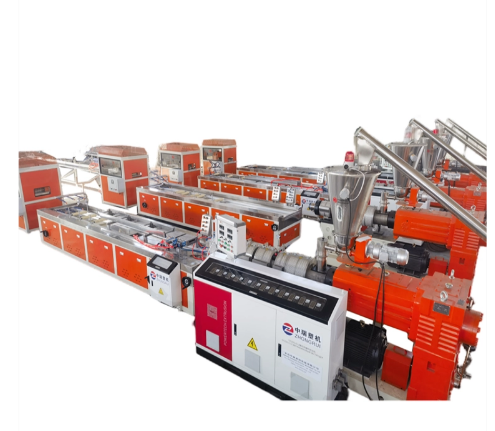
A suitable machine should maintain stable material flow and provide effective temperature control. These features help reduce thermal degradation and support consistent profile quality. Buyers should also examine the feeding system, drive configuration, venting requirements, and compatibility with the selected die. For procurement teams comparing aPVC Profile Production Line, these details provide a more useful basis for selection than general claims about machine performance.
Parallel Twin-Screw Extruders for Specialized PVC Applications
Parallel twin-screw extruders may suit applications requiring specific output levels, screw configurations, or processing characteristics. Their performance depends on the screw design, drive system, torque capacity, and material formulation. Buyers should request technical explanations for the proposed configuration. They should also confirm whether the supplier has processed comparable profiles under similar conditions.
A production trial can reveal issues that a specification sheet cannot show. It helps buyers evaluate melt stability, surface finish, dimensions, and practical output. Maintenance access and replacement-part availability also deserve attention. A machine that meets the production target but requires frequent maintenance may create unnecessary operating costs. Therefore, buyers should compare verified production results alongside the purchase price.
Single-Screw Extruders for Compatible Plastic Profile Materials
Single-screw extruders can process many thermoplastics, including suitable PE and PP formulations. However, their suitability for PVC depends on the formulation and the required processing conditions. Rigid PVC is sensitive to heat and shear, so buyers must verify that the proposed system can process it safely and consistently. A single-screw machine should not be selected simply because its initial price is lower.
The following table summarizes the main selection considerations.
Extruder type
Key consideration
Buyer priority
Conical twin-screw
Rigid PVC processing
Stable plasticization
Parallel twin-screw
Application-specific processing
Verified output and configuration
Single-screw
Compatible thermoplastics
Material suitability
Tip: Ask suppliers to confirm the recommended extruder type using your material formulation, profile drawings, and target output.
How Should Buyers Match Extruders to Different PVC Profile Products?
Window and Door Frames Requiring Dimensional Stability
Window and door frames require consistent dimensions and reliable structural performance. Their cross-sections may include multiple cavities, reinforcing sections, and connecting features. The extruder must supply a stable melt to the die. The die, calibration equipment, and cooling system must then maintain the intended geometry. Poor coordination can cause warping, uneven wall thickness, or dimensional variation.
Buyers should provide profile drawings and material specifications before requesting quotations. They should identify critical dimensions, wall thicknesses, surface requirements, and acceptable tolerances. The supplier can then recommend a suitable configuration for evaluation. Sample production should verify dimensions at several points along the profile. This approach gives buyers more reliable evidence than rated output alone.
PVC Wall Panels, Decorative Trims, and Cable Trunking
PVC wall panels, decorative trims, and cable trunking differ in width, thickness, shape, and surface requirements. A wide panel may need different die and calibration arrangements from a narrow trim. Cable trunking may also require consistent internal dimensions and secure cover fitting. These differences influence equipment selection and the required downstream configuration.
Buyers should compare the maximum profile dimensions, die arrangement, cooling capacity, and haul-off performance. They should also confirm whether the line can support planned product variations. For example, manufacturers expecting to produce several panel designs should ask about die changes and calibration adjustments. High-Yield PVC Wall Panel Line for Construction provides a relevant product reference for buyers evaluating wall-panel manufacturing equipment. Actual specifications should be confirmed against each project's requirements.
Foamed PVC and Wood-Plastic Composite Profiles
Foamed PVC and wood-plastic composite profiles require particular attention to material formulation. Foamed products may need controlled gas formation, melt strength, and cooling to achieve the intended structure. Wood-plastic composites contain wood-based fillers and polymers, which can change flow behavior and processing requirements. Equipment suitable for one formulation may not deliver the same results with another.
Buyers should disclose the material recipe, filler content, target density, and desired surface finish. They should ask whether the screw configuration and venting arrangements suit the formulation. Trials should check product weight, dimensions, surface appearance, and internal structure where relevant. The die and cooling system must also support the required profile shape. These checks help prevent purchasing a line that performs well with one material but struggles with the intended production recipe.
Tip: Foamed PVC and WPC are not interchangeable applications; verify material compatibility before approving the machine configuration.
Which Extruder Specifications Matter Most During Purchasing?
Screw Diameter, Configuration, and Length-to-Diameter Ratio
Screw specifications influence material transport, mixing, plasticization, and melt delivery. Screw diameter alone does not determine the quality or output of a PVC profile production line. The screw configuration, length-to-diameter ratio, channel design, and operating speed must suit the intended material. Buyers should ask suppliers to explain how these specifications support the target production conditions.
A larger screw may offer higher capacity in some configurations, but it can also increase investment and operating requirements. The correct choice depends on the profile, formulation, and expected demand. Buyers should request a clear explanation of the recommended screw design. They should also check whether the machine can maintain stable operation at the expected production rate. Avoid comparing screw dimensions without reviewing the full equipment configuration.
Motor Power, Torque, and Practical Output Capacity
Motor power and torque affect the extruder's ability to process material under load. However, neither value guarantees a specific production rate. Actual output depends on the formulation, screw design, die resistance, profile dimensions, and operating conditions. Buyers should distinguish between maximum rated capacity and the output achievable for their intended product.
Request production data for a comparable profile and formulation. Confirm whether the quoted capacity refers to raw material throughput or acceptable finished product output. Clarify the test conditions, including material grade, profile dimensions, and operating speed. If the supplier provides a capacity guarantee, define how it will be measured and documented. This creates a consistent basis for comparing competing offers.
Temperature Control and PVC Processing Stability
PVC requires careful thermal management during extrusion. Excessive heat or prolonged residence time may cause material degradation. Insufficient heating can prevent proper plasticization and affect surface quality. Buyers should therefore evaluate barrel temperature zones, cooling arrangements, sensor placement, and control accuracy. They should also ask how operators monitor temperature changes during production.
Stable temperature control must work alongside suitable screw geometry and feeding conditions. A control panel alone cannot compensate for an unsuitable processing design. During a trial, buyers should check whether the melt remains consistent during steady production. They should also observe startup behavior and changes in output. These results help reveal whether the equipment can support reliable manufacturing across normal operating conditions.
Tip: Request a documented production trial using your intended PVC compound before accepting output and quality claims.
How Does the Extruder Affect the Complete PVC Profile Production Line?
Compatibility Between the Extruder and Profile Die
The extruder and profile die must operate as a coordinated system. The extruder supplies molten PVC, while the die shapes it into the required cross-section. Uneven material distribution can create inconsistent wall thickness, surface defects, or dimensional problems. Buyers should therefore evaluate the die alongside the extruder rather than treat it as a separate accessory.
The die design must match the material, profile geometry, and required output. Complex profiles may need carefully balanced flow channels and precise adjustment during commissioning. Buyers should provide drawings and discuss critical dimensions with the supplier. They should also confirm the die's material, maintenance requirements, and changeover process. A well-matched configuration helps maintain product consistency and reduces unnecessary adjustment during production.
Calibration, Cooling, and Profile Dimensional Accuracy
After leaving the die, a PVC profile must retain its intended shape as it cools. Calibration equipment helps control dimensions, while cooling removes heat from the extruded material. The required arrangement depends on the profile's size, wall thickness, shape, and production speed. Inadequate cooling or calibration can lead to deformation, shrinkage, or dimensional variation.
Buyers should ask about calibration-table length, vacuum control where applicable, cooling capacity, and adjustment options. They should also confirm that the equipment suits the target profile rather than relying on general descriptions. For decorative wall panels, surface quality may be especially important. Precision-Calibrated PVC Wall Panel Line for Decoration is a relevant reference when evaluating equipment designed for decorative panel production. Confirm the actual configuration and performance specifications before ordering.
Haul-Off, Cutting, and Auxiliary Equipment Integration
The haul-off unit pulls the profile through the downstream equipment at a controlled speed. The cutting system then produces the required finished lengths. If these components operate at inconsistent speeds, the profile may stretch, deform, or vary in length. Buyers should therefore confirm that the haul-off and cutter can match the intended production rate.
Auxiliary equipment also affects overall performance. Depending on the production process, a line may require mixers, feeders, crushers, or other material-handling equipment. Buyers should clarify which components are included in the quotation. They should also check electrical compatibility, control integration, installation requirements, and operator access. A complete supply list helps prevent unexpected costs after delivery.
Tip: Request a complete line layout and equipment list before comparing quotations from different suppliers.
How Can Buyers Compare Extruder Efficiency and Total Ownership Costs?
Actual Production Output Versus Rated Capacity
Rated capacity provides an initial reference, but actual output is more useful for purchasing decisions. Different PVC formulations and profile designs can produce different results on the same machine. Thick profiles, complex cross-sections, and demanding surface requirements may affect achievable production speed. Buyers should therefore compare equipment under equivalent operating conditions.
Ask each supplier to state the expected output for the intended product. Confirm the material grade, profile dimensions, and acceptable quality standards used in the estimate. Also clarify whether the quoted rate represents stable production or a short-term maximum. A documented trial provides stronger evidence than an unsupported capacity claim. This information helps procurement teams select equipment that meets realistic production targets.
Energy Consumption, Material Waste, and Maintenance
Energy costs depend on the drive system, heating and cooling requirements, production conditions, and operating practices. Material waste can also affect profitability. Startup adjustments, unstable extrusion, and frequent product changes may increase scrap. Buyers should consider these factors when comparing a PVC profile extruder's long-term performance.
Maintenance costs require similar attention. Screws, barrels, dies, and other wear parts may need inspection or replacement over time. Buyers should ask about maintenance intervals, spare-part availability, and recommended service procedures. They should also consider cleaning time and access to key components. Reliable service support can reduce downtime and improve production planning.
Initial Purchase Price Versus Long-Term Operating Value
A lower purchase price does not always produce a lower total cost. Buyers should compare the complete supply scope, expected output, energy use, maintenance needs, and technical support. They should also consider the cost of installation, operator training, commissioning, and spare parts. These expenses can significantly affect the investment.
A practical comparison should include the following factors:
Evaluation factor
What buyers should verify
Purchase price
Complete equipment and accessories
Production capacity
Output under agreed conditions
Energy use
Consumption during representative production
Maintenance
Service intervals and replacement parts
Technical support
Installation, training, and response arrangements
Warranty
Coverage, exclusions, and claim procedures
Tip: Compare quotations using the same technical requirements and supply scope to avoid misleading price differences.
What Should Buyers Verify Before Ordering a PVC Profile Extruder?
Production Trials and Finished Profile Samples
A production trial helps buyers verify whether the proposed equipment suits their application. Ideally, the supplier should test the intended material formulation and a representative profile design. The finished samples should be checked against agreed dimensions, surface requirements, and mechanical specifications. Where relevant, buyers should also examine weight consistency and internal structure.
The trial conditions should be recorded clearly. These may include material grade, operating speed, temperature settings, and measured output. Buyers should retain approved samples and inspection records for later comparison. If testing cannot be completed before purchase, the contract should define commissioning tests and acceptance criteria. This reduces uncertainty when the machine reaches the production site.
Manufacturer Experience and Customization Capabilities
Supplier experience matters because profile extrusion involves several connected processing stages. Buyers should evaluate the manufacturer's experience with similar products and materials. They should also ask how the proposed line will accommodate the required profile dimensions and production targets. Relevant drawings, sample products, and technical discussions can help establish whether the configuration is suitable.
Customization may involve the screw design, die, calibration table, haul-off unit, cutter, or control system. Buyers should distinguish between standard equipment and confirmed custom features. They should also check installation guidance, operator training, spare-part supply, and after-sales arrangements. Qingdao Zhongrui Plastic Machinery Co., Ltd. supplies various plastic pipe, profile, and sheet production lines, alongside extrusion and auxiliary equipment. Buyers can review the company websiteto explore its product range and discuss their specific requirements.
Technical Specifications, Warranty, and Delivery Commitments
Before placing an order, buyers should review the technical agreement carefully. It should identify the main equipment, included accessories, utilities, control requirements, and expected production performance. The warranty should explain its duration, coverage, exclusions, and claim process. Buyers should also confirm delivery terms, installation responsibilities, and commissioning support.
Unclear specifications can create disputes after delivery. For example, a quoted production rate may depend on a particular material formulation or profile size. These conditions should appear in the agreement. Buyers should also establish how performance will be tested and who will approve the results. Clear documentation protects both parties and makes project planning more predictable.
How Can Buyers Build a Reliable Extruder Selection Checklist?
Define Product Requirements and Production Targets
Start by documenting the products the line must manufacture. Include material formulation, profile drawings, dimensions, wall thickness, surface finish, and required tolerances. Estimate the expected production volume and planned operating hours. If several products will share one line, identify the differences between them.
These details help suppliers recommend a suitable configuration. They also prevent buyers from comparing machines designed for different applications. Where future expansion is expected, discuss the required flexibility before selecting the equipment. However, avoid paying for capacity or features without a clear business need. The best configuration balances current production requirements with realistic growth plans.
Compare Suppliers Using Consistent Technical Criteria
Use one specification sheet for every supplier. Record extruder type, screw configuration, motor power, expected output, temperature controls, and downstream equipment. Add energy requirements, maintenance access, spare parts, warranty terms, and service arrangements. Request clarification whenever a quotation omits important information.
Buyers should also distinguish confirmed specifications from estimates. For example, an output figure should identify the material and product conditions used for assessment. Likewise, claims about energy savings should include a clear comparison basis. Consistent evaluation makes supplier discussions more productive and helps purchasing teams identify meaningful differences.
Confirm Acceptance Criteria Before Finalizing the Purchase
Before signing the order, define measurable acceptance requirements. These may cover finished dimensions, surface quality, stable production output, cutting accuracy, and continuous operating performance. The specific criteria should reflect the product and the agreed equipment capabilities. Buyers should also establish testing procedures, documentation requirements, and responsibility for corrective work.
A structured acceptance process helps prevent disagreements during commissioning. It also gives the production team a clear reference for future quality checks. Keep the approved samples, test results, technical agreement, and maintenance documents together. This record supports equipment handover and long-term production management.
Conclusion
Choosing the right PVC Profile Production Line extruder improves product quality and production efficiency. Buyers should compare screw designs, output capacity, energy use, and maintenance needs. Qingdao Zhongrui Plastic Machinery Co., Ltd. offers PVC profile production equipment for different manufacturing needs. Its solutions help buyers improve production consistency and support long-term operational value.
FAQ
Q: Which extruder suits a PVC Profile Production Line?
A: Twin-screw extruders often suit rigid PVC profiles.
Q: How do buyers choose an extruder?
A: Compare screw design, output capacity, and temperature control.
Q: What affects PVC profile extrusion costs?
A: Energy use, material waste, maintenance, and equipment price.
Q: Why test before purchasing?
A: Trials verify product quality, dimensions, and actual output.
Q: Can one line produce different profiles?
A: Yes, if dies and configurations support each product.
Qingdao Zhongrui Plastic Machinery Co., Ltd. is located in Jiaozhou City, Qingdao City, Shandong Province. It is 30 kilometers away from Qingdao Port and only 20 kilometers away from the airport.




 +86-18561886575 (Mr.Wu)

 +8618561886575
 238 Yangzhou West Road, Jiaozhou City, Qingdao City, Shandong Province