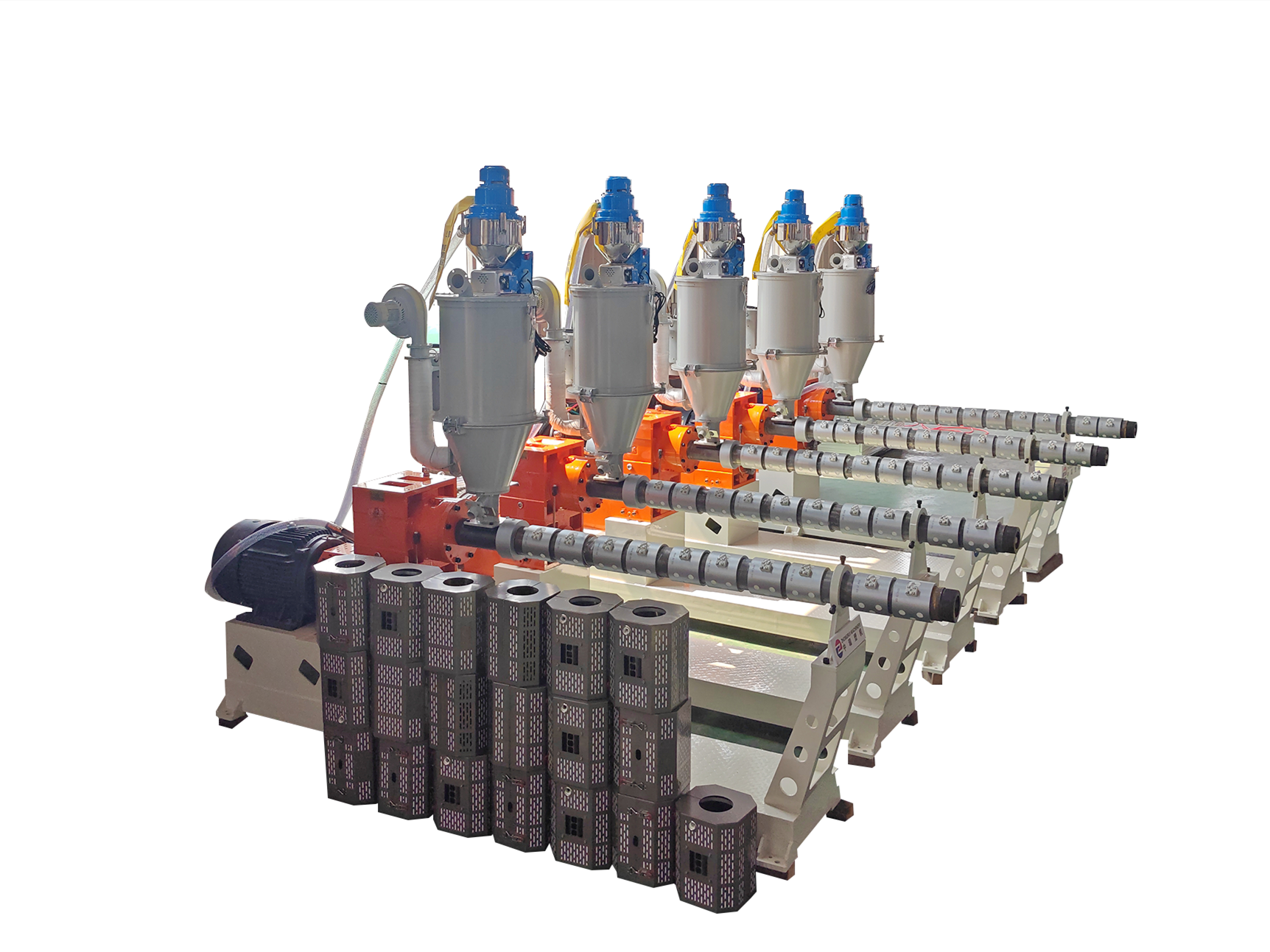
In the plastic processing industry, the selection of extruders directly determines the product quality, production efficiency and long-term operating costs. As the core equipment of plastic machinery, the single-screw extruder and the twin-screw extruder each have their own unique technical advantages and application scenarios. This article will provide systematic selection references for industry colleagues from four dimensions: technical principles, performance comparison, application scenarios and selection strategies.
I.Core Technology Principle: The Fundamental Differences in the Transport Mechanism
![WPS图片(3)]()
1.1 Single screw extruder: Drag flow conveying mechanism
The single screw extruder adopts the drag flow principle, relying on the frictional force between the polymer, the rotating screw and the fixed barrel to push the material forward. This mechanism essentially treats the extruder as an efficient "pump",mainly used for the melting and pressurized transportation of materials.
In the single screw system, the material undergoes three typical stages: the feeding section (solid transportation), the compression section (melted plasticization), and the metering section (homogenization output). The entire process is relatively mild, with moderate shear force, and is particularly suitable for handling single materials that are pre-mixed uniformly.
 1.2 Twin-screw Extruder: Positive displacement forced conveying
The twin-screw extruder employs two intermeshing screws that actively push the material through a positive displacement mechanism. This design makes it more akin to a sophisticated "mixing reactor" rather than a simple conveying pump.
The twin-screw system generates high-frequency shearing and intense mixing effects through the periodic changes of "∞"-shaped or "C"-shaped chambers. Co-rotating twin screws provide excellent dispersion and mixing capabilities, while counter-rotating ones produce higher shear forces and conveying pressure.
II. Comprehensive Performance Comparison: Analysis of Advantages and Limitations
2.1 Mixing and Dispersion Capability
The mixing capacity of a single-screw extruder is relatively limited. It mainly relies on the geometric shape of the screw (such as barrier type or pin type screw) to achieve basic mixing. For simple formulations or premixed materials, this level of mixing is sufficient. However, when dealing with multi-component systems, it often falls short.
The double screw extruder has an overwhelming advantage in mixing performance. Its dispersion mixing ability can break up agglomerates and achieve nanoscale dispersion; the distribution mixing can ensure uniform distribution of each component. Experimental data shows that the mixing efficiency of the double screw system can reach 3-5 times that of a single screw, and is particularly suitable for the production of color masterbatches, modified plastics and composite materials.
2.2 Exhaust and Evaporation Performance
In the processing of recycled materials or damp materials, the exhaust capacity is of vital importance. The surface of the solid conveying zone in a single-screw extruder is less capable of surface renewal and has low gas exhaust efficiency. Usually, pre-drying treatment is required.
The double-screw extruder, by virtue of the periodic changes in the volume of the meshing zone, forms a significant "suction effect", with extremely high exhaust efficiency. Its self-cleaning function also prevents material stagnation and degradation, enabling materials with a moisture content of up to 2-3% to be directly processed without pre-drying, significantly reducing energy consumption and process complexity.
2.3 Output and Energy Efficiency Performance
Under the same screw diameter, the output of a twin-screw extruder can typically reach 2-3 times that of a single-screw extruder. This is because the positive displacement conveying reduces the backflow loss and the material advancement is more stable and controllable.
However, from the perspective of energy consumption, single-screw extruders have an advantage when processing simple materials. Their structure is simple, and the friction-generated heat efficiency is high, with a lower basic energy consumption per unit output. But for complex processes, the twin-screw extruder can achieve better overall energy efficiency by reducing the waste rate and secondary processing.
2.4 Equipment Costs and Maintenance
The initial investment of a single-screw extruder is typically 30-50% lower than that of a twin-screw extruder of the same specification, and its maintenance cost is also lower. Its structure is simple, and the replacement of screws and barrel is convenient. The technical requirements for operators are relatively relaxed.
The twin-screw extruder, however, requires high-precision distribution gearboxes, modular screw components and complex control systems, resulting in significantly higher purchase and maintenance costs. But its modular design allows for flexible adjustment of screw combinations according to process requirements, and in the long run, it has stronger process adaptability and upgrade potential.
III. Precise Application Scenario Matching


3.1 The Optimal Application of Single Screw Extruders
Based on cost-effectiveness and ease of operation, the single screw extruder performs exceptionally well in the following scenarios:
Pipe, profile and sheet production: When using uniformly mixed PVC, PE or PP granules to produce building pipes, window profiles, and decorative sheets, the single screw system can provide stable melt pressure and consistent extrusion speed, ensuring product dimensional accuracy.
Film and sheet extrusion: For bulk products such as agricultural films and packaging films, the single screw extruder, when equipped with appropriate nozzles and cooling systems, can achieve efficient and cost-effective continuous production.
Single material recycling: When dealing with clean industrial scraps, PET bottle chips, and other recycled materials with a single component, the single screw system has a short investment payback period and low operational risks.
3.2 The Irreplaceability of Twin-Screw Extruders
In the following high-value-added fields, twin-screw technology is almost the only option:
Engineering plastic modification: When adding functional components such as glass fibers, flame retardants, and nano-fillers, the dispersion ability of the twin-screw ensures that the material performance meets the standards for high-end applications in areas like automobiles and electronic appliances.
Reaction extrusion and polymerization: When conducting in-situ polymerization, graft reactions, and other chemical modifications, precise temperature control and residence time control by the twin-screw are crucial.
Complex recycling systems: When dealing with complex waste materials such as mixed plastics, printed films with ink or glue, and high-humidity agricultural films, the forced evaporation and homogenization capabilities of the twin-screw are essential to ensure the quality of recycled materials.
Color masterbatches and functional masterbatches production: For color masterbatches with extremely high pigment dispersion requirements, and functional masterbatches that need precise control of additive content, the precise mixing capabilities of the twin-screw are necessary.
IV. Scientific Decision-making Framework for Equipment Selection

4.1 Evaluation of Material Characteristics
Material form: Powdered materials (such as PVC powder) tend to form bridges in a single screw, while the forced feeding of a twin screw is more suitable; for granular materials, both methods can be used.
Thermal sensitivity: Materials such as PVC and PLA that are sensitive to heat require short residence times in the twin-screw unit and precise temperature control (±0.5℃) to prevent degradation and discoloration.
Component complexity: For single polymer, use a single screw; for multi-component blending, with high filling (>30%) and liquid additives included, a twin screw must be selected.
4.2 Product Quality Positioning
If the product is used in low-end markets such as building templates and garbage bags, the cost-performance advantage of a single screw is obvious; if it is targeted at fields like automotive components, medical devices, and high-end packaging, the material performance consistency provided by a twin screw is the market entry threshold.
4.3 Long-term Operational Considerations
Capacity planning: A single screw is suitable for large-scale production of a single product; a double screw is suitable for flexible manufacturing with multiple varieties, small batches, and rapid line changes.
Technical reserves: Operating a twin-screw machine requires a higher level of skill. The enterprise needs to assess the capabilities of the technical team or invest in training.
Life cycle cost: Calculate the total costs over a 5-10 year period, including equipment depreciation, energy consumption, maintenance, and scrap rate, rather than just comparing the initial investment.
4.4 Trend of Hybrid Solutions
The current industry-leading practice is to adopt a "single screw + double screw" two-stage system: the first stage single screw performs pre-melting and coarse filtration, while the second stage double screw conducts deep evaporation, fine mixing and modification. This combination takes into account both cost and performance and is the mainstream configuration for the production of high-quality recycled materials.
 V. Conclusion: There is no best option, only the most suitable one
The single-screw and double-screw extruders are not in a substitutive relationship but rather a complementary one. The single-screw is the "cornerstone" of the plastic industry, supporting the production of bulk plastic products with extremely high cost-effectiveness; the double-screw is the "technical engine", driving the advancement of material modification and high-value recycling at the forefront.
For the customers of Qingdao Zhongrui Plastic Machinery Co., Ltd., the decision-making process should return to the essence of the business: clarifying the characteristics of raw materials, positioning the product market, and evaluating the long-term strategy, finding the best balance point between technological advancement and economic feasibility. Whether choosing a mature and reliable single-screw system or investing in a high-performance double-screw production line, the key lies in the precise matching of equipment capabilities and business needs, ultimately achieving a triple improvement in quality, efficiency, and benefits.


 +86-18561886575 (Mr.Wu)
 +8618561886575
 238 Yangzhou West Road, Jiaozhou City, Qingdao City, Shandong Province