Zhongrui's High-capacity PP Packaging Belt Production Line is engineered for efficiency and high output. This innovative machine produces durable, flexible, and cost-effective PP straps, replacing traditional steel straps across various industries. Ideal for manufacturers seeking quality and sustainability.
According to many years of plastic machinery development and design experience, in the introduction of foreign advanced technology and digestion and absorption, on the basis of self-developed PE pipe production line. Has the unique structure, the design is novel, the equipment entire line layout is reasonable, the control performance is strong and so on.
The PE/PPR Pipe Production Line delivers reliable and efficient manufacturing of various pipes for water supply and drainage in agriculture and construction. Experience advanced technology and precision for high-quality production.
Discover the Highly Cost Effective PVC Pipe Production Line from Zhongrui. Engineered for durability and efficiency, this advanced production line ensures high-quality PVC pipes suitable for a variety of applications. Experience seamless operation, reduced maintenance, and significant cost savings.
The Composite Infiltration Irrigation Pipe Production Line is a high-efficiency system designed to produce drip irrigation tape for agricultural applications. With precision control, energy-saving technology, and advanced automation, it ensures superior performance in greenhouse, field crop, and water conservation irrigation systems.
Discover the PVC Hose Production Line designed for efficient, high-speed manufacturing of PVC hoses. Our advanced system ensures precision, versatility, and durability, making it an ideal choice for various industrial applications.
The PVC Imitation Marble Sheet Slab Extruder Machine Production Line is designed for producing high-quality, durable, and visually appealing marble-like PVC sheets. Offering fire resistance, water resistance, and high-temperature durability, it’s ideal for a variety of interior decoration applications. This advanced extrusion line guarantees high efficiency and stable output, making it a top choice for businesses looking to scale up production.
Zhongrui's PMMA Board Production Line is designed for precision, high-output plastic sheet manufacturing. With advanced technology including a vertical three-roll calender, Siemens motor, and ABB inverter, it ensures high plasticizing ability and energy-efficient performance. Ideal for producing PMMA, PC, and ABS sheets for construction, packaging, and automotive industries.
0
0
Complete Guide to Modern PVC Pipe Production Lines
Views: 0 Author: Site Editor Publish Time: 2026-07-23 Origin: Site
Transitioning from legacy plastic manufacturing to highly automated, energy-efficient extrusion setups is mandatory for remaining competitive in the global pipe market. Manufacturers face the challenge of balancing high initial capital expenditure against the need for reduced energy consumption, higher output rates, and minimized raw material waste. A structured, step-by-step approach to evaluating machinery specifications is required to ensure long-term profitability and operational reliability. You must analyze everything from raw powder handling to final cutting mechanisms. Understanding how to configure a PVC pipe production line correctly prevents costly bottlenecks and material degradation. We will explore equipment selection, application-specific setups, and risk mitigation strategies. This guide provides the technical foundation needed to build a resilient, high-yield manufacturing floor.
Extruder Selection Dictates Capability: The choice between conical and parallel twin-screw configurations directly impacts material flexibility, calcium carbonate (CaCO3) loading limits, and overall output capacity.
Energy and Automation Drive ROI: Modern lines utilizing permanent magnet synchronous motors (PMSM) and inline quality control significantly lower operational costs through energy savings and scrap reduction.
Application-Specific Configurations: Equipment must be tailored to the end product; a PVC conduit pipe production line requires a fundamentally different downstream setup than a high-pressure water pipe line.
Vendor Support is Critical: Long-term success relies heavily on post-sale service level agreements (SLAs), spare parts availability, and comprehensive operator training.
Anatomy of a High-Performance PVC Pipe Extrusion Line: A Step-by-Step Evaluation
Raw Material Sourcing, Handling, and Blending
Handling top-notch PVC resin in powder form presents specific logistical challenges. Flowability and moisture control dictate the final product quality before melting even begins. You must evaluate automated dosing and mixing systems carefully. They ensure precise resin and additive formulations across every batch. PVC resin (typically SG-5 grade) must be blended with stabilizers, stearic acid, PE wax, and calcium carbonate. The hot mixing unit runs at high speeds, generating friction to heat the compound to approximately 120°C. This opens the PVC pores, allowing additives to absorb fully. The material then drops immediately into a cooling mixer, bringing the temperature down to 40°C to prevent agglomeration and thermal degradation.
Closed-loop conveying systems drastically reduce airborne dust on the factory floor. This improves workplace safety and maintains material consistency. Vacuum loaders transport the blended powder directly from storage silos to the extruder hopper. Spring feeders or vacuum systems eliminate manual handling errors and prevent contamination. Gravimetric dosing units mounted above the hopper weigh the material continuously, adjusting the feed rate to match the extruder's exact throughput requirements.
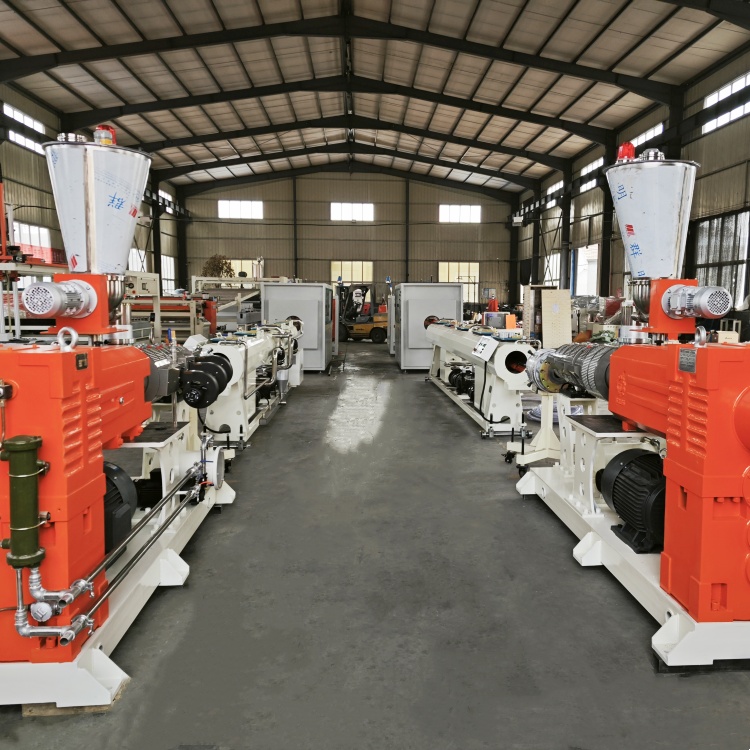
The Core: Choosing the Right PVC Pipe Extruder
Selecting the main machine defines your absolute production limits. Compare conical twin-screw versus parallel twin-screw extruders based on your specific recipes. Conical designs offer excellent shear rates and rapid plasticization efficiency. The tapering screws build high melt pressure quickly, making them highly effective for processing high-filler calcium carbonate (CaCO3) recipes without causing excessive barrel wear. Parallel twin-screw machines handle higher output volumes much more effectively. They provide a longer residence time for the melt, which is ideal for large-diameter pipes requiring massive throughput.
A heavy-duty PVC pipe extruder forms the heart of your operation. Screw geometry, compression ratios, and degassing zones directly influence processing stability. Proper venting removes trapped gases and moisture, preventing internal bubbles in the finished pipe. The gearbox must feature heavy-duty thrust bearings to withstand the immense backpressure generated during extrusion. Oil cooling systems for the gearbox and internal screw temperature control systems are mandatory for continuous, 24/7 operation.
Extruder Configuration Comparison
Feature
Conical Twin-Screw
Parallel Twin-Screw
Optimal Output Volume
Medium (150 - 800 kg/h)
High (500 - 1500+ kg/h)
Shear Rate
High
Moderate
CaCO3 Filler Capacity
High (Up to 100 phr)
Moderate (Up to 50 phr)
Typical Application
Standard pipes, profiles, conduits
Large diameter, high-volume pressure pipes
Die Heads and Mold Tooling
Evaluate spider die versus basket die designs based on your target pipe diameters. Melt flow characteristics change significantly depending on the internal tooling structure. Spider dies distribute the melt evenly using internal legs, but they can leave weld lines if the melt pressure is not optimized. Basket dies offer better homogenization for larger diameter pipes by forcing the melt through a perforated cylinder, eliminating weld lines entirely. Precision tooling impacts wall thickness uniformity directly. Better uniformity reduces material giveaway and protects your profit margins.
Ceramic band heaters on the die head maintain precise temperature profiles. This prevents melt fracture and ensures a smooth internal and external pipe surface. The die lip must be polished to a mirror finish to reduce friction. The compression ratio within the die head must match the specific PVC formulation to ensure the pipe maintains its shape as it exits the tooling.
Downstream Equipment: Cooling, Calibration, and Pulling
Vacuum Calibration Tanks: Sizing requirements determine optimal cooling rates. Proper cooling prevents pipe deformation and surface defects at high extrusion speeds. High-volume water pumps spray chilled water directly onto the hot pipe surface. The vacuum environment forces the soft plastic against the brass or stainless steel sizing sleeve. Tanks are typically 6 to 9 meters long and constructed from 304 stainless steel to prevent corrosion.
Haul-off Machines: Assess caterpillar track configurations carefully. You need two-caterpillar setups for small pipes and conduits. Multi-caterpillar systems (four, six, or eight tracks) are mandatory for large diameters. They provide consistent pulling tension without slippage or pipe crushing. Servo-driven motors ensure the pulling speed matches the extruder output perfectly. Polyurethane blocks on the tracks prevent scratching the pipe surface.
Inline Printing, Cutting, and Finishing
Inline Printing and Marking Systems: Evaluate continuous inkjet (CIJ) versus laser marking technologies. Laser marking offers permanent traceability, standard compliance, and clear batch identification. It alters the surface of the PVC chemically, creating a high-contrast mark. It also eliminates the need for consumable ink and solvent replacements, reducing ongoing maintenance.
Cutting and Belling: Compare planetary cutting systems for smooth, chamfered edges. Planetary saws orbit the pipe, cutting through thick walls without generating excessive heat. Swarf extraction systems vacuum up the PVC dust immediately. Automated belling machines handle inline socket formation seamlessly. They heat the pipe end using infrared ovens and insert a mandrel to form the connection joint, whether it is a U-type, R-type, or rectangular socket.
Configuration Strategies for Specific Applications
High-Pressure Water and Sewage Pipes
Manufacturing pressure pipes demands rigorous equipment specifications. You need high-torque gearboxes to handle dense, highly viscous melt flows. Extended cooling zones ensure the thick walls solidify completely before reaching the haul-off unit. If the core remains hot, the pipe will deform under the pulling tracks. Thicker wall calibration requires precise vacuum control to maintain strict internal diameter tolerances. ISO standards dictate exact dimensions for pressure ratings (e.g., PN10, PN16). Your equipment must hold these tolerances over long, continuous production runs. Ultrasonic thickness scanners are highly recommended for these applications to monitor the wall thickness 360 degrees around the pipe.
PVC Conduit Pipe Production Line Setup
Electrical conduits require high-speed, smaller-diameter outputs. Optimization strategies focus on maximizing line speed without compromising pipe flexibility. A dedicated PVC conduit pipe production line often utilizes dual-strand or multi-strand extrusion heads. These heads maximize yield from a single extruder by pushing the melt through a Y-block into two or four separate die heads. They double or quadruple output rates while minimizing floor space usage. Downstream equipment must handle multiple strands simultaneously. Dual vacuum tanks and dual haul-off machines operate independently. This allows operators to adjust the speed of one strand without affecting the other, accommodating minor variations in melt flow.
Downstream Cooling Tank Specifications
Pipe Diameter Range
Recommended Tank Length
Vacuum Pump Capacity
16mm - 32mm (Conduit)
4 to 6 meters
4 kW
50mm - 160mm (Drainage)
6 to 9 meters
5.5 kW - 7.5 kW
200mm - 630mm (Pressure/Sewage)
9 to 12 meters (Dual Tanks)
11 kW - 15 kW
Technical Evaluation Dimensions: Features to Outcomes
Energy Consumption vs. Output (kg/h)
Define Specific Energy Consumption (SEC) metrics for baseline comparisons between vendors. This metric reveals true operational efficiency by measuring kilowatts used per kilogram of plastic processed. Evaluate the integration of Variable Frequency Drives (VFD) and permanent magnet synchronous motors (PMSM). PMSM technologies excel at reducing electrical overhead during continuous operation. They run cooler and more efficiently than standard AC asynchronous motors, often delivering 10% to 15% energy savings. Insulated barrel heater bands also prevent heat loss into the factory environment. This reduces the load on your facility's air conditioning systems and ensures the heat goes directly into plasticizing the resin.
Automation and Quality Control Integration
Assess the value of inline ultrasonic thickness measurement systems. They provide real-time dimensional control and prevent costly material waste. Automated visual inspection systems detect surface defects, discoloration, or brittleness before the cutting stage using high-speed cameras. Review PLC control systems like Siemens or B&R carefully. They handle recipe management, data logging, and predictive maintenance alerts efficiently. Closed-loop control systems automatically adjust haul-off speeds if the pipe thickness deviates from the setpoint. This removes human error from the quality control process and ensures every meter of pipe meets strict industry standards.
Long-Term ROI Factors
CapEx vs. OpEx Trade-offs
Analyze how higher upfront costs for premium machinery offset long-term maintenance. Cheaper initial investments often lead to higher energy consumption and frequent mechanical breakdowns. A reliable PVC pipe extrusion line balances capital expenditure with manageable operating expenses. High-quality gearboxes and wear-resistant bimetallic screws last significantly longer. This reduces downtime and replacement part costs over a ten-year operational lifespan. Factor in the cost of unscheduled downtime, scrapped material, and delayed customer shipments when evaluating cheaper equipment proposals.
Material Yield and Scrap Reduction
Calculate the financial impact of automated gravimetric dosing. Gravimetric systems weigh the material as it enters the extruder, ensuring exact throughput control. Precision die heads lower raw material waste significantly over a 5-year period. Running a pipe just 0.1mm over the required thickness wastes thousands of kilograms of resin annually. Reducing scrap by even a fraction of a percent yields massive financial savings. Automated belling machines also reduce scrap by preventing deformed sockets at the end of the line. Precise temperature control in the belling oven ensures the PVC softens just enough to form the socket without burning or tearing.
Implementation Risks and Mitigation Strategies
Facility Requirements and Layout Planning
Identify critical infrastructure needs early in the planning phase. Floor space constraints dictate the layout of the entire extrusion line. You must account for the length of the cooling tanks, the haul-off, the cutter, and the pipe collection tables. Power supply stability prevents sudden shutdowns and material degradation inside the barrel. Voltage drops can damage sensitive PLC components and servo drives. Chilled water system capacity must match the cooling tank requirements precisely. A 500 kg/h line typically requires a 30 HP industrial chiller. Insufficient water cooling limits your maximum extrusion speed and causes pipe ovality. Compressed air systems must deliver clean, dry air at 0.6 to 0.8 MPa to operate pneumatic clamps and cutting saws.
Operator Training and Adoption
Address the risk of production downtime due to knowledge gaps. Emphasize the need for mandatory vendor-led training programs. These programs must cover both daily operation and basic troubleshooting. Skilled operators prevent minor processing issues from becoming major mechanical failures. They must understand how to adjust temperature profiles, vacuum pressure, and haul-off speeds correctly. Poorly trained staff often waste hours trying to stabilize the melt flow, generating massive amounts of scrap in the process. Document all standard operating procedures for future reference and ensure new hires undergo rigorous hands-on training.
Supply Chain and Spare Parts Availability
Provide a framework for auditing vendor service level agreements. Focus heavily on the lead times for critical wear components. Screws, barrels, and heating bands require regular replacement based on production volume and the abrasiveness of the formulation. Delays in receiving these parts halt production entirely. Stock essential spare parts locally to minimize risk. Ask vendors for a recommended spare parts list during the initial procurement phase. Verify their technical support response times for software or PLC troubleshooting, ensuring they offer remote diagnostic capabilities.
Conclusion
Request detailed technical specifications from shortlisted vendors, focusing on motor efficiency, gearbox ratings, and screw geometry.
Mandate material trial runs using your specific powdered resin recipes before signing final acceptance documents to verify output claims.
Perform a site-specific operational cost calculation to understand your true return on investment over five years, factoring in energy and scrap rates.
Verify the exact dimensions of your facility against the proposed equipment layout, including water, compressed air, and power drop locations.
FAQ
Q: What is the standard operational lifespan of a twin-screw PVC pipe extruder?
A: A well-maintained twin-screw extruder typically operates efficiently for 10 to 15 years. Lifespan depends heavily on the abrasiveness of the raw materials used, particularly the percentage of calcium carbonate filler. Regular replacement of wear parts like screws and barrels extends the machine's viable service life.
Q: How much floor space is required to install a standard PVC pipe production line?
A: A standard line requires approximately 20 to 30 meters in length and 3 to 5 meters in width. High-speed lines or those producing large-diameter pipes may require up to 40 meters to accommodate extended vacuum calibration and cooling tanks.
Q: What is the technical difference between conical and parallel twin-screw extruders?
A: Conical extruders feature screws that taper toward the die, providing high shear and excellent plasticization for standard PVC mixtures. Parallel extruders maintain a consistent screw diameter, offering higher overall output capacities and better handling of high-filler formulations over long production runs.
Q: How do modern extrusion lines control and maintain uniform wall thickness?
A: Modern lines utilize inline ultrasonic thickness measurement systems. These sensors continuously scan the pipe as it exits the cooling tank. The system feeds data back to the PLC, which automatically adjusts haul-off speeds or extruder RPM to maintain strict dimensional tolerances.
Q: Can a single production line manufacture both high-pressure water pipes and electrical conduits?
A: While possible, it is highly inefficient. High-pressure pipes require thick-wall calibration and heavy-duty cooling. Conduits require high-speed, multi-strand setups. Switching between these extremes demands significant downtime for tooling changes and recalibration, making dedicated lines much more profitable.
Q: What are the primary causes of surface defects or brittleness in extruded PVC pipes?
A: Surface defects usually stem from improper melt temperatures, moisture in the raw resin, or inadequate vacuum calibration. Brittleness is often caused by incorrect formulation blending, excessive calcium carbonate filler, or degraded PVC material resulting from prolonged exposure to high heat in the barrel.
Q: How does gravimetric dosing improve the ROI of a pipe extrusion line?
A: Gravimetric dosing continuously weighs raw materials before they enter the extruder, ensuring exact throughput control. This eliminates overfeeding and maintains precise pipe wall thickness. By preventing material giveaway, manufacturers save thousands of kilograms of resin annually, drastically improving long-term profitability.
Qingdao Zhongrui Plastic Machinery Co., Ltd. is located in Jiaozhou City, Qingdao City, Shandong Province. It is 30 kilometers away from Qingdao Port and only 20 kilometers away from the airport.



 +86-18561886575 (Mr.Wu)
 +8618561886575
 238 Yangzhou West Road, Jiaozhou City, Qingdao City, Shandong Province