Zhongrui's High-capacity PP Packaging Belt Production Line is engineered for efficiency and high output. This innovative machine produces durable, flexible, and cost-effective PP straps, replacing traditional steel straps across various industries. Ideal for manufacturers seeking quality and sustainability.
According to many years of plastic machinery development and design experience, in the introduction of foreign advanced technology and digestion and absorption, on the basis of self-developed PE pipe production line. Has the unique structure, the design is novel, the equipment entire line layout is reasonable, the control performance is strong and so on.
The PE/PPR Pipe Production Line delivers reliable and efficient manufacturing of various pipes for water supply and drainage in agriculture and construction. Experience advanced technology and precision for high-quality production.
Discover the Highly Cost Effective PVC Pipe Production Line from Zhongrui. Engineered for durability and efficiency, this advanced production line ensures high-quality PVC pipes suitable for a variety of applications. Experience seamless operation, reduced maintenance, and significant cost savings.
The Composite Infiltration Irrigation Pipe Production Line is a high-efficiency system designed to produce drip irrigation tape for agricultural applications. With precision control, energy-saving technology, and advanced automation, it ensures superior performance in greenhouse, field crop, and water conservation irrigation systems.
Discover the PVC Hose Production Line designed for efficient, high-speed manufacturing of PVC hoses. Our advanced system ensures precision, versatility, and durability, making it an ideal choice for various industrial applications.
The PVC Imitation Marble Sheet Slab Extruder Machine Production Line is designed for producing high-quality, durable, and visually appealing marble-like PVC sheets. Offering fire resistance, water resistance, and high-temperature durability, it’s ideal for a variety of interior decoration applications. This advanced extrusion line guarantees high efficiency and stable output, making it a top choice for businesses looking to scale up production.
Zhongrui's PMMA Board Production Line is designed for precision, high-output plastic sheet manufacturing. With advanced technology including a vertical three-roll calender, Siemens motor, and ABB inverter, it ensures high plasticizing ability and energy-efficient performance. Ideal for producing PMMA, PC, and ABS sheets for construction, packaging, and automotive industries.
0
0
How to Cut Plastic Sheets: 5 Methods for Beginners
Views: 0 Author: Site Editor Publish Time: 2026-10-29 Origin: Site
A cracked acrylic panel sits on your workbench. You have a fresh sheet for a weekend project. Either way, you need a clean cut, and you are not sure where to start.
Relax. You have five solid options: scoring and snapping, a hand saw, a jigsaw, a circular or table saw, and laser cutting. Each one works. The trick is matching the tool to your plastic type and thickness.
Safety comes first. Grab goggles, gloves, and a mask if your workspace lacks ventilation, as Bee Plastic advises. Then learn how to cut a plastic sheet with confidence. You will find clear steps, plus tips that help you learn how to cut plastic sheet without chipped edges. Want to know how to cut a plastic sheet that arrived straight from a Plastic Sheet Extrusion Line Manufacturer? Same rules apply. Curious about multiple ways to cut acrylic sheets? They are all here.
Always wear safety gear like goggles and gloves when cutting plastic.
Practice on scrap pieces first to learn how your tools behave.
Use a fine-toothed blade and slow speed to avoid melting or chipping.
Finish cut edges by sanding and polishing for a clean, professional look.
How to Cut Plastic Sheets: Know Your Material
Plastic Types and Thicknesses
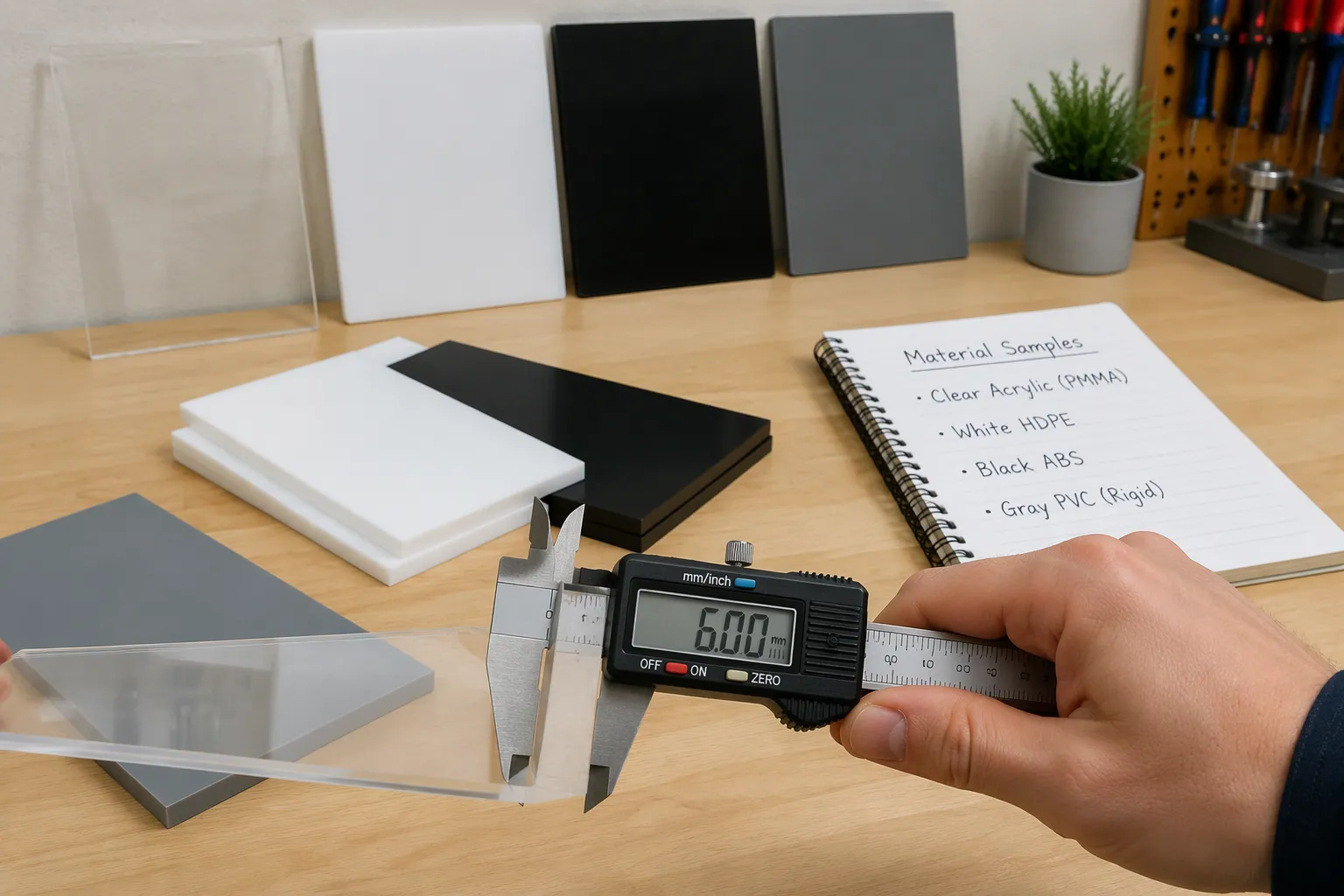
Before you choose a blade, check the label on your sheet. Every plastic acts differently when a knife or saw cuts it. The table below shows the common ones, based on Zhihong Plastic's property guide.
Plastic
Typical properties
PP
Low density, low water absorption, resists many aqueous chemicals; homopolymer and copolymer grades differ in stiffness
PE
LDPE stays flexible; HDPE is stiffer and used in solid panels
PS
GPPS offers clarity and rigidity; HIPS trades clarity for toughness
ABS
Balances stiffness and impact behavior; extruded sheet suits thermoformed housings
PMMA/acrylic
Clear or translucent displays, signs, and glazing; cast and extruded forms
PVC
Rigid uPVC for sheets and profiles; plasticized PVC for flexible products
Thickness changes a lot. Kastlite lists acrylic from 1/16 in (1.5 mm) to 4 in (100 mm), rigid PVC from 0.020 in (0.5 mm) to 1 in (25 mm), and ABS from 0.020 in (0.5 mm) to 1/2 in (12.7 mm). For all five materials, 1/8 in (3 mm) is the most common sheet thickness.
Store-bought sheets often begin on a plastic sheet production line. An extruder melts pellets, and a flat T-die forms the sheet. Then calender rolls cool it, and a cutter trims it. Lines may run widths from about 8 inches to 91 inches and thicknesses from about 0.010 inches to 3 inches, though specs vary by material and equipment. A PMMA sheet production line and a PVC sheet production line use the same basic extrusion steps. Keep this split in mind: the line makes the sheet, and your knife, saw, or laser cuts it later.
How to Cut a Plastic Sheet: Choosing a Method
Here is the simple rule. Thin sheets under about 3 mm often work well with scoring and snapping when the material allows it. Thicker, stiffer, or larger sheets usually need a hand saw, jigsaw, circular saw, table saw, or laser cutter.
Match the tool to the job. Rigid acrylic and polycarbonate often need routing or laser cutting, Ward-Kennedy notes, while flexible plastics can be cut with a blade. Heat-sensitive thermoplastics may melt when cut with heat. Brittle plastics can crack if you cut too hard.
So the best way to cut plastic depends on three things: material, thickness, and shape. Straight lines work best with saws. Curves work best with a jigsaw. Detailed designs work best with a laser. Gather your tools for cutting plastic sheet, clamp the work, and practice on scrap first.
Method 1: Scoring and Snapping
Tools and Steps for How to Cut Plastic
Scoring and snapping goes by a few names: scribing and breaking, scoring and breaking plastic, or plain hand cutting. You need very little to start. Kunxin Plastics lists the basics: a scoring knife or utility knife, a metal straight edge, a flat workbench, clamps, gloves and goggles, and fine sandpaper for the edges.
Here is how to cut a plastic sheet by hand, following the steps Kastlite describes for sheets under 3 mm:
Lay the sheet on a flat surface, with the cut line overhanging the bench edge by about 1 inch.
Align a metal ruler along the line and clamp it down.
Score with firm, steady pressure, making 5–10 passes to deepen the groove.
Flip the sheet and score the same line on the back.
Line the score up with the bench edge and press down on the overhang. The sheet snaps along the score.
Smooth the edge with 220-grit sandpaper.
This is the easiest way to learn how to cut a plastic sheet without a saw. It also suits a thin PMMA sheet or PVC sheet from an extrusion line, since those arrive flat and uniform.
Tips for Clean Breaks
Excelite Plas offers the key advice: make several controlled passes instead of pressing hard once. A deep, consistent groove gives you a straighter break. Support both sides of the cut near the line before you bend, and the sheet snaps cleanly instead of cracking.
You can cut acrylic sheets this way too. Score the acrylic sheet, snap it, then sand and polish the edge. SendCutSend suggests starting around 120 grit and working finer, keeping a power sander moving so heat does not melt the acrylic. Follow those steps and you will know how to cut acrylic sheet without breaking or cracking. For cutting acrylic manually, practice on scrap first. That is the real secret to cutting plastic well.
Method 2: Hand Saw and Jigsaw
Hand Saw Basics for Straight Cuts
A hand saw is perhaps the most universal option for cutting Perspex and acrylic sheets. It needs fairly little skill, and almost every workshop has one. You can learn how to cut plastic with it in an afternoon.
Safety comes first. The Safety Company recommends impact-resistant eyewear and heavy-duty gloves. Inspect the saw's screws and fittings before each use, because a single loose screw may let the blade slip and slice into your hand. Replace a dull blade right away, since dull blades raise the risk of injury. Note that coping saws suit light, thin materials of 1 inch thickness or less.
Clamp the sheet firmly. Use a fine-toothed blade, then cut down slowly and steadily. Avoid too much pressure. Let the teeth do the work, and you will get a clean line.
Jigsaw Techniques for Curves
A jigsaw, also called a saber saw, is your best pick for curves and cutouts. Pick the right blade first. Kunxin Plastics suggests a fine-tooth, straight-cut metal blade in high-speed steel or bi-metal, with 10–14 teeth per inch. Onevantool advises 10–20 TPI for acrylic and a narrow blade of 6 mm or less for tight curves.
Blade feature
Recommendation
Reason
Tooth type
Fine-tooth, straight-cut metal
Prevents chipping
Tooth count
10–14 TPI
Smooth cut on hard plastics
Material
HSS or bi-metal
Resists heat buildup
Edge
Ground or milled
Clean finish
Set the speed low. Onevantool puts it at 800–1,500 SPM, while Kunxin Plastics suggests around 1,500–2,000 strokes per minute with low orbital action. Both warn that too much speed melts the acrylic. Tape the cut line with blue painter's tape, cut just outside the line, then sand away the marks. Cut one sheet at a time, or it may crack. When you cut acrylic sheets this way, stop if the material gets hot.
A band saw and a circular saw are other power-tool options. A vertical band saw cuts plastics cleanly and reduces kickback, Weho Machinery notes. A circular saw handles thick plastic sheets above ⅛ inch, per Zealtech Automation.
Method 3: Circular Saw, Table Saw, and Laser Cutting
Power Saw Setup and Safe Feed
A circular saw or table saw earns its place on long, straight cuts through thicker sheets. Blade choice decides your edge quality. Acrylite recommends carbide-tipped blades with sharp teeth, and a triple-chip tooth design with a 10 to 15 degree clearance angle for acrylic. A 10-inch, 80-tooth blade handles all-purpose table saw work.
Acrylic sheet thickness (in)
Blade diameter (in)
Teeth
Blade clearance above material (in)
1/16–1/8
10
80
1/8
1/8–1/2
10
80
1/4
1/2–1
10
60
1/2
Setup matters as much as the blade. Precious Plastic notes that plastic needs fewer teeth cutting at once, which limits heat and gives cleaner cuts. Support the sheet so it sits flat without vibration. Acrylite advises feeding evenly at 100 to 300 inches per minute, because uneven feed melts or chips the edge. Keep the blade guard, splitter, and anti-kickback device in place, and never put your hands within four inches of the blade.
When to Cut Acrylic Sheets with a Laser
Laser cutting acrylic shines when you need clean edges and complex shapes. A laser melts and vaporizes a thin line of material, so it never stresses the sheet into cracking or chipping, SendCutSend explains. Computer control also means sweeping curves and sharp internal corners come out smoothly, which is why signage and display work often goes this route.
CO2 lasers are used to cut acrylic because their 10.6 µm wavelength is strongly absorbed by the plastic, while fiber lasers at around 1.06 µm pass through clear acrylic, per SendCutSend.
That is the practical limit: laser cutting acrylic usually means a shop or makerspace with a CO2 machine. If you want to know how to cut acrylic sheets like a pro on intricate designs, this is the tool. For plain straight cuts, a saw still wins on cost and speed. Either way, you now know how to cut a plastic sheet and how to cut plastic with the right tool for the job. Practice on scrap, then cut acrylic sheets for your real project with confidence.
Finishing Edges and Common Mistakes
Smoothing and Polishing Cut Edges
A fresh cut leaves a rough edge. Metro Plastics describes the fix in three stages: cut to size, smooth away saw marks, then polish until the edge turns clear again. You can follow the same path at home.
Sanding is the safest and most repeatable method. Signs101 forum users suggest starting around 150–200 grit and working up to about 600–800 grit, then finishing with polishing compound. Spend real time at the 150, 180, and 220 grit stages for a consistent finish. Keep a power sander moving, because staying in one spot builds enough heat to melt the acrylic.
Flame polishing with a torch is the quickest route to a crystal-clear edge. It is also the quickest way to ruin a sign without practice, so test on scrap first. A torch with an oxygen and hydrogen mix gives the clearest result. Never let alcohol touch a flame-polished edge, since a 70/30 mix has caused crazing. A buffing wheel with compound brick works well too. For other plastics, deburr the edge with a fine file or sandpaper.
Beginner Mistakes to Skip
Most bad cuts trace back to a few habits. SendCutSend warns against cutting too fast or too slow with a dull blade, and against aggressive blades that chip the material. Mask the surface that slides on the saw table, and leave the factory film on until you finish. Support the sheet so it cannot bend, and consider sandwiching it between plywood or MDF on a table saw.
Laserpecker adds a serious safety point: never cut PVC on a laser, because it releases toxic fumes when heated. Learning how to cut plastic correctly means matching blade, speed, and support to the material.
Practice on scrap before a real project. That habit alone teaches you how to cut a plastic sheet cleanly. Run a few test cuts, check the edge, and adjust. Soon you will cut a plastic sheet cleanly every time, and you will know how to cut plastic safely and effectively. These tips for cutting acrylic carry over to a PMMA sheet or PVC sheet from an extrusion line. With practice, you will cut acrylic parts that look shop-finished, and you will cut plastic sheets with real confidence.
You now have five paths: scoring and snapping, a hand saw, a jigsaw, a power saw, and a laser. Thin sheets under about 3 mm often snap cleanly. Thick or rigid sheets need a saw or laser. That match rule is the best way to cut plastic without waste.
Method
Tools
Best use
Scoring
Utility knife, straight edge
Thin sheets, straight lines
Hand saw
Fine-tooth blade
Straight cuts, low skill
Jigsaw
10–14 TPI blade
Curves and cutouts
Power saw
Carbide blade
Long cuts, thick sheets
Laser
CO2 machine
Complex shapes, clean edges
Practice on scrap first. Soon you will know how to cut plastic sheet safely, and how to cut a plastic sheet that looks shop-finished. Learning how to cut plastic takes patience, not talent.
FAQ
What is the easiest way to cut plastic sheet for a first project?
Start with scoring and snapping. You only need a utility knife, a straight edge, and clamps. This works best on thin sheets under about 3 mm. Practice on scrap first, then try your real piece. Once you learn how to cut plastic sheet this way, straight lines become quick and cheap.
Can I score and snap a thick sheet?
No. Scoring suits thin material. Thick or rigid sheets need a saw or a laser. If you force a snap on a thick sheet, it cracks instead of breaking cleanly. Switch to a hand saw or jigsaw for anything above that thin range.
Why do my cut edges look melted or chipped?
Heat and speed cause most of this. A dull blade, a fast feed rate, or too many teeth all build heat. Use a fine-tooth carbide blade, feed steadily, and keep the sheet supported. Mask the surface too. These habits help you cut plastic sheet with clean edges every time.
Do I need a laser cutter for acrylic?
Not for simple straight cuts. A saw handles those faster and cheaper. A laser earns its place on complex shapes and clear edges, and it usually means a shop or makerspace with a CO2 machine. For basic work, a saw is fine.
Does the sheet's origin affect how I cut it?
Not really. A sheet from a plastic sheet production line behaves like any store-bought sheet of the same material and thickness. Whether it is a PMMA sheet, a PVC sheet, or an extruded board, you still match your tool to the material and thickness. The extrusion process shapes the sheet; your knife or saw does the cutting.
Qingdao Zhongrui Plastic Machinery Co., Ltd. is located in Jiaozhou City, Qingdao City, Shandong Province. It is 30 kilometers away from Qingdao Port and only 20 kilometers away from the airport.



 +86-18561886575 (Mr.Wu)

 +8618561886575
 238 Yangzhou West Road, Jiaozhou City, Qingdao City, Shandong Province