Thermoplastic polyurethane (TPU/PU) presents a massive manufacturing conflict. Its defining characteristic—extreme flexibility—makes it incredibly difficult to stabilize immediately after extrusion. Improper cooling and calibration lead directly to ovality, inconsistent wall thickness, and compromised pressure ratings. These defects destroy yield rates and profitability, especially when you manufacture high-tolerance components for pick-and-place machinery or compact pneumatic systems. The molten polymer sags, stretches, and deforms the second it leaves the die head. To solve this, operators rely on specialized vacuum sizing and multi-stage cooling baths within a dedicated extrusion setup. These systems ensure dimensional accuracy, structural integrity, and thermal memory at high line speeds. You cannot rely on basic cooling troughs to handle such a sensitive thermoplastic elastomer. Success requires precise thermal profiling and exact mechanical calibration to lock in the profile before gravity takes over.
- Precision Calibration is Non-Negotiable: Flexible PU requires specialized vacuum calibration tanks to counteract the material's tendency to collapse or deform before solidifying.
- Temperature Profiling Dictates Quality: Staged cooling prevents surface defects and internal stress, ensuring the PU pipe retains its flexibility, chemical resistance, and performance across extreme temperature ranges (e.g., -40°C to 55°C).
- Equipment Specificity Matters: Standard PVC or PE lines are insufficient; a purpose-built PU pipe production line is required to manage the specific melt strength, thermoplastic memory, and shrinkage rates of polyurethane.
- Speed vs. Stability Trade-off: Evaluating cooling tank length and chiller capacity is critical for scaling production without sacrificing dimensional tolerances or form-factor requirements (such as straight vs. retractable coil tubing).
The Unique Extrusion Challenges of Flexible PU Pipe
Extruding flexible tubing requires strict adherence to specific success criteria. You must maintain exact concentricity throughout the entire production run. The tubing needs to achieve specified burst pressures reliably. It must also preserve its inherent flexibility for compact piping applications. Achieving these metrics is difficult due to the physical nature of the polymer. Polyurethane possesses a unique melt flow index that fluctuates wildly with minor temperature changes. A shift of just two degrees Celsius in the die head can turn a stable melt into a runny liquid. This low melt strength makes the molten polymer highly susceptible to gravity.
Tension from the haul-off unit immediately distorts the profile upon exiting the die head. Rigid PVC holds its shape easily as it cools. In contrast, PU's unique thermoplastic memory demands highly controlled solidification. If you pull the material too hard while it is hot, it remembers that stretched state. It will later shrink or warp when exposed to heat in the field. We see this frequently when operators try to push line speeds beyond the cooling capacity.
Introducing masterbatches adds another layer of complexity. Industry-standard color-coded tubing often requires over twenty distinct colors for complex pneumatic lines. These colorants slightly alter the melt viscosity. They also change the thermal conductivity of the base polymer. Different colors absorb and release heat at slightly different rates. A dark blue or black resin will cool differently than a clear or natural resin. This reality requires highly adaptable cooling parameters on the factory floor. Operators must adjust water temperatures and vacuum levels whenever they change colors.
Standard cooling methods fail miserably with this material. Rapid quenching causes rapid surface crystallization. You freeze the outer skin instantly. Meanwhile, the core of the tube wall remains completely molten. This thermal imbalance leads to severe post-extrusion shrinkage. It creates internal stresses that compromise the final chemical resistance of the tubing. A dedicated polyurethane pipe extrusion line prevents these failures through precise thermal management. The machinery must support the soft melt while extracting heat at a controlled, deliberate rate.
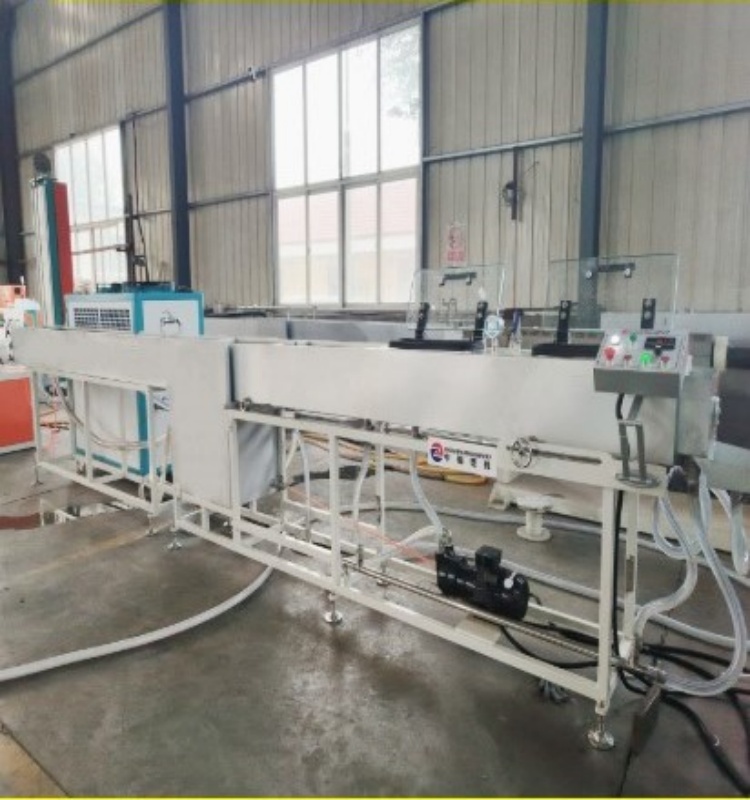
![PU pipe cooling and calibration]()
Core Components of a Polyurethane Pipe Extrusion Line
The cooling and calibration phases require highly specific machinery. You cannot use generic troughs and expect tight tolerances. The process begins the moment the melt exits the extruder. The hot polymer transitions directly into the calibration tooling. You must keep the physical distance between the die and the calibrator minimal. A short gap prevents the soft polymer from sagging under its own weight. Even a one-inch gap can cause the melt to droop, ruining the concentricity before the material even enters the sizing sleeve.
Vacuum calibration tanks handle the initial sizing and stabilization. These tanks utilize controlled negative pressure. The vacuum holds the molten PU outward against a precisely machined sizing sleeve. Simultaneously, an initial water spray hits the material. This rapid, controlled spray freezes the outer skin immediately. It locks in the outer diameter before the vacuum is released. Liquid ring vacuum pumps are the industry standard for these tanks. They handle the inevitable moisture carryover from the cooling water without sustaining internal damage. The mechanics inside this tank determine the baseline quality of the entire run.
Secondary cooling water baths follow the initial vacuum tank. These extended tanks gradually reduce the core temperature of the material. They use either submerged or spray cooling methods. The goal here is deep, penetrating cooling. The pipe must be completely solid before it reaches the haul-off puller. If the core is still warm, the puller belts will crush the tube and ruin the concentricity.
To understand the equipment layout, consider the following standard components found on a high-performance line:
- Extruder Die Head: Shapes the molten polymer into a tubular profile with specific inner and outer dimensions.
- Vacuum Sizing Sleeve: A brass or stainless steel cylinder that dictates the exact outer diameter using water lubrication and negative pressure.
- Primary Vacuum Tank: A sealed chamber where the initial skin freezing occurs under strict vacuum control.
- Secondary Spray Tanks: Long, unsealed troughs equipped with high-velocity nozzles to extract remaining core heat.
- Haul-Off Unit: A multi-belt puller that maintains consistent line tension without crushing the cooled tubing.
The Calibration Process: Achieving Dimensional Accuracy
Calibration techniques map directly to final product specifications. Straight lengths require different handling parameters than tubing destined for retractable coils. Sizing sleeves dictate the precise outer diameter of the product. Engineers choose between water-lubricated and dry sleeves based on the specific resin grade. Water lubrication reduces friction on the soft, sticky skin of the hot polymer. This prevents surface tearing and chatter marks. Dry sleeves are rarely used for soft elastomers because the material tends to bind against the metal.
Vacuum pressure adjustments control the wall thickness dynamically. You must synchronize this vacuum level with the haul-off speeds. High vacuum pulls the material outward, potentially thinning the wall if the pull speed is too fast. Proper synchronization prevents this wall thinning. It ensures uniform thickness across the entire circular profile. Operators monitor these two variables constantly to maintain dimensional stability. A drop in vacuum pressure immediately results in an undersized outer diameter.
Internal air pressure sizing is an older, alternative method. It involves pumping air through the die head into the center of the tube. Modern facilities prefer vacuum calibration for elastomers. Vacuum sizing provides superior external control for flexible, small-diameter tubing. High-stakes pneumatic applications demand exact outer diameters for push-to-connect fittings. Producing a reliable PU pipe relies entirely on the precision of this vacuum stage.
| Feature | Internal Air Pressure Sizing | Vacuum Calibration Sizing |
| Setup Complexity | Low. Requires basic air regulation. | High. Requires sealed tanks and heavy-duty pumps. |
| Outer Diameter Precision | Moderate. Prone to slight variations based on air flow. | Excellent. Locked physically against a rigid metal sleeve. |
| Suitability for Soft PU | Poor. Internal air pressure easily causes ballooning. | Ideal. Supports the weak melt structure externally. |
| Wall Thickness Control | Difficult to maintain uniformly over long runs. | Highly controllable via precise vacuum level adjustments. |
Cooling Dynamics and Temperature Profiling
Engineers evaluate cooling systems through specific thermal and mechanical lenses. Staged temperature reduction is a mandatory requirement. You start with warm water in the initial calibration zone. This prevents thermal shock to the sensitive polymer. Progressively colder baths follow down the line. This gradient approach locks in the structural integrity safely. It prepares the tubing for demanding high-temperature applications reaching up to 200°F.
Water flow rates impact the process significantly. High-velocity spray cooling offers excellent heat transfer efficiency by creating turbulent flow on the pipe surface. The droplets break through the thermal boundary layer, extracting heat much faster than laminar flow in a submersion bath. Full submersion is common in older setups but problematic for soft materials. Spray cooling provides rapid, uniform temperature reduction. It also eliminates the physical drag caused by moving through a dense body of water.
Preventing ovality requires careful mechanical support. Soft tubing floats in submersion tanks due to trapped air. This buoyancy pushes the pipe against the top of the sizing plates, causing friction and deformation. Spray tanks eliminate this buoyancy issue. Proper support rollers placed at frequent intervals prevent the pipe from sagging. Optimized water surface tension stops physical deformation. It prevents surface water marks from permanently scarring the soft exterior.
Consider the following temperature profile for a standard 8mm pneumatic line:
- Zone 1 (Vacuum Sizing): Water temperature maintained at 25°C to 30°C to prevent immediate surface shock and allow the material to flow against the sleeve.
- Zone 2 (Primary Cooling): Water temperature dropped to 15°C to 20°C to begin extracting core heat rapidly.
- Zone 3 (Secondary Cooling): Chilled water at 10°C to 12°C to finalize solidification before the haul-off belts.
- Zone 4 (Air Wipe): High-pressure ambient air blows off residual moisture before coiling.
Evaluating a Plastic Pipe Production Line for PU Applications
You must assess the commercial and operational value of the machinery before installation. Cooling tank length directly dictates your maximum viable extrusion speeds. Chiller capacity, measured in tons of cooling, limits your scalability. A line running at 50 meters per minute requires significantly more chiller tonnage than a line running at 20 meters per minute. Faster line speeds give the polymer less time in the cooling zone. Therefore, high-speed production requires significantly longer tanks and more powerful chillers. You cannot push the speed past the cooling capacity without producing scrap. If the tubing exits the tank warm, it will deform on the reel.
Energy consumption heavily impacts daily operational costs. Maintaining precise water temperatures requires constant power. Closed-loop water systems save resources by recycling chilled water. Variable frequency drive (VFD) pumps reduce electrical draw by adjusting motor speeds to match exact demand. These efficiency upgrades pay for themselves quickly in a high-volume facility. A well-designed plastic pipe production line integrates these energy-saving features directly into the main control panel.
High-grade digital sensors are mandatory for quality control. You must strictly calibrate and maintain these instruments. Follow the OEM specifications to ensure absolute temperature and vacuum accuracy. A minor sensor drift can ruin thousands of feet of tubing before detection. Consider the equipment footprint during the planning phase. Extended cooling lines require significant physical floor space. Modular tanks offer a major strategic benefit. They allow for future capacity upgrades without replacing the entire setup.
When sourcing a PU pipe production line, evaluate the following mechanical specifications:
- Vacuum Pump Capacity: Ensure the pumps can maintain a consistent negative pressure of at least -0.05 to -0.08 MPa without surging.
- Water Filtration: Look for dual-stage inline filters to prevent plastic fines from clogging the spray nozzles.
- Haul-Off Synchronization: Verify that the puller belts are servo-driven and electronically tied to the extruder screw speed.
- Sleeve Interchangeability: Check how quickly operators can swap sizing sleeves during a product changeover.
Implementation Risks and Mitigation Strategies
Factory floor operations present practical, daily challenges. Moisture absorption in PU resins is a massive risk. Polyurethane is highly hygroscopic. Hydrolysis destroys melt stability during the critical calibration phase. Moisture turns into steam inside the extruder barrel. This causes bubbles, surface defects, and erratic sizing. You must implement rigorous pre-drying protocols using desiccant dryers before the resin enters the hopper. The moisture content must drop below 0.02% to ensure a stable melt profile.
Improper cooling creates hidden internal micro-stresses. These stresses compromise the tubing's performance in the field. They cause premature failures in high-pressure pneumatics. They lead to ruptures in chemical transfer lines or dynamic pick-and-place applications. The tubing might look perfect on the reel but fail under repetitive flexing. Stress-free cooling is the only way to prevent this liability. You achieve this by maintaining the correct temperature gradient across all cooling zones.
Operator training is absolutely essential. Operators must balance vacuum pressure, water temperature, and haul-off speeds simultaneously. They need to understand how adjusting one variable impacts the others. Routine maintenance prevents unexpected downtime and quality drops. Clean the vacuum pumps regularly to maintain consistent negative pressure. Inspect and clear the spray nozzles weekly. Clogged nozzles create dry spots on the pipe, leading to uneven cooling and immediate ovality.
| Common Defect | Root Cause | Immediate Corrective Action |
| Severe Ovality | Haul-off tension too high or core is still molten. | Reduce puller speed and lower secondary tank water temperature. |
| Surface Chatter Marks | Insufficient water lubrication in the sizing sleeve. | Increase water flow to the calibration sleeve inlet. |
| Wall Thinning | Vacuum pressure is set too high for the line speed. | Decrease vacuum level or slightly increase extruder RPM. |
| Internal Bubbles | High moisture content in the raw PU resin. | Verify desiccant dryer operation and extend drying time. |
Conclusion
- Conduct material-specific trial runs with equipment manufacturers using your exact resin grades to validate cooling lengths and vacuum stability.
- Test colorant behavior under standard operating speeds to identify any thermal conductivity issues before full-scale production.
- Establish strict pre-drying protocols and moisture checks using desiccant dryers before commissioning new extrusion equipment.
- Implement a weekly maintenance schedule for vacuum pumps and spray nozzles to guarantee uniform cooling and prevent ovality.
FAQ
Q: What is the ideal water temperature for cooling flexible PU pipe?
A: A staged approach is necessary. Start with warmer water (25°C to 30°C) in the initial calibration zone to prevent thermal shock. Gradually transition to chilled water (10°C to 15°C) in the secondary tanks. The exact temperatures depend heavily on the specific PU grade and its intended operating temperature range.
Q: Why does my extruded PU pipe suffer from ovality?
A: Ovality usually stems from excessive haul-off tension pulling on the soft melt. Insufficient vacuum calibration also causes the tube to collapse. Additionally, inadequate support rollers inside the cooling tank allow the heavy, water-laden pipe to flatten before the material has fully solidified.
Q: Can I use a standard plastic pipe production line to make PU tubing?
A: While physically possible, it is highly discouraged. Standard lines designed for rigid PVC or PE lack precise vacuum control. They also miss the specialized haul-off mechanisms required for highly flexible materials. Using them for PU typically leads to severe dimensional instability and high scrap rates.
Q: How does line speed affect the calibration of PU pipe?
A: Line speed and cooling time share an inverse relationship. Faster extrusion speeds give the polymer less time in the water bath. Therefore, high-speed production requires significantly longer cooling tanks. The pipe must be completely solid before reaching the puller to prevent crushing and deformation.
Q: How does cooling impact the manufacturing of retractable PU coil tubing?
A: Proper, stress-free cooling establishes a neutral baseline for the polymer. If cooled unevenly, internal stresses remain trapped. The tubing is later reheated and thermoformed into a coiled shape. Stress-free extrusion ensures the final product retains its spring memory and retracts perfectly after stretching.
Q: What is the difference between spray cooling and immersion cooling for PU?
A: Spray cooling uses high-velocity nozzles to hit the pipe with water, offering superior heat transfer rates. Immersion cooling submerges the pipe completely. Spray cooling is preferred for flexible PU because it prevents buoyancy issues that cause soft pipes to float and deform in immersion tanks.
Q: How do you control the wall thickness of a PU pipe during extrusion?
A: Wall thickness relies on a delicate interplay of variables. You balance the extruder RPM and melt pump consistency to ensure steady material flow. Simultaneously, you adjust the vacuum calibration pressure to hold the outer diameter while fine-tuning the exact speed of the haul-off unit.



 +86-18561886575 (Mr.Wu)
 +8618561886575
 238 Yangzhou West Road, Jiaozhou City, Qingdao City, Shandong Province