Achieving uniform thickness during PVC foam board production presents a notorious manufacturing challenge. The entire extrusion process remains highly sensitive to even minor thermomechanical fluctuations. Inconsistent thickness directly hurts your bottom line. It generates excessive material waste and drives up costly reject rates on the factory floor. End-users also suffer from compromised structural integrity and poor surface printability when boards lack dimensional uniformity.
We will analyze the exact thermomechanical controls required to stabilize your daily output. You will learn how precise formulation balances and strict equipment specifications protect your profit margins. We will explore practical adjustments for die heads, vacuum cooling units, and haul-off drives. These technical insights will help you eliminate manual process drifting and keep your extrusion line running flawlessly.
Key Takeaways
- Precision Die Calibration: Micro-adjustments in die lip gaps and vacuum calibration plates are the first line of defense against thickness variation.
- Thermal and Pressure Synergy: Consistent melt pressure and precise zone temperature controls prevent irregular foaming expansion.
- Formulation Stability: The exact ratio of foaming agents to regulators dictates melt strength, directly impacting dimensional stability.
- Machinery Capabilities: Upgrading to closed-loop PLC systems on a modern extrusion line eliminates the human error of manual process drifting.
The Business Cost of Thickness Variation in Extrusion
Thickness variation drains profitability quietly but continuously. When your extrusion equipment produces over-thickness boards, you give away expensive raw materials for free. A board measuring just one millimeter over the target specification consumes thousands of pounds of excess resin over a standard production month. Conversely, under-thickness production leads directly to rejected batches. Quality control teams must scrap these boards, wasting the raw materials, the electrical energy used for extrusion, and your operators' valuable time.
Rigid tolerances are absolutely critical for end-users. When dimensional stability fails, downstream applications suffer severe consequences. Consider these common application failures caused by inconsistent board thickness:
- Flatbed UV Printing: Uneven boards cause catastrophic print head strikes. A slight surface swell can destroy a high-precision print head, costing your client thousands of dollars in equipment damage and downtime.
- Cabinetry and Furniture Assembly: PVC foam boards often replace traditional wood in damp environments. Thickness variations cause joint mismatches during assembly. Cabinet corners will not align perfectly, leading to visible defects and structural weakness.
- Signage Routing: CNC routers rely on perfectly flat materials for accurate depth cutting. Varying thickness results in uneven engraving depths across a single display sign.
You must evaluate your baseline capabilities to fix these issues. Audit your current equipment’s reject rates over a 30-day period. Look for patterns in the data to determine the root cause. If thickness drifts only during shift changes, operator error or inconsistent manual adjustments are likely at fault. If variations happen after mixing new resin batches, material inconsistency is the culprit. However, if thickness continuously surges despite skilled operators and stable materials, you are facing inherent machinery limitations.
![PVC Foam Board Extrusion Production Line Equipment]()
Critical Variables in Die Head and Calibration Management
Micro-adjustments at the die head and calibration unit serve as your primary defense against thickness variation. Operators must master these physical settings to lock in dimensional stability before the board cools.
Die Lip Adjustment Logistics
Standardizing the die gap setting procedure prevents random daily variations. Operators must follow a strict, repeatable sequence when adjusting the die bolts. We recommend these steps for standardizing the die gap:
- Clean the die lips thoroughly to remove any burnt material or plate-out residue.
- Set the initial die gap slightly smaller than your target product thickness. The melt will naturally expand upon exiting the die lip due to the foaming agents.
- Measure the gap using precision feeler gauges across the entire width to ensure absolute parallel alignment.
- Allow the die head to reach full thermal equilibrium before making any secondary micro-adjustments during the startup phase.
Die lip temperature uniformity heavily impacts melt flow velocity. The massive metal die block must maintain identical heat levels across its entire width. Cold spots increase the viscosity of the polymer melt. This slows down the flow velocity in specific areas. Hot spots decrease viscosity, speeding up the localized flow. These velocity differences translate immediately into transverse thickness variations, causing wavy edges or center bulging.
Vacuum Calibration Plate Tuning
The vacuum calibration unit acts as the mold that locks in the board's final thickness. The cooling water temperature and flow rate dictate how quickly the outer skin of the board freezes. If the water runs too warm, the core continues expanding, pushing the skin outward and increasing the board's final thickness. If the water runs too cold, the sudden thermal shock can warp the board.
You must also balance the vacuum pressure meticulously. The vacuum forces the soft, expanding foam against the precision-machined cooling plates. If you set the vacuum pressure too high, the board experiences excessive friction. This causes surface dragging, chatter marks, and a reduction in overall haul-off speed. If you set the vacuum pressure too low, the unit fails to constrain the expanding foam properly. The board will swell beyond your target thickness parameters.
Take-off Speed Synchronization
Extrusion is a delicate balance of pushing and pulling. You must ensure exact synchronization between the extrusion output volume and the haul-off speed. If the extruder pushes material faster than the haul-off unit pulls it, the board will bunch up and become excessively thick. If the haul-off pulls faster than the die extrudes, the board stretches, causing longitudinal thickness surging and internal stress. Modern lines require automated speed matching to prevent this human error.
Synchronizing Melt Temperature and Screw Speed
Thermal stability inside the extruder barrel dictates how the chemical foaming process unfolds. You cannot control board thickness without mastering the relationship between mechanical friction and applied heat.
Shear Heat and RPM
The rotation of the extruder screws generates massive amounts of internal friction, known as shear heat. Screw RPM directly controls this shear heat generation. Inconsistent screw speeds generate highly variable shear temperatures within the melt. This temperature instability leads to premature or delayed decomposition of the foaming agents. If the gas releases too early in the barrel, it escapes back out the hopper. If it releases too late, the board continues expanding after leaving the calibration unit, ruining your thickness tolerances.
Barrel Temperature Profiling
Establishing a precise temperature profile across the barrel heating zones is essential. Most operators utilize a reverse or balanced temperature profile. This approach applies higher heat in the early melting zones and gradually reduces the heat as the melt approaches the die head. This prevents thermal degradation while ensuring thorough plasticization.
You must actively monitor for localized hot spots. A malfunctioning heater band or a worn screw flight can create intense friction in one specific zone. These hot spots cause localized over-expansion of the foam cells. You will typically see this defect manifest as wavy edges or severe center bulging on the finished board.
Table 1: Common Extrusion Temperature Profile Strategies
| Profile Strategy | Zone Heat Distribution | Primary Effect on Melt | Impact on Board Thickness |
| Reverse Profile | High heat in feed zones, lower near die | Delays premature foaming, increases melt strength | Highly stable thickness, prevents post-extrusion swelling |
| Flat Profile | Equal heat across all zones | Maintains steady viscosity for non-foamed products | Risks early gas expansion, leading to unpredictable thickness |
| Hump Profile | High heat in middle zones, low at ends | Forces rapid plasticization of highly filled resins | Can cause center bulging if gas escapes too aggressively |
Melt Pressure Feedback Loops
Maintaining a constant back pressure immediately before the die is absolutely non-negotiable. Melt pressure dictates the density and structure of the microcellular foam. Pressure drops allow the gas bubbles to coalesce and collapse, resulting in thin, dense boards. Pressure spikes force too much material through the die lip simultaneously. Closed-loop pressure sensors must constantly monitor this metric to keep cell structure and thickness uniform.
Formulation Balance and Melt Strength Optimization
Mechanical settings can only control a stable chemical formulation. If your raw material mix lacks structural integrity, no amount of die adjustment will fix your thickness issues. The chemistry dictates the physical properties of the hot melt.
Foaming Agent vs. Regulator Ratios
The exact ratio between foaming agents and processing regulators determines your success. Blowing agents, such as AC (Azodicarbonamide) or NC (Sodium Bicarbonate), dictate the total volume of gas generated inside the barrel. They create the cellular structure.
However, gas alone is useless without high molecular weight acrylic regulators. These regulators act as a stretchy, elastic net. They wrap around the expanding gas bubbles, preventing them from bursting. If you use an insufficient amount of regulator, you suffer from poor melt strength. The cell walls rupture under the gas pressure. This cell collapse causes the entire board structure to shrink, resulting in severe under-thickness and a pitted surface finish.
Lubricant Systems
Lubricants prevent the sticky PVC compound from burning onto the hot metal surfaces. You must balance internal lubricants (which reduce friction between polymer chains) and external lubricants (which prevent the melt from sticking to the barrel and die).
Imbalances lead directly to a phenomenon called plate-out. Plate-out occurs when excess external lubricants separate from the melt and deposit a hard residue onto the die lip. As this residue builds up over a production run, it subtly alters the effective die gap. A perfectly calibrated die will slowly close up due to plate-out, gradually reducing your board thickness and forcing mid-run shutdowns for cleaning.
Regrind Management
Using high percentages of recycled materials (regrind) is common for cost reduction, but it carries significant risks. Regrind particles vary wildly in size and bulk density compared to virgin resin powder. These variations disrupt how the extruder feeds material into the screws. Inconsistent feeding alters the total volume of material moving through the barrel. This disrupts the continuous extrusion flow rate, causing longitudinal thickness surging that ruins entire pallets of finished goods.
Evaluating a PVC Foam Board Production Line for Process Stability
Sometimes, the chemistry is perfect, and the operators are highly skilled, yet thickness variations persist. When process adjustments continually fail, the root cause is often outdated machinery lacking modern sensor accuracy and torque stability.
Criteria for Upgrading Machinery
Legacy extrusion lines rely heavily on manual dials, open-loop heating controls, and basic AC drives. They cannot react to micro-fluctuations in melt pressure or shear heat. To achieve zero-defect tolerances, you must evaluate the technological capabilities of your existing floor equipment. Upgrading machinery becomes necessary when reject rates cut deeply into your profit margins.
Automation and PLC Controls
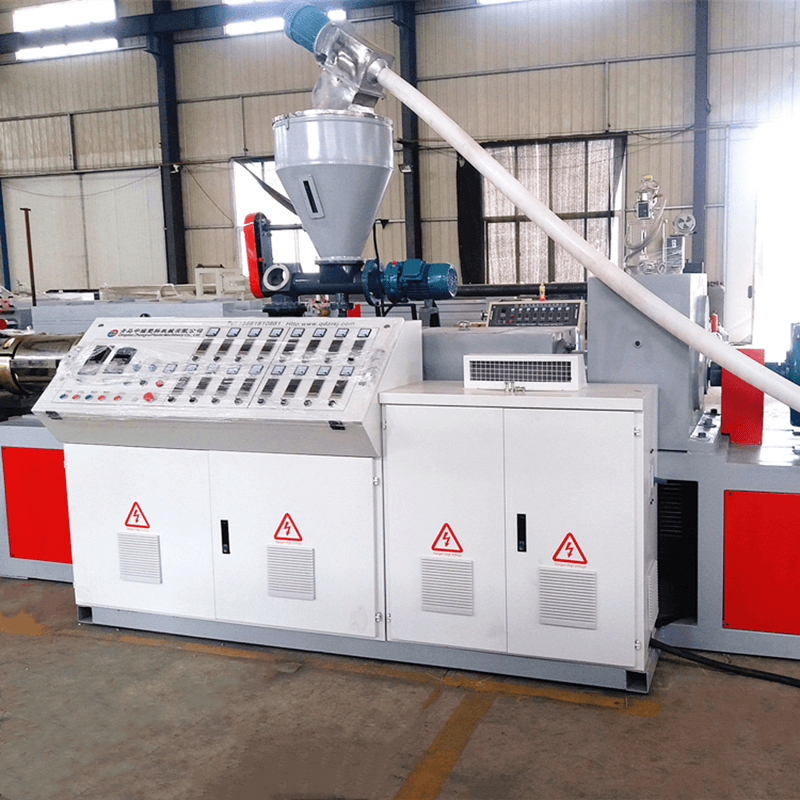
Modern manufacturing requires intelligent systems. Assessing a plastic sheet production line for integrated closed-loop feedback systems is your best path forward. A centralized PLC (Programmable Logic Controller) continuously monitors melt pressure transducers. If the pressure spikes, the PLC automatically communicates with the downstream equipment to adjust haul-off speeds by fractions of a millimeter per second. This closed-loop automation eliminates the human error of manual process drifting, guaranteeing identical thickness from the first board to the last.
Drive and Gearbox Robustness
The mechanical heartbeat of your extruder is its gearbox and drive motor. High-torque, stable gearboxes are vital for preventing micro-surging. If a cheap gearbox experiences slight rotational hesitations under heavy load, the screws will push material inconsistently. This stuttering effect causes distinct transverse thickness banding across the board. You need heavy-duty, European-standard gearboxes designed specifically for the high back-pressure demands of foam extrusion.
Application-Specific Machinery
General-purpose extruders often struggle to meet the rigid demands of specialized industries. If you are producing primarily for the signage and printing industry, you need purpose-built equipment. Evaluating a specialized PVC advertising board production machinery setup ensures your output is optimized for ultra-flat, rigid surface requirements. These specialized lines often feature extended vacuum calibration tables and ultra-precise haul-off nip rollers that prevent any surface crushing while maintaining tight dimensional constraints.
Vendor Selection
Choosing the right OEM (Original Equipment Manufacturer) determines your long-term success. What should you demand from a top-tier PVC foam sheet board extrusion machine production line manufacturer? First, insist on rigorous Factory Acceptance Testing (FAT) before shipment. Require the vendor to run your specific formulation continuously to prove run stability and thickness control. Second, demand clear warranties on barrel and screw wear life, as wear directly impacts pressure stability. Finally, ensure they provide robust local technical support to assist with advanced recipe tuning and operator training during commissioning.
Conclusion
Achieving and maintaining consistent PVC foam board thickness never relies on a single magic setting. It requires a continuous, delicate balance of mechanical torque, thermal profiling, and chemical stability. Operators must meticulously manage die lip gaps, sync haul-off speeds, and balance foaming agents with acrylic regulators to prevent cell collapse. Even minor deviations in cooling water flow or screw RPM will manifest as costly thickness variations.
To eliminate material waste and protect your profit margins, take decisive action today. Conduct a comprehensive process audit of your current cooling and haul-off synchronization. Document your baseline reject rates and identify specific hardware bottlenecks. If your current equipment relies on manual controls and open-loop feedback, request a technical consultation from an OEM for a modern PVC foam board production line upgrade. Investing in closed-loop automation guarantees the flawless dimensional stability your end-users demand.
FAQ
Q: Why is my PVC foam board thicker in the middle than on the edges?
A: Center bulging typically stems from die lip bowing under high melt pressure. It also frequently points to uneven temperature distribution in the die head, where a hotter center forces material out faster. Additionally, insufficient edge cooling in the vacuum calibration block allows the edges to compress while the hot core continues expanding.
Q: How often should thickness be measured during a continuous extrusion run?
A: We strongly recommend installing automated inline thickness gauges that monitor the board continuously using laser or ultrasonic sensors. If automation is unavailable, operators must perform manual micrometer checks at both edges and the center during every single roll or pallet change to catch drifting variations early.
Q: Can changing the calcium carbonate (filler) ratio affect board thickness?
A: Yes. Higher calcium carbonate filler loads significantly increase the compound's thermal conductivity and alter its overall melt viscosity. This changes how the material behaves inside the die. You will often require immediate adjustments to screw speed, haul-off synchronization, and die temperatures to maintain uniform thickness.



 +86-18561886575 (Mr.Wu)
 +8618561886575
 238 Yangzhou West Road, Jiaozhou City, Qingdao City, Shandong Province