Global demand for high-performance PVC piping in municipal infrastructure, construction, and agriculture is escalating. Product quality and project liability depend entirely on manufacturing precision. Facility managers and procurement engineers face a strict operational challenge. They must balance high-volume throughput with exact dimensional tolerances, minimize raw material waste, and prevent the thermal degradation of heat-sensitive PVC compounds. Mastering the step-by-step manufacturing process is the prerequisite for evaluating, specifying, and investing in a high-yield PVC Pipe Production Line that meets modern global compliance standards like ASTM, ISO, and AWWA. Understanding how raw powder transforms into a finished structural pipe allows operators to optimize parameters, reduce scrap rates, and maintain continuous production cycles.
Key Takeaways
- Process Linearity: PVC pipe manufacturing is a continuous extrusion process requiring precise synchronization between material compounding, thermal plasticization, and downstream calibration.
- Equipment Specificity: Heat-sensitive PVC requires specialized PVC pipe extrusion machinery—typically conical or parallel twin-screw extruders—to ensure proper plasticization without burning the material.
- Quality Control: Wall thickness, concentricity, and mechanical strength are dictated by the die head design and the efficiency of the vacuum calibration and cooling tanks.
- Investment Criteria: Evaluating a plastic pipe production line requires analyzing the trade-offs between output capacity (kg/hr), specific energy consumption, and long-term tooling changeover ROI.
The Core Components of a PVC Pipe Production Line
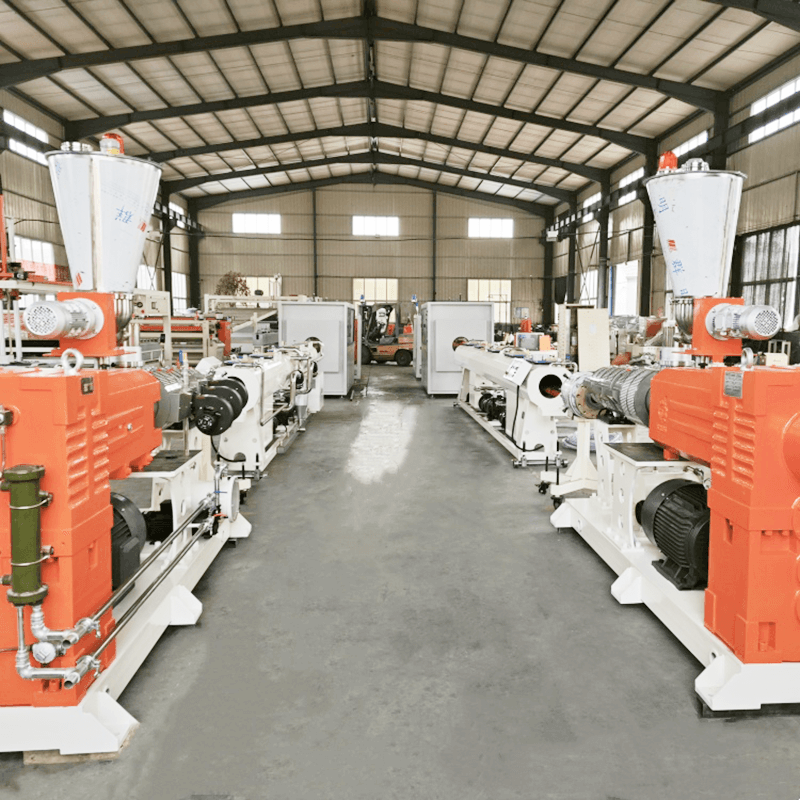
A successful extrusion operation relies on a sequence of highly specialized machines working in unison. Each component handles a specific phase of the transformation process, from raw powder handling to final cutting. Operators must understand the mechanical function of each unit to troubleshoot defects and maintain line speed.
Raw Material Preparation (Mixers and Dosers)
PVC resin cannot be processed in its raw state. It requires a precise blend of additives to achieve the necessary physical properties and thermal stability. High-speed heating and cooling mixers are mandatory for this stage. The heating mixer uses high-speed friction generated by the impeller blades to raise the temperature of the PVC resin. This mechanical action opens the polymer pores, allowing stabilizers, plasticizers, lubricants, and pigments to absorb fully.
Operators follow a strict dosing sequence. Resin enters first, followed by stabilizers at around 60°C, lubricants at 80°C, and calcium carbonate fillers at 90°C. Once the dry blend reaches the target discharge temperature of 120°C, it drops into a cooling mixer. The cooling unit uses a water-jacketed vessel and slow-speed agitation to rapidly drop the temperature to 40°C. This prevents early fusion and caking, creating a homogenous, free-flowing dry blend ready for the extrusion hopper.
The Extrusion Unit (Twin-Screw Technology)
Twin-screw extruders are the undisputed industry standard for processing unplasticized PVC (UPVC). Heat-sensitive PVC degrades rapidly under excessive shear or high temperatures. Twin screws operate on the principle of positive displacement. They push the material forward efficiently at lower RPMs, generating less shear heat than single-screw machines. The barrel features a vacuum degassing port midway down its length to extract moisture and volatile gases, preventing porosity in the finished pipe wall.
Operators typically choose between two twin-screw configurations based on their production targets. Selecting the correct PVC pipe extrusion machinery establishes the baseline efficiency for the entire plant.
| Extruder Configuration | Mechanical Characteristics | Primary Application | Output Range |
| Conical Twin-Screw | Screws taper from a large feed diameter to a smaller discharge diameter. High compression ratio. | Small to medium diameter pipes, high filler formulations, frequent recipe changes. | 150 - 600 kg/hr |
| Parallel Twin-Screw | Screws maintain a consistent diameter. Longer L/D ratio for extended residence time. | Large diameter municipal pipes, high-volume continuous runs. | 500 - 1500+ kg/hr |
Die Heads and Tooling
The extrusion die transitions the solid melt into a hollow tubular profile. Spider dies and basket dies are the most common configurations. The die head design directly impacts melt flow dynamics. A well-engineered die minimizes weld-line weaknesses caused by the spider legs splitting the melt stream. It ensures uniform distribution of the polymer before it exits the die lip. The die land length must be calculated perfectly to prevent die swell, which alters the outer diameter. Operators rely on precise die centering bolts to make rapid wall-thickness adjustments during production runs.
Downstream PVC Pipe Manufacturing Equipment
The quality of the pipe is locked in immediately after it exits the die. Downstream PVC pipe manufacturing equipment handles the critical tasks of sizing, cooling, pulling, and cutting. If any of these downstream components fail to synchronize with the extruder, the entire production run becomes scrap.
- Vacuum Calibration Tanks: The molten pipe enters a brass or stainless steel sizing sleeve inside a vacuum chamber. Negative pressure pulls the soft polymer against the sleeve, dictating the exact outer diameter. A water ring at the entrance provides initial cooling to set the outer skin, locking the dimensions in place.
- Cooling Tanks: Subsequent cooling tanks use high-volume spray nozzles. Full cone spray nozzles are highly efficient for most diameters, breaking the boundary layer of heat. This removes residual internal heat and solidifies the pipe's core structural matrix. Water temperature is strictly maintained between 15°C and 20°C.
- Haul-off Units (Caterpillars): Multi-belt haul-offs provide the continuous traction required to pull the pipe through the cooling tanks. They utilize servo motors to maintain a perfectly consistent line speed. The belts feature non-marking rubber pads. Slippage or uneven pneumatic clamping pressure causes immediate pipe deformation and wall thickness variations.
- Cutting and Belling Machines: Planetary saws travel with the pipe to deliver clean, chamfered cuts without stopping the line. Swarf extraction systems vacuum up the PVC dust immediately. Belling machines then heat the end of the cut pipe using infrared ovens and form a socket joint over an expanding mandrel.
![PVC Pipe Manufacturing Process Line Components]()
Step-by-Step: The PVC Pipe Manufacturing Process
Transforming compounded PVC powder into a rigid structural pipe requires exact timing and thermal control. The process moves linearly through five distinct stages. Operators monitor control panels continuously to ensure all parameters remain within strict tolerances.
Stage 1: Compounding and Feeding
The process begins as the dry blend transfers into the extruder hopper via a spring auger or vacuum loader. Gravity alone is insufficient for consistent feeding. Gravimetric feeders actively measure and control the mass-flow rate of the powder entering the barrel. Maintaining a constant feed rate prevents material surging, stabilizes the melt pressure, and eliminates density fluctuations in the final product.
Stage 2: Melting and Plasticization
Inside the extruder barrel, the thermomechanical transformation occurs. The combination of external ceramic barrel heaters and the internal mechanical shear of the rotating twin screws converts the powder into a viscous melt. The barrel is divided into specific temperature zones, typically ranging from 170°C at the feed throat to 195°C near the die. Operators manage these zones precisely. The goal is to achieve a uniform melt without exceeding critical degradation temperatures, which causes the PVC to burn and release corrosive hydrochloric acid gas.
Stage 3: Shaping Through the Extrusion Die
The plasticized melt travels from the screw tip, passes through an adapter, and enters the die head. Melt pressure sensors monitor flow stability continuously at this juncture, typically reading between 100 and 150 bar. The polymer flows around the internal mandrel, taking on its tubular shape. Symmetrical flow distribution here is non-negotiable. Any variation in flow velocity results in internal stresses and uneven mechanical strength in the finished pipe.
Stage 4: Vacuum Sizing and Thermal Quenching
The molten tube exits the die and immediately enters the vacuum calibrator. The sizing sleeve dictates the exact outer diameter. The vacuum, usually set between -0.05 and -0.08 MPa, forces the soft plastic against the chilled metal sleeve. Controlled thermal quenching begins instantly. Rapid cooling prevents structural sagging. It stops the pipe from developing ovality before the polymer chains fully solidify.
Stage 5: Traction, Cutting, and Finishing
The haul-off unit pulls the solidified pipe continuously down the line. The speed of the haul-off relative to the extruder output determines the final wall thickness. Length sensors track the extruded pipe. Once the target length is reached, the sensors trigger the synchronized planetary saw. The saw clamps onto the moving pipe, cuts it, chamfers the edge, and resets. The final automated belling process expands one end of the pipe to create either a solvent cement joint or an elastomeric seal joint.
Evaluating a PVC Pipe Extrusion Line for Your Facility
Investing in capital equipment requires a rigorous technical evaluation. Facility managers must look beyond basic output numbers. They need to assess operational efficiency, control integration, and long-term reliability to ensure profitable manufacturing.
Production Capacity vs. Energy Consumption Trade-offs
Output capacity must be weighed against specific energy consumption. High-output motors draw significant amperage. Facilities must balance this against local power costs and existing plant electrical infrastructure. Modern extruders utilize permanent magnet synchronous motors (PMSM) to reduce energy draw. A highly efficient line should operate at a specific energy consumption rate of 0.25 to 0.35 kWh/kg. Evaluating the energy efficiency of the barrel heating and cooling systems also provides a clearer picture of long-term operational costs.
Automation and PLC Integration
Centralized control systems are mandatory for modern manufacturing. Systems powered by Siemens or B&R PLCs reduce operator error significantly. Automated line speed synchronization ensures the haul-off speed perfectly matches the extruder output. Recipe management allows operators to recall specific temperature and speed settings for quick job changeovers via an HMI touchscreen. Real-time melt pressure monitoring triggers automatic shutdowns if safety thresholds are breached, lowering scrap rates and protecting the machinery from catastrophic overpressure events.
Tooling Flexibility and Changeover Efficiency
Manufacturing multiple pipe diameters is an operational reality. The efficiency of a PVC pipe extrusion line depends heavily on changeover speed. Evaluate machinery based on the ease of swapping die heads and vacuum sizing sleeves. Look for downstream equipment that allows rapid adjustment of haul-off clamping forces and cooling tank water levels. Minimizing production downtime during size changes directly improves overall equipment effectiveness.
Vendor Support and Spare Parts Lifecycle
Extrusion is an abrasive process. Wear components degrade over time. Screws, barrels, and heating elements require eventual replacement. Calcium carbonate fillers accelerate this wear. Evaluate vendors who provide robust long-term support. Verify their inventory of critical spare parts. A well-supported Plastic Pipe Production Line remains viable over a 10+ year operational horizon. Look for vendors offering bimetallic screws and nitrided barrels, which offer superior wear resistance compared to standard steel components.
Common Implementation Risks in Plastic Pipe Production Lines
Even with premium equipment, the extrusion process carries inherent risks. Operators must anticipate material behavior and mechanical deviations to maintain product quality and prevent unplanned downtime.
Material Degradation and Thermal Stability
The highest risk in PVC processing is material degradation. PVC burns inside the barrel due to excessive mechanical shear, excessive residence time, or failed heater bands. This creates black specks in the pipe and releases corrosive gases that pit the screw plating. Mitigation strategies include utilizing optimized screw geometry designed specifically for your formulation. Strict maintenance of barrel cooling fans is also required to prevent temperature override in the compression zone.
Inconsistent Wall Thickness and Calibration Failures
Uneven wall thickness compromises the pressure rating of the pipe. Causes include die misalignment, material surging, or uneven water flow in the cooling tanks. If the vacuum pressure fluctuates, the pipe will pull away from the sizing sleeve, causing dimensional failures. Ultrasonic thickness gauges mounted after the cooling tank provide real-time data. Automated die centering systems use this data to adjust thermal bolts in the die head, keeping dimensions perfectly tight without manual intervention.
Mitigating Downtime with Predictive Maintenance
Reactive maintenance destroys profitability. Implement a strict predictive maintenance schedule for the entire extrusion line. Focus on regular screw and barrel wear measurement using bore gauges. Service vacuum pumps routinely to maintain consistent negative pressure. Install and monitor filtration systems for the calibration tank water. Hard water deposits and polymer dust clog spray nozzles rapidly, leading to uneven cooling and pipe ovality.
| Maintenance Interval | Component | Action Required |
| Daily | Vacuum Pumps & Filters | Check water levels, clean inlet filters, verify negative pressure stability. |
| Weekly | Cooling Tank Nozzles | Inspect for calcium buildup or polymer dust clogs. Clean or replace blocked nozzles. |
| Monthly | Extruder Barrel Heaters | Test amperage draw on all ceramic heater bands. Inspect cooling fans for dust accumulation. |
| Bi-Annually | Screws and Barrel | Measure flight wear using bore gauges. Check thrust bearing lubrication. |
Conclusion
Take the following steps to advance your equipment procurement process:
- Request detailed technical proposals that specify screw geometry, motor types, and PLC integration capabilities from shortlisted vendors.
- Demand verifiable output and specific energy consumption data from real-world installations operating under similar environmental conditions.
- Arrange for a material trial run using your specific PVC formulation to validate melt stability before finalizing any machinery purchase.
- Audit the vendor's spare parts inventory and service response times for critical wear components like bimetallic screws and sizing sleeves.
FAQ
Q: What is the difference between a single-screw and twin-screw PVC pipe extrusion line?
A: Twin-screw extruders provide the necessary positive displacement, low shear, and low-temperature plasticization required for heat-sensitive PVC powder. Single-screw extruders generate too much shear heat for PVC powder and are typically used for pre-compounded pellets or stable materials like PE and PP.
Q: How much space is required for a standard plastic pipe production line?
A: A standard line requires a footprint of roughly 25 to 40 meters in length and 3 to 5 meters in width. Downstream cooling tanks for large-diameter pipes significantly increase the required line length to ensure adequate core cooling and prevent deformation.
Q: What causes ovality in PVC pipe manufacturing?
A: Ovality, or out-of-round pipes, is primarily caused by insufficient cooling before the pipe reaches the haul-off unit. Excessive haul-off clamping pressure or improper vacuum calibration settings also deform the soft pipe before the polymer chains fully solidify.
Q: How is the wall thickness of a PVC pipe controlled during production?
A: Wall thickness relates directly to the interaction between extruder screw speed, which dictates material output, and haul-off speed, which dictates the pulling rate. Operators achieve fine-tuning through manual or automated die gap adjustments at the extrusion head using thermal centering bolts.
Q: Can one PVC pipe extrusion machinery setup produce multiple pipe sizes?
A: Yes. While the main extruder remains the same, operators must change the die head, vacuum sizing sleeve, rubber haul-off blocks, and cutting clamps to accommodate different diameter ranges. This requires planned downtime and efficient quick-change tooling systems.
Q: What is the typical lifespan of the screw and barrel in a PVC extruder?
A: Lifespan depends heavily on the percentage of abrasive calcium carbonate filler in the formulation. Using bimetallic coatings on the screw and barrel extends their lifespan significantly, often exceeding 15,000 to 20,000 operational hours before requiring replacement or refurbishment.



 +86-18561886575 (Mr.Wu)

 +8618561886575
 238 Yangzhou West Road, Jiaozhou City, Qingdao City, Shandong Province