Material failure in industrial, municipal, and commercial piping systems results in catastrophic downtime and severe safety hazards. Engineers and project managers often assume a baseline material performance based on published polymer science, yet a significant disconnect exists between theoretical lab data and actual field behavior. Theoretical strength is irrelevant if the physical product cannot withstand sustained operational stresses due to manufacturing inconsistencies.
Defects such as variable wall thickness, poor compounding, and thermal degradation during extrusion frequently compromise weight capacity, pressure ratings, and joint integrity. A pipe may appear structurally sound upon visual inspection while harboring internal micro-fractures. Evaluating the integrity of a piping system requires solving a two-part equation: understanding the baseline material science—including tensile strength, schedule ratings, and variants like CPVC or PVC-O—and auditing the manufacturing process itself. The precision of the PVC Pipe Production Line directly dictates the physical limits of the final product, as even the highest-grade resin will fail if the extrusion process lacks rigorous control.
Key Takeaways
- Rigid PVC (PVC-U) offers a baseline tensile strength of 40–55 MPa, making it highly resilient, but actual load-bearing capacity depends strictly on dimensional accuracy (Schedule 40 vs. Schedule 80).
- Advanced variations like CPVC expand operational temperature ranges (-40°C to 95°C), while PVC-O (Oriented PVC) maximizes impact strength for high-pressure water applications.
- The structural integrity of any PVC pipe—and its compatibility with high-pressure fittings—is directly dictated by the precision of the PVC pipe production line; temperature control and extrusion consistency prevent brittle failure and weak weld lines.
- Investing in or sourcing from modern PVC pipe manufacturing equipment ensures compliance with strict ASTM and ISO standards across all nominal pipe sizes, reducing the risk of batch rejections and field failures.
Baseline Strength Metrics: Tensile Strength, Weight, and Pressure Ratings
Evaluating the viability of a pipe for pressurized environments requires strict adherence to engineering metrics. You cannot rely on visual inspection to determine if a pipe will hold under extreme load. Engineers must prioritize tensile strength data, weight capacity analysis, and precise dimensional verification to ensure long-term safety and performance.
Tensile Strength and Material Resilience
Rigid PVC, or PVC-U, provides a standard tensile strength between 40 and 55 MPa. This metric represents the maximum stress a material can withstand before reaching a failure state. It is an exceptionally resilient polymer designed for rigorous environments where internal fluid pressure constantly stresses the pipe wall. The 40–55 MPa range ensures the pipe maintains its geometry under continuous load, provided the polymer matrix remains intact during manufacturing.
When comparing PVC's strength-to-weight ratio against traditional materials, its engineering utility becomes clear. Steel and copper provide high absolute strength, but they introduce significant weight penalties and risks related to corrosion and galvanic reaction. In contrast, standard low-density polyethylene (LDPE) offers a tensile strength of approximately 7 MPa, which is far lower than PVC. This stark difference confirms why PVC remains the industry standard for municipal water distribution and high-pressure fluid handling.
Weight Capacity and Load Bearing Realities
The physical weight capacity of PVC is vital for both fluid transport and structural anchoring applications. Data confirms significant load-bearing utility when used in ballast. A standard 4-inch PVC pipe filled with concrete commonly weighs 35 to 36 lbs per 2.5 to 4-foot section. This specific configuration provides excellent results for industrial anchoring. The rigid walls effectively contain the concrete mass without experiencing excessive bulging or splitting.
However, lateral load bearing introduces specific constraints. PVC pipe is engineered for internal pressure rather than external lateral force. Long horizontal runs filled with liquid will experience deflection if they lack proper support spacing. You must implement strict support protocols, using hangers at defined intervals based on pipe diameter and ambient temperature. Failing to support the pipe correctly leads to localized stress concentrations at joints, which causes premature leaks or structural snaps.
Schedule 40 vs. Schedule 80 Specifications
The dimensional differences between Schedule 40 and Schedule 80 define their operational limits. These specifications apply across the nominal pipe size spectrum, from 1/8 inch up to 24 inches. The relationship between the outer diameter (O.D.) and the inner wall thickness is the primary factor distinguishing these products. The outer diameter remains consistent across both schedules to ensure universal compatibility with standard fittings. The critical difference is the wall thickness.
Schedule 80 features a thicker inner wall, which exponentially increases pressure ratings. While this allows the pipe to handle higher internal forces, it reduces the internal flow volume. Manufacturers must maintain precise extrusion tolerances to ensure the thicker walls cool without warping. The following table highlights these differences:
| Feature | Schedule 40 PVC | Schedule 80 PVC |
| Wall Thickness | Standard for general use. | Increased for industrial pressure. |
| Outer Diameter | Standardized for fitting compatibility. | Identical to Schedule 40. |
| Internal Flow | Higher flow volume. | Reduced due to wall thickness. |
| Pressure Handling | Moderate pressure environments. | High-pressure industrial systems. |
![PVC Pipe Production Line Equipment]()
Advanced Material Variations: CPVC and PVC-O
Standard rigid PVC cannot accommodate every engineering challenge. Aggressive chemicals and high-impact environments necessitate specialized chemical compositions or molecular modifications. These variations allow for extended performance in conditions that would degrade standard materials.
CPVC (Chlorinated Polyvinyl Chloride) Properties
CPVC is the result of a post-chlorination process that elevates the thermal limits of the polymer. While standard PVC typically softens around 60°C, CPVC maintains structural integrity up to 95°C. This makes it the standard choice for hot water distribution and demanding industrial fluid handling. Its chemical resistance profile is also superior, resisting degradation from acids, salts, and bases that often destroy metal piping systems.
PVC-O (Oriented PVC) for Maximum Impact Strength
PVC-O utilizes a bi-axial molecular orientation process to reach higher levels of impact resistance. During manufacturing, the pipe is stretched both radially and longitudinally. This aligns the molecular chains, resulting in ultra-strong pipes. These pipes offer higher pressure ratings with thinner walls, increasing efficiency. However, the process requires highly specialized equipment capable of precise stretching without compromising the structural matrix of the material.
How a PVC Pipe Production Line Determines Final Pipe Strength
Theoretical material strength is irrelevant if the manufacturing process produces a defective product. The structural integrity of the final pipe relies on the calibration and precision of the machinery used to create it.
Precision Extrusion, Wall Thickness, and Fitting Compatibility
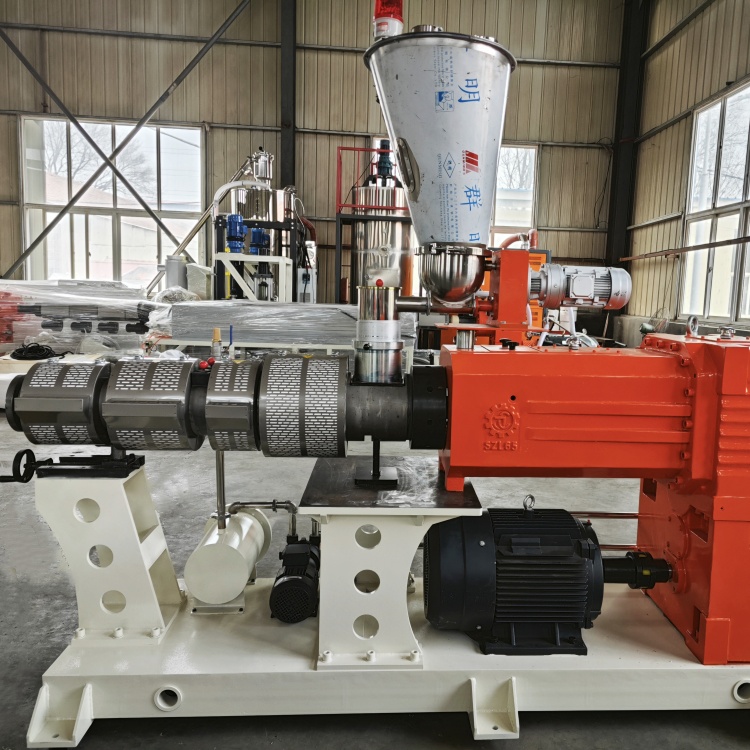
A high-quality Plastic Pipe Production Line uses advanced die heads and vacuum calibration tanks. The die head shapes the molten plastic, while the vacuum tank locks in the diameter by holding the plastic against a sizing sleeve. If the die head is poorly calibrated, the pipe will have thin spots, which are common failure points in pressure applications. Furthermore, inconsistent O.D. dimensions prevent the pipe from seating properly within fittings, causing joints to fail under stress.
Thermal Management in the Plastic Pipe Processing Line
Temperature control is the most critical variable in extrusion. PVC requires specific heat levels in the barrel and along the screw. Overheating leads to material degradation, resulting in brittle pipes that shatter under load. Underheating prevents fusion, creating weak weld lines along the pipe length. A modern PVC pipe processing line must provide exact thermal control to maintain the material's structural integrity.
Evaluating PVC Pipe Manufacturing Equipment for High-Strength Output
To produce high-strength pipe, you must assess machinery capabilities using a clear framework. Outdated equipment cannot provide the tolerances required for modern industrial standards.
Key Features in Modern Extrusion Machinery
- Gravimetric Dosing: Ensures exact blending of raw materials and stabilizers, eliminating human error in the compounding phase.
- PLC Automation: Allows central monitoring of temperatures and extrusion pressures, providing stability across long production runs.
- Ultrasonic Monitoring: Sensors scan the pipe in real-time, detecting wall thickness deviations before the product leaves the cooling tank.
- Twin-Screw Extruders: Offer superior plasticization and a more homogeneous melt, which is necessary for high-strength requirements.
Scalability and Automation
Modern PVC pipe extrusion machinery must handle varying pipe diameters and schedules while maintaining structural tolerances. Automated haul-off units ensure the pipe is pulled at the correct speed to prevent micro-fractures, and integrated cutting units ensure clean ends. When equipment supports inline hydrostatic pressure testing, manufacturers can verify strength before shipping, which significantly reduces the risk of field failure.
Implementation Realities and Manufacturing Trade-Offs
The main challenge in pipe extrusion is balancing throughput with cooling time. Increasing line speed is tempting for efficiency, but if the cooling infrastructure is insufficient, the pipe will remain too soft, leading to warping and loss of structural stability. Effective mitigation involves extending the vacuum calibration and multi-stage cooling tanks to ensure the pipe is fully stabilized. Additionally, regular maintenance—including cleaning the die head and calibrating haul-off caterpillars—is essential to prevent common defects like surface pitting or stress retention.
Conclusion
PVC pipe strength is an engineered outcome, not merely an inherent material property. It relies on dimensional accuracy, thermal processing, and chemical compounding. To maintain high standards, prioritize equipment that offers closed-loop automation and real-time monitoring.
- Audit your current production line's calibration and cooling synchronization to identify bottlenecks.
- Verify your supplier's equipment includes gravimetric dosing and twin-screw extrusion to ensure material consistency.
- Implement ultrasonic monitoring to detect and reject out-of-spec products early in the process.
- Consult with specialists to optimize your die head design for specific schedule requirements.
FAQ
Q: What is the tensile strength of standard rigid PVC pipe?
A: The tensile strength of standard rigid PVC ranges from 40 to 55 MPa. This strength allows it to handle significant internal pressure, vastly outperforming plastics like LDPE, which typically sits at around 7 MPa.
Q: How much weight can a 4-inch Schedule 40 PVC pipe hold?
A: A 4-inch Schedule 40 PVC pipe filled with concrete typically weighs 35 to 36 lbs per 2.5 to 4-foot section. For lateral loads, the capacity is entirely dependent on proper support spacing; without adequate hangers, the pipe will deflect or sag over time.
Q: What makes Schedule 80 PVC stronger than Schedule 40?
A: Schedule 80 features a thicker inner wall than Schedule 40, which drastically increases pressure ratings. Because the outer diameter is the same, it remains compatible with standard fittings while providing extra structural resistance for industrial applications.
Q: How does a PVC pipe production line impact pipe pressure ratings?
A: The production line defines the pipe's integrity. Precise extrusion and calibration prevent thin walls, which are critical weak points. Furthermore, controlled cooling ensures the polymer is properly crystallized, preventing brittle failures that occur when manufacturing temperatures are inconsistent.
Q: What is the strongest type of PVC pipe available?
A: PVC-O (Oriented PVC) is the strongest for impact and high-pressure water handling due to its bi-axial molecular alignment. For high-temperature or corrosive chemical environments, CPVC is the most robust choice, capable of handling temperatures up to 95°C.
Q: Why is temperature control critical in a PVC pipe processing line?
A: PVC is sensitive to heat. Overheating degrades the polymer and creates brittle pipes, while underheating prevents proper fusion. Precise temperature management across the extruder barrel is required to avoid internal stress and weak weld lines.



 +86-18561886575 (Mr.Wu)

 +8618561886575
 238 Yangzhou West Road, Jiaozhou City, Qingdao City, Shandong Province