Clear PVC is a highly specialized product engineered for visual monitoring, not a direct replacement for standard plumbing infrastructure. Many people mistakenly assume transparent piping works well for residential sewer lines to spot clogs. However, this ignores the realities of light exposure, biofilm buildup, and thermal limits. True clear PVC is a rigid material used primarily in chemical processing, food production, and controlled laboratory environments. Manufacturing this transparent material requires strict control over resin purity and thermal processing. You cannot simply run clear resin through standard equipment and expect optical clarity. Producing it successfully demands specialized machinery capable of managing shear stress and heat history. This article breaks down the material science behind clear PVC, the specific capabilities required from a PVC Pipe Production Line, and why it remains a niche industrial solution rather than a commodity building material.
- Clear PVC is primarily a specialty product for visual monitoring, not a direct substitute for opaque plumbing-grade PVC or sewer lines.
- Manufacturing transparency requires tighter control over resin purity and thermal processing parameters than standard opaque production.
- A standard PVC pipe extrusion line cannot produce clear piping without modifications to screw design and cooling/sizing technology.
- Success in adopting or producing clear pipe depends on balancing material clarity with pressure-rating compliance, temperature limits, and system completeness (fittings).
The Reality of Clear PVC: Composition and Material Science
Distinguishing between rigid transparent PVC and flexible clear vinyl is the first step in understanding this material. Rigid clear PVC is engineered for Schedule 40 and Schedule 80 applications. It maintains the structural integrity needed for fixed, pressurized installations. Flexible clear vinyl, on the other hand, contains heavy plasticizers. Installers use flexible vinyl for navigating tight spaces, low-pressure medical tubing, or temporary fluid routing. You cannot thread or solvent-weld flexible vinyl the same way you handle rigid pipe.
The raw resin formulation for clear pipe differs entirely from commodity grey or white pipe. Standard opaque PVC relies on titanium dioxide and various calcium carbonate fillers. These additives provide UV stability, impact resistance, and lower the overall material cost. Clear formulations strip out these opacifying agents. Instead, they require high-purity, unpigmented PVC resin. Manufacturers must use specialized organotin heat stabilizers. These specific stabilizers prevent the polymer chains from degrading under heat without altering the refractive index of the plastic.
Retaining the core benefits of standard PVC is a balancing act. The clear formulation must still resist rust, scale buildup, and chemical corrosion. It must remain lightweight for easy handling on the job site. However, the lack of standard fillers changes how the material behaves under stress. The impact of additives—or the lack thereof—means the stabilization and lubrication packages must be perfectly dialed in. If the lubrication is too high, the pipe becomes hazy. If the stabilization is too low, the material suffers from thermal degradation during extrusion. This degradation manifests as a distinct yellow tint, completely ruining the visual clarity required by the end user.
Technical Requirements for a Clear PVC Pipe Production Line
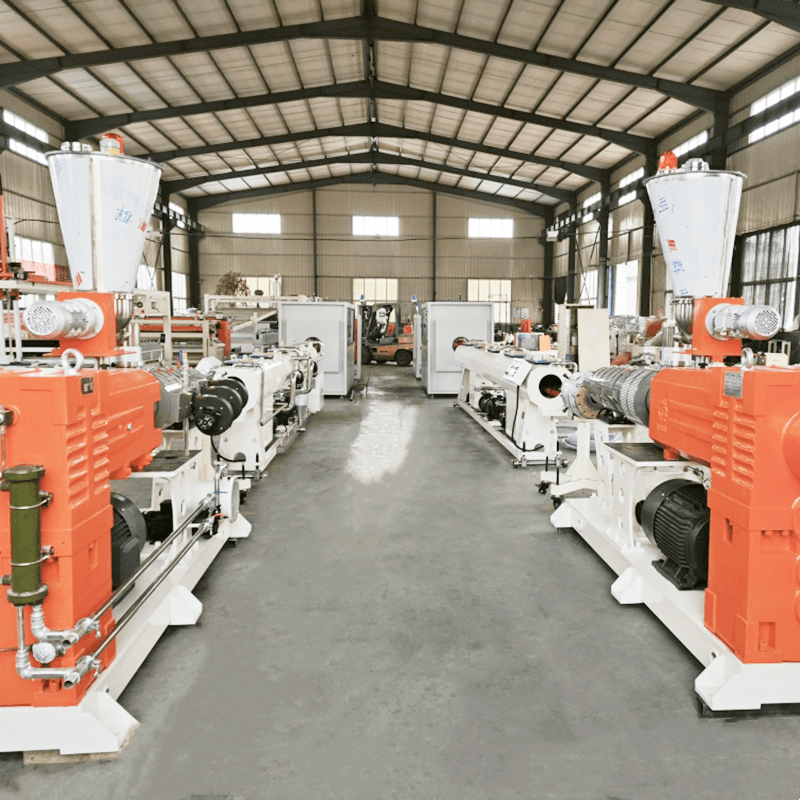
Running clear resin through a standard extrusion setup usually results in failure. A conventional PVC pipe manufacturing equipment setup is built for high-volume, opaque output where minor surface imperfections or slight thermal variations remain hidden. With clear PVC, every single flaw is magnified. The primary hurdle is managing the heat history of the polymer. PVC is highly sensitive to shear heat generated by the friction of the extrusion screw.
Precision screw and barrel design is non-negotiable. Engineers must reduce shear stress to maintain material transparency. Standard screws often have high compression ratios designed to aggressively melt and mix heavily filled opaque resins. For clear PVC, you need a low-shear screw profile. This prevents the material from burning or yellowing as it travels down the barrel. The melt temperature must remain incredibly consistent. Even a five-degree fluctuation can cause optical distortion or haziness in the finished pipe.
Advanced die design plays an equally critical role. The internal surfaces of the extrusion die must feature a high-gloss, mirror-like finish. Any microscopic scratch or machining mark on the die wall will transfer directly to the pipe. On a white pipe, a tiny die line is invisible. On a clear pipe, it catches the light and looks like a massive crack. Manufacturers spend significant time polishing the die lips and flow channels to ensure absolute smoothness.
Cooling and sizing present another major challenge. Standard vacuum sizing tanks use brass or stainless steel sizing sleeves. If these sleeves are not perfectly calibrated, they drag against the soft, hot plastic. This dragging causes surface marring or chatter marks. To prevent this, operators implement specialized vacuum sizing units with intense water lubrication. The water acts as a barrier, allowing the pipe to hold its shape without scraping against the metal sleeve.
| Extrusion Parameter | Standard Opaque PVC | Clear Rigid PVC |
| Screw Compression Ratio | High (Aggressive mixing) | Low (Gentle melting, low shear) |
| Die Surface Finish | Standard machined finish | High-gloss mirror polish |
| Heat Stabilization | Lead or Calcium-Zinc based | Organotin based (optical clarity) |
| Sizing Sleeve Contact | Direct contact acceptable | High water lubrication required |
| Cooling Water Quality | Standard plant water | Filtered, chilled water to prevent scaling |
![PVC Pipe Extrusion Technology]()
System Completeness: Integrating Clear Pipe and Fittings
A transparent piping system is useless if the connections block your view. When industrial users install clear pipe to monitor fluid flow, they need matching clear PVC fittings. This includes elbows, tees, reducers, bushings, adapters, crosses, wyes, and end caps. Maintaining full system visibility requires every component to offer the same optical clarity as the straight pipe sections.
Manufacturing these fittings involves a completely different process. While straight pipe relies on continuous extrusion, fittings require injection molding equipment. Injection molding forces molten clear resin into a closed steel cavity under massive pressure. The cooling dynamics inside a mold are vastly different from a water bath. Molders must carefully control the gate size, injection speed, and mold temperature to prevent flow marks, sink marks, or internal voids. A void inside a clear fitting not only looks bad but acts as a stress concentrator that can lead to mechanical failure under pressure.
Tolerance matching between the extruded pipe and the molded fitting is critical. Clear PVC systems rely on solvent welding, just like standard PVC. The solvent cement chemically melts the surface of the pipe and the inside of the fitting, fusing them together. If the pipe is slightly out of round, or if the fitting socket is too large, the solvent will not bridge the gap properly. In an opaque system, installers might just apply extra cement. In a clear system, excess cement looks sloppy and traps air bubbles, which ruins the visual inspection capability. Tight manufacturing tolerances ensure a clean, leak-proof, and visually perfect solvent weld.
Evaluation Dimensions: Clear Pipe vs. Standard Infrastructure
When evaluating clear pipe against standard infrastructure, you must look beyond the obvious visual differences. There are significant performance trade-offs. Clear formulations generally have lower impact resistance than their opaque counterparts. The lack of rubber modifiers and impact-absorbing fillers makes the clear plastic slightly more brittle, especially in cold environments. Furthermore, clear PVC has virtually zero UV stability. If you install it outdoors without a heavy UV-blocking coating, the sun will rapidly degrade the polymer chains, causing it to turn yellow, become brittle, and eventually shatter.
Pressure and wall thickness remain consistent with industry standards. You can source clear PVC in standard Schedule 40 and Schedule 80 dimensions. This allows installers to use standard pipe hangers, clamps, and routing techniques. However, transparency does impact structural integrity under constant pressure. The organotin stabilizers used for clarity do not offer the same long-term hydrostatic strength as the heavy metal stabilizers used in industrial grey PVC. Engineers must often derate the pressure capacity of a clear system by 10 to 15 percent compared to an identical opaque system.
Temperature limitations are another major factor. Clear PVC is generally rated safe only for cold water and specific ambient temperature limits. It typically maxes out around 140 degrees Fahrenheit. As the temperature rises, the material loses its tensile strength and begins to deform. Unlike standard CPVC, which can handle hot water up to 200 degrees Fahrenheit, clear PVC will soften and fail if exposed to high-temperature process fluids.
The clog visibility myth is perhaps the most persistent misunderstanding in the plumbing world. Homeowners frequently ask contractors to install clear pipes for sewer lines so they can spot clogs. In reality, this does not work. The moment wastewater flows through the pipe, a layer of biofilm begins to form on the interior walls. Algae growth accelerates if any ambient light hits the pipe. Within a few weeks, waste residue and bacterial slime completely coat the inside. The pipe becomes entirely opaque, defeating the entire purpose of the transparent material.
Compliance and safety standards also differ. Navigating ASTM and NSF standards for transparent process piping requires careful attention. While some clear PVC meets NSF 61 standards for potable water, it is more commonly certified under specific ASTM D1784 cell classifications for industrial use. You must verify local codes before using it in any municipal or residential application.
Strategic Applications: Where Visual Monitoring Justifies the Cost
Given the higher cost and lower impact resistance, clear PVC is reserved for strategic applications where visual monitoring is absolutely necessary. It is rarely used in standard residential or commercial conduit projects. The primary domain for this material is industrial process piping. Plant operators use it to observe flow rates, check for aeration, and spot contamination in chemical or food processing lines. Being able to visually confirm that a line is clear of debris before running a new chemical batch saves thousands of dollars in ruined product.
Research and development facilities and pilot plants rely heavily on clear piping. Engineers need to see fluid behavior in real-time. They use transparent sections to monitor mixing efficiency, observe settling rates in slurries, and verify the performance of new pump designs. The ability to record high-speed video of fluid dynamics through a clear pipe is invaluable for scaling up chemical processes.
Specialized construction and plumbing also utilize flexible clear PVC variants. Installers use these flexible hoses to navigate complex, non-pressurized routing inside machinery or medical devices. In these scenarios, the flexibility and visibility outweigh the need for high pressure ratings.
Beyond fluid handling, clear PVC serves a role in point-of-purchase displays and aesthetic construction. High-end retail environments use transparent tubes to build custom shelving, display cases, or architectural lighting enclosures. These non-fluid use cases capitalize on the material's rigidity and clean look without worrying about pressure or chemical compatibility.
Sourcing and Investing in Plastic Pipe Production Line Technology
For manufacturers, deciding to produce clear PVC requires a careful assessment of existing equipment. Scaling production means choosing between investing in a dedicated Plastic Pipe Production Line or attempting to retrofit an older machine. Retrofitting is risky. If the barrel has any residual opaque resin, carbon buildup, or degraded material, it will contaminate the clear run. Black specks and cloudy streaks will ruin the batch.
When sourcing new equipment designed specifically for transparency, you must look for several key features. First, integrated melt temperature monitoring is essential. You need real-time data on the polymer's heat state to prevent yellowing. Second, high-precision dosing systems for additives are required. Gravimetric feeders ensure the exact ratio of expensive organotin stabilizers enters the mix. Third, downstream high-polish haul-offs are critical. Standard caterpillar haul-offs use rough rubber belts that can scuff the exterior of the pipe. Clear pipe requires soft, non-marking belts that grip the pipe firmly without scratching the glossy surface.
Mitigating implementation risks involves strict quality control. Managing batch-to-batch consistency requires a cleanroom-like approach to material handling. Dust, dirt, or cross-contamination from a nearby white PVC line will destroy the optical clarity. Manufacturers must also test for light stability, ensuring the pipe meets the specified shelf-life requirements before it even reaches the distributor.
Cost-Benefit Analysis: The ROI of Clear Pipe Manufacturing
Analyzing the market demand for clear piping reveals a highly specialized, low-volume, high-margin landscape. The niche nature of clear piping means it will never match the tonnage of standard white plumbing pipe. However, the profit margins on clear products are significantly higher. Customers are willing to pay a premium for the diagnostic capabilities the pipe provides.
Production overheads are undeniably higher. The transparent-grade resins and specialized tin stabilizers cost much more than commodity PVC compounds. Increased maintenance costs also factor into the equation. Operators must spend more time purging the extruder, polishing the dies, and calibrating the downstream sizing equipment. Scrap rates are typically higher during startup because it takes longer to dial in the perfect optical clarity.
Despite these costs, offering clear pipe serves as a powerful strategic positioning tool. It elevates a manufacturer's catalog. By adding clear pipe as a premium value-add alongside standard PVC conduit production line outputs, a company demonstrates advanced technical capability. It attracts specialized industrial clients who may also purchase large volumes of standard pipe for the rest of their facility.
Conclusion
- Audit your current extrusion machinery to determine if the screw profiles and cooling tanks can handle the strict thermal and surface requirements of clear resin.
- Partner with a specialized polymer supplier to source high-purity, organotin-stabilized PVC compounds that prevent thermal yellowing during production.
- Upgrade your extrusion dies to high-gloss, mirror-polished finishes to eliminate surface defects and die lines.
- Implement non-marking haul-off belts and precision vacuum sizing sleeves to protect the optical clarity of the pipe during the downstream cooling phase.
FAQ
Q: Why don't they make household plumbing or sewer pipes out of clear plastic so you can see clogs?
A: Clear pipes are impractical for sewer lines because the interior surface quickly coats with biofilm, grease, and waste residue. Furthermore, exposure to ambient light promotes rapid algae growth inside the pipe. Within weeks, the pipe becomes completely opaque, defeating the purpose of the transparent material while costing significantly more than standard opaque PVC.
Q: Can a standard PVC pipe production line make clear pipes?
A: No, standard lines require significant modifications. Clear pipe production demands low-shear screw profiles to prevent heat degradation, high-polish dies to eliminate surface scratches, and specialized cooling controls. Standard equipment is built for high-speed opaque output and will typically burn or scratch clear resin, resulting in a hazy, yellowed product.
Q: Does clear PVC pipe come in standard Schedule 40 and Schedule 80 sizes?
A: Yes, manufacturers produce clear PVC to exact Schedule 40 and Schedule 80 dimensions. This ensures full compatibility with standard industrial fittings, hangers, and valves. However, you must verify the specific pressure ratings, as clear formulations often have slightly lower hydrostatic strength than their opaque counterparts.
Q: Is clear PVC pipe safe for hot water?
A: No, clear PVC is rated strictly for cold water and ambient temperature applications, typically maxing out around 140 degrees Fahrenheit. Exposure to hot water causes the material to soften, deform, and lose its structural integrity. For high-temperature fluid handling, you must use CPVC or other heat-resistant industrial polymers.
Q: What industries most commonly require clear PVC piping?
A: The primary users are chemical processing plants, food and beverage facilities, and research laboratories. These industries rely on clear piping for visual flow monitoring, detecting air bubbles, verifying sanitation levels, and observing fluid dynamics in real-time without shutting down the system.
Q: Does clear PVC pipe degrade faster than opaque PVC?
A: Yes, clear PVC lacks the titanium dioxide and protective fillers found in opaque pipe, making it highly susceptible to UV radiation. If installed outdoors or under intense lighting without protective coatings, the polymer chains break down quickly, causing the pipe to turn yellow, become brittle, and eventually crack.
Q: What differentiates a dedicated PVC conduit production line from a clear-pipe extrusion setup?
A: A conduit line prioritizes high-speed, high-volume output using heavily filled, low-cost resins. A clear-pipe setup prioritizes optical perfection. It operates at slower speeds, utilizes high-purity resins, requires mirror-polished dies, and uses specialized non-marking downstream equipment to prevent any surface abrasions that would ruin the pipe's transparency.



 +86-18561886575 (Mr.Wu)

 +8618561886575
 238 Yangzhou West Road, Jiaozhou City, Qingdao City, Shandong Province