Polyvinyl chloride (PVC) forms the backbone of global infrastructure. Over half of all PVC produced globally goes into piping applications. Yet its origins trace back to an accidental 19th-century discovery. It remained commercially unusable for decades due to severe material limitations. For modern plant operators, understanding the historical bottlenecks of PVC processing is necessary. You must recognize early issues like thermal degradation, extreme brittleness, and severe extrusion limitations. This historical context matters when evaluating the capabilities of contemporary production machinery. Tracing the evolution from the first rudimentary German tubes in 1932 to today’s highly automated equipment reveals practical insights. You will see exactly how modern machinery solves historical challenges related to yield, material strength, and operational efficiency at a massive global scale.
- Historical Timeline: PVC was discovered in 1835 and patented in 1913, but the first successful PVC pipe was not manufactured until 1932 in Germany.
- Technological Shift: Early manufacturing struggled with material brittleness; the development of advanced PVC pipe extrusion systems enabled the high-volume, durable water distribution networks adopted in America and globally by the 1950s.
- Material Evolution: The 1970 introduction of PVC-O (Oriented PVC) marked a critical leap in material science, pioneered by Uponor and scaled by manufacturers like Molecor and Wavin, requiring specialized extrusion and orientation machinery.
- Modern Evaluation: Today’s procurement of a PVC pipe production line hinges on evaluating twin-screw extruder efficiency, automated downstream calibration, and energy consumption metrics to meet modern tonnage demands.
The Accidental Discovery: Early Origins of Polyvinyl Chloride (1835–1913)
French physicist Henri Victor Regnault first discovered polyvinyl chloride in 1835. He left flasks containing vinyl chloride exposed to direct sunlight. A white solid formed inside the glass containers. Decades later in 1872, German chemist Eugen Baumann observed the exact same phenomenon independently. Vinyl chloride gas (C2H3Cl) polymerized naturally when exposed to ultraviolet light.
Despite these early chemical discoveries, researchers faced a massive material bottleneck. The resulting polymer was extremely rigid, highly brittle, and impossible to work with using standard mechanical methods. It severely lacked thermal stability. Applying heat caused the material to degrade rapidly. It burned and released hydrochloric acid gas before it could ever reach a melting point. Nobody could mold it into useful shapes. The primary success criteria for industrial manufacturing simply did not exist yet.
In 1913, German chemist Friedrich Klatte secured the first official patent for PVC. He detailed a specific method for polymerizing vinyl chloride using sunlight. Commercial application remained a complete failure. Early manufacturers lacked the appropriate chemical plasticizers. They also lacked processing machinery capable of handling the rigid polymer under pressure. The material sat on laboratory shelves for years. It was merely a scientific curiosity waiting for a significant engineering breakthrough. Chemists understood the molecular structure, but mechanical engineers had no way to process the raw resin into a usable physical form.
![Modern PVC pipe production line machinery]()
1932: The Birth of the First PVC Pipe Production Line in Germany
The 1930s brought a necessary breakthrough in material science. Researchers finally introduced effective plasticizers to the rigid polymer matrix. These chemical additives allowed PVC to become flexible and workable at lower temperatures. Manufacturers could finally mold and extrude the material without it degrading under intense heat. This solved the immediate thermal stability crisis that had plagued chemists for nearly a century.
This chemical breakthrough culminated in a massive 1932 milestone. Engineers in Germany successfully created the first commercial PVC tubes. They utilized rudimentary extrusion methods to force the heated, plasticized polymer through circular metal dies. This early setup served as the fundamental prototype for all future PVC pipe manufacturing equipment. It proved that continuous pipe forming was mechanically possible. Early machines used basic ram extrusion techniques. A hydraulic piston forced the softened material through a heated die block. It was slow and produced short lengths of pipe, but it proved the concept.
By the late 1930s, Germany deployed these early PVC pipes for actual physical infrastructure. They installed them extensively for drinking water distribution and chemical fluid transport. These early installations established the baseline success criteria for the entire piping industry. The pipes demonstrated impressive long-term durability. They resisted corrosion from aggressive soil conditions and water. They maintained strict chemical stability even when transporting harsh industrial fluids across factory floors. Engineers noted that the smooth internal walls prevented scale buildup, a common problem with cast iron pipes of that era.
Post-WWII Expansion: The Evolution of PVC Pipe Extrusion Systems
Following World War II, the demand for rebuilding global infrastructure skyrocketed. PVC piping spread rapidly to the United States and across the globe post-1950. Municipalities desperately needed reliable, corrosion-resistant water distribution networks. The transition from metal to plastic changed municipal engineering. Iron pipes suffered from tuberculation, where mineral deposits choked the water flow. Lead pipes posed severe health risks. PVC offered a smooth internal bore that maintained high flow rates indefinitely. It did not rust, rot, or react with soil chemicals. This made it the ideal material for underground water mains and residential plumbing.
This exponential increase in infrastructure demand forced a massive manufacturing transition. Plant operators could no longer rely on slow, inconsistent batch processing methods. They needed continuous, high-yield manufacturing capabilities to meet municipal contracts. Engineers developed advanced PVC Pipe Production Line setups to meet this global tonnage demand. Extruder barrels grew larger. Heating zones became significantly more precise. Downstream cooling and cutting mechanisms automated the entire workflow. The shift from single-screw to early twin-screw designs allowed factories to process dry PVC powder directly, bypassing the expensive pelletizing step.
The next major technological leap occurred in 1970. Yorkshire Imperial Plastics (which later became Uponor) in the UK developed PVC-O. This stands for Molecularly Oriented PVC. The complex process aligns the polymer molecules bi-axially during the cooling phase. It dramatically increases the hoop strength and overall strength-to-weight ratio of the pipe. Companies like Molecor and Wavin subsequently scaled this orientation technology commercially.
Producing PVC-O required a fundamental redesign of existing machinery. Standard extruders could not handle the complex mechanical stretching process required for orientation. Manufacturers developed highly specialized PVC pipe extrusion systems. These systems incorporated precise temperature control and mechanical expansion units. They allowed operators to orient the molecules without compromising the pipe wall integrity or causing micro-fractures. The orientation process involves expanding the extruded pipe over a mandrel or inside a mold under highly controlled thermal conditions.
From History to Modernity: Evaluating Today's Plastic Pipe Production Line
Modern manufacturing looks vastly different from the rudimentary German setups of 1932. Today, plant operators must evaluate highly sophisticated machinery to maintain competitive operating margins.
Shifting Extrusion Technologies
Historical single-screw extruders struggled immensely with rigid PVC powder. They provided poor mixing dynamics and inconsistent shear rates across the barrel. This often led to severe thermal burning or unmelted polymer particles in the final product. Modern operations rely entirely on conical and parallel twin-screw extruders. Engineers design these specifically for processing rigid PVC powder at high volumes. Twin screws provide superior melt homogeneity. They control shear forces precisely by intermeshing the screw flights. Conical twin screws excel at building high pressure for smaller pipe diameters. Parallel twin screws deliver massive output rates for large-diameter municipal pipes.
Core Components of Modern Lines
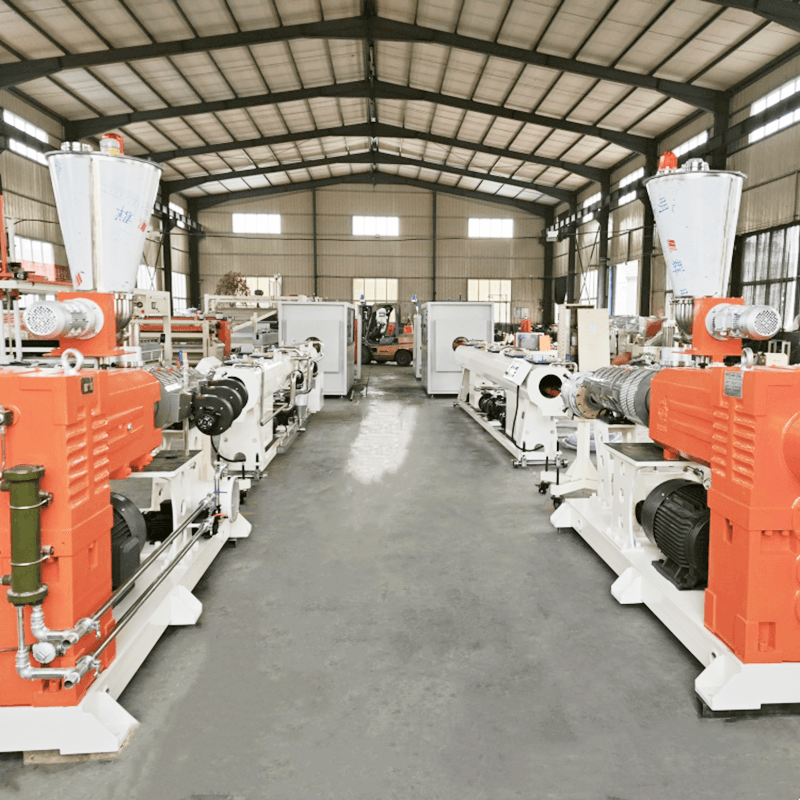
You must map out the exact anatomy of a modern Plastic Pipe Production Line to understand its true capabilities. Meeting today's global tonnage demands requires several synchronized components operating flawlessly.
- High-speed mixing and gravimetric feeding systems ensure precise material recipes. They eliminate volumetric feeding errors by measuring the exact mass of the resin, calcium carbonate, and stabilizers before they enter the extruder.
- Twin-screw extrusion focuses strictly on melt homogeneity, pressure stability, and shear control. The counter-rotating screws knead the dry powder into a uniform melt without exceeding the degradation temperature.
- Spider die heads distribute the polymer melt evenly into a tubular shape. Modern dies feature internal heating and cooling channels to prevent material stagnation and burning.
- Vacuum calibration tanks maintain strict dimensional accuracy during the water-cooling phase. The vacuum environment forces the soft pipe against a sizing sleeve while chilled water solidifies the polymer structure.
- Haul-off machines provide consistent pulling tension using multiple caterpillar tracks. They grip the pipe firmly without deforming the warm surface, ensuring a steady speed through the calibration tanks.
- Planetary cutters deliver clean, chamfered cuts at high line speeds. The cutting saw orbits the pipe, creating a perfectly square edge required for leak-proof joint assembly in the field.
- Automated belling machines form precise sockets at the pipe ends. They reheat the cut end and use a mechanical mandrel to shape the socket, allowing for immediate push-fit joint assembly.
Evaluation Dimensions: Features to Outcomes
Connecting historical flaws to modern machine features helps clarify complex procurement decisions. Early pioneers faced uneven wall thickness, thermal burning, and brittleness. Modern equipment solves these directly through engineering.
| Historical Flaw | Modern Machine Feature | Operational Outcome |
| Thermal Burning | Optimized screw core temperature control | Prevents material degradation during high-shear mixing. |
| Uneven Wall Thickness | Inline ultrasonic measuring devices | Ensures strict dimensional compliance and saves raw material. |
| Brittleness | Advanced PLC control systems | Maintains exact processing temperatures for optimal polymer fusion. |
| Slow Production Rates | Internal pipe cooling systems | Accelerates line speed without compromising structural integrity. |
| Material Bridging | Force-feeding hopper mechanisms | Ensures continuous powder flow into the extruder throat. |
Technical Evaluation: Upgrading Your PVC Pipe Production Line
Upgrading your current extrusion setup requires careful technical evaluation. You must look far beyond basic output numbers and theoretical capacities.
Scalability and Automation
Modern lines utilize advanced closed-loop control systems. These systems minimize human error on the busy plant floor. They automatically adjust haul-off speeds and extruder RPMs to maintain consistent pipe weight per meter. This automation drastically reduces scrap rates during the startup phase. It also allows for rapid tooling changes. Operators can switch between different pipe diameters efficiently. A single well-equipped line might handle diameters ranging from 16mm up to 1200mm with the right interchangeable die heads.
Overall Value Influencing Factors
You must weigh conceptual trade-offs when evaluating new equipment. Consider the initial capital expenditure carefully. European manufacturing equipment often carries a higher upfront cost compared to Asian machinery. However, you must balance this against long-term operational expenditure. Look closely at energy efficiency metrics. Evaluate the output capacity measured in kilograms per hour (kg/hr). High-efficiency permanent magnet motors and insulated barrel heaters reduce daily power consumption. This directly impacts your bottom line over a ten-year operational lifespan.
Maintenance and Tooling Considerations
Procuring a high-capacity line requires a proactive approach to maintenance. Twin-screw extruders experience significant wear over time due to the abrasive nature of rigid PVC compounds. Calcium carbonate fillers act like sandpaper against the screw flights and barrel walls. You must evaluate the metallurgical properties of the extrusion components. Bimetallic barrels and specially coated screws offer significantly longer lifespans compared to standard nitrided steel. Evaluate the ease of tooling changes. Quick-change die heads and adjustable calibration sleeves reduce machine downtime. Every minute spent swapping tooling is a minute of lost production. Modern lines feature hinged die heads and motorized height adjustments to accelerate these changeovers.
Implementation Risks and Mitigation
Deploying new machinery always carries operational risk. You must anticipate these challenges before installation begins.
- Risk: Material degradation due to poor shear control in the extruder. Excessive friction burns the PVC powder inside the barrel.
- Mitigation: Specify machinery with optimized screw core temperature control systems. Ensure the screw geometry matches your specific resin formulation perfectly.
- Risk: Dimensional non-compliance in high-speed production. Pushing a line to maximum capacity often results in ovality or thin walls.
- Mitigation: Integrate inline ultrasonic wall thickness measuring devices. Tie these sensors directly into the haul-off PLC for automatic speed correction.
- Risk: Inconsistent material feeding causing pressure surges at the die head.
- Mitigation: Install gravimetric dosing systems to ensure exact mass flow rates regardless of bulk density variations in the powder.
- Risk: Inadequate cooling leading to pipe deformation during the haul-off stage.
- Mitigation: Size the vacuum calibration and secondary cooling tanks based on the maximum expected line speed and wall thickness.
Conclusion
The journey of polyvinyl chloride demonstrates serious engineering perseverance. It started as an unworkable 19th-century polymer. It evolved into a building material used globally. Advancements in extrusion technology and material science drove this entire transformation.
When shortlisting modern equipment, your focus must remain sharp. Prioritize melt quality, energy efficiency, and automated quality control. You are solving the very problems early pioneers faced, just at a massive industrial scale. Evaluate the extruder screw design carefully. Demand precise temperature control systems from your vendors.
Take the following steps to optimize your production capabilities today:
- Conduct a comprehensive capacity audit of your current extrusion lines to identify specific throughput bottlenecks.
- Request detailed technical datasheets for modern twin-screw extruders, focusing heavily on specific energy consumption per kilogram of output.
- Calculate the exact return on investment for upgrading to automated downstream equipment like ultrasonic thickness gauges.
- Schedule a comprehensive material trial with equipment vendors using your specific PVC powder formulation.
FAQ
Q: When was PVC pipe first invented and used?
A: The first commercial PVC pipe was manufactured in 1932 in Germany. Engineers utilized early extrusion methods to form the tubes. By the late 1930s, municipalities began using these pipes for drinking water distribution and chemical transport, establishing the material's durability and corrosion resistance.
Q: Who is credited with the invention of PVC?
A: French physicist Henri Victor Regnault first discovered PVC in 1835. In 1872, Eugen Baumann observed vinyl chloride polymerizing in sunlight. German chemist Friedrich Klatte secured the first official patent for polyvinyl chloride in 1913, though commercialization took decades.
Q: How have PVC pipe extrusion systems changed since the 1930s?
A: Early manufacturing relied on rudimentary molding and slow batch processing. Today, the industry uses continuous, automated twin-screw extrusion. Modern systems feature precise thermal control, closed-loop automation, and advanced cooling, allowing plants to process tons of rigid material daily without thermal degradation.
Q: What components make up a standard PVC pipe production line today?
A: A modern line consists of several synchronized machines. It starts with a high-speed mixer and gravimetric feeder. This feeds into a twin-screw extruder and die head. Downstream equipment includes a vacuum calibration tank, haul-off machine, planetary cutter, and an automated belling machine.
Q: When was PVC-O pipe developed?
A: PVC-O (Molecularly Oriented PVC) was developed in 1970 by Yorkshire Imperial Plastics in the UK. Companies like Molecor and Wavin later scaled the technology. It requires specialized bi-axial orientation machinery and dramatically increases the pipe's strength-to-weight ratio.
Q: What should manufacturers look for in modern PVC pipe manufacturing equipment?
A: Plant operators should focus on energy efficiency, output stability, and advanced screw design. Look for PLC automation and optimized screw core temperature control. These features prevent thermal degradation, ensure consistent melt homogeneity, and maintain strict dimensional accuracy at high line speeds.



 +86-18561886575 (Mr.Wu)

 +8618561886575
 238 Yangzhou West Road, Jiaozhou City, Qingdao City, Shandong Province