In modern plastic manufacturing, a Plastic Pipe Production Line is a complete extrusion system used to produce pipes with stable size, smooth surface, and reliable strength. A PVC pipe making machine production line is widely applied to manufacture plastic pipes for water supply, drainage, electrical conduit, irrigation, and industrial transport systems. Instead of using a single machine, manufacturers use a full production line because pipe extrusion requires several stages working together, including plasticizing, forming, sizing, cooling, pulling, and cutting. A professional Plastic Pipe Production Line ensures continuous production with high efficiency and consistent quality. Each machine must operate in coordination to keep the correct diameter, wall thickness, and surface finish. With modern automation technology, production lines use intelligent control systems to adjust temperature, speed, and pressure accurately, making the PVC pipe making machine production line suitable for producing pipes that meet international standards.
1.Main Components of Plastic Pipe Production Line
Twin Screw Extruder
The twin screw extruder is the core equipment of a Plastic Pipe Production Line used for PVC materials. PVC requires strong mixing and stable heating, which makes twin screw extruders more suitable than single screw machines. The extruder melts and plasticizes the raw material, ensuring uniform flow before the pipe is formed. A high-quality extruder improves pipe strength, surface quality, and production stability.
Pipe Die Head
The die head shapes the molten plastic into a pipe. Its design determines the outside diameter, wall thickness, and surface smoothness. In a professional Plastic Pipe Production Line, the die head must be precisely machined to avoid uneven flow or deformation. Different dies are used for different pipe sizes.
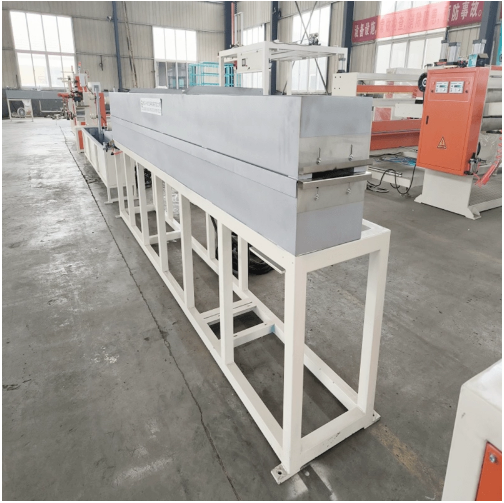
Vacuum Calibration Tank
After extrusion, the pipe enters the vacuum calibration tank, where the pipe size is fixed. The vacuum system holds the pipe against the calibration sleeve to keep the diameter accurate. This step is very important in any Plastic Pipe Production Line, because it determines the final dimension and roundness of the pipe.
Cooling Tank
The cooling tank reduces the temperature of the pipe and stabilizes its shape. Proper cooling prevents deformation and shrinkage. In large-diameter pipe production, multiple cooling tanks may be used to ensure stable results.
Haul-off Machine
The haul-off machine pulls the pipe forward at a constant speed. The pulling speed affects both diameter and wall thickness. Automatic speed control is necessary in a modern Plastic Pipe Production Line to maintain stable production.
Cutter Machine
The cutter cuts the pipe into required lengths. Depending on pipe size, different cutting systems can be used, such as planetary cutter, saw cutter, or automatic knife cutter.
Stacker or Belling Machine
After cutting, pipes are collected by a stacker or processed by a belling machine if socket pipes are required. This completes the production process.
2.Main Equipment in Plastic Pipe Production Line
Equipment | Function | Importance in Plastic Pipe Production Line |
Twin screw extruder | Melts and mixes PVC | Core of the line |
Die head | Shapes pipe | Controls diameter |
Vacuum tank | Fixes size | Ensures precision |
Cooling tank | Stabilizes pipe | Prevents deformation |
Haul-off | Pulls pipe | Controls thickness |
Cutter | Cuts pipe | Keeps length accurate |
Stacker / Belling | Finishing | Final processing |
3.Working Process of PVC Pipe Making Machine Production Line
Raw Material Mixing
PVC resin, stabilizers, lubricants, and additives are mixed evenly before feeding into the extruder. Proper mixing ensures stable melting and good pipe quality in the Plastic Pipe Production Line.
Feeding and Plasticizing
The mixed material enters the twin screw extruder, where it is heated and melted. The screws rotate to mix the material thoroughly and push it forward under controlled temperature.
Extrusion Forming
The molten material passes through the die head, forming a pipe shape. The size at this stage is slightly larger than the final size because the pipe will be calibrated later.
Vacuum Calibration
The pipe enters the vacuum tank, where calibration sleeves and vacuum pressure fix the outside diameter. This step ensures high precision in the Plastic Pipe Production Line.
Cooling
The pipe moves through cooling tanks to reduce temperature gradually. Stable cooling keeps the pipe round and smooth.
Haul-off and Speed Control
The haul-off pulls the pipe at constant speed. If the speed changes, the pipe diameter may change. Automatic control keeps the production stable.
Cutting and Stacking
The cutter trims the pipe to required length, and the stacker collects finished products. If socket pipes are needed, the belling machine forms the socket.
4.Types of Pipes Produced by Plastic Pipe Production Line
PVC-U Pipe
Rigid PVC pipe is widely used for water supply, drainage, and electrical conduit systems. It has good strength, corrosion resistance, and long service life, making it one of the most common products made by a Plastic Pipe Production Line. PVC-U pipes are suitable for construction, municipal engineering, and industrial fluid transportation because they are durable and easy to install.
PVC-M Pipe
Modified PVC pipe has higher impact resistance and better toughness compared with standard PVC-U pipes. It is often used for underground installation where the pipe must withstand external pressure or ground movement. A modern Plastic Pipe Production Line can produce PVC-M pipes by adjusting material formulation and extrusion parameters.
PVC-O Pipe
Oriented PVC pipe has very high strength due to molecular orientation during processing. It is commonly used in high-pressure water supply systems and large infrastructure projects. Producing PVC-O pipes requires precise control, so a high-quality Plastic Pipe Production Line is necessary to maintain stable performance.
Electrical Conduit Pipe
Electrical conduit pipes are used to protect cables in buildings, roads, and communication systems. These pipes require smooth surfaces and accurate diameter to ensure easy installation. A reliable Plastic Pipe Production Line can produce conduit pipes in different sizes for various construction standards.
Drainage Pipe
Large-diameter drainage pipes are used in municipal engineering, sewage systems, and rainwater transportation. These pipes must have good strength and stable shape. A heavy-duty Plastic Pipe Production Line with strong extrusion capacity is usually required for producing large pipes.
Irrigation Pipe
Irrigation pipes are widely used in agriculture for water transportation. They need to be lightweight, corrosion resistant, and cost effective. With proper configuration, a Plastic Pipe Production Line can produce irrigation pipes in different diameters to meet farming and irrigation system requirements.
5.Pipe Types and Applications
Pipe Type | Application | Advantage |
PVC-U | Water supply | Strong and durable |
PVC-M | Underground pipe | Impact resistant |
PVC-O | High pressure | High strength |
Conduit pipe | Cable protection | Lightweight |
Drainage pipe | Sewage system | Corrosion resistant |
Irrigation pipe | Agriculture | Low cost |
A flexible Plastic Pipe Production Line can produce different pipe types by changing dies and calibration sleeves.

6.How to Choose a Good Plastic Pipe Production Line
Pipe Diameter Range
The production line should match the required pipe size range. Small lines are suitable for conduit pipes or small water pipes, while large Plastic Pipe Production Line models are used for drainage pipes or large-diameter industrial pipes. Choosing the correct range ensures stable production and avoids frequent equipment changes.
Output Capacity
Different factories need different production speeds depending on their order volume. A production line with higher output can improve efficiency, but it should also match the actual demand. Selecting a Plastic Pipe Production Line with the right capacity helps reduce energy consumption and operating cost while keeping production stable.
Extruder Quality
The extruder determines the melting quality of the material and directly affects pipe strength, surface finish, and dimensional stability. A high-quality extruder with proper screw design provides better plasticizing performance, which is very important for long-term operation in a professional Plastic Pipe Production Line.
Control System
Automatic control systems allow precise adjustment of temperature, speed, and pressure during extrusion. This improves product accuracy and reduces human error. Modern Plastic Pipe Production Line equipment usually uses PLC control and touch-screen operation to make production easier and more reliable.
Material Type
Different materials such as PVC, PE, or PPR require different screw structures and heating settings. When choosing a production line, it is important to confirm the material type to ensure the machine is designed for that material. A suitable Plastic Pipe Production Line will provide better efficiency and longer service life.
Manufacturer Experience
Choosing an experienced supplier is very important for equipment quality and after-sales service. A professional manufacturer can provide technical support, installation guidance, and customized solutions according to production requirements. An experienced Plastic Pipe Production Line supplier can also help optimize the configuration to achieve stable performance and long-term reliability.
7.Factors to Consider When Buying
Factor | Why Important |
Pipe size range | Determines line model |
Output capacity | Affects efficiency |
Extruder type | Affects plasticizing |
Control system | Ensures stability |
Cooling length | Affects pipe shape |
Manufacturer support | Important for service |
A reliable Plastic Pipe Production Line supplier can provide customized solutions according to production requirements.
FAQ Section
What is included in a Plastic Pipe Production Line?
A complete line usually includes a twin screw extruder, die head, vacuum calibration tank, cooling tank, haul-off machine, cutter, and stacker or belling machine.
Can one Plastic Pipe Production Line produce different pipe sizes?
Yes, different pipe diameters can be produced by changing the die head, calibration sleeve, and adjusting the production parameters.
Why is calibration important in pipe production?
Calibration fixes the pipe diameter and keeps the pipe round. Without proper calibration, the pipe size will not meet standard requirements.
How long can a Plastic Pipe Production Line run continuously?
A high-quality production line can run continuously for long periods with proper maintenance, allowing stable and efficient pipe manufacturing.
Conclusion
A PVC pipe making machine production line is an essential system for manufacturing high-quality plastic pipes. From raw material mixing to extrusion, calibration, cooling, cutting, and stacking, every stage must work together to produce pipes with accurate size and stable performance. A modern Plastic Pipe Production Line uses advanced extruders, precise calibration systems, and automatic control technology to ensure consistent quality and high efficiency.
Choosing the right production line allows manufacturers to produce different pipe types, meet international standards, and maintain long-term stable operation. With proper equipment and professional design, a high-quality Plastic Pipe Production Line can greatly improve productivity, reduce waste, and provide reliable pipe solutions for construction, water supply, and industrial applications.



 +86-18561886575 (Mr.Wu)
 +8618561886575
 238 Yangzhou West Road, Jiaozhou City, Qingdao City, Shandong Province