In municipal, industrial, and residential infrastructure, pipe color is not an aesthetic choice. It is a critical safety language designed to prevent catastrophic cross-connection errors and ensure material suitability for specific environments. For contractors and engineers, misidentifying pipe applications leads to compliance failures and safety hazards. For manufacturers, the inability to consistently produce color-accurate, standard-compliant pipes—or the failure to distinguish between varying piping materials like PVC, PPR, and PEX—results in high scrap rates, rejected batches, and lost contracts. Understanding the exact applications for black, green, and white PVC pipes is the baseline. For manufacturers looking to capture market share, the focus must shift to evaluating how a modern PVC Pipe Production Line handles precise color dosing, co-extrusion, and rapid material changeovers without compromising structural integrity.
Key Takeaways
- Application Dictates Color: While white is the standard for potable water, green indicates drainage/sewer, and black signals UV-resistant formulations.
- Manufacturing Complexity: Producing compliant colored pipes requires advanced PVC pipe manufacturing systems capable of precise gravimetric dosing to prevent pigment degradation and ensure color uniformity.
- Cost-Efficiency via Co-Extrusion: Utilize co-extrusion (A-B-A layers) to apply expensive colorants and UV stabilizers only to the outer layer, significantly reducing operational costs compared to solid-wall coloring.
- Equipment Evaluation: Selecting the right machinery requires balancing rapid color changeover capabilities against the risk of cross-contamination, prioritizing lines with optimized die heads and automated purging sequences.
- Standardization Awareness: Distinguish PVC color coding from other systems like PPR (red/blue stripes for temp) and PEX to avoid industry-wide confusion in material procurement.
The Universal Standards of PVC Pipe Color Coding
White PVC Pipes: Plumbing and Potable Water
White PVC dominates residential and commercial plumbing networks. You will see it specified as Schedule 40 or Schedule 80. These classifications dictate wall thickness and pressure ratings for indoor fluid transfer. The bright white finish relies heavily on titanium dioxide (TiO2). This specific additive does more than just color the plastic. It provides a baseline level of ultraviolet protection during transport and temporary job site storage.
Producing white potable water pipes demands strict adherence to NSF/ANSI 61 standards. These regulations govern chemical leaching limits. You cannot use heavy metal stabilizers like lead or cadmium in these formulations. Water purity remains the absolute priority. Extrusion operators must maintain tight control over barrel temperatures. If the heat profile spikes, the PVC compound degrades. This degradation manifests as yellowing or brown streaks along the pipe wall. A single discolored batch will fail certification audits and end up in the grinder.
Green PVC Pipes: Sewer, Drainage, and Earthing
Green PVC pipes serve entirely different infrastructural demands. Field crews instantly recognize green as the universal indicator for gravity sewer lines and wastewater drainage. Electrical contractors also use specific green conduits for earthing applications. This visual distinction prevents catastrophic trenching errors. When an excavator operator sees green plastic in the dirt, they know exactly what hazards lie below. Mixing a raw sewage line with a potable water trench creates massive liability.
Sewer applications require robust structural designs. Green pipes often feature heavy-wall solid construction or corrugated profiles to withstand deep burial soil loads and surface traffic weight. Manufacturing these thick-walled products requires specialized downstream equipment. You must integrate heavy-duty vacuum calibration tanks into your Plastic Pipe Production Line. Vacuum calibration tanks pull the extruded plastic against sizing sleeves using negative pressure. This process locks in the outer diameter while the water cools the plastic. If the vacuum pressure fluctuates, the green pipe will fail dimensional inspections, rendering it useless for municipal sewer connections. Extended cooling flumes are mandatory. If the thick green walls do not cool evenly, the pipe develops internal stress and ovality issues. Out-of-round pipes will not fit into standard bell-and-spigot joints on the job site.
Black PVC Pipes: UV Resistance and Outdoor Use
Black PVC pipes handle harsh outdoor exposure. Installers rely on them for agricultural irrigation, above-ground industrial fluid transport, and solar heating networks. Standard white PVC fails in these environments. Direct sunlight breaks down the polymer chains, turning the plastic brittle and prone to shattering under pressure.
Carbon black is the active ingredient that prevents this failure. It acts as a highly effective UV stabilizer. The carbon particles absorb ultraviolet radiation and safely dissipate it as trace heat. However, black pipes absorb significantly more solar thermal energy than lighter colors. This heat absorption causes higher rates of thermal expansion and contraction.
Manufacturers face specific challenges when running black formulations:
- Dispersion: The carbon black must mix perfectly into the resin. Carbon black particles tend to agglomerate. If the extruder screw does not break apart these clusters, the pipe wall will contain microscopic voids. These voids act as stress concentrators, leading to premature burst failures when the pipe is pressurized in the field.
- Cooling capacity: Black pipes retain heat longer during the extrusion process. Operators must increase water flow in the cooling tanks to solidify the profile before it hits the haul-off unit.
- Dimensional stability: The increased heat retention can cause the pipe to warp if the haul-off speed pulls the material too aggressively.
Other Critical Color Designations and Material Distinctions
The plastic pipe industry relies on several other color codes. Misunderstanding these standards leads to dangerous installation errors and failed inspections.
- Orange: This color warns excavators of underground power or telecommunications lines. It signals high-voltage cables or critical fiber-optic networks.
- Red and Blue Striping: These markings belong to PPR or PEX plumbing systems. They differentiate hot and cold water lines. Manufacturers must ensure their PVC conduit production line does not adopt these specific market standards. PVC color coding focuses on environmental safety and application type, not fluid temperature ratings.
- Grey: Standard indoor electrical conduit uses grey pigmentation. It houses standard wiring safely within walls and ceilings.
- Purple: Reclaimed water systems utilize purple pipes. This distinct color prevents anyone from accidentally tapping into treated wastewater for drinking or bathing.
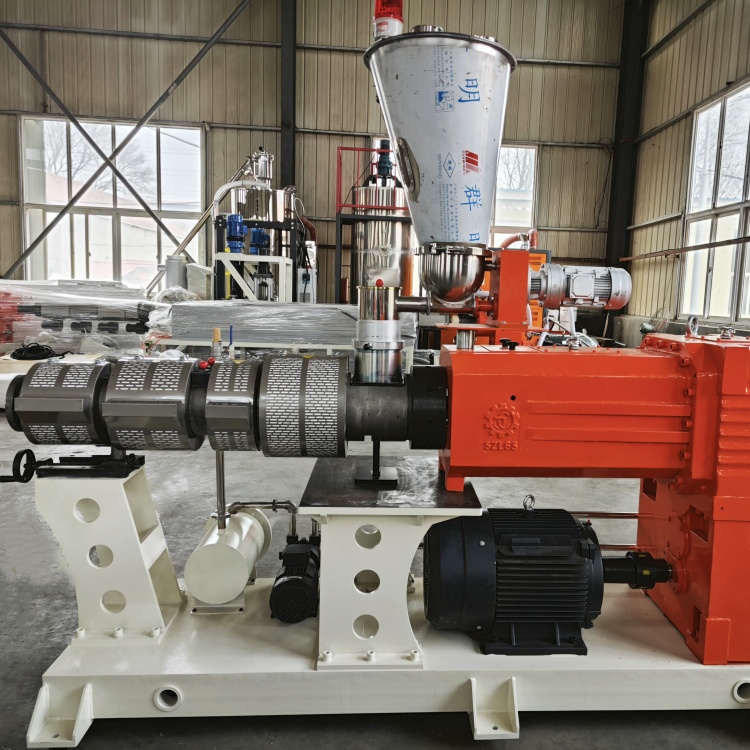
![PVC Pipe Color Coding and Production Extrusion Line]()
Manufacturing Compliant Colors: The Role of a Modern PVC Pipe Production Line
Color Dosing and Mixing Accuracy
Producing perfectly colored PVC requires absolute mechanical precision. The process starts at the material feeding stage. Older volumetric feeders measure resin and pigment by volume. This method fails because bulk density varies from batch to batch. Modern PVC pipe manufacturing systems utilize gravimetric dosing technology. Gravimetric systems eliminate the guesswork. They use load cells to monitor the exact weight of the hopper. As the extruder pulls material, the controller calculates the mass flow rate and adjusts the masterbatch feeder to match the primary resin flow perfectly. This guarantees the pigment ratio remains locked in, regardless of material settling in the hopper.
Masterbatch dispersion presents the next mechanical hurdle. PVC is notoriously heat-sensitive. It requires twin-screw extruders to process correctly. The screw design must balance aggressive mixing with gentle material handling. The pigment needs homogeneous dispersion throughout the melt flow. If the screw profile generates too much shear friction, the PVC compound will burn. Optimized screw geometries fold the pigment into the resin without exceeding the thermal degradation threshold.
Co-Extrusion vs. Mono-Extrusion for Colored Pipes
How you apply the color directly impacts your manufacturing margins. Mono-extrusion pushes a single, solid-colored compound through the die. The entire pipe wall contains expensive pigment. Co-extrusion changes the math entirely. It applies a thin, colored outer layer over a neutral or recycled core.
Multi-layer die heads enable this A-B-A structure. You can run unpigmented virgin resin or regrind material in the thick core layer. The premium colorants and UV stabilizers stay restricted to the outer skin. This method meets all visual identification and environmental resistance standards. It drastically cuts down the consumption of premium masterbatch while maintaining the exact structural integrity of a solid-wall pipe.
Comparison of Extrusion Methods for Colored PVC Pipes | Production Feature | Mono-Extrusion (Solid Wall) | Co-Extrusion (A-B-A Layers) |
| Pigment Consumption | High (100% of wall thickness requires colorant) | Low (Colorant restricted to 10-20% outer skin) |
| Core Material Utilization | Requires virgin colored compound throughout | Allows use of recycled or unpigmented virgin resin |
| Equipment Complexity | Standard single-die machinery setup | Requires multi-layer die heads and secondary extruders |
| Color Changeover Speed | Slower (Entire main barrel requires extensive purging) | Faster (Only the smaller outer extruder requires purging) |
| Material Efficiency | Lower yield per kilogram of masterbatch | Maximum yield per kilogram of masterbatch |
While co-extrusion requires a higher initial equipment investment, the reduction in daily pigment consumption yields rapid returns. High-volume pipe facilities recover the machinery costs quickly through raw material savings.
Evaluating PVC Pipe Extrusion Machinery for Color Consistency
Material Handling and Cross-Contamination Risks
Switching a production line from black pipe to white pipe creates a massive operational bottleneck. Changeover downtime destroys daily output metrics. Every minute the machine spends purging old color is lost production time. You must evaluate machinery based on its changeover efficiency. Advanced systems feature self-cleaning screw profiles. These designs eliminate dead zones where colored melt typically stagnates and degrades.
Purging efficiency separates elite equipment from average machinery. Optimized melt channels inside the die head prevent color hang-up. Automated purging sequences push the old compound out rapidly, minimizing the scrap generated during the transition. High-performance PVC pipe extrusion machinery cuts changeover waste significantly.
Component hygiene matters just as much as the extruder itself. Cross-contamination frequently occurs before the material even enters the feed throat. You need dedicated vacuum loaders for different color batches. Polished stainless steel hoppers stop pigment dust from clinging to the interior walls. A single stray pellet of black masterbatch will ruin an entire length of white plumbing pipe. Strict material handling protocols protect your product yield.
Temperature Control and Pigment Degradation
Thermal sensitivity ruins color consistency. Poor barrel temperature control leads to immediate visual defects. If the heater bands overshoot their setpoints, the pigment burns. This creates dark streaking and compromises the physical strength of the pipe. Modern extruders rely on precise PID temperature controllers. They use targeted air blowers or closed-loop oil cooling systems on the barrel zones to maintain exact thermal profiles.
The screw geometry must align with the thermal stability of your specific formulation. The Length-to-Diameter (L/D) ratio determines the residence time of the melt inside the barrel. A longer L/D ratio provides superior mixing for complex color formulations. However, it also increases the time the PVC spends under intense heat. Engineers must balance this equation. The screw profile must deliver a perfectly mixed, homogeneous colored melt without triggering thermal degradation before the plastic reaches the die.
Scaling Production: Adapting a PVC Conduit Production Line for Custom Colors
Tooling and Die Head Considerations
Introducing different colored compounds requires precise tooling adjustments. Pigments alter the melt flow index of the PVC base resin. Black compounds flow differently through the die than white compounds. The die head must maintain uniform wall thickness despite these flow variations. Engineers design spider dies and basket dies to balance these flow dynamics. If the flow becomes uneven, the resulting pipe will be eccentric, featuring a thick wall on one side and a dangerously thin wall on the other.
Striping capabilities add another layer of mechanical complexity. Many municipal standards require a base color with a contrasting longitudinal stripe. A white telecommunications conduit might require a green stripe for specific network identification. This process requires dedicated co-extruders. A small secondary extruder feeds the stripe color directly into the main die head just before the melt exits the tooling. The die must embed the stripe smoothly into the pipe surface. It cannot create a weak weld line or leave a raised ridge that would snag during installation.
Quality Control and Inline Monitoring
Manual color checks fail in high-speed production environments. Human operators cannot visually detect minor shade variations under harsh factory lighting while the pipe moves at high line speeds. Integrating inline optical sensors provides the only reliable solution. Automated colorimeters scan the pipe surface continuously as it exits the cooling tank. They detect microscopic color shifts in real-time. If the shade drifts outside the acceptable tolerance parameters, the system alerts the operator immediately. This rapid feedback loop prevents the facility from producing miles of out-of-spec pipe.
Colorant distribution also impacts physical dimensions. Ultrasonic wall measurement systems are critical for quality assurance. These sensors scan the entire circumference of the pipe continuously. They ensure the wall thickness meets strict ASTM or ISO standards. They verify that the addition of pigment has not compromised the concentricity of the extrusion. The system logs this dimensional data automatically, providing a permanent record for quality assurance documentation.
Investment Trade-offs in a Plastic Pipe Production Line
Capex vs. Opex in Multi-Color Extrusion
Facility managers face difficult choices when expanding their color capabilities. They must choose between dedicated and agile production strategies. One approach involves purchasing multiple mono-extrusion lines. You dedicate each line to a single color. This strategy eliminates changeover downtime entirely. You never have to purge a black line to run white pipe. However, this approach requires massive factory floor space and high initial capital expenditure.
The alternative strategy focuses on investing in a single, high-end co-extrusion line designed for rapid color changeovers. This reduces floor space requirements and lowers the initial equipment footprint. However, it increases operational complexity. Multi-layer die heads require highly trained maintenance staff. Cleaning, assembling, and calibrating a co-extrusion die is a delicate mechanical process. Facilities must weigh these maintenance realities against the flexibility and material savings of an agile system.
Compliance and Certification Realities
Municipal contracts demand rigorous proof of compliance. Pipe manufacturers must provide extensive documentation for every batch shipped to a job site. Integrating SCADA (Supervisory Control and Data Acquisition) systems into the extrusion line is mandatory. These systems log every critical parameter during the production run. They record gravimetric dosing rates, barrel zone temperatures, melt pressures, and haul-off speeds. Modern SCADA setups tie directly into the plant's ERP system. This integration allows quality control managers to track the exact lot number of the green pigment used on a specific night shift. If a municipality audits a batch of green sewer pipe, the manufacturer can instantly provide the exact production data to prove compliance.
Resin and additive sourcing directly impacts certification. Changing pigment suppliers can alter the physical properties of the finished pipe. Every new color batch must maintain the established hydrostatic design basis (HDB). The HDB dictates the long-term pressure rating and structural lifespan of the pipe. Manufacturers must conduct extensive burst testing and long-term pressure testing when introducing new color formulations. Ensuring the pigment does not weaken the polymer matrix remains a continuous obligation for the quality control department.
Conclusion
Securing municipal contracts and maintaining high production margins requires flawless execution in pipe color coding. Relying on outdated volumetric feeding or manual color checks guarantees high scrap rates and rejected batches. Facility managers must upgrade their operational protocols to ensure every colored pipe meets strict environmental and structural standards.
Take the following actions to optimize your production line:
- Audit your material handling systems and install dedicated vacuum loaders for each pigment to eliminate cross-contamination.
- Upgrade to gravimetric dosing units to lock in exact pigment-to-resin ratios and prevent color drifting.
- Implement inline automated colorimeters and ultrasonic wall scanners to catch defects in real-time before the pipe reaches the haul-off unit.
- Transition high-volume colored pipe production to co-extrusion lines, restricting expensive masterbatch to the outer skin layer to maximize material yield.
FAQ
Q: What does a green PVC pipe indicate?
A: Green PVC pipes are universally recognized as gravity sewer and wastewater drainage lines. This distinct color coding prevents accidental cross-connection with potable water systems during trenching and excavation.
Q: Why are some PVC pipes black?
A: Black PVC pipes contain carbon black, which acts as a powerful UV stabilizer. This formulation provides essential ultraviolet resistance for outdoor applications like agricultural irrigation, preventing the polymer from degrading and becoming brittle in direct sunlight.
Q: Can one PVC pipe production line manufacture multiple colors?
A: Yes. A single line can produce multiple colors if equipped with advanced purging systems, self-cleaning screw profiles, and co-extrusion technology. These features manage rapid color changeovers while minimizing material waste and downtime.
Q: What is the difference between solid color and co-extruded PVC?
A: Solid pipes use colored compound throughout the entire wall thickness. Co-extruded pipes feature a thin, colored outer layer applied over a neutral or recycled core. Co-extrusion is significantly more material-efficient and cost-effective.
Q: Do red and blue markings apply to PVC pipes?
A: No. Red and blue stripes or solid colors primarily identify hot and cold water lines in PPR and PEX systems. PVC color coding focuses on environmental safety and specific infrastructure applications, such as white for plumbing or green for sewer.
Q: Does adding colorant affect PVC strength?
A: Yes. Incorrect pigment ratios or poor thermal control during extrusion can degrade the PVC resin. Precise gravimetric dosing and optimized screw geometries are vital to ensure the colorant integrates perfectly without compromising the pipe's structural integrity.



 +86-18561886575 (Mr.Wu)

 +8618561886575
 238 Yangzhou West Road, Jiaozhou City, Qingdao City, Shandong Province