High-quality PVC pipe manufacturing starts at the molecular level with precise material formulation. Manufacturers frequently experience high scrap rates, thermal degradation, and inconsistent pipe yields. These issues rarely stem from machine failure. Instead, they occur because the chosen machinery is misaligned with specific raw material blends. Resins, stabilizers, and fillers dictate every mechanical requirement on the factory floor. Understanding the exact chemical composition of PVC is critical. You must know how this material behaves under intense heat and pressure inside the barrel. This foundational knowledge allows operators and engineers to evaluate, specify, and optimize a high-yield extrusion setup. We will break down the core materials used in pipe manufacturing and demonstrate exactly how your specific formulation impacts machinery selection, screw design, and downstream cooling requirements.
- PVC pipe is primarily composed of polyvinyl chloride resin (derived from ethylene and chlorine), but in its pure, hard, and brittle white powder form, it requires a precise matrix of additives to process correctly.
- The formulation of your dry blend directly dictates the technical requirements of your PVC pipe manufacturing systems, particularly screw design, motor torque, and cooling capacity.
- Rigid PVC (UPVC) requires specialized twin-screw extrusion technology due to its high melt viscosity and shear sensitivity.
- Evaluating equipment based on material handling, automated dosing, and precise thermal control mitigates the risk of material degradation, ensures long-term circumferential stress resistance, and maximizes operational ROI.
The Core Chemistry: Understanding PVC Raw Materials
Polyvinyl Chloride (PVC) Resin: The Foundation
Polyvinyl chloride is a versatile thermoplastic resin formed through the polymerization of vinyl chloride monomer (VCM). In its pure state, PVC is a hard, brittle white powder. You cannot extrude this raw powder without significant modification. The molecular weight of the resin determines its mechanical capabilities and processing behavior. Industry standards measure this molecular weight using a metric called the K-value. Pipe manufacturing typically utilizes PVC resins with K-values ranging from K65 to K68. Higher K-values indicate longer polymer chains, which provide superior mechanical strength and impact resistance. However, higher K-values also increase the melt viscosity of the compound. High viscosity requires extruders equipped with robust gearboxes and high-torque motors to push the stiff melt through the die head. Selecting the correct resin grade is the first step in configuring your production equipment.
Ethylene and Chlorine: The Upstream Inputs
The building blocks of PVC separate it from other commodity plastics like polyethylene. The raw material breakdown consists of 43% ethylene and 57% chlorine. The ethylene component derives from hydrocarbon processing and petroleum refining. The chlorine component comes from the electrolysis of standard industrial salt (sodium chloride). This unique chemical composition provides several advantages for infrastructure applications. The high chlorine content makes PVC inherently flame-retardant. It will not support combustion once the external flame source is removed. Furthermore, this composition provides excellent chemical stability. It resists oxidation, corrosion, and degradation from harsh soil conditions. These inherent properties set the baseline for durable, long-lasting underground water and sewer networks.
Circumferential Stress and Long-Term Stability
The chemical stability of the PVC matrix ensures minimal change in its molecular structure over time. This stability is critical for pressure-bearing applications. Proper material formulation directly influences the Hydrostatic Design Basis (HDB) of the finished pipe. The HDB rating determines how much internal pressure the pipe can handle continuously over its lifespan. Rigid PVC pipes must withstand high circumferential stress, commonly known as hoop stress. When water flows through a pipe under pressure, it pushes outward against the pipe walls. A well-formulated and properly extruded PVC pipe resists this outward force without yielding or cracking. By maintaining strict control over the resin quality and extrusion parameters, manufacturers produce pipes that easily achieve a 50- to 100-year operational lifespan under continuous municipal pressure.
![PVC Pipe Production Line Equipment]()
Heat Stabilizers: Preventing Thermal Degradation
Pure PVC resin is thermally unstable. It degrades, discolors, and burns long before reaching the temperature required to melt it into a flowable state. Heat stabilizers are an absolute necessity in any PVC formulation. They widen the thermal processing window, allowing the material to pass through the heated extruder barrel without breaking down. Manufacturers choose from several types of stabilizers based on regional regulations and application requirements. Calcium-Zinc stabilizers offer a safer, environmentally friendly alternative, providing excellent thermal stability for potable water pipe production. Tin-based stabilizers provide exceptional heat stability and clarity but carry a higher cost. Lead-based stabilizers were historically popular for their low cost and high effectiveness, though environmental regulations have heavily restricted their use in many global markets today.
Lubricants, Fillers, and Modifiers
Creating a processable dry blend requires a precise balance of internal and external lubricants. Internal lubricants reduce friction between the polymer chains, lowering the overall melt viscosity and preventing excessive shear heating. External lubricants migrate to the surface of the melt, preventing the hot PVC from sticking to the metallic surfaces of the extruder barrel, screw, and die head. Calcium Carbonate (CaCO3) serves as the most common filler in PVC pipe formulations. It reduces raw material costs by displacing more expensive PVC resin. However, adding filler involves strict economic and mechanical trade-offs. High filler loads increase the brittleness of the final pipe. They also create a highly abrasive melt that accelerates wear on extruder screws and barrels. To counteract brittleness, manufacturers add impact modifiers. These elastomeric additives absorb energy and prevent crack propagation, ensuring the pipe passes mandatory drop-weight impact tests.
High-Speed Mixing and Dosing: Preparing the Dry Blend
The extrusion process begins in the mixing room. A high-speed hot and cold mixing unit is necessary to disperse all additives uniformly into the PVC resin. The high-speed impeller in the hot mixer generates intense friction, heating the batch to approximately 120°C. At this temperature, the pores of the PVC resin expand, allowing liquid and solid additives to absorb fully into the polymer matrix. Once the hot mixing phase completes, the material discharges into a cooling mixer. The cooling mixer features a large water-jacketed vessel that drops the batch temperature below 40°C. This rapid cooling prevents the stabilizers from degrading prematurely and stops the compound from agglomerating. Automated gravimetric dosing systems feed these raw materials into the mixer. Gravimetric systems weigh each component continuously, ensuring absolute batch-to-batch consistency and preventing formulation errors.
Mapping Material Flow Through Standard Extrusion Operations
The physical properties of your formulated dry blend dictate the synchronization of all downstream operations. The material flows through a continuous sequence: feeding, melting, forming, cooling, pulling, and cutting. The bulk density and flowability of the powder determine how efficiently the hopper feeds the extruder. Poor flowability causes inconsistent feeding, leading to surging and dimensional variations in the final pipe. The drive systems and haul-off speeds must calibrate perfectly to the specific melt flow index of the compound. If the haul-off pulls the pipe faster than the extruder delivers the melt, the pipe wall becomes too thin. If the extruder pushes material faster than the haul-off pulls it, the pipe wall thickens out of tolerance. Advanced PLC control systems synchronize these speeds automatically, relying on continuous feedback from the drive motors and downstream sensors.
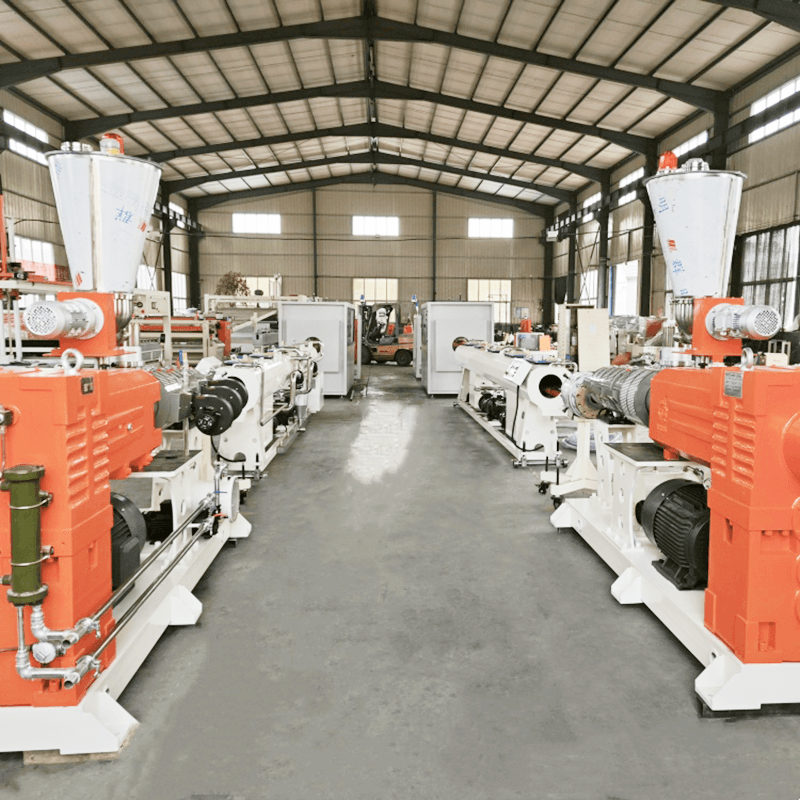
Processing rigid PVC powder requires specific mechanical configurations. Single-screw extruders generate too much shear heat and lack the positive displacement necessary to convey dry powder efficiently. Twin-screw extruders are mandatory for rigid PVC pipe production. Manufacturers generally choose between two twin-screw designs:
- Conical Twin-Screw Extruders: These feature screws that taper from a large diameter at the feed throat to a smaller diameter at the die end. This design provides excellent compression, high pressure generation, and low shear. They are ideal for large-diameter pipes and highly filled formulations.
- Parallel Twin-Screw Extruders: These feature screws with a consistent diameter from end to end. They offer longer residence times for thorough mixing and are highly efficient for long production runs of standard pipe sizes.
The specific heat capacity of your PVC formulation dictates the design of the barrel heating zones. Ceramic heater bands provide the necessary external heat to initiate melting. Because PVC is shear-sensitive, the mechanical friction of the screws generates significant internal heat. Extruders must feature robust screw core temperature control systems. These systems circulate oil or distilled water through the center of the screws to remove excess heat and prevent the material from burning.
Die Head Design and Material Flow Dynamics
The die head transforms the amorphous melt into a precise tubular shape. The rheology, or flow behavior, of melted PVC requires highly streamlined tooling. Manufacturers use spider die heads for pipe extrusion. The melt flows around a central torpedo supported by spider legs. The internal channels of the die must be highly polished and free of any dead zones. Stagnant areas allow the PVC to degrade and burn, causing black streaks in the finished product. As the material exits the die lips, it experiences die swell. The polymer chains relax and expand as they leave the high-pressure environment. Engineers must calculate this material swell and design the die tooling slightly smaller than the target pipe diameter to ensure accurate final dimensions.
UPVC vs. CPVC: Equipment Trade-Offs
While standard Unplasticized PVC (UPVC) dominates the water main and drainage markets, Chlorinated PVC (CPVC) serves high-temperature applications. CPVC handles hot water distribution and highly corrosive industrial chemicals. The manufacturing process for CPVC involves chlorinating standard PVC resin, which raises its heat deflection temperature. Processing CPVC introduces severe mechanical challenges. The higher chlorine content makes the melt highly corrosive and exceptionally viscous. Standard nitrided screws and barrels will degrade rapidly when processing CPVC. Manufacturers must upgrade to bimetallic components. These components feature a thick layer of tungsten carbide or other corrosion-resistant alloys cast into the barrel lining and welded onto the screw flights. Without these metallurgical upgrades, equipment failure is inevitable.
| Material Type | Primary Application | Key Formulation Characteristic | Machinery Impact |
| UPVC (Unplasticized) | Cold water mains, sewer, drainage | Rigid, high K-value resin, moderate filler | Requires standard twin-screw extrusion, precise core cooling. |
| CPVC (Chlorinated) | Hot water, industrial chemicals | High chlorine content, high viscosity | Requires bimetallic, highly corrosion-resistant screws and barrels. |
| Conduit PVC | Electrical wiring protection | High flexibility, UV stabilizers, fire retardants | Requires high-speed, dual-strand downstream equipment. |
Electrical conduit requires a fundamentally different formulation than pressure pipe. Conduit must bend without snapping during installation. Therefore, the formulation includes specific impact modifiers to increase flexibility. It also requires heavy doses of UV stabilizers for outdoor installations and specialized fire retardants to protect electrical wiring. Because conduit typically involves smaller diameters produced in massive volumes, equipment configurations change. High-speed, dual-strand extrusion lines are the standard. A single extruder feeds a specialized dual die head, producing two pipes simultaneously. This setup doubles the output capacity without requiring a massive, energy-consuming single-screw setup. The downstream equipment must feature dual vacuum tanks, dual haul-offs, and high-speed cutting units capable of matching the rapid line speed.
Scalability, Automation, and Downstream Integration
The extrusion process does not end when the pipe leaves the die. Downstream equipment must perfectly match the extrusion output to maintain dimensional stability. Vacuum calibration tanks freeze the pipe dimensions immediately after it exits the die. The hot pipe enters a sizing sleeve inside a vacuum chamber. The vacuum pulls the soft plastic against the sleeve while water sprays cool the material, locking in the outside diameter. Material shrinkage rates and heat deflection temperatures dictate the length and cooling capacity of these sizing tanks. Thick-walled pressure pipes retain massive amounts of core heat. They require extended cooling tanks and chilled water systems to prevent the pipe from warping or shrinking out of tolerance after it is cut. Planetary cutters follow the haul-off unit. They clamp onto the moving pipe and use a rotating saw blade to provide clean, square cuts without interrupting the continuous line speed.
Implementation Risks: Material and Machinery Misalignment
Burn Marks and Thermal Degradation
Thermal degradation is the most common and costly processing error in PVC manufacturing. It occurs when the material absorbs too much heat, causing the chlorine atoms to strip away from the polymer chain. This reaction releases hydrochloric acid gas, which further accelerates the degradation process. The visible result is black streaks, yellowing, or severe burn marks on the finished pipe. This risk stems directly from incorrect screw geometry or failed temperature controllers. If the compression ratio of the screw is too high for your specific formulation, it generates excessive shear heat. If the barrel cooling fans fail, the external temperature spikes. Specifying extruders with advanced PLC control systems mitigates this risk. These systems monitor melt pressure and temperature in real-time. Precise oil or water screw core cooling is also essential to extract internal frictional heat before it damages the compound.
Wall Thickness Inconsistencies and Calibration Failures
Producing pipe with uneven wall thickness wastes raw material and guarantees failure during pressure testing. This issue often originates in the feed throat. Poor dry blend flowability or inconsistent bulk density causes the extruder to surge. Surging means the output volume fluctuates, pushing more material through the die one second and less the next. Implementing gravimetric feeding systems ensures a constant, measured supply of material into the screws, eliminating flow-related surging. Additionally, moisture or trapped air in the dry blend causes bubbles and surface defects. Ensuring proper vacuum venting on the extruder barrel removes these volatiles before the melt reaches the die head. A strong, consistent vacuum pulls gases out of the melt, resulting in a dense, structurally sound pipe wall.
Conclusion
The successful production of PVC pipe relies on the symbiotic relationship between the chemical formulation of the resin blend and the mechanical capabilities of the extrusion equipment. You cannot fix a poor formulation with a great machine, and you cannot process a great formulation on inadequate equipment. To ensure long-term operational success, take the following actionable steps:
- Prioritize machinery manufacturers who offer customized screw designs tailored specifically to your K-value resin and filler ratios, rather than accepting generic, off-the-shelf profiles.
- Conduct comprehensive material rheology testing with your prospective equipment supplier to map the exact thermal behavior of your compound.
- Request a full-scale trial run using your specific dry blend formulation before finalizing any capital equipment purchases.
- Implement automated gravimetric dosing systems to eliminate human error and maintain strict batch-to-batch consistency.
- Establish a rigorous preventative maintenance schedule focused on monitoring screw and barrel wear, especially if running high calcium carbonate filler loads.
FAQ
Q: What is the primary raw material used in a PVC pipe production line?
A: The primary material is polyvinyl chloride (PVC) resin, typically in a hard, brittle white powder form. Because pure PVC cannot be processed alone, it must be combined with heat stabilizers, lubricants, and fillers to create an extrudable dry blend.
Q: Why can't pure PVC resin be used in a PVC pipe extrusion line?
A: Pure PVC is thermally unstable. It will degrade, discolor, and burn at the high temperatures required to melt it into a flowable state. Heat stabilizers must be added to the formulation to widen the thermal processing window and prevent degradation.
Q: How does adding calcium carbonate affect plastic pipe production line machinery?
A: Calcium carbonate reduces raw material costs by acting as a filler. However, high filler loads increase the abrasiveness of the melted compound. This requires manufacturers to use bimetallic or specially coated screws and barrels to prevent premature equipment wear.
Q: What is the difference between UPVC and CPVC in terms of manufacturing?
A: UPVC is standard rigid PVC used for cold water applications. CPVC contains additional chlorine, allowing it to handle higher temperatures. However, CPVC is highly corrosive when melted, requiring specialized, corrosion-resistant extrusion equipment and upgraded metallurgy.
Q: Why do PVC conduit production lines often use twin-screw extruders?
A: Twin-screw extruders provide the positive displacement and low-shear mixing required to process rigid PVC powder efficiently. Single-screw extruders generate too much friction and lack the conveying capability needed for dry powder, leading to thermal degradation.
Q: How does the K-value of PVC resin impact the extrusion process?
A: The K-value indicates the molecular weight of the resin. Higher K-values (like K65-K68 used for pipes) offer better mechanical properties and stress resistance. However, they have higher melt viscosities, requiring extruders with higher motor torque and robust gearboxes.



 +86-18561886575 (Mr.Wu)

 +8618561886575
 238 Yangzhou West Road, Jiaozhou City, Qingdao City, Shandong Province