Zhongrui's High-capacity PP Packaging Belt Production Line is engineered for efficiency and high output. This innovative machine produces durable, flexible, and cost-effective PP straps, replacing traditional steel straps across various industries. Ideal for manufacturers seeking quality and sustainability.
According to many years of plastic machinery development and design experience, in the introduction of foreign advanced technology and digestion and absorption, on the basis of self-developed PE pipe production line. Has the unique structure, the design is novel, the equipment entire line layout is reasonable, the control performance is strong and so on.
The PE/PPR Pipe Production Line delivers reliable and efficient manufacturing of various pipes for water supply and drainage in agriculture and construction. Experience advanced technology and precision for high-quality production.
Discover the Highly Cost Effective PVC Pipe Production Line from Zhongrui. Engineered for durability and efficiency, this advanced production line ensures high-quality PVC pipes suitable for a variety of applications. Experience seamless operation, reduced maintenance, and significant cost savings.
The Composite Infiltration Irrigation Pipe Production Line is a high-efficiency system designed to produce drip irrigation tape for agricultural applications. With precision control, energy-saving technology, and advanced automation, it ensures superior performance in greenhouse, field crop, and water conservation irrigation systems.
Discover the PVC Hose Production Line designed for efficient, high-speed manufacturing of PVC hoses. Our advanced system ensures precision, versatility, and durability, making it an ideal choice for various industrial applications.
The PVC Imitation Marble Sheet Slab Extruder Machine Production Line is designed for producing high-quality, durable, and visually appealing marble-like PVC sheets. Offering fire resistance, water resistance, and high-temperature durability, it’s ideal for a variety of interior decoration applications. This advanced extrusion line guarantees high efficiency and stable output, making it a top choice for businesses looking to scale up production.
Zhongrui's PMMA Board Production Line is designed for precision, high-output plastic sheet manufacturing. With advanced technology including a vertical three-roll calender, Siemens motor, and ABB inverter, it ensures high plasticizing ability and energy-efficient performance. Ideal for producing PMMA, PC, and ABS sheets for construction, packaging, and automotive industries.
0
0
Plastic Pipe Production Line Screw Type Comparison Guide
Views: 0 Author: Site Editor Publish Time: 2026-10-06 Origin: Site
Choosing a screw for a plastic pipe production line starts with one simple answer. A conical twin-screw extruder (SJSZ) works well for PVC dry-blend powder. A single-screw extruder (SJ) works well for pelletized thermoplastics. This rule covers most plastic pipe extrusion line choices, but three things can change it. Those are feedstock form, output target, and pipe diameter with wall thickness.
Each pipe extrusion line pairs its screw with a die, sizing, and haul-off setup. A PVC pipe production line, a Bellows Production Line, or a PU/TPU Pipe Production Line each has its own needs. This guide compares both designs on specifications alone. It shows where each type fits best. No design wins everywhere.
Key Takeaways
Choose a conical twin-screw extruder for PVC dry-blend powder.
Choose a single-screw extruder for pelletized plastics like PE and PP.
Match the extruder size to your output target in kg/h.
Check pipe diameter and wall thickness to set the downstream equipment.
Run the extruder at about 80% of its maximum output for stable production.
Why Screw Choice Matters
The Screw As Processing Core
The extruder screw handles plasticization, melt homogeneity, and output stability. These three jobs shape how the line performs more than any single auxiliary machine. A mixer blends the feedstock, and a chiller controls temperature. Neither one can fix an unstable melt after it leaves the screw.
The screw melts the polymer, mixes it, and pushes it forward at a steady rate. A well-matched design sends uniform melt pressure to the die head. That consistency carries through vacuum sizing, cooling, and haul-off. Wall thickness stays on target, and the line runs at its rated output.
This is why twin screw extruders and single screw designs differ in more than geometry. Each design matches a specific feedstock form. The conical twin-screw design handles PVC dry-blend powder with positive conveying. The single screw suits pelletized thermoplastics with simpler geometry. Matching the screw to the feedstock keeps the whole line stable.
Cost Of A Mismatch
A mismatch shows up in neutral, measurable ways. Output becomes unstable, wall thickness varies along the pipe, and scrap rates rise. Operators then slow the line to regain control, which cuts effective capacity.
Purchase cost also differs by design. Single screw extruders have a lower initial purchase cost and a simpler gearbox structure. Conical twin screw extruders need a higher initial investment and a more complex gearbox and screw system. For PVC pipe makers, the twin-screw route often makes up that gap over the full lifecycle. Dry-blend processing skips the pelletizing step, scrap rates run lower, and output per unit time is higher with better long-term stability.
Neither design is cheaper in every case. The right comparison weighs feedstock, output target, and pipe dimensions together. A screw that fits the material and the product range protects both output stability and total cost of ownership.
Plastic Pipe Extrusion Line Context
How Lines Are Configured
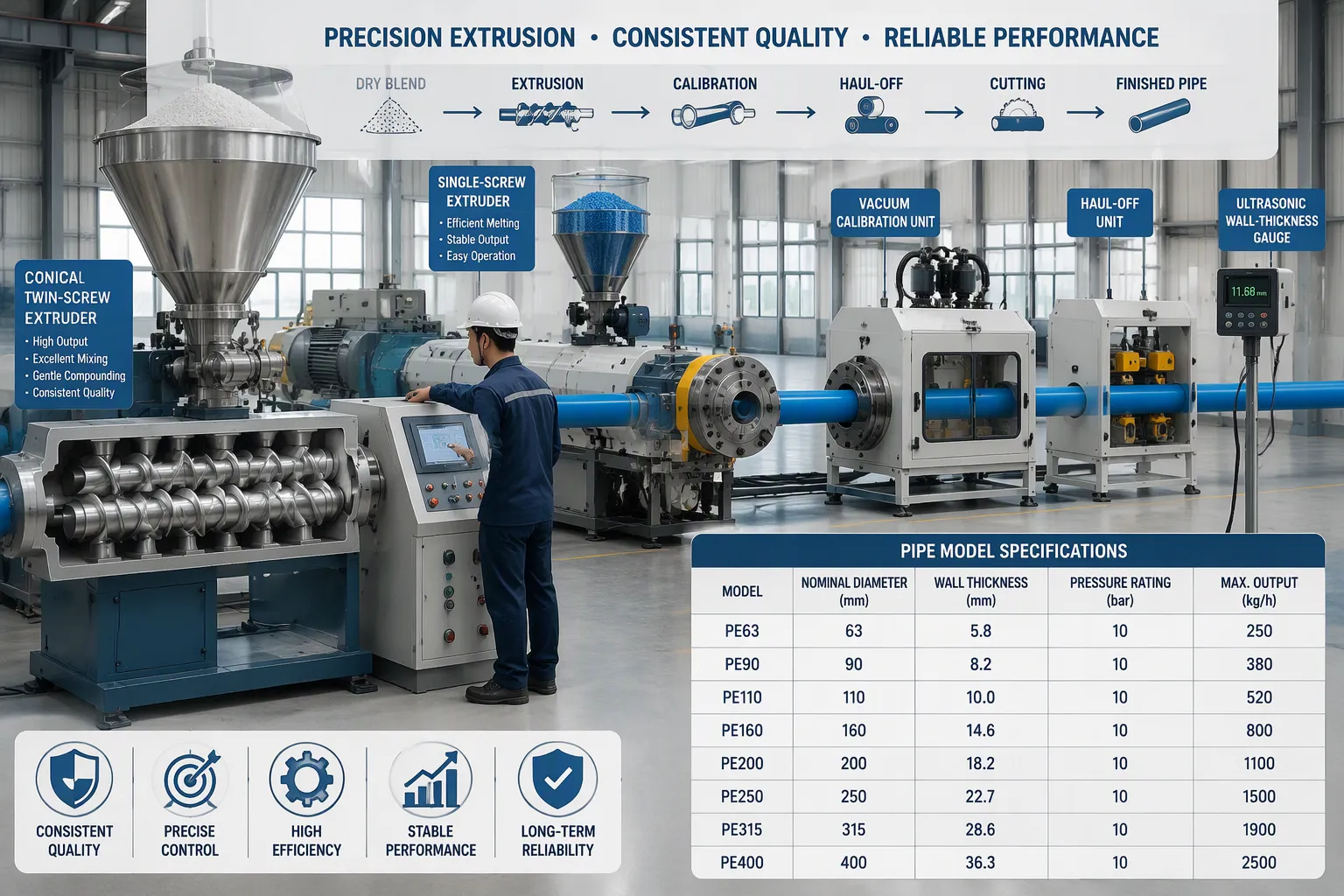
A complete plastic pipe extrusion line works as a chain of connected stations. The extruder heats the plastic and pushes it through the system. A hopper holds the raw plastic pellets or powder and feeds them into the barrel, where the screw moves and melts the material. The die then shapes the melted plastic into a round profile. Vacuum sizing and a cooling system set the form before the puller draws the pipe out at a steady speed. A cutter finishes the job by cutting the product into the lengths you want.
Component
Function
Extruder
Heats and pushes plastic through the system
Hopper
Holds and feeds raw plastic pellets or powder
Screw
Moves and melts plastic inside the barrel
Die
Shapes the melted plastic into the final product
Cooling System
Cools the shaped plastic to set its form
Puller
Pulls the product out of the die at a steady speed
Cutter
Cuts the product into desired lengths
Other machines help this core setup. Plastic mixers blend powder evenly, crushers and shredders recycle scrap, water chillers speed up cooling, and pipe belling machines get ends ready for field connections. A control unit adjusts machine settings across the whole plastic pipe extrusion line.
Where SJSZ And SJ Fit
Different kinds of extruders are used to make pipes, and twin screw extruders come in several designs. This guide looks at two common choices for pipe lines: the conical twin screw (SJSZ) and the single screw (SJ). Twin-screw designs also differ by rotation and barrel shape, which is why buyers compare co-rotating vs. counter-rotating and conical vs. parallel setups. Parallel twin-screw extruders, co-rotating twin-screw extruders, and counter-rotating twin-screw extruders each have their own designs. Intermeshing twin-screw extruders add one more choice.
Screw choice also depends on material, diameter range, wall thickness, output target, quality standard, and future production plans. A plastic pipe production line built for one polymer may not work for another without changes. The same idea applies to plastic extrusion and plastic pipe extrusion work: the feedstock and the product range narrow the field before you compare any models.
Conical Twin Screw (SJSZ) Capabilities
Design And Powder Feeding
Conical twin-screw extruders have two screws that fit together and taper from a big feed end to a smaller metering end. This shape gives positive conveying, so PVC dry-blend powder moves forward at a steady rate without slipping. The way the flights fit together also creates a self-wiping action. Material keeps clearing off the screw surfaces, and this stops hot spots and trapped spots where the plastic could break down. This matters for PVC because PVC starts to degrade and change color above about 200 °C. The big feed zone takes in powder easily, while low screw speed and spread-out shear limit heat damage. Many intermeshing twin-screw extruders use this same self-cleaning idea, and the twin-screw design keeps output steady over long runs.
Material choice is a key variable for PVC profiles and pipes. Standard screws use 38CrMoAlA steel with gas nitriding and hard chrome plating. Abrasive compounds need tungsten carbide overlay on the flight lands. Barrels use 42CrMo forged alloy steel with a nitrided bore, or a bimetallic liner for heavily filled compounds. Compression ratio also affects melting and pressure build-up, so buyers should check it against their filler loading.
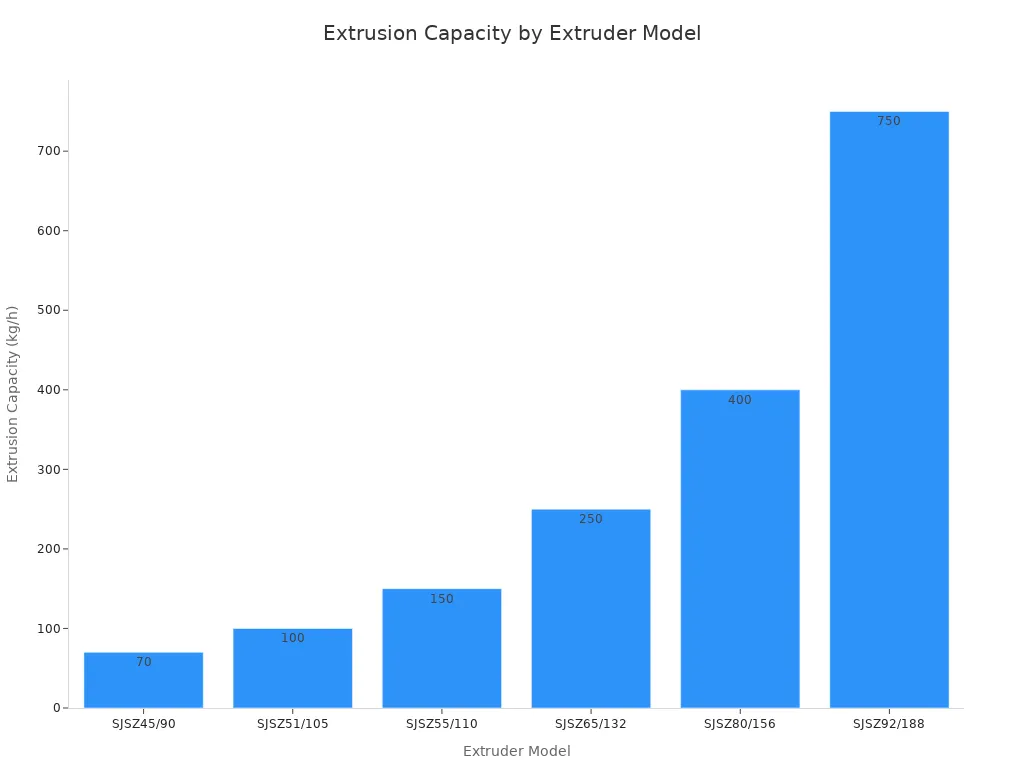
These numbers are typical ranges, not fixed facts for every case. Actual output depends on die design, wall thickness, and cooling capacity. A twin-screw extruder sized near the top of the range leaves room for future diameter changes. Buyers should check capacity against their own pipe dimensions before they finalize a twin-screw extrusion machine order. Twin screw extruders with bigger barrels also need matching haul-off and cooling lengths, so the whole line stays balanced. A twin-screw setup with a matched die and sizing tank protects wall thickness at the top of the output range.
Single-Screw Extruder Capabilities
Design And Pellet Melting
A single-screw extruder has one turning screw inside a heated barrel. This setup is simpler than a twin-screw design, and that simple build works well for pelletized plastics like PE, HDPE, PP, and PE-RT. Pellets go into the barrel and move through three zones. In the feed zone, pellets pack together and move forward. In the transition zone, the channel gets shallower, pressure goes up, and a melt film forms on the barrel wall. In the metering zone, the material comes out fully melted and mixed, with steady pressure that keeps output even.
Melting happens through both heat and motion. Shear heating in the compression zone is the main source of melt, while barrel heaters set the heat boundary and start the melt film. Screw shape controls the melt path: channel depth sets shear strength, compression ratio guides the change from solid to melt, and flight shape builds steady pressure. Barrier screws add a second flight that keeps solids apart from melt, which lowers the risk of unmelted bits and boosts throughput and heat stability. This design gives strong melt mixing for flexible and high-pressure pipe uses.
Specifications And Output
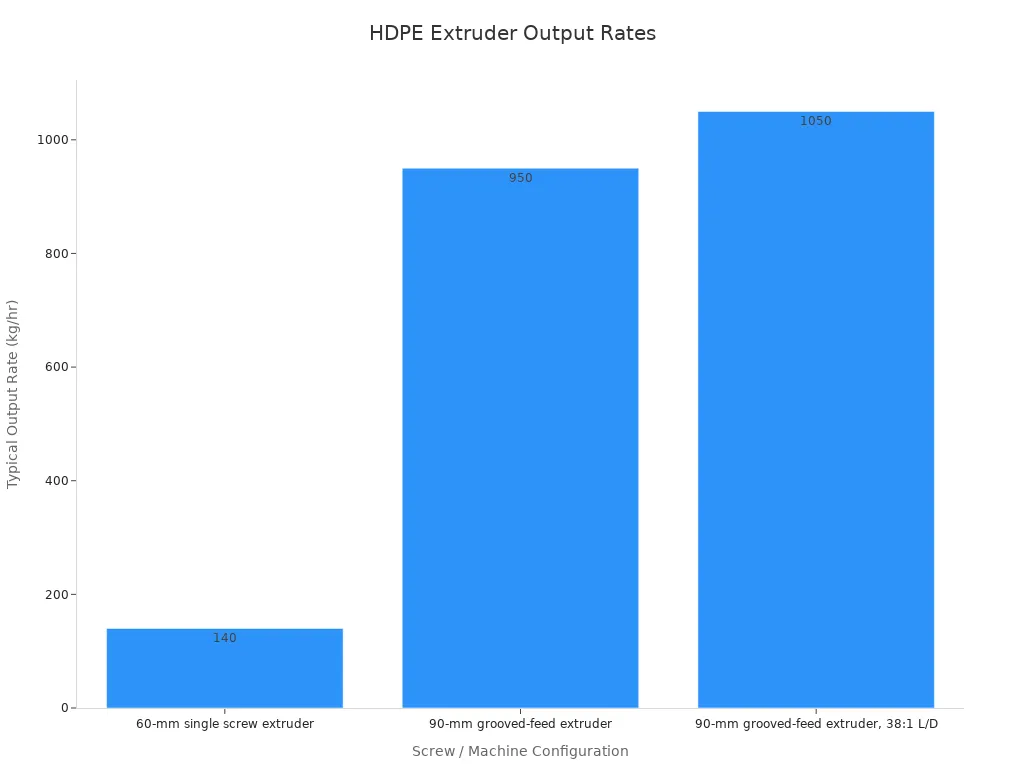
Typical single screw extruders for PE pipe cover a wide range. A common setup pairs a 20mm–800mm diameter range with 50–400 kg/h output and an L/D ratio of 30:1 or 33:1. A typical 65mm machine puts out a moderate 200–400 kg/h. Output grows with barrel size and screw length, as the HDPE numbers below show.
Screw / Machine Configuration
Material
Typical Output Rate
60-mm single screw extruder
HDPE pellets
~80–200 kg/hr
90-mm grooved-feed extruder
HDPE
~800–1,100 kg/hr
90-mm grooved-feed extruder, 38:1 L/D
HDPE
~1,000–1,100 kg/hr
These numbers are typical, not fixed. Longer L/D ratios give higher output and better melt mixing at faster screw speeds.
For lower-output PE pipe lines (50–200 kg/h), single screw extruders are usually the more economical choice.
Matching Your Plastic Pipe Production Line
Step 1 — Classify Feedstock
Feedstock form is the first filter, and it narrows the field quickly. The steps below walk through the classification in order.
Powder dry blend fed straight into the die points to the SJSZ range, the conical twin-screw design. The powder skips pelletizing, and the intermeshing screws move it along with steady pressure.
Pelletized or regranulated material points to an SJ extruder, the single-screw design. The same applies to a multi-material profile that runs several polymers on one line.
Polyolefin pipe such as HDPE or PPR falls into the GS-type screw extruder group.
A buyer who stops at step one already has a strong signal. The remaining steps confirm or adjust that first read.
Step 2 — Match Output And Dimensions
Output and dimensions turn the feedstock signal into a machine of the right size. Diameter control comes from a mix of die gap, haul-off speed, and vacuum calibration downstream. The die makes a slightly oversized tube, and the calibrator pulls it down to the exact diameter. Wall thickness is set by changing the haul-off speed: pulling faster thins the wall, and pulling slower thickens it. Most modern lines use an ultrasonic wall-thickness gauge at the calibration exit so operators can adjust in real time. Changing pipe size means swapping the mandrel and die ring for a different diameter.
A line for 20–63 mm PPR water pipes needs a different extrusion system from one making 315–630 mm HDPE pressure pipes, even with similar raw materials. Output, cooling, hauling, and cutting needs all differ. The table below shows how twin screw extruders map to pipe size and capacity.
Model
Suitable Pipe Diameter
Output Capacity
TSE-75-RP-S
60–160 mm
150–300 kg/hr
TSE-90-RP-S
90–250 mm
300–450 kg/hr
TSE-110-RP-S
160–400 mm
300–450 kg/hr
TSE-130-RP-S
400–630 mm
800–1000 kg/hr
Size capacity so production runs at about 80% of peak rating. Pushing the theoretical maximum causes wear and material degradation. Buyers should also confirm material type, minimum and maximum diameter, wall thickness, single-layer or multilayer structure, required capacity, main application, applicable standard, factory space, and local voltage and frequency. A quality standard and future production plans deserve a check before anyone finalizes the screw type. Each step narrows the fit rather than ranking the designs. That discipline is what separates the right plastic pipe extrusion line from one that merely runs.
Single-Screw Extruder Vs. Twin-Screw Extruder Use Cases
Where SJSZ Lines Excel
Conical twin-screw extruders serve rigid PVC work best. A PVC pipe extrusion line built around the SJSZ design takes PVC dry-blend powder straight from the mixer, so the powder skips pelletizing entirely. Municipal drainage pipe, electrical conduit, and building water supply pipe all fall in this group. The same architecture covers rigid PVC profiles and pipes, where steady powder conveying and self-cleaning flights protect the melt from hot spots. U-PVC and C-PVC water supply and drainage pipe make up the bulk of this demand. The powder route also cuts one process step, since no pelletizing line sits between the mixer and the extruder.
Model size tracks pipe diameter closely. An SJSZ-51 handles 16–40 mm electrical casing at roughly 180–250 kg/h of line capacity. The SJSZ-65 covers 50–110 mm, 63–160 mm, or 110–250 mm ranges depending on the die set. An SJSZ-80 reaches 200–400 mm, and the SJSZ-92 covers 315–630 mm. PVC threading pipe in 16–63 mm runs at 1–20 m/min, with speed varying by pipe size. Across the series, output spans about 135 kg/h to 1,400 kg/h, and total power runs from 38 kW to 255 kW. A single SJSZ-51 draws 18.5 kW, while an SJSZ-65/132 uses a 37 kW main drive. These figures are typical, so buyers should confirm them against their own die and cooling setup.
Where SJ Lines Excel
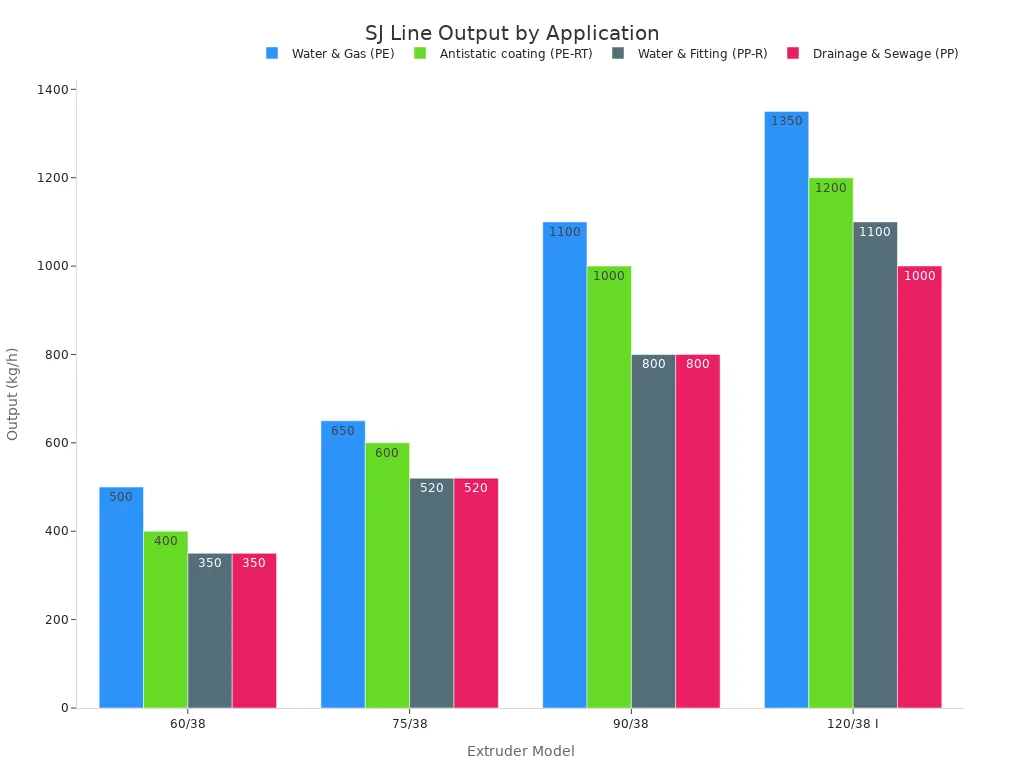
A single-screw extruder suits pelletized thermoplastics. An HDPE pipe extrusion line for agricultural irrigation, industrial gas transportation, or municipal water distribution pairs an SJ screw with a grooved-feed barrel. The PE-32 model covers 16–32 mm at 180 kg/h, the PE-110 covers 20–110 mm at 350 kg/h, and the PE-800 reaches 315–800 mm at 1,000 kg/h. A 90/38 extruder pushes 1,100 kg/h for water and gas PE pipe, and a 120/38 I reaches 1,350 kg/h. Two- or three-layer spiral molds add anti-flammable and anti-static pipe for mining work. Output climbs with barrel size, so a buyer can size the screw to the diameter range and the target rate at the same time.
PPR and PE-RT lines add co-extrusion and vacuum sizing for hot and cold water plumbing. A PPR pipe extrusion line with a single SJ 65/33 extruder makes 20–63 mm pipe at 100–120 kg/h, while a double-line SJ 60/38 setup lifts that to 250–350 kg/h. PE-RT machines run 16–32 mm at 80–100 kg/h in low-speed form and 180–220 kg/h in high-speed form. PP drainage and sewage pipe follows the same pattern, from 350 kg/h on a 60/38 up to 1,000 kg/h on a 120/38 I. These lines serve underfloor heating, central heating, potable water conveyance, and industrial chemical fluid transport. Vacuum sizing holds the outside diameter while the haul-off sets wall thickness, and co-extrusion adds a second layer where the application needs one.
The comparison between single-screw extruder vs. twin-screw extruder use cases comes down to feedstock and product family, not rank. A supplier with a broad material range covers PE, PC, PVC, PP, PP-R, PET, PE-RT, and PA, and customizes screw designs per polymer. That flexibility lets one plastic pipe production line supplier serve both architectures without pushing either one. Single screw extruders and twin screw extruders each keep their own place, and the twin-screw and single-screw routes both stay in the catalog.
Side-By-Side Comparison
Feedstock, Output, And Dimension Matrix
The table below puts both designs on the same set of criteria. It compares material form, mixing demand, cost tier, operation, product type, diameter range, wall thickness, and output target. All figures come from typical ranges, so buyers should use them as guides, not limits.
Criterion
Conical Twin-Screw (SJSZ)
Single-Screw (SJ)
Material form
PVC dry-blend powder
Pelletized thermoplastics (PE, HDPE, PP, PE-RT)
Mixing demand
High; intermeshing screws self-clean
Moderate; barrier screws separate solids from melt
Cost tier
Higher initial investment, complex gearbox
Lower initial purchase cost, simpler gearbox
Operation
Low screw speed, spread-out shear
Grooved feed, longer L/D for higher output
Product type
Rigid PVC drainage, conduit, water supply
Irrigation, gas transport, water mains, plumbing
Diameter range
About 16 mm to 630 mm
16 mm to 1,600 mm OD depending on die set
Wall thickness
Set by formulation and downstream sizing
Set by diameter and SDR combination
Output target
Roughly 120–800 kg/h by model
80 to over 1,500 kg/h by tier
The diameter bands break down further by size class. A 51/105 mm to 55/110 mm conical pair handles 16–110 mm work, a 65/132 mm to 68/143 mm pair handles 63–250 mm, and an 80/156 mm to 92/188 mm pair reaches 160–400+ mm. On the single-screw side, small-bore lines run 16–63 mm at 80–200 kg/hr, mid-range lines run 75–250 mm at 200–600 kg/hr, and large-diameter lines run 315–1,600 mm at 500 to over 1,500 kg/hr.
Reading The Table For Your Line
Wall thickness ties directly to output. A 315 mm SDR 11 pipe has a nominal wall near 28.6 mm and needs about 737 kg/hr at 0.5 m/min. A 110 mm SDR 17 pipe weighs only 2.0 kg/m and needs about 121 kg/hr at the same speed. So the SDR pairing sets the extruder scale you need before you compare any brands.
Sizing margin matters as much as peak rating. Run the twin-screw extruder at 70–85% of rated maximum output to leave room for material variation and wear. A 65/132 mm machine may handle 315 mm thin-wall pipe but struggle with heavy-wall pressure pipe at that same diameter. Above roughly 400 mm, parallel twin screw extruders or large single-screw machines increasingly take over for higher throughput. Each column in the matrix fits a different job, and the pipe extrusion line that matches feedstock, output, and dimensions together will run stable.
Practical Selection Rules
Quick Rules Of Thumb
The form of the feedstock settles most decisions before you compare any models. The table below sums up the common pairings.
Feedstock
Recommended extruder
Rule of thumb
Uniform, free-flowing pellets
Single screw
Drag flow moves pellets well, so the twin screw's extra mixing power is not needed
PVC dry blend for rigid pipe
Counter-rotating twin screw (conical or parallel)
Powder needs steady pushing, and a tighter spread of time in the barrel lowers heat damage
Simple PE/PP pipe from pellets
Single screw
Steady drag flow gives even melt pressure at a lower cost
A buyer can back up that first read with two checks. First, compare the target output with the model's usual capacity range. Second, match pipe diameter and wall thickness to the die and sizing setup. Both checks are part of the same pipe extrusion line plan, and neither one beats the feedstock signal.
Grooved feeds still cannot match twin screw flexibility for uneven feedstocks. Smooth-feed single screw extruders usually work better when a plant runs many polymers, uses low-bulk-density regrind, or changes regrind particle size and percentage. For high-melting-point or high-crystallinity materials such as nylon, PET, or polycarbonate, grooved feeds must be heated to stop dangerous pressure buildup, which partly cancels their conveying edge.
Customization And Support Checklist
A standard catalog model seldom fits every job. Buyers should make sure the supplier adapts the screw design, die head, and control system to the polymer and product range. Automatic computer digital control belongs on the list too, because it keeps wall thickness and output steady over long runs. The turnkey scope deserves a check as well: mixers, crushers, chillers, and belling machines should come from the same source, so the plastic pipe production line runs as one system.
Support is what separates a workable plastic pipe extrusion line from a risky purchase. Look for an R&D team with patent-backed customization, factory layout planning, operator training, and round-the-clock after-sales service. These items protect uptime long after the twin-screw or single-screw machine arrives. A supplier who covers plastic extrusion from layout to training keeps the pipe extrusion line productive for years.
The decision rule stays simple. PVC dry-blend powder points to a conical twin-screw extruder (SJSZ). Pelletized thermoplastics point to a single screw (SJ). Output and dimension checks confirm the choice.
Three factors work as one system, not in isolation:
Feedstock form sets the starting direction.
Output target in kg/h sizes the model.
Pipe diameter and wall thickness fix the downstream scope.
A buyer who weighs all three avoids a mismatch between screw and line. Twin screw extruders and single screw machines each fit their own feedstock and product family.
The practical next step is a line-specific recommendation. Share the feedstock, target output, and pipe dimensions with the supplier. That data lets the supplier match the screw to the pipe extrusion line.
FAQ
Which screw type suits PVC dry-blend powder?
A conical twin-screw extruder (SJSZ) fits PVC dry-blend powder. The intermeshing screws give positive conveying and self-cleaning action. This design moves powder forward at a steady rate and limits heat damage. A buyer running rigid PVC drainage, conduit, or water supply pipe should start with this option.
When should a buyer choose a single-screw extruder?
A single-screw extruder (SJ) fits pelletized thermoplastics such as PE, HDPE, PP, and PE-RT. The simpler geometry melts pellets with steady drag flow. These machines serve irrigation, gas transport, water mains, and hot and cold water plumbing. A buyer working from pellets should start here.
How does output target affect the model choice?
Output target in kg/h sizes the model. A small line may need only 80–200 kg/h, while a large line can exceed 1,500 kg/h. Buyers should run the machine at about 80% of peak rating. This margin leaves room for material variation and wear.
Do pipe diameter and wall thickness change the screw decision?
Diameter and wall thickness shape the downstream scope more than the screw itself. A 315 mm SDR 11 pipe needs a heavier setup than a 110 mm SDR 17 pipe. Buyers should confirm die, sizing, and haul-off together with the screw choice.
Can one supplier cover both screw types?
Yes. A broad supplier covers PE, PC, PVC, PP, PP-R, PET, PE-RT, and PA, and customizes screw designs per polymer. That range lets one source serve both twin screw extruders and single-screw machines. Buyers should confirm the pipe extrusion line scope, training, and after-sales support before ordering.
Qingdao Zhongrui Plastic Machinery Co., Ltd. is located in Jiaozhou City, Qingdao City, Shandong Province. It is 30 kilometers away from Qingdao Port and only 20 kilometers away from the airport.



 +86-18561886575 (Mr.Wu)

 +8618561886575
 238 Yangzhou West Road, Jiaozhou City, Qingdao City, Shandong Province