Zhongrui's High-capacity PP Packaging Belt Production Line is engineered for efficiency and high output. This innovative machine produces durable, flexible, and cost-effective PP straps, replacing traditional steel straps across various industries. Ideal for manufacturers seeking quality and sustainability.
According to many years of plastic machinery development and design experience, in the introduction of foreign advanced technology and digestion and absorption, on the basis of self-developed PE pipe production line. Has the unique structure, the design is novel, the equipment entire line layout is reasonable, the control performance is strong and so on.
The PE/PPR Pipe Production Line delivers reliable and efficient manufacturing of various pipes for water supply and drainage in agriculture and construction. Experience advanced technology and precision for high-quality production.
Discover the Highly Cost Effective PVC Pipe Production Line from Zhongrui. Engineered for durability and efficiency, this advanced production line ensures high-quality PVC pipes suitable for a variety of applications. Experience seamless operation, reduced maintenance, and significant cost savings.
The Composite Infiltration Irrigation Pipe Production Line is a high-efficiency system designed to produce drip irrigation tape for agricultural applications. With precision control, energy-saving technology, and advanced automation, it ensures superior performance in greenhouse, field crop, and water conservation irrigation systems.
Discover the PVC Hose Production Line designed for efficient, high-speed manufacturing of PVC hoses. Our advanced system ensures precision, versatility, and durability, making it an ideal choice for various industrial applications.
The PVC Imitation Marble Sheet Slab Extruder Machine Production Line is designed for producing high-quality, durable, and visually appealing marble-like PVC sheets. Offering fire resistance, water resistance, and high-temperature durability, it’s ideal for a variety of interior decoration applications. This advanced extrusion line guarantees high efficiency and stable output, making it a top choice for businesses looking to scale up production.
Zhongrui's PMMA Board Production Line is designed for precision, high-output plastic sheet manufacturing. With advanced technology including a vertical three-roll calender, Siemens motor, and ABB inverter, it ensures high plasticizing ability and energy-efficient performance. Ideal for producing PMMA, PC, and ABS sheets for construction, packaging, and automotive industries.
0
0
PVC Pipe Production Line Pressure Pipe Standards Explained
Views: 0 Author: Site Editor Publish Time: 2026-10-20 Origin: Site
A PVC pressure rating is the most force a pipe can safely handle at normal temperatures. This number matters for safety and performance. A pipe rated below the real working pressure can leak or burst. Repairs cost time and money.
Readers can learn to read a rating and match it to the application.
Key Takeaways
A PVC pressure rating shows the highest pressure inside a pipe that it can handle safely at 73°F.
Change psi to bar easily: divide psi by 14.5 to get bar. Or multiply bar by 14.5 to get psi.
Hot water lowers a pipe's pressure capacity, so always check derating charts for hot water.
Schedule 80 pipes have thicker walls and can handle higher pressure than Schedule 40 pipes of the same size.
Pick the right pipe for the job by matching its rating to the use and checking industry standards.
PVC Pipe Pressure Ratings Explained
Why Ratings Matter
To understand pvc pipe pressure ratings, start with a clear definition. A pvc pressure rating is the force a pipe can safely hold up to in testing at normal temperatures, and it is often given in psi. Manufacturers write down this value as a standard number. The pvc pressure rating tells installers how much internal load a pipe can take without failing, whether it is shown in psi or bar. A pvc pressure rating is based on water at 73°F. Hotter temperatures lower the capacity, so the same pipe carries less load in hot service.
Temperature (°F)
Derating Factor (relative to 73°F rating)
73
1.00 (full pressure rating)
110
~0.50
120–140
~0.40 down to ~0.20
140
~0.20 (retains only ~20–22% of room-temperature rating)
Picking the right pipe protects the system. A study by the Utah State University Buried Structures Laboratory looked at 188 utilities across the United States and Canada. The study found that this pipe has the lowest overall failure rate compared to cast iron, ductile iron, concrete, steel, and asbestos cement pipes. This record supports careful rating selection for pvc and cpvc pipe.
How Ratings Are Tested
Testing follows a set order. First, the long-term rating of fittings comes from extending a regression line drawn from fitting failure data over time. Second, failure data come from testing water-filled pipe-and-fitting assemblies per Test Method D1598, using water at 73°F, with assemblies placed in water or air. Third, the extrapolation gives the long-term hydrostatic pressure rating, and the pressure design basis (PDB) is set from the long-term hydrostatic pressure-strength at 100,000 h and at 50 years, checked per Section 6.3. Fourth, the fitting pressure rating is found by multiplying the PDB by the right design factor (DF).
Data must come close to a straight line on log-log coordinates. High scatter or a downward curve gives conservative extrapolated values. Data that fail lower confidence limits are classed as unsuitable. The method is like Test Method D2837, which has been used for about 30 years to set the hydrostatic design stress (HDS) of plastic pipe materials and is the basis for all pressure ratings given to plastic pipes. These pvc pressure rating numbers appear in psi and bar on the pipe. A higher psi number means a stronger pipe. Engineers compare psi values across pipe sizes.
Reading PSI, Bar, Class, and Schedule
PSI and Bar Basics
PSI and bar both measure pressure directly. One bar equals about 14.5038 psi. A reader converts psi to bar by dividing the psi value by 14.5038. The reverse conversion multiplies bar by 14.5038. These two units appear on labels, datasheets, and test reports, so fluency in both prevents costly misreads.
From
To Bar
To PSI
1 Bar
1
14.50
1 PSI
0.0689
1
A pvc bar pressure rating and a psi pressure rating describe the same capacity in different units. A pipe marked 10 bar carries roughly 145 psi. Installers who confuse the two units risk under-sizing a line. The conversion is simple arithmetic, and it removes guesswork from pvc pressure ratings and classes.
Class vs Schedule Systems
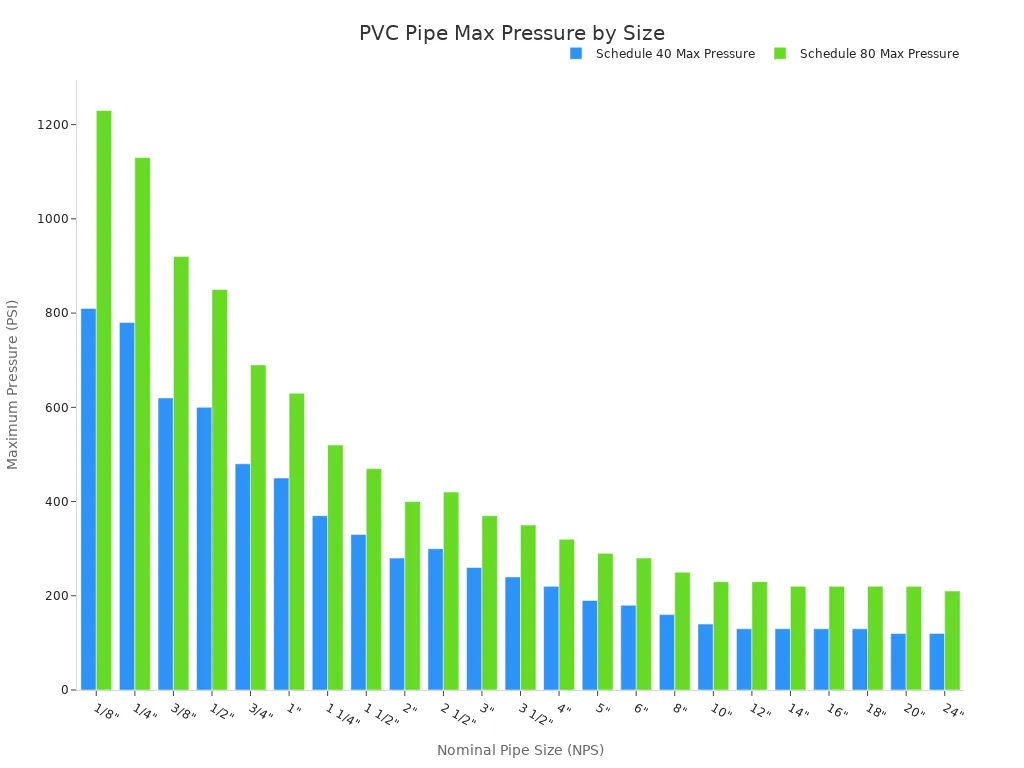
Schedule systems tie wall thickness to a nominal size. The schedule 40 pvc pressure rating and the schedule 80 pvc pressure rating differ because SCH 80 carries thicker walls. Maximum pressure also falls as nominal pipe size grows. A 1/2" SCH 40 pipe holds 600 psi, while a 4" SCH 40 pipe holds 220 psi. The schedule 80 pvc psi rating at 1/2" reaches 850 psi, and the 4" size drops to 320 psi. The chart below shows the full spread.
These pvc psi ratings vary by diameter, so buyers must check the size-specific value. ASTM standards govern both pressure and non-pressure applications. ASTM D1785 covers schedule pipe, and its ratings shift with diameter. AWWA C900 takes a different path for water mains. It uses a Pressure Class method with a 2.5 safety factor and a surge allowance. That method yields a size-independent capacity, expressed through dimension ratio (DR). A lower DR means a thicker wall and a higher pvc pressure rating. The DR system lets engineers pick a pressure pipe for a main without recalculating per diameter. Each system fits a different job, and each one rewards careful reading of the label.
Factors Affecting PVC Pressure Rating
Temperature and Wall Thickness
Heat changes how much a pipe can hold. PVC strength depends on time and temperature. As the operating temperature goes up, the material's allowable stress goes down. Then a lower internal load must serve the same design life. This is why engineers do not trust one fixed number. They read pressure-temperature derating charts from manufacturers or industry handbooks. These charts guide pipe size, schedule, and layout choices. A system must meet its pressure rating and its temperature rating together across real operating conditions.
Wall thickness and diameter work together to set hoop stress under internal load. A thicker wall lowers hoop stress and supports a higher pvc pressure rating. A larger diameter raises hoop stress at the same load. This is why a lower dimension ratio, which means a thicker wall, lifts capacity. Schedule 80 has a thicker wall than Schedule 40 and earns a higher rating. A lower SDR or DR number follows the same rule. Thicker walls also add margin against impact and external loads.
Diameter and Production Line Quality
For a fixed class and material, capacity falls as diameter grows. Internal load acts over a larger circumference, so small pipe holds more. A 1/2-inch Schedule 40 pipe is rated at 600 psi at 73°F. A 4-inch Schedule 40 pipe drops to 220 psi. Thinner walls lower the pvc psi rating further, because the reduced wall raises the stress the pipe feels.
A good pvc pipe production line protects the stated number. Gravimetric blending holds feed rate to about ±1% of target, so wall thickness stays tight. A conical twin-screw extruder delivers a homogeneous, well-mixed melt at stable pressure. Vacuum calibration fixes outer diameter and roundness, and spray cooling locks dimensions in. Servo haul-off speed sets final wall thickness, and inline ultrasonic gauges and laser scanners catch drift early. Every stage of the pvc pipe manufacturing process therefore shapes the final rating. Buyers who study the factors affect pvc pressure ratings can compare lines on real dimensional control, not just a label. Ratings in psi and bar only hold when the pvc pipe production line holds tolerance.
Selecting the Right PVC PSI Rating
Matching Rating to Application
The right pvc psi rating depends on the job. City water mains need a high pvc pressure rating to handle steady flow and pump cycling. AWWA C900 covers this use, and its dimension ratio system sets capacity by wall thickness. Drain lines carry little internal load, so a lower rating works fine. Irrigation systems face sudden pressure changes from water hammer when valves close fast. Class 200 PVC offers good flexibility for home irrigation, while Class 315 gives higher ratings for commercial systems. Electrical conduit protects cables and needs no pressure capacity at all. Industrial uses vary widely, and each one needs a close look at chemical exposure and operating temperature.
Temperature changes everything. Standard PVC works well up to 140°F. For hot water, CPVC handles up to 200°F without warping or weakening like regular PVC. A properly rated pipe must handle normal operating pressure plus occasional surges from pump starts or quick-closing valves. Engineers check pressure-temperature charts to make sure that maximum pressure plus surges never go above the derated working pressure at the highest expected fluid temperature. A Class 200 PVC pipe at 100°F may be rated only about 160 psi. Wrong pressure selection often causes failures that look like material defects but really come from design errors. Home systems usually run 40–80 psi, so SCH 40 suits standard cold water and SCH 80 suits higher pressures. Surge resistance differs by material: PVC shows moderate surge resistance, while HDPE shows high surge resistance. PVC also derates more severely at high temperature. For projects with frequent pump cycling, HDPE is often preferred because of its ductility. PVC can offer higher ratings in cooler, static conditions.
Compliance and Long-Term Cost
Compliance checks protect the buyer. ASTM D1785 covers PVC plastic pipe in Schedules 40, 80, and 120. ASTM D2241 covers SDR-PR pipe. AWWA C900 governs PVC pressure pipe for water, and C900-22 extends coverage to 60-inch sizes. Pipe must be made from PVC compound with cell classification 12454 per ASTM D1784. Gasket joints must meet ASTM D3139, and the elastomeric gasket must conform to ASTM F477. A buyer who confirms these standards avoids a pvc psi rating that looks good on paper but fails in service.
Cost deserves a lifecycle view. PVC wins on upfront material cost, often about twice cheaper per foot than HDPE. A 4-inch pipe runs $2.00–$3.50 per foot in PVC versus $4.50–$7.00 in HDPE. An 8-inch pipe runs $6.00–$9.00 versus $14.00–$20.00. Over 50 years, though, PVC's higher repair and water-loss costs nearly erase that advantage. A 12-inch, 10 km project shows PVC at roughly $2,430,000 total lifecycle cost and HDPE at roughly $2,525,000. In harsher conditions, HDPE's total cost becomes lower. PVC pipe lifespan is estimated at around 100 years, driven by chemical stability and corrosion resistance. Iron and concrete pipes degrade internally almost immediately after installation. Ductile iron can last as little as 11–14 years in moderately corrosive soils. It takes up to 54% more energy to pump water through ductile iron and 100% more through HDPE than through PVC.
A high-quality pvc pipe production line supports high-pressure applications and long service life. Gravimetric blending, conical twin-screw extrusion, and inline ultrasonic gauges keep wall thickness within tolerance. That precision protects every pvc psi rating printed on the pipe. Buyers who weigh compliance, temperature, surge, and lifecycle cost make a sound choice. Each material fits a different job, and each one rewards careful reading of the label.
Pressure ratings are a safety and performance tool, not just a label on a pipe. Readers should first figure out which rating system is being used, whether psi, bar, class, or schedule. Next, they must think about temperature and pipe dimensions, since both change the real capacity of pvc pipe. Finally, they should match the pipe to the job, from water mains to drainage and conduit.
Careful selection protects every installation. A pvc pipe with a checked rating works reliably under high pressure. Good manufacturing keeps wall thickness within tolerance, and that precision supports the psi value printed on each length. Buyers who read the label and confirm the psi figure get dependable service.
FAQ
What does a pressure rating on PVC pipe actually mean?
A rating states the internal load a pipe can safely hold at 73°F, tested with water. Manufacturers print this value as a standard number. Installers use it to size lines and avoid bursts. Heat lowers the real capacity, so the printed figure only holds at normal temperatures.
How do I convert psi to bar?
One bar equals about 14.5038 psi. Divide a psi value by 14.5038 to get bar. Multiply a bar value by 14.5038 to get psi back. This arithmetic removes guesswork when a datasheet mixes units.
Why does a larger diameter pipe carry a lower psi rating?
Internal load acts over a larger circumference as diameter grows. Hoop stress rises at the same load. A 1/2-inch Schedule 40 pipe holds 600 psi, while a 4-inch pipe holds 220 psi. Buyers must check the size-specific value, not the class alone.
Do Schedule 40 and Schedule 80 PVC pipes share the same rating?
No. Schedule 80 carries thicker walls than Schedule 40, so it earns a higher value. At 1/2 inch, SCH 40 holds 600 psi and SCH 80 holds 850 psi. At 4 inches, the gap narrows to 220 psi versus 320 psi.
Which standards should a buyer confirm before purchase?
ASTM D1785 covers Schedule 40, 80, and 120 pipe. ASTM D2241 covers SDR-PR pipe. AWWA C900 governs PVC pressure pipe for water mains and uses dimension ratio to set capacity. A buyer who confirms these standards avoids a rating that fails in service.
Qingdao Zhongrui Plastic Machinery Co., Ltd. is located in Jiaozhou City, Qingdao City, Shandong Province. It is 30 kilometers away from Qingdao Port and only 20 kilometers away from the airport.



 +86-18561886575 (Mr.Wu)

 +8618561886575
 238 Yangzhou West Road, Jiaozhou City, Qingdao City, Shandong Province