Zhongrui's High-capacity PP Packaging Belt Production Line is engineered for efficiency and high output. This innovative machine produces durable, flexible, and cost-effective PP straps, replacing traditional steel straps across various industries. Ideal for manufacturers seeking quality and sustainability.
According to many years of plastic machinery development and design experience, in the introduction of foreign advanced technology and digestion and absorption, on the basis of self-developed PE pipe production line. Has the unique structure, the design is novel, the equipment entire line layout is reasonable, the control performance is strong and so on.
The PE/PPR Pipe Production Line delivers reliable and efficient manufacturing of various pipes for water supply and drainage in agriculture and construction. Experience advanced technology and precision for high-quality production.
Discover the Highly Cost Effective PVC Pipe Production Line from Zhongrui. Engineered for durability and efficiency, this advanced production line ensures high-quality PVC pipes suitable for a variety of applications. Experience seamless operation, reduced maintenance, and significant cost savings.
The Composite Infiltration Irrigation Pipe Production Line is a high-efficiency system designed to produce drip irrigation tape for agricultural applications. With precision control, energy-saving technology, and advanced automation, it ensures superior performance in greenhouse, field crop, and water conservation irrigation systems.
Discover the PVC Hose Production Line designed for efficient, high-speed manufacturing of PVC hoses. Our advanced system ensures precision, versatility, and durability, making it an ideal choice for various industrial applications.
The PVC Imitation Marble Sheet Slab Extruder Machine Production Line is designed for producing high-quality, durable, and visually appealing marble-like PVC sheets. Offering fire resistance, water resistance, and high-temperature durability, it’s ideal for a variety of interior decoration applications. This advanced extrusion line guarantees high efficiency and stable output, making it a top choice for businesses looking to scale up production.
Zhongrui's PMMA Board Production Line is designed for precision, high-output plastic sheet manufacturing. With advanced technology including a vertical three-roll calender, Siemens motor, and ABB inverter, it ensures high plasticizing ability and energy-efficient performance. Ideal for producing PMMA, PC, and ABS sheets for construction, packaging, and automotive industries.
0
0
Schedule 40 vs Schedule 80 PVC Pipe: Key Differences Explained
Views: 0 Author: Site Editor Publish Time: 2026-11-03 Origin: Site
The main difference between schedule 40 vs schedule 80 pvc pipe is the wall thickness. Schedule 40 has thinner walls and lower pressure ratings. Schedule 80 has thicker walls and higher pressure ratings.
Both schedules have the same outside diameter for a given nominal size. So the choice depends on your pressure needs, flow requirements, cost, and application. A line that stays well within its rated limits may work with schedule 40, while a tough or exposed installation may need schedule 80.
This post gives a direct, side-by-side comparison. You will see how wall thickness, ratings, sizing, color, and price differ, so you can choose schedule 40 or schedule 80 with confidence. Makers of pvc pipe use equipment such as a Plastic Pipe Production Line or PVC Pipe Production Line to form each schedule to spec.
Key Takeaways
Schedule 80 PVC pipes have thicker walls than Schedule 40 pipes. The thicker walls make Schedule 80 stronger and able to handle higher pressure.
Schedule 80 pipes have a higher pressure rating than Schedule 40 pipes of the same size. For example, a 1-inch Schedule 80 pipe can handle 630 PSI, while Schedule 40 can handle 450 PSI.
Both schedules have the same outside diameter, so they fit the same fittings. But Schedule 80 has a smaller inside diameter, and that can slow down water flow a little.
Schedule 40 PVC is usually white and costs less. It works well for home plumbing, drainage, and irrigation. Schedule 80 PVC is often gray and costs more. It suits industrial, chemical, and high-pressure jobs.
Always check the print stamp on the pipe to confirm its schedule. Color is only a hint. Match fittings to the pipe schedule to keep the whole system safe.
Comparing Schedule 40 and Schedule 80 Wall Thickness
A quick look at 1/2-inch pipe shows the gap in numbers. Merit Brass lists a schedule 40 wall thickness of 0.109 inches and a schedule 80 wall thickness of 0.147 inches. That makes schedule 80 PVC pipe about 34.9% thicker at this size. The table below puts the two side by side.
Nominal Size
Schedule 40 Wall
Schedule 80 Wall
1/2"
0.109 in
0.147 in
Strength in Practice
Wall thickness is the only real difference between the two schedules. Everything else follows from it. A thicker wall adds material, and that extra material raises the pressure a pvc pipe can hold. Lesso America explains that schedule 80 PVC has a thicker wall, which increases its strength and allows it to handle higher-pressure applications. Schedule 40 PVC has a thinner wall, so it suits lower-pressure systems.
This single variable drives every other choice you make. When comparing schedule 40 and schedule 80, you are really comparing the thickness of its walls. The outside diameter stays the same, so the pipe still fits the same trench or hanger. The inside diameter shrinks as the wall grows, and the price rises with the added material. Keep this chain in mind. Once you know the wall thickness you need, the rest of the decision becomes simple.
Pressure Ratings of Schedule 40 and Schedule 80 PVC
Comparing Pressure Ratings
The wall thickness gap shows up directly in the numbers. For 1/2-inch pipe, Bastone Plastics lists a schedule 40 PVC rating of 600 PSI and a schedule 80 PVC rating of 850 PSI. That makes schedule 80 roughly 41.7% higher at this size. The table below shows how both schedules perform across common sizes.
Pipe Size
Schedule 40 PSI
Schedule 80 PSI
1/2"
600
850
3/4"
480
690
1"
450
630
1-1/2"
330
470
2"
280
400
3"
260
370
4"
220
320
These figures are not fixed for every job. PVC Fittings Direct notes that ratings assume an optimal temperature of 73 degrees Fahrenheit. As the temperature rises, the pressure a pvc pipe can hold drops. At 110 degrees, a 6-inch schedule 40 pipe falls from 180 PSI to about 91 PSI. Always check the manufacturer chart for your size and operating conditions before you rely on any pressure ratings for pipe sizes.
How Thicker Walls Affect Flow
A thicker wall grows inward, not outward. PVC Pipe Supplies explains that schedule 80 adds material to the inside wall only, so the outside diameter stays the same. The inside diameter shrinks, and that smaller opening slightly restricts fluid flow.
This trade-off matters when you size a line near its limit. A schedule 40 pipe of the same nominal size carries a bit more volume. A schedule 80 pipe carries less but holds more pressure. Match the pipe to the job: favor flow on low-pressure lines, and favor strength on high-pressure ones. Check dimensions and pressure ratings together, and confirm the water pressure rating against your system's peak demand.
Schedule 40 vs Schedule 80 Pipes and Fittings Sizing
Same OD, Different ID
Both schedules share one fixed measurement. For any nominal size, the outside diameter stays the same. PVC Fittings Online confirms that schedule 40 and schedule 80 PVC pipes have the exact same outside diameter. That shared OD lets both schedules use the same fittings.
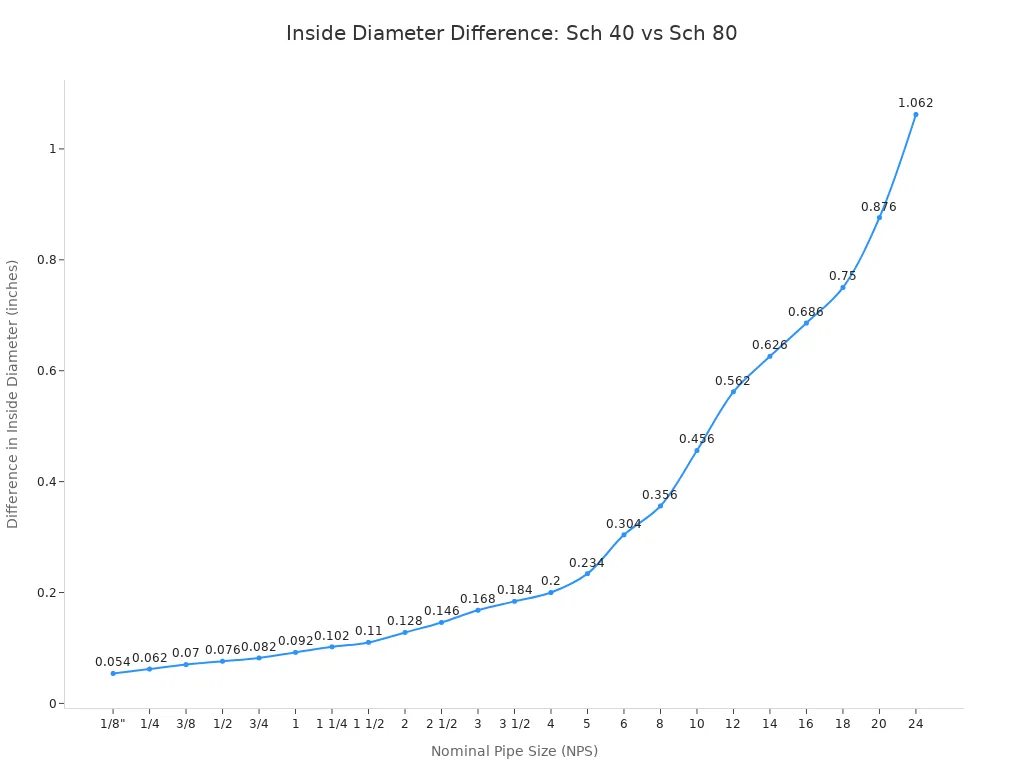
The inside diameter tells a different story. A thicker wall grows inward, so the opening shrinks. The table below, drawn from PVC Pipe Supplies, shows how the gap widens as pipe size grows.
Nominal Size
Outside Diameter
Schedule 40 Wall
Schedule 80 Wall
1/2"
0.840 in
0.109 in
0.147 in
2"
2.375 in
0.154 in
0.218 in
4"
4.500 in
0.237 in
0.337 in
PVC Pipe Supplies also charts this inside diameter gap across the full size range. The chart makes one point clear: schedule 40 pvc pipe dimensions and schedule 80 pvc pipe dimensions diverge only on the inside.
Fittings and Joining
Fittings use the same nominal sizing system, so socket and threaded parts connect across schedules. Pressure handling is the catch. Maxx Supply warns that a system is only as strong as its weakest part. A schedule 40 fitting on schedule 80 pipe can pull the whole assembly down to the lower rating.
Keep these points in mind when you compare schedule 40 vs schedule 80 pipes and fittings:
Match fittings to the pipe schedule so pressure handling stays correct.
Never mix schedules in one pressure line without code and manufacturer approval.
Check pressure, temperature, and media compatibility across the full assembly.
Joining methods stay the same for both. Hipco notes that solvent cementing, described in ASTM D-2855, is the most widely used method for schedule 40 pvc and schedule 80 PVC. Threading suits schedule 80, but threaded joints must be derated by 50% from solvent-cemented systems. Whatever the method, apply cement to both surfaces and follow the maker's cure times.
Identifying Schedule 80 PVC by Color
Why Schedule 80 Is Usually Gray
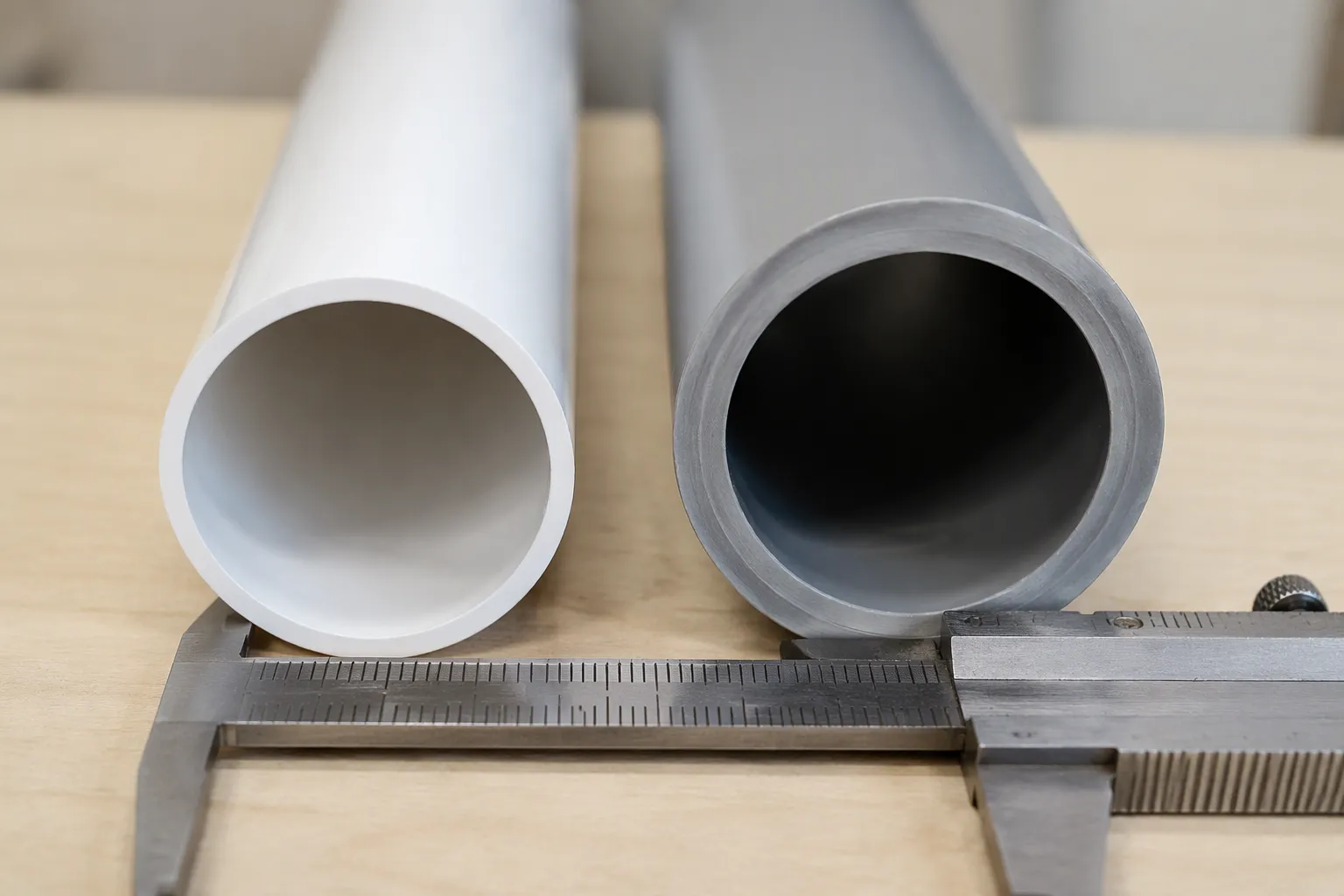
Color gives you a fast first clue. Schedule 80 PVC pipe commonly comes in gray, while schedule 40 PVC is typically white. Product listings back this up. PVC Fittings Online titles its category page "Schedule 80 PVC Pipe (Gray)," and US Plastic sells gray schedule 80 PVC pipe in sizes from 3/8 inch up to 8 inches. 247garden also lists its 1/2-inch schedule 80 PVC pipes as "Gray Color for High Pressure Piping System."
Treat color as a hint, not proof. Manufacturers can produce pipe in other colors, and sunlight, dirt, or paint can change how a pipe looks. A gray pipe in your hand is probably schedule 80, but you should confirm before you cut or join it.
Reading Print Stamps
The print stamp on the pipe is the reliable identifier. Most PVC pipe carries size information printed directly on it. Bastone Plastics explains that you look for numbers like "1/2," "3/4," "1," "1-1/2," or "2" followed by letters like "SCH 40" or "SCH 80." The number before "SCH" is your pipe size, and the schedule number tells you the wall class.
A full stamp often carries more than the schedule. Maxx Supply notes that manufacturers print the standard specification designation, which may include ASTM D1785 or D3034, along with the nominal size, schedule or SDR, pressure rating, and material designation. You may also see the maker's name or trademark, a production code, an application code such as DWV, and certification logos for potable water or sewer use.
Check these marks before installation:
The schedule number, such as SCH 40 or SCH 80
The nominal size, such as 1/2 or 2
The pressure rating and standard, such as ASTM D1785
If the stamp is faded, measure the wall thickness and compare it to a published chart. That step settles the question when the print is gone.
Cost Considerations
Price per Foot and Fittings
Thicker walls use more material, so you pay more for each foot. A price comparison on Mike Holt's electrical forum shows the gap for 4-inch PVC conduit. Schedule 80 cost $2.65 per foot, while schedule 40 cost $1.77 per foot. That is a difference of $0.88 per foot at that size.
Product
Schedule
Price per foot
4" PVC conduit
Schedule 80
$2.65/ft
4" PVC conduit
Schedule 40
$1.77/ft
Difference
—
$0.88/ft
Fittings cost more in the same way. Schedule 80 fittings have more plastic, so they usually cost more than schedule 40 fittings. On a long run with many elbows and tees, those small gaps add up fast. Price the pipe and the fittings together before you pick a schedule.
Long-Term Value Factors
A higher upfront price does not always mean a worse deal. Western Ag Pipe notes that schedule 80 PVC costs more because it has extra material. Even so, the added cost may pay off when your project needs higher durability and pressure resistance. Lesso America makes a similar case. Schedule 80 PVC lasts longer, so you replace and repair it less often, which lowers maintenance costs over time. It also resists harsh chemicals and environmental factors, which cuts the risk of corrosion and breakdown.
Supply On Time lists the situations that justify the higher price. These include truly high working pressure, such as pump discharge, filtration loops, and commercial equipment skids. They also include physical exposure, such as a riser standing tall in a yard or a run across a parking structure. Chemical or industrial service is a third case, where the thicker wall gives extra margin against attack from the inside. Pool and spa pads are a common example, since many pump and filter makers specify gray pipe there.
Weigh the price of schedule 40 pipe against these risks. A low-pressure line that stays protected rarely needs the upgrade. A tough, exposed, or high-pressure line often earns back the difference.
Application Suitability
Both schedules work well for real projects. The right PVC pipe depends on where the line runs and how hard it works. Read each case below and match it to your own layout.
Where Schedule 40 Fits Best
Schedule 40 PVC is the white pipe you see around buildings. It works for drainage, irrigation, and other cold water systems, according to PVC Fittings Online. Lesso America notes that this pipe serves residential and commercial plumbing, drainage systems, and lower-pressure water supply lines. It gives enough strength for many jobs, but it is not made for high-pressure environments.
Maxx Supply lists several common fits for schedule 40:
Cold water supply lines, pool plumbing, and irrigation systems, as long as you apply temperature derating and control pressure surges.
Potable water distribution, service lines, and utility systems where codes permit PVC.
Agricultural and landscaping irrigation, where the right choice prevents mainline bursts and lateral leaks under pump cycling and valve closure.
PVC Pipe Supplies adds HVAC ductwork, venting, and exhaust work to the list. Drain, waste, and vent systems also use this pipe. A smooth inside keeps clogs away and holds flow steady. For most schedule 40 and schedule 80 plumbing decisions in a home, the thinner wall covers the load.
A few habits keep a schedule 40 line safe. Check the local code before you bury potable water pipe. Derate the rating for hot water or a hot attic run. Add surge protection where pumps cycle often. Each step keeps the line inside its limits.
Where Schedule 80 Fits Best
Schedule 80 PVC piping earns its place where the workload climbs. Hipco reports good use in chemical processing, industrial planting, chilled water distribution, salt water, chemical drainage, and other industrial jobs that move corrosive fluids. The thicker wall gives extra margin against attack from inside the line.
Industrial settings are not the only fit. A pump discharge, a filtration loop, or a commercial equipment skid can need more strength than a thin wall provides. Exposed runs also benefit. A riser standing in a yard or a line crossing a parking structure faces impact and sunlight, and the heavier wall resists both.
Plan the whole assembly, not just the pipe. Hipco notes that threaded fittings rate at half of solvent-cemented systems, flanged fittings carry a set limit, and union fittings carry another. A valve or flange can cap the rating of the entire run. Size every part to the same pressure class.
One caution applies to every schedule 40 or schedule 80 PVC or CPVC pipe system. Hipco warns against testing or using PVC piping for air or compressed gasses. Keep that rule in mind when you plan any line.
Neither schedule wins everywhere. Compare schedule 40 vs schedule 80 PVC pipe against your own layout, and let the job decide.
Schedule 40 vs Schedule 80 PVC Pipe at a Glance
You have seen the details. Now you need one place to compare them side by side. The table below pulls the key attributes together. Use it as a quick reference when you stand in the supply house or review a quote.
Quick Comparison Table
Attribute
Schedule 40 PVC
Schedule 80 PVC
Wall thickness
Thinner; 1-inch pipe has a 0.133-inch minimum wall
Thicker; 1-inch pipe has a 0.179-inch minimum wall
Pressure rating
1-inch pipe: 450 PSI
1-inch pipe: 630 PSI
Color
Generally white
Often gray
Cost
Less expensive
More expensive
Best use
Residential plumbing, drainage, irrigation, and other cold water systems
Commercial, chemical, and industrial work where higher pressure and durability matter
The wall and rating figures come from Commercial Industrial Supply. The color, cost, and use notes follow 247garden and Hipco. Read the table as a starting point, not a final answer. Your own line may run hotter, sit in the sun, or carry a chemical load. Each of those conditions shifts the numbers.
Start with the wall thickness row. A 1-inch schedule 40 pipe carries a 0.133-inch minimum wall. The same size in schedule 80 measures 0.179 inches. That extra material explains the rating gap in the next row. Commercial Industrial Supply lists 450 PSI for the schedule 40 pipe and 630 PSI for the schedule 80 pipe at that size.
Now check the color row. White usually signals schedule 40, and gray usually signals schedule 80. Treat this as a hint only. Confirm the class by reading the print stamp, as covered earlier.
Move to the cost row. The thicker wall costs more per foot and more at every fitting. Budget for the whole run, not just the straight lengths.
Finish with the best-use row. Schedule 40 suits home plumbing, drainage, and irrigation. Schedule 80 suits industrial, chemical, and high-stress work. Neither row is a verdict on quality. Each one simply names the job the pipe handles well.
Keep one habit in mind as you shop. Carry a copy of a schedule 40 & 80 PVC, CPVC size & operational pressure table with you. That chart lists ratings by size and temperature for both schedules. It turns a guess into a checked decision.
The same logic applies to any schedule 40 & schedule 80 pipe you compare, whatever the material. Match the wall to the workload, then confirm the fittings share that class. A quick glance at this table gets you close. A check against the manufacturer chart gets you home.
The choice comes down to simple math. Schedule 40 has thinner walls, allows more flow, and costs less for most home and low-pressure jobs. Schedule 80 has thicker walls and a higher pressure rating for industrial, chemical, or exposed setups.
Your job decides which one wins. Check your highest pressure, your temperature, and your budget before you buy. Pick schedule 40 or schedule 80 based on those three things, then make sure the fittings match the pipe class.
Need help choosing pipe and fittings for your project? Contact Qingdao Zhongrui Plastic Machinery Co., Ltd. Their line of plastic pipe and profile production lines is a neutral resource for your production needs.
FAQ
Can you mix schedule 40 and schedule 80 PVC pipe and fittings?
You can join them because both share the same outside diameter. Pressure is the catch. A system only holds as strong as its weakest part, so a schedule 40 fitting on schedule 80 pipe pulls the whole line down to the lower rating. Get code and manufacturer approval before you mix.
Is gray PVC pipe always schedule 80?
No. Gray is a common color for schedule 80, and white is typical for schedule 40. Color is only a hint, though. Manufacturers can produce other colors, and sunlight or paint can change the look. Read the print stamp for "SCH 80" or "SCH 40" to confirm the class.
Can schedule 40 PVC handle hot water?
Only within limits. Pressure ratings assume about 73 degrees Fahrenheit, and the rating drops as temperature rises. Check the manufacturer chart for your size and temperature before you run hot water through any PVC line.
Can PVC pipe carry compressed air?
No. Do not test or use PVC or CPVC piping for air or compressed gasses. The pipe is rated for liquids, and a gas line under pressure can fail violently. Keep this rule in mind for every schedule 40 or schedule 80 line you plan.
Does schedule 80 reduce flow compared with schedule 40?
Yes, slightly. Schedule 80 adds material to the inside wall, so the outside diameter stays the same and the inside diameter shrinks. That smaller opening restricts flow a little at a given nominal size. Favor schedule 40 for flow and schedule 80 for pressure.
Qingdao Zhongrui Plastic Machinery Co., Ltd. is located in Jiaozhou City, Qingdao City, Shandong Province. It is 30 kilometers away from Qingdao Port and only 20 kilometers away from the airport.



 +86-18561886575 (Mr.Wu)

 +8618561886575
 238 Yangzhou West Road, Jiaozhou City, Qingdao City, Shandong Province