Zhongrui's High-capacity PP Packaging Belt Production Line is engineered for efficiency and high output. This innovative machine produces durable, flexible, and cost-effective PP straps, replacing traditional steel straps across various industries. Ideal for manufacturers seeking quality and sustainability.
According to many years of plastic machinery development and design experience, in the introduction of foreign advanced technology and digestion and absorption, on the basis of self-developed PE pipe production line. Has the unique structure, the design is novel, the equipment entire line layout is reasonable, the control performance is strong and so on.
The PE/PPR Pipe Production Line delivers reliable and efficient manufacturing of various pipes for water supply and drainage in agriculture and construction. Experience advanced technology and precision for high-quality production.
Discover the Highly Cost Effective PVC Pipe Production Line from Zhongrui. Engineered for durability and efficiency, this advanced production line ensures high-quality PVC pipes suitable for a variety of applications. Experience seamless operation, reduced maintenance, and significant cost savings.
The Composite Infiltration Irrigation Pipe Production Line is a high-efficiency system designed to produce drip irrigation tape for agricultural applications. With precision control, energy-saving technology, and advanced automation, it ensures superior performance in greenhouse, field crop, and water conservation irrigation systems.
Discover the PVC Hose Production Line designed for efficient, high-speed manufacturing of PVC hoses. Our advanced system ensures precision, versatility, and durability, making it an ideal choice for various industrial applications.
The PVC Imitation Marble Sheet Slab Extruder Machine Production Line is designed for producing high-quality, durable, and visually appealing marble-like PVC sheets. Offering fire resistance, water resistance, and high-temperature durability, it’s ideal for a variety of interior decoration applications. This advanced extrusion line guarantees high efficiency and stable output, making it a top choice for businesses looking to scale up production.
Zhongrui's PMMA Board Production Line is designed for precision, high-output plastic sheet manufacturing. With advanced technology including a vertical three-roll calender, Siemens motor, and ABB inverter, it ensures high plasticizing ability and energy-efficient performance. Ideal for producing PMMA, PC, and ABS sheets for construction, packaging, and automotive industries.
0
0
What Is PE Pipe and What Does PE Stand For?
Views: 0 Author: Site Editor Publish Time: 2026-10-27 Origin: Site
PE stands for Polyethylene. A PE pipe is a flexible plastic tube made from ethylene-based resin, and you will find this pipe carrying water, gas, and irrigation lines at homes, farms, and job sites. These lines appear so often because they resist corrosion, hold up under pressure, and keep water flowing for decades. Builders, farmers, and utility crews rely on them every day. You may spot them buried under streets or coiled across an open field. This article explains the material, how manufacturers make PE pipe, the properties that matter, how pressure ratings work, and where people use it most.
Key Takeaways
PE stands for polyethylene, a strong and flexible plastic used to make pipes for water, gas, and irrigation.
PE pipes resist corrosion and can last up to 100 years, making them a reliable choice for buried lines.
Pressure classes like PN6, PN10, and PN16 show the maximum pressure a pipe can handle; choose the right class for your job.
PE pipes are easy to join and bend, which saves time and money on installation.
You can use PE pipes for many purposes, from farm irrigation to municipal water mains and mining operations.
What Does PE Stand For in PE Pipe?
Polyethylene Explained
The letters PE stand for polyethylene, a thermoplastic material built from long chains of carbon and hydrogen. Manufacturers start with ethylene gas and link many molecules together through a process called polymerization of ethylene. Sourcezon describes several routes for this reaction, including high-pressure polymerization, low-pressure polymerization, and metallocene polymerization. Each route gives the resin different properties, such as molecular weight, branching, and crystal structure.
The result is a semi-crystalline polymer. Sales Plastics explains that high-density polyethylene has a linear molecular structure with low branching and high crystallinity. That structure delivers greater tensile strength and stiffness than low-density grades. You get a material that resists acids, bases, and many organic solvents, which suits corrosive fluid handling and long-life infrastructure.
How PE Pipe Is Made
Extrusion turns resin pellets into a finished pipe. The process follows a steady sequence:
You feed dried pellets into a hopper, then a rotating screw carries them through a heated barrel.
The screw melts and mixes the resin, and a die shapes the melt into a round profile.
A vacuum tank holds the shape while water cooling solidifies the wall.
A puller hauls the pipe at a steady speed, and a cutter trims it to length or a coiler winds it.
Temperature zones step up along the barrel to melt the resin without degrading it. Sharcpm notes that a screw with a large aspect ratio gives longer residence time and more even plasticization. Puller speed typically runs slightly faster than extrusion speed to offset cooling shrinkage.
The same extrusion approach underlies most PE and PPR lines. Qingdao Zhongrui Plastic Machinery Co., Ltd. builds a PE/PPR Pipe Production Line that covers 16 mm to 1600 mm diameters, and the line can switch between PE, PPR, PP, and PB by changing dies and screws. Output sizes span a wide field: small lines handle 20–110 mm for residential work, while large infrastructure projects use 450–1200 mm pipe, according to industry size tables.
Finally, remember that PE pipe is a broad term. It covers any thermoplastic pipe made from ethylene-based resin, including HDPE, LDPE, and PE-RT grades. The label describes the family, not one single product.
Key Properties of PE Pipes
Flexibility and Durability
PE pipes combine flexibility with long-term strength. AGRU America describes polyethylene as rugged, flexible, and durable, with a 100-year service life. That lifespan makes it one of the most durable human-made materials on the planet.
You get several practical benefits from this material:
PE resists electrochemical corrosion, so it handles corrosive fluids and harsh ground conditions.
Its ductility gives outstanding fatigue resistance under surge events, where rigid plastics struggle.
The smooth bore resists fouling and biological buildup, so flow stays steady over the service life.
The flexibility allows installation by horizontal directional drilling, so crews bore under rivers and structures without extensive excavation.
High-grade grades such as PE 100-RC raise slow crack growth resistance further. AGRU America reports that PE 100-RC fittings delivered up to 10 times the service life of standard PE 100 parts in lab tests. PE also molds and welds easily, which keeps fabrication and jointing costs low.
Material Variants
PE pipe is a family, not a single product. Suppliers divide it into low density polyethylene, medium density polyethylene, and high density polyethylene, according to Pedredgepipe. HDPE brings high crystallinity and stiffness for pressure service. LDPE offers softer, more pliable walls for low-demand duties.
PE-RT is a high-temperature flexible pressure pipe resin. It also appears in aluminum composite and multilayer barrier constructions. The table below shows how it compares with general pipe HDPE:
Property
PE-RT
General HDPE
Operating temperature
158–203°F
68–104°F
Hot water distribution
Specialized use
Not recommended
Tensile modulus
600–1000 MPa
900–1200 MPa
Flexibility
Higher
General
Standard HDPE loses strength above 70°C, so keep it for cold water supply and buried lines. PE-RT suits underfloor heating and hot water. Both grades fall under recognized standards. EN 12201-1:2024 covers water supply and drains and sewers under pressure, while ASTM F2389 and GB/T 13663 set related requirements.
Pressure Classes for PE Pipe
Understanding Pressure Classes
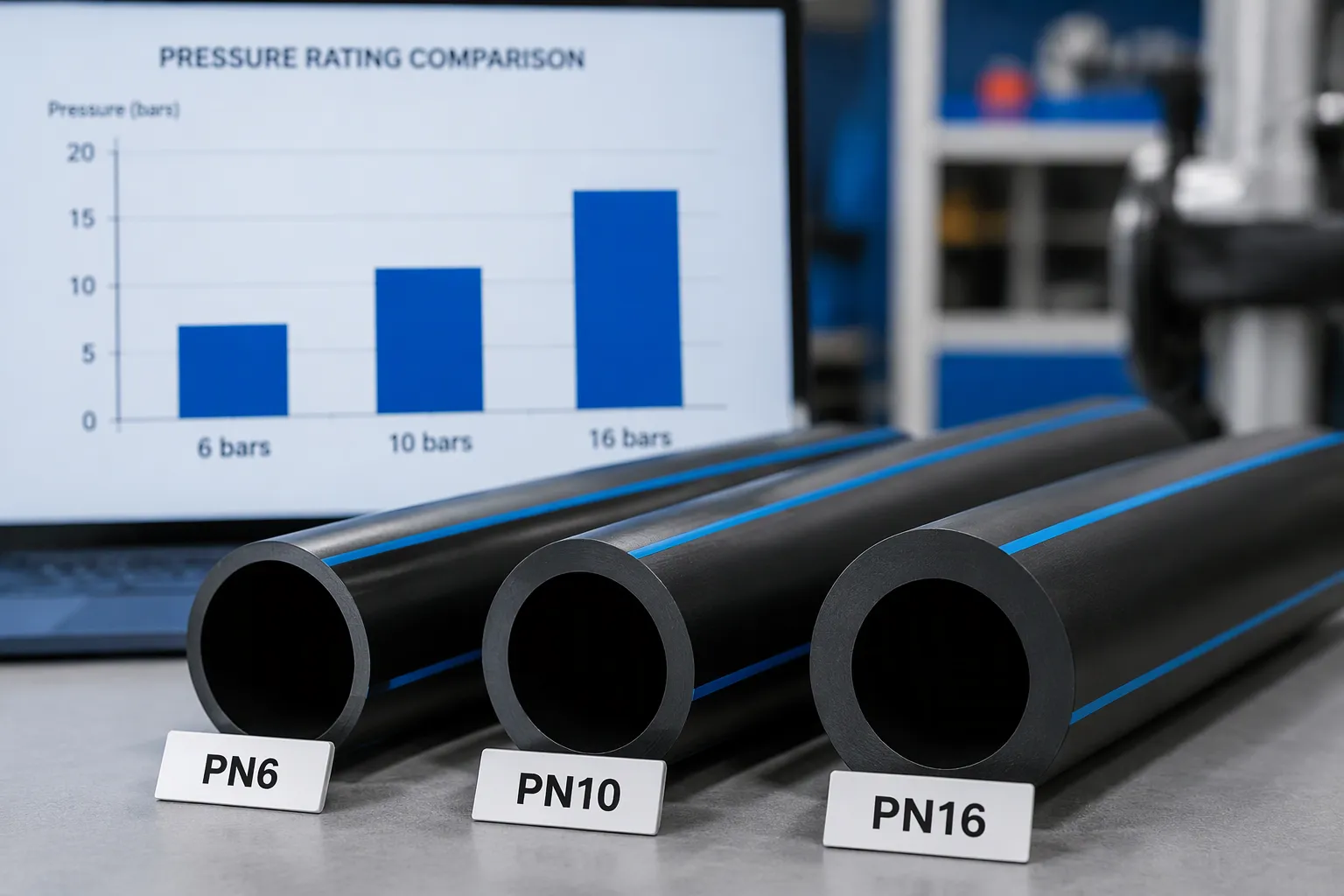
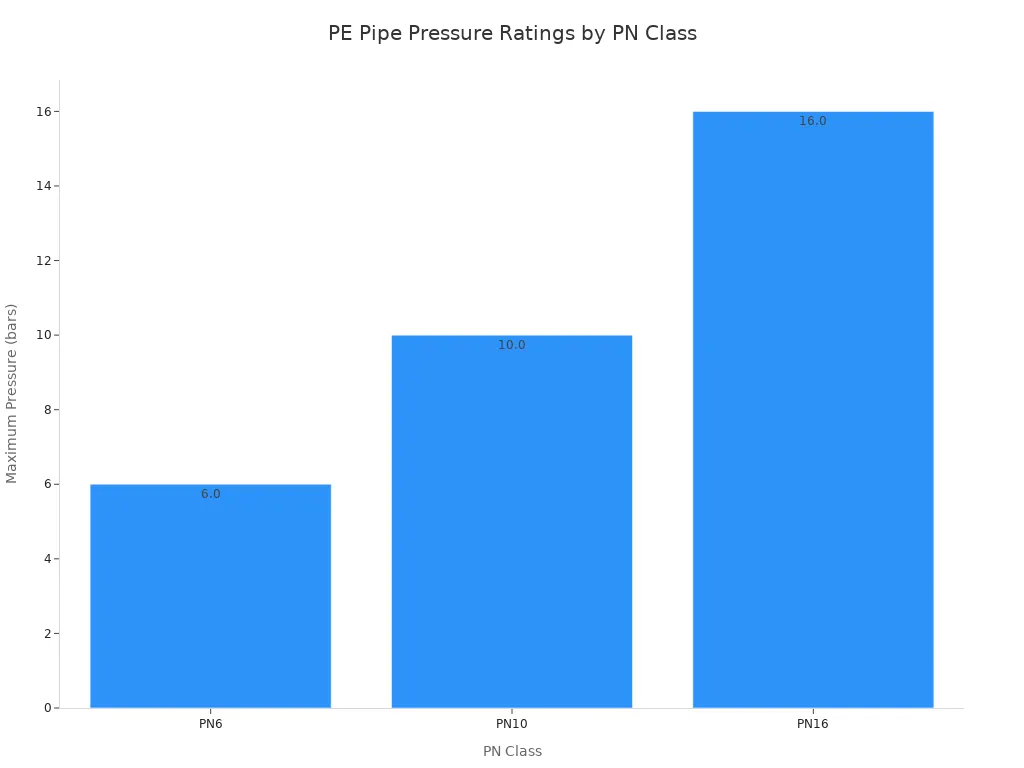
A pressure class tells you the maximum continuous operating pressure a pipe handles under normal conditions. The PN system gives you a simple label for that limit. PN stands for Pressure Nominal, a European-based designation measured in bars, according to Haili. PN10 means the pipe is rated for a maximum continuous operating pressure of 10 bars. One bar equals 0.1 MPa, so 10 bars is approximately 145 psi. The pressure grade of pe pipe reflects wall thickness and strength. A higher PN means a thicker wall and a higher tolerance.
The table below from Haili shows how the three common classes compare:
PN Class
Maximum Pressure
Wall Thickness
Typical Applications
PN6
6 bars
Thinner wall; lightweight and more flexible
Gravity-fed irrigation, tank discharge, garden drip lines
PN10
10 bars
Medium wall thickness
Farm irrigation, urban water pipelines, sprinkler systems
PN16
16 bars
Thick wall; heavier and more expensive
Municipal water mains, industrial piping, hilly terrain
Haili also charts these limits side by side. The bar chart makes the jump from 6 to 16 bars easy to see at a glance.
Match the class to your duty. A gravity line needs far less strength than a pressurized main. Choosing PN16 for a low-head drip system wastes money on wall thickness you never use.
Reading SDR Ratings
The Standard Dimension Ratio links wall thickness to diameter. The Plastic Pipe Institute defines the dimension ratio as the pipe outside diameter divided by the minimum wall thickness. Certain ratios that meet an ASTM International number series (32.5, 26, 21, 17, 13.5, 11, 9 and 7.3) carry the SDR label. Each step changes minimum wall thickness by roughly 25 percent.
Pipe Warehouse UK gives the working formula: SDR = D / s, where D is outside diameter and s is wall thickness. A 90 mm outer diameter pipe with an SDR of 11 has a wall of 8.18 mm, because 90 divided by 11 equals 8.18. A lower SDR means a thicker wall and a higher pressure rating. A higher SDR means a thinner wall, lighter weight, and lower material cost.
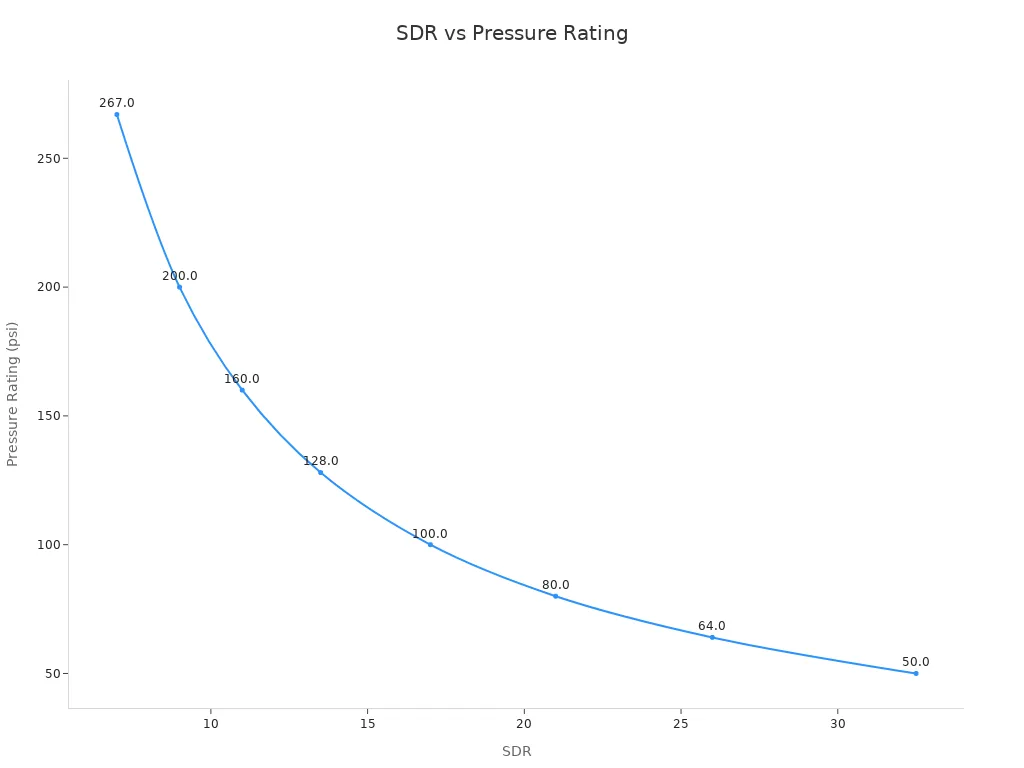
Utility Pipe Supply also publishes a line chart that plots this inverse trend. The curve falls steeply as SDR climbs.
The same source gives the ISO equation: pressure rating = (2 x HDS) / (SDR - 1). HDS is the hydrostatic design stress, which equals the hydrostatic design basis divided by a design factor of 2.0. For PE4710 at 73.4 degrees F, the design basis is 1,600 psi, so HDS is 800 psi. Run SDR 11 through the equation and you get 160 psi, which matches the table.
Common Uses of PE Pipe
Water, Gas, and Irrigation
You will find PE pipe in drinking water lines, gas mains, and farm irrigation systems. Smart Joint reports that municipalities often specify it for resilience, longevity, and ease of use. These lines carry drinking water, recycled water, and wastewater to homes, businesses, and treatment plants.
Corrosion resistance makes the material a strong fit for buried lines. Acid, chemicals, and soil elements erode metal pipe over time. PE pipes do not rust or corrode, even when harsh chemicals touch them. Their flexibility lets them bend around terrain, so you need fewer fittings and costly parts. Smart Joint notes that high-density polyethylene offers cost-effectiveness and longevity, which makes it a low-maintenance choice for long buried runs.
Gas distribution and irrigation draw on the same strengths. The material resists cracks and breakages, and it comes in many diameters for easy fitting changes. Pressure ratings matter in every one of these duties, so match the class to the load. Crews also lay PE pipe in water supply networks that serve whole towns.
PE pipes resist low pH acids and high pH caustic solutions. They also stand up to abrasion from solids. The semi-rigid wall handles high external loads and pressure surges, and the flexible nature expands with surges to extend pipeline life.
Farmers choose HDPE for irrigation, drainage, waste management, and livestock watering. Heat-fused joints improve leakage protection. The pipe resists fertilizers, pesticides, and other agricultural chemicals that damage other materials. Erapipefittings lists drip irrigation, sprinkler irrigation, drainage pipes, and farmland irrigation supply among typical jobs. Small systems often use LDPE for low-pressure, high-flexibility duty. Together, these duties show how polyethylene piping systems serve both heavy industry and everyday farming.
PE stands for polyethylene, and a PE pipe is a durable, flexible, corrosion-resistant option for buried lines. These PE pipes stay lightweight, join easily, and last for decades. Easy joining keeps installation costs down. You also get a wide range of pressure ratings to match each job. That mix suits water supply, gas distribution, and irrigation alike. Every PE pipe carries a printed class, so read that label first. Check the pressure class against your system demand. Then confirm local code requirements for your pipe size and burial depth. A quick pressure check now protects your water line for years.
FAQ
What does PE mean in PE pipe?
PE stands for polyethylene, a thermoplastic made by polymerizing ethylene gas. Manufacturers melt the resin and extrude it into a round profile. The finished product is a flexible tube for water, gas, and irrigation lines.
Is HDPE the same as PE pipe?
HDPE is one grade within the polyethylene family. The PE label covers HDPE, LDPE, and PE-RT. HDPE offers high stiffness and strength for pressure service. LDPE gives you a softer wall for low-demand duties. PE-RT handles hot water and underfloor heating.
How long do PE pipes last?
Polyethylene piping carries a service life of about 100 years, according to AGRU America. The material resists corrosion, fatigue, and biological buildup. Buried lines keep steady flow for decades with little maintenance.
How do you join PE pipe?
Crews join polyethylene pipe by heat fusion or mechanical fittings. Heat fusion melts the ends and bonds them into one continuous length. The joint stays as strong as the pipe wall. Flexible PE also bends around terrain, so you need fewer fittings.
How do you choose the right pressure class?
Match the class to your system demand. PN6 suits gravity-fed irrigation, PN10 covers farm and urban lines, and PN16 handles municipal mains and hilly terrain. Check the printed class on the pipe and confirm local code requirements before you buy.
Qingdao Zhongrui Plastic Machinery Co., Ltd. is located in Jiaozhou City, Qingdao City, Shandong Province. It is 30 kilometers away from Qingdao Port and only 20 kilometers away from the airport.



 +86-18561886575 (Mr.Wu)

 +8618561886575
 238 Yangzhou West Road, Jiaozhou City, Qingdao City, Shandong Province