In modern manufacturing, PVC sealing strips are unsung heroes. They provide critical insulation, weatherproofing, and sound dampening in industries ranging from construction and automotive to home appliances. Their effectiveness keeps buildings energy-efficient, car cabins quiet, and refrigerators airtight. The industry has decisively moved away from labor-intensive manual applications toward high-speed, automated production. This shift demands a sophisticated understanding of the machinery involved. Choosing the right equipment is no longer just about capacity; it's a strategic decision balancing technology, material science, and long-term financial performance. This guide will help you navigate the complex technical trade-offs between different machine configurations, ensuring you select a system that optimizes your return on investment and production quality.
Key Takeaways
Production Volume vs. Machine Type: Single-screw extruders suit standard profiles, while twin-screw systems are required for high-filler or complex composite strips.
Precision is Non-Negotiable: Vacuum calibration and cooling stability determine the final sealing performance (airtightness and water resistance).
TCO Over CAPEX: Energy-efficient motors and low-scrap die designs significantly reduce long-term operational costs.
Material Versatility: Modern PVC sealing strip making machines must handle soft PVC, rigid PVC, and co-extruded (multi-material) designs.
Classification by Extrusion Technology: Single-Screw vs. Twin-Screw Systems
The heart of any PVC sealing strip production line is the extruder, which melts and pressurizes the raw material. The choice between a single-screw and a twin-screw system is the first and most critical decision, as it directly impacts material compatibility, output quality, and operational efficiency. Understanding the core differences is essential for matching the machine to your specific production needs.
Single-Screw Extruders
Single-screw extruders are the workhorses for many standard applications. They excel at processing pre-compounded PVC granules that are already stabilized and plasticized. The design features a single rotating screw within a heated barrel. This setup provides consistent melting and conveying action, making it ideal for simple, flexible sealing strips used in applications like basic window gaskets or door seals. Their primary advantages are a lower initial investment and simpler maintenance. However, they offer less mixing and shearing action, which can be a limitation for more complex material formulations.
Conical Twin-Screw Extruders
For industrial-grade seals that require enhanced durability and performance, conical twin-screw extruders are superior. These machines use two intermeshing, counter-rotating screws. This configuration generates significantly more shear and promotes better homogenization. It makes them exceptionally effective at processing raw PVC powder directly, along with high levels of fillers like calcium carbonate. This capability reduces raw material costs. The intense mixing action ensures a uniform melt, which is critical for producing dense, high-performance seals used in automotive weatherstripping or heavy-duty construction applications.
Co-Extrusion Lines
Co-extrusion represents the gold standard for high-end and multi-functional sealing strips. This technology involves using two or more extruders to feed different materials into a single die head. The result is a single, integrated profile with distinct properties. A common example is weatherstripping for high-performance windows, which features a rigid PVC base for secure mounting and a soft, flexible PVC lip for an airtight seal. This approach allows for the creation of complex products that a single extruder cannot produce, unlocking advanced functionality and design possibilities.
Success Criteria
Regardless of the type, success hinges on matching the screw geometry to your specific material formulation. The design of the screw's feed, compression, and metering zones must be optimized for your PVC compound to prevent thermal degradation. An incorrect match can lead to burnt material, inconsistent output, and poor mechanical properties in the final product.
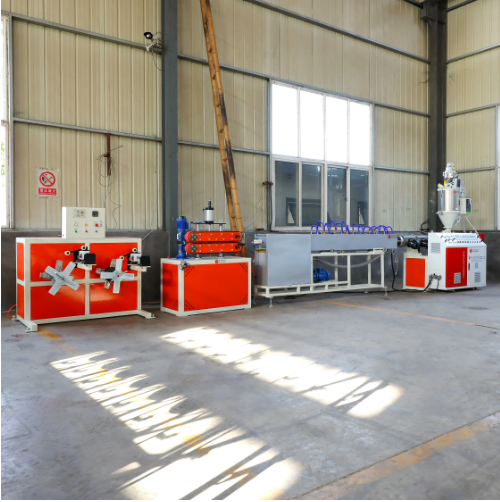
![Types Of PVC Sealing Strip Machines]()
High-Precision Components: Defining the Production Line Quality
While the extruder melts the material, the downstream equipment shapes, cools, and finishes the product. The quality of these components is non-negotiable for achieving tight tolerances and consistent performance. A precision PVC sealing strip production line is a sum of its parts, and weakness in any single area can compromise the entire process.
Vacuum Calibration Tables
Once the molten PVC exits the die head, it must be cooled and solidified into its final shape. This is the role of the vacuum calibration table. The profile is pulled through a series of sizing plates or calibrators within a stainless steel vacuum tank. The vacuum pressure holds the soft profile against the inner walls of the calibrator while water circulation cools it rapidly. This process is crucial for ensuring dimensional stability, achieving a smooth surface finish, and preventing "sinking" or collapse in hollow or complex profiles.
Haul-off Units
The haul-off unit, or puller, is responsible for drawing the sealing strip through the entire downstream line at a constant speed. Its importance cannot be overstated; any fluctuation in pulling speed will cause stretching or compression, leading to dimensional inaccuracies. The two primary types are:
Caterpillar Haul-off: Uses multiple belts or cleated pads to provide a large contact area, offering a powerful and stable pull suitable for larger or rigid profiles.
Belt Haul-off: Employs two synchronized belts, providing a gentler grip ideal for soft, delicate, or easily deformable sealing strips.
Modern haul-off units feature servo motors and are synchronized with the extruder's output to maintain consistent tension and prevent defects.
Precision Die Head Design
The die head is where the molten plastic is shaped into its final cross-section. Its internal design is a matter of complex fluid dynamics. Advanced die heads utilize optimized flow channels to ensure uniform material velocity and pressure distribution across the entire profile. This engineering prevents issues like uneven wall thickness, internal stresses, and surface imperfections. A well-designed die minimizes material waste and reduces the time needed for line setup and calibration.
Automatic Cutting & Coiling
The final stage of the line involves cutting the continuous strip to the required length. The transition from manual labor to automated systems marks a significant leap in efficiency and precision. High-speed planetary cutters provide clean, burr-free cuts without stopping the line. For some applications, online punching systems can create installation holes or other features in real-time. The finished strips are then wound by automatic coilers, creating "ready-to-install" products that streamline downstream assembly processes.
Key Evaluation Dimensions for Procurement Teams
When procuring PVC sealing strip machines, procurement teams must look beyond the initial price tag. A strategic evaluation involves assessing technical capabilities against business objectives. This requires a balanced analysis of throughput, precision, flexibility, and future-readiness.
Machine Evaluation Framework | Dimension | Key Questions to Ask | Impact on Operations |
| Throughput vs. Tolerance | What is the machine's maximum output (kg/h) while maintaining the required dimensional tolerance (e.g., ±0.05mm)? | Balances production speed with product quality and scrap rate. High throughput is useless if the product is out of spec. |
| Material Compatibility | Can the machine efficiently process our primary formulation, recycled PVC, or alternative materials like TPE/TPV? | Determines raw material sourcing flexibility and ability to meet sustainability goals or market trends for different polymers. |
| Automation & Industry 4.0 | Does the machine feature a PLC control system? Can it provide real-time data on temperature, pressure, and line speed? | Improves process consistency, reduces reliance on operator skill, and enables remote monitoring and predictive maintenance. |
| Scalability | Is the line's design modular? Can we add components like magnetic strip inserters, flocking units, or online printers later? | Future-proofs the investment, allowing the business to adapt to new product demands without replacing the entire line. |
Throughput vs. Tolerance
Every manufacturer wants higher output, but not at the expense of quality. It is crucial to analyze the machine's specified capacity (often in kg/h or m/min) in conjunction with its guaranteed dimensional precision. For applications in the automotive or high-end construction sectors, tolerances as tight as ±0.05mm may be required. Ask vendors for performance data demonstrating their machines can maintain these tolerances at target production speeds.
Automation & Industry 4.0
Modern production lines are increasingly integrated with advanced control systems. A Programmable Logic Controller (PLC) with a human-machine interface (HMI) is now standard. It allows operators to set, monitor, and adjust parameters like melt temperature, screw speed, pressure, and haul-off speed from a central console. This integration ensures process repeatability and reduces the chance of human error. Advanced systems can also log production data, facilitating quality control and aligning with Industry 4.0 principles of smart manufacturing.
Total Cost of Ownership (TCO) and ROI Drivers
A savvy investment focuses on the Total Cost of Ownership (TCO), not just the initial capital expenditure (CAPEX). Over the lifespan of the machine, operational costs like energy, material waste, and maintenance can far exceed the purchase price. Optimizing these factors is the key to maximizing your Return on Investment (ROI).
Energy Efficiency
Energy is a major operational overhead in extrusion. Look for machines equipped with modern, energy-saving technologies. These include:
AC Frequency Conversion Motors: These motors adjust their power consumption based on the required load, unlike older DC motors that often run at full power.
Ceramic Heaters: They offer faster heating times and better insulation compared to traditional cast aluminum or mica band heaters, reducing radiant heat loss and overall power usage.
Scrap Rate Reduction
Material waste directly impacts profitability. Advanced control systems play a crucial role here. A "start-stop" synchronization feature ensures that the extruder, haul-off, and cutter ramp up and down in perfect harmony. This minimizes the amount of out-of-spec material produced during line startup and shutdown, which is a common source of scrap in less sophisticated systems.
Maintenance Realities
Downtime is costly. Therefore, evaluating a machine's maintenance requirements is essential. Key components like the screw and barrel are wear parts. Ask about their material and treatment—nitrided or bimetallic screws, for instance, offer a significantly longer lifespan when processing abrasive materials. Also, consider the accessibility of wear parts. Are they standard components that are easy to source, or are they proprietary parts with long lead times? Proactive maintenance planning is much easier with well-designed, serviceable machinery.
Labor Savings
One of the most compelling ROI drivers for investing in automated PVC sealing strip making machines is the reduction in labor costs. A fully automated line with integrated cutting and coiling can often be managed by a single operator, whereas older, semi-automatic systems might require two or three people. The calculation is straightforward: compare the long-term labor savings against the incremental cost of automation to see a clear financial benefit.
Implementation Considerations and Risk Mitigation
Purchasing the machine is only the first step. Successful implementation requires careful planning and an awareness of potential pitfalls. Addressing these factors proactively can prevent costly delays and ensure the production line performs to its full potential from day one.
Facility Requirements
An extrusion line has specific utility and space needs. Before installation, you must verify that your facility can provide:
Stable Power: Extruders draw significant power, and fluctuations can affect motor speed and heater stability, leading to production defects.
Adequate Water Cooling: The vacuum calibration and cooling troughs require a consistent supply of chilled water. The cooling capacity must match the machine's throughput.
Sufficient Floor Space: A production line is long. You must account for the extruder, the full length of the cooling troughs, the haul-off unit, the cutter, and a run-out table or coiler.
The "Formulation-Machine" Gap
A common reason for poor performance is not a mechanical fault but a mismatch between the machine and the material formulation. A machine optimized for virgin PVC granules may struggle with a high-percentage recycled compound. It is crucial to work with a vendor who understands material science. The best suppliers will often ask for samples of your material to test on their equipment or help you optimize your formulation to run smoothly on their machines. Closing this gap is key to achieving consistent quality.
Operator Skill Levels
There is a delicate balance between machine sophistication and the technical expertise of your workforce. While a highly automated line with a complex control system can offer superior performance, it may be overwhelming for an inexperienced team. Consider the availability of skilled technicians and operators. Choose a machine with an intuitive user interface and ensure the vendor provides comprehensive training for your staff.
Vendor Support
The relationship with your machine supplier shouldn't end after delivery. Strong vendor support is a critical risk mitigation tool. When evaluating suppliers, inquire about their post-sale services. Do they offer die-testing services to ensure your profile design works before the machine even ships? Do they provide remote technical troubleshooting to quickly diagnose issues? A vendor who acts as a long-term partner is invaluable for minimizing downtime and maximizing the productivity of your investment.
Conclusion
Choosing the right PVC sealing strip machine is a multi-faceted decision that extends far beyond a simple price comparison. The optimal choice depends entirely on your specific application and long-term business goals. For high-volume automotive weatherstripping requiring multi-material properties, a co-extrusion line is necessary. For standard window gaskets using a consistent compound, a reliable single-screw extruder may be the most cost-effective solution.
Ultimately, the long-term value of investing in a high-quality, precision PVC sealing strip production line is found in its consistency, reliability, and efficiency. By prioritizing output quality, material flexibility, and low total cost of ownership, you position your operation for sustained profitability and a competitive edge. The final recommendation is clear: invest in a system that delivers consistent, high-quality results day after day, as this will always yield a greater return than a machine chosen solely for its low initial price.
FAQ
Q: What is the average production speed of a modern PVC sealing strip machine?
A: The production speed varies significantly based on the profile's size, complexity, and material. For simple, small profiles, speeds can reach 15–20 meters per minute. For larger, more complex shapes, such as automotive weatherstripping, speeds are typically in the 5–10 m/min range to ensure proper cooling and dimensional accuracy.
Q: Can one machine produce both soft and rigid PVC strips?
A: A standard single-extruder machine is typically optimized for either soft or rigid PVC due to different processing requirements. While some adjustments can be made, producing both efficiently often requires a co-extrusion line. This setup uses two separate extruders—one for the rigid material and one for the soft material—which feed into a single die to create a bonded, dual-durometer profile.
Q: How does a magnetic sealing strip machine differ from standard types?
A: A magnetic sealing strip machine is a specialized production line that integrates an additional unit to insert a magnetic strip into the PVC profile as it is being extruded. This insertion happens just before the profile enters the calibration unit. The line requires precise synchronization between the extruder, the magnetic strip feeder, and the haul-off to ensure the magnet is correctly and securely embedded within the PVC seal, which is common for refrigerator doors.
Q: What are the common causes of dimensional instability in PVC extrusion?
A: The most common causes are inconsistent cooling and improper haul-off tension. If the water temperature in the calibration tank fluctuates, the PVC will shrink unevenly, causing warping. If the haul-off speed is too fast or varies, it will stretch the soft profile, reducing its dimensions. Other factors include melt temperature instability and pressure pulsations from the extruder.



 +86-18561886575 (Mr.Wu)
 +8618561886575
 238 Yangzhou West Road, Jiaozhou City, Qingdao City, Shandong Province