The demand for high-performance PVC strips is rapidly expanding across key sectors. Industries from cold chain logistics and cleanroom manufacturing to food processing now rely on these solutions, moving away from traditional physical barriers. This market evolution requires a significant manufacturing upgrade. Businesses are transitioning from manual, low-output setups to fully automated, high-precision extrusion lines capable of meeting stringent quality standards. This shift is critical for maintaining competitiveness and achieving operational efficiency. Our guide serves as a technical and commercial roadmap for this transition. You will learn how to evaluate, select, and implement modern PVC strip production lines, ensuring you can balance high throughput with superior material integrity and achieve a strong return on investment.
Key Takeaways
Configuration Matters: Choosing between single-line and dual-line configurations is the primary driver of ROI based on factory footprint.
Material Versatility: Modern lines must handle diverse formulations, including UV-stabilized, anti-static, and low-temperature (polar) grades.
Precision Control: Advanced PLC systems and synchronized haul-off units are non-negotiable for maintaining wall thickness and strip clarity.
TCO Focus: Energy-efficient heating and high-torque twin-screw extruders significantly reduce long-term operational costs compared to entry-level single-screw models.
![Modern PVC Strip Production Lines]()
Defining the Modern PVC Strip Production Line: Scope and Capabilities
A modern PVC strip production line is far more than a machine for making simple door curtains. Its true value lies in its versatility and ability to adapt to diverse market demands. The most capable systems are engineered as modular platforms. They can be reconfigured with different tooling and downstream equipment to produce a wide array of products. This includes components for a PVC ceiling strip production line or even semi-rigid items typically made on a specialized PVC profile production line. This flexibility allows manufacturers to pivot quickly to capture new revenue streams without investing in entirely new machinery.
Material Science Integration
Success in PVC extrusion is fundamentally a matter of material science. A top-tier production line must effectively process various PVC formulations, each with unique thermal and flow characteristics. Understanding these differences is crucial for quality control.
Flexible PVC: The most common material for strip curtains, rich in plasticizers like DOP or DOTP to achieve softness and pliability. The production line must ensure uniform melting without degrading these sensitive additives.
PVC-U (Unplasticized/Rigid): Used for more structural profiles. While less common for strips, a versatile line should handle its higher processing temperatures and melt viscosity without issues.
Modified Grades (PVC-M/PVC-O): These are engineered for high-impact applications. PVC-M (Modified) and PVC-O (Oriented) contain impact modifiers or have undergone molecular re-alignment. The extrusion process must preserve these enhanced properties, which requires precise temperature and pressure control.
Market Applications
The capabilities of modern PVC strip production lines directly serve several high-growth industrial sectors. By understanding these applications, you can better tailor your equipment and material choices to meet specific customer needs.
Industrial Sealing Strips: The automotive and construction industries require durable sealing strips for doors, windows, and enclosures. These often have complex geometries and require high dimensional accuracy.
Thermal Barriers for Cold Storage: Polar grade PVC strips are essential for walk-in freezers and refrigerated trucks. They are formulated to remain flexible at temperatures well below freezing, preventing cracking and ensuring an effective thermal seal.
Anti-Insect and UV-Filtering Strips: Food processing plants and restaurants use yellow or amber-tinted strips that deter insects. Other formulations include UV inhibitors to protect sensitive goods from sunlight in warehouse doorways.
Technical Architecture: Core Components of a High-Efficiency Line
The performance of any PVC strip production line is determined by the quality and integration of its core components. Each stage, from melting the raw material to cutting the final product, must work in perfect harmony to achieve consistent output and minimize waste. Understanding this technical architecture is the first step toward making an informed investment.
The Extrusion Unit
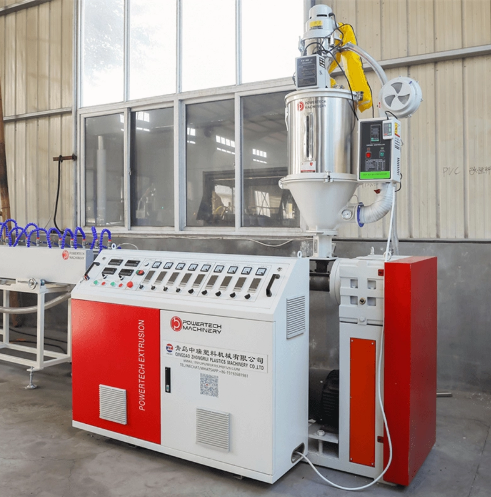
The extruder is the heart of the production line. For processing PVC powder, which is heat-sensitive and has high friction, a twin-screw extruder is the industry standard. These machines provide superior mixing and thermal control compared to single-screw models. The choice between conical and parallel designs depends on your specific production goals.
Table 1: Extruder Comparison for PVC Processing | Feature | Conical Twin-Screw Extruder | Parallel Twin-Screw Extruder |
| Typical Application | Small to medium profiles, flexible strips | High-volume output, large profiles, compounding |
| Pressure Buildup | Naturally builds pressure due to decreasing screw diameter | More uniform pressure profile |
| Shear Rate | Lower shear, gentler on heat-sensitive materials | Higher shear, excellent for mixing and dispersion |
| Advantage | Better for materials requiring less intensive mixing | Higher throughput and versatility |
Regardless of the screw design, a high-torque gearbox is non-negotiable. It provides the necessary power to overcome the high resistance of PVC resin as it melts and plasticizes, ensuring smooth and consistent material flow.
Die Head and Tooling
The die head shapes the molten PVC into its final strip form. For high-quality output, die heads must have chrome-plated internal flow channels. This smooth, non-stick surface prevents material from stagnating and burning, which can cause black specks and other defects in the final product. Furthermore, modern dies feature adjustable lips, allowing operators to easily change the strip width (e.g., from 200mm to 400mm) and thickness without a complete tooling changeover, significantly reducing downtime.
Cooling and Calibration
Once the PVC strip exits the die, it must be cooled and solidified precisely to maintain its dimensions. High-end lines use stainless steel vacuum calibration tables. These tables use a gentle vacuum to hold the soft strip against a cooled, polished surface, ensuring a flat, even finish. This method is superior to simple water spray tanks, which can cause surface imperfections and internal stress. A superior surface finish is critical for applications where clarity matters, and it helps maintain what engineers refer to as the "Hazen-Williams" flow efficiency, a term borrowed from piping that relates to surface smoothness.
Haul-off and Cutting Systems
The haul-off unit pulls the solidified strip away from the calibrator at a perfectly consistent speed. Synchronized caterpillar-style haul-offs are essential. They use rubber-padded belts to grip the strip gently but firmly across a wide area, preventing any stretching or deformation that could compromise its thickness. The final step is cutting or winding. For a high-speed PVC sealing strip production line, an automated "no-dust" cutter provides clean, precise cuts on the fly. For larger strip curtains, an automated winder neatly rolls the product to a pre-set length, ready for packaging.
Evaluation Framework: Choosing the Right Configuration for Your Business
Selecting the right PVC strip production line involves more than just comparing technical specifications. It requires a strategic evaluation of your business needs, production volume, and long-term growth plans. The right configuration will deliver a strong ROI, while the wrong choice can lead to inefficiencies and missed opportunities.
Dual-Line vs. Single-Line Systems
One of the most significant decisions is whether to invest in a single-line or dual-line system. Each has distinct advantages tied to output, flexibility, and factory footprint.
Table 2: Single-Line vs. Dual-Line Production System Comparison | Factor | Dual-Line System | Single-Line System |
| Output Volume | High (e.g., up to 400 kg/hr). Ideal for mass production. | Lower to moderate. Suited for smaller runs. |
| Footprint Efficiency | Excellent. Produces double the output in roughly the same floor space as one large single line. | Standard. Requires more space per unit of output compared to dual lines. |
| Product Flexibility | Lower. Best for running two identical or very similar products continuously. | High. Perfect for frequent changes in strip width, thickness, or material formulation. |
| Ideal Use Case | Standardized products like 200mm clear strips for warehouse doors. | Custom orders, specialized materials (e.g., anti-static), and varied product portfolios. |
Automation and Industry 4.0
Modern production lines leverage automation to achieve unparalleled consistency and efficiency. Look for systems that incorporate Industry 4.0 principles:
Gravimetric Dosing Systems: These systems automatically weigh and blend the PVC resin, plasticizers (DOP), stabilizers, and other additives with extreme precision. This eliminates manual mixing errors and ensures every batch has the exact same formulation.
PLC-Based Recipe Management: A Programmable Logic Controller (PLC) acts as the brain of the line. Advanced systems allow you to store production "recipes" for different products. An operator can select a recipe, and the PLC will automatically set all parameters, from extruder temperatures to haul-off speed, guaranteeing batch-to-batch consistency.
Remote Monitoring: Many systems now offer remote access, allowing production managers to monitor line status, track output, and diagnose issues from a computer or mobile device, improving uptime and operational oversight.
Scalability Dimensions
Your production line should be an asset that grows with your business. When evaluating options, consider the modularity of the design. Can it be easily upgraded in the future? For example, if you later decide to produce double-ribbed anti-scratch strips, which are popular for high-traffic areas, can you add a ribbing unit to the existing line? A scalable machine offers a lower initial investment while providing a clear path for future expansion and product diversification.
Operational Excellence: Formulation, Temperature, and Quality Control
Owning a state-of-the-art production line is only half the battle. Achieving operational excellence requires a deep understanding of material chemistry, precise process control, and rigorous quality assurance protocols. Mastering these elements is what separates average producers from industry leaders.
The Chemistry of Success
The final properties of a PVC strip are determined by its chemical formulation. A successful operator knows how to optimize this mix for specific applications.
Optimizing the Additives Mix: The balance of additives is crucial. Plasticizers like DOP (Dioctyl Phthalate) or its non-phthalate alternative DOTP provide flexibility. Impact modifiers like CPE (Chlorinated Polyethylene) enhance toughness and prevent shattering, especially in colder environments. Getting this ratio right is key to meeting performance specifications.
Thermal Expansion Management: PVC, like all plastics, expands and contracts with temperature changes. This is a critical design consideration. For instance, according to industry design guides, PVC's pressure rating can drop to just 22% of its room temperature value at 140°F (60°C). Products must be formulated and manufactured to perform reliably within their intended operational temperature range.
Temperature Profiling
PVC is notoriously sensitive to heat. If processed at too low a temperature, it won't plasticize properly, leading to a weak, brittle product. If the temperature is too high, the material will degrade, causing "yellowing," burning, and a loss of physical properties. Precise temperature control across the extruder barrel is therefore essential.
Feeding Zone: Kept coolest to allow solid material to convey smoothly.
Plasticizing Zone: The main heating section, typically set between 180°C and 220°C, where the PVC powder melts into a homogenous fluid.
Extrusion Zone & Die: Slightly cooler, often between 170°C and 190°C, to stabilize the melt just before it is shaped by the die.
Modern lines use multiple PID (Proportional-Integral-Derivative) controllers for each zone, maintaining temperatures within a very tight tolerance (±1°C) to ensure process stability.
Quality Assurance Protocols
Consistent quality cannot be left to chance. A robust quality assurance program should include both in-line monitoring and post-production testing.
In-line Monitoring: Automated systems like laser diameter gauges or ultrasonic thickness monitors provide real-time data on the strip's dimensions. If any parameter drifts out of tolerance, the system can alert the operator or even make automatic adjustments.
Physical Property Testing: Regular samples should be taken from the line for lab testing. Key tests include tensile strength (to measure durability), UV degradation resistance (for outdoor applications), and transparency measurement (often reported as a "Haze value").
Strategic Implementation: TCO, ROI, and Factory Layout
Implementing a new PVC strip production line is a major capital investment. A strategic approach focusing on Total Cost of Ownership (TCO), Return on Investment (ROI), and efficient factory planning is essential to maximize profitability and ensure a smooth operational launch.
Total Cost of Ownership (TCO) Drivers
The initial purchase price is only one part of the equation. TCO considers all costs over the equipment's lifespan. Key drivers include:
Energy Consumption: The extruder's heating system is a major energy consumer. Modern lines with energy-efficient ceramic heaters can offer significant savings over older cast aluminum designs. Variable Frequency Drives (VFDs) on motors also reduce power usage during startup and partial load operation.
Maintenance Intervals: The screw and barrel are high-wear components. Standard nitrided steel sets may require replacement after 8,000-12,000 hours. Investing in more durable bimetallic options can extend this lifespan to over 20,000 hours, reducing downtime and long-term maintenance costs, especially when processing formulations with abrasive fillers like calcium carbonate (CaCO3).
ROI Calculation Factors
A strong ROI is built on both cost savings and increased revenue potential. When building your business case, quantify these key factors:
Labor Savings: Automation plays a huge role. Automated material dosing, recipe management, and integrated winding/cutting systems can drastically reduce the number of operators needed to run the line.
Material Savings: Advanced process controls minimize scrap during startup and shutdown. Furthermore, the ability to efficiently recycle scrap is a significant advantage. PVC is highly recyclable and can often be reprocessed up to seven times without significant degradation of its properties, turning waste into a valuable resource.
Increased Throughput: A high-efficiency line produces more finished product per hour, allowing you to fulfill larger orders and capture more market share.
Facility Planning
An optimized factory layout is crucial for safety and efficiency. A well-planned workflow minimizes material handling and prevents bottlenecks. Consider creating distinct zones within your facility:
Material Handling Zone: A dedicated area for receiving and storing raw materials (PVC resin, additives). It should be located near the start of the production line to simplify loading.
Extrusion Zone: The area housing the extruder, die, and calibration table. This zone requires proper ventilation and safety clearances.
Cooling and Finishing Zone: The space for the haul-off unit, cutter or winder, and initial quality inspection.
Finished Goods Storage: A well-organized area for storing and staging finished rolls or strips before shipment. An efficient layout here prevents damage to the product and reduces the secondary handling of heavy PVC rolls.
Conclusion
Modernizing or implementing new PVC strip production lines is a strategic decision that balances advanced technical precision with commercial agility. The shift towards automated, high-efficiency systems is not just about increasing output; it is about achieving unparalleled product consistency, material versatility, and long-term operational savings. By focusing on the core components and a holistic evaluation framework, you can equip your business to meet the demanding standards of today's industrial markets.
Ultimately, your success will depend on choosing robust and reliable machinery. Prioritize equipment with sophisticated PLC controls for recipe management and high-torque twin-screw extrusion units. These features are critical for managing the difficult, high-friction nature of PVC processing and will ensure reliability and profitability for years to come. As a final step, conduct a thorough audit of your material requirements and perform a detailed throughput analysis. This data will provide the clarity needed to make the crucial final decision between a flexible single-line configuration and a high-volume dual-line system.
FAQ
Q: What is the difference between a PVC strip line and a standard PVC profile production line?
A: The primary difference lies in the downstream equipment. A PVC strip line focuses on the controlled cooling and continuous winding of flexible materials. In contrast, a standard PVC profile line uses vacuum calibration tanks and automated saws for creating and cutting rigid shapes, such as window frames or pipes.
Q: Can one line produce both ceiling strips and door curtains?
A: Yes, this is a key advantage of modern, versatile lines. A single line can produce both products, provided that the die head and downstream equipment, like the haul-off and cutter, are designed for quick-change modularity. This allows for rapid changeovers between different product dimensions and types.
Q: How do I prevent the PVC from burning inside the extruder?
A: Preventing thermal degradation of PVC involves a multi-faceted approach. It requires using specialized screw designs that promote even mixing, incorporating internal oil cooling channels within the screw, and relying on high-precision PID temperature controllers to maintain exact temperatures in each barrel zone, preventing overheating.
Q: What is the typical lifespan of a twin-screw barrel in a PVC sealing strip production line?
A: The lifespan depends on the barrel's material and the abrasiveness of the PVC formulation. Standard nitrided steel barrels typically last between 8,000 and 12,000 operating hours. For formulations with high levels of fillers like CaCO3, choosing a more durable bimetallic option can extend the lifespan beyond 20,000 hours.



 +86-18561886575 (Mr.Wu)
 +8618561886575
 238 Yangzhou West Road, Jiaozhou City, Qingdao City, Shandong Province