The increasing regulatory focus on stormwater management and green building standards has driven a massive surge in demand for high-quality drainage solutions across modern roofing and civil infrastructure. Urban developers require reliable, high-volume water diversion systems now more than ever before. For manufacturers, capturing this rising demand requires far more than relying on standard extrusion machinery. It requires a purpose-built configuration balancing rapid output speed alongside uncompromising structural integrity. Suboptimal manufacturing setups inevitably lead to warped sheets, frequent machinery downtime, and compromised product quality. This comprehensive guide breaks down exactly how to configure the optimal manufacturing setup to meet these strict industry demands. We will evaluate critical equipment capabilities and explore practical ways to mitigate operational risks when scaling your production volume. You will learn how to navigate component integration, assess application-specific variations, and finalize vendor selection to ensure operational excellence.
Key Takeaways
- End-use applications (roofing vs. heavy civil works) directly dictate the required dimple height, sheet width, and compressive strength capabilities of your equipment.
- Integrating a customizable drainage board production line reduces downtime when switching between different product specifications or integrating geotextile layers.
- Evaluating a plastic drainage sheet extrusion machine requires looking beyond theoretical output rates to assess melt uniformity, cooling efficiency, and tolerance for recycled resins.
- Successful deployment relies on strict Factory Acceptance Testing (FAT) and verifying vendor support for continuous operations.
Core Components of a Drainage Board Production Line
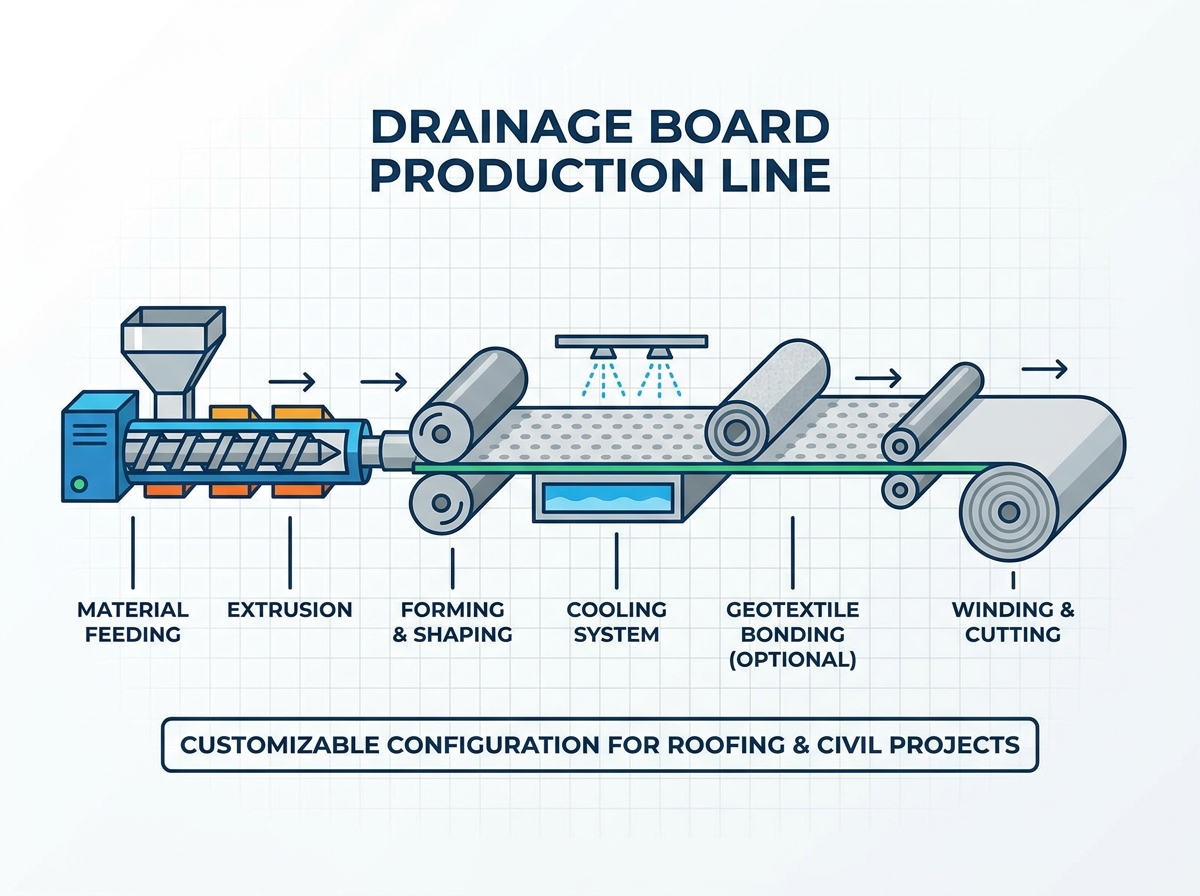
Understanding the mechanical anatomy of your production line prevents costly integration errors. You must configure each module to work in perfect synchronization. A bottleneck in one area instantly impacts the entire output. We recommend breaking down the machinery into five critical zones.
- Material Feeding and Extrusion: Consistency begins at the hopper. You need gravimetric dosing systems for absolute material consistency. These systems weigh the polymer pellets and additives before feeding them into the extruder. This prevents uneven melt flows. For virgin HDPE, standard single-screw extruders perform exceptionally well. However, processing recycled HDPE often requires twin-screw extruders. They provide superior mixing capabilities and handle varying moisture levels efficiently.
- Forming and Shaping Unit: This module serves as the heart of the operation. It transforms flat polymer melts into structural drainage boards. Vacuum or mechanical forming rollers press the hot plastic into designated molds. They create the signature dimpled structure. Vacuum systems pull the plastic into the cavities. Mechanical systems stamp the shape directly. High-precision rollers ensure every dimple maintains uniform wall thickness.
- Cooling and Haul-Off Systems: Heat management dictates product stability. You must prioritize precise temperature control. If you cool the plastic too quickly, internal stresses cause sheet warping. If you cool it too slowly, the dimples collapse under their own weight. Synchronized haul-off mechanisms pull the sheet through long, temperature-regulated water baths. This prevents shrinkage and eliminates structural weakness.
- Optional Geotextile Thermal Bonding: Many modern projects require composite drainage materials. You can bond filtration fabrics directly onto the dimples natively on a plastic sheet production line. Frame this unit as a high-value add-on. It uses precisely calibrated heat rollers to melt the tips of the dimples slightly. The machine then presses the geotextile onto the hot plastic. This eliminates the need for messy adhesives.
- Winding and Cutting: Final packaging requires delicate handling. Automated tension control remains critical here. If the winder pulls too tightly, it crushes the newly formed dimples during the final roll-up phase. Modern systems use dancer rollers and torque motors. They maintain perfectly consistent tension across massive rolls of finished product.
![Drainage Board Production Line Configuration]()
Configuration Variations: Roofing vs. Civil Engineering Demands
End-use environments dictate your equipment specifications. You cannot use a one-size-fits-all approach. Roof systems face entirely different stressors compared to subterranean retaining walls. Manufacturers must align their machine configurations with the specific project requirements they intend to supply.
Green Roofing Applications
Green roofs blend architecture with living biology. They demand highly specialized drainage profiles. Manufacturers must account for soil weight, moisture retention, and aggressive plant roots.
- Requirements: Green roofs need lower profile dimples, usually between 8mm and 12mm. They also require integrated root barriers and built-in water retention capabilities. The drainage board must store small amounts of water while draining the excess.
- Configuration Impact: This application requires precision forming rollers. The molds often feature cup-like dimple designs for water storage. Furthermore, the extruder must handle specialized chemical additives. You will likely inject root-resistance compounds and UV stabilizers directly into the polymer mix. Your dosing system must accommodate these micro-additions precisely.
Civil and Foundation Projects (Retaining Walls, Tunnels)
Heavy infrastructure projects subject drainage boards to immense hydrostatic and mechanical pressure. These materials sit under tons of compacted soil and concrete.
- Requirements: Civil works demand exceptionally high compressive strength. You need thicker gauge sheets and aggressive dimple profiles, often up to 20mm or 30mm. Projects also require wider format rolls. Wider rolls minimize overlapping seams on-site, which reduces installation labor and potential leak points.
- Configuration Impact: This profile demands high-torque extruders. You need robust, wide-format HDPE drainage board equipment capable of processing heavier material loads. The forming unit must withstand higher mechanical resistance. Critically, the drive motors must maintain exact line speeds even when pushing thick, heavy polymer masses.
Table 1: Configuration Matrix for Target Applications
| Application Focus | Typical Dimple Height | Extruder Requirement | Forming Roller Specialty | Additives Processed |
| Green Roofing | 8mm - 12mm | Standard Torque, High Precision | Cup-shaped retention molds | UV Stabilizers, Root Inhibitors |
| Civil Engineering | 15mm - 30mm | High Torque, Heavy Output | Deep-draw high-pressure molds | Antioxidants, Impact Modifiers |
Evaluation Criteria for Extrusion and Forming Equipment
Purchasing capital equipment requires intense scrutiny. Specs on paper rarely tell the whole story. You must look past marketing brochures and evaluate the mechanical realities of the machinery. Focus on yield metrics, metallurgy, and material versatility.
Output Capacity vs. Actual Yield
Many buyers fixate on theoretical maximum speeds. This represents a dangerous oversight. We strongly advise buyers to evaluate realistic operational speeds instead. High speeds combined with poor cooling always result in rejected batches. When the plastic moves too fast, it exits the cooling bath while still soft. The haul-off tension then stretches the dimples, ruining their compressive strength. Calculate your expected ROI based on the actual yield of sellable product, not the maximum motor RPM. Ask vendors for yield data based on continuous 24-hour run cycles.
Mold Precision and Wear Resistance
The forming rollers endure constant thermal and mechanical stress. Discuss the specific metallurgy used for these dimple forming rollers with your vendor. Industry leaders use hardened alloy steel, often treated with nitriding processes. This provides exceptional wear resistance.
What to watch out for: Beware of cheaper, unhardened carbon steel rollers. They seem cost-effective initially. However, they wear down quickly under continuous friction. Worn molds lead to uneven dimple heights. Uneven dimples compromise the board's compressive strength, causing catastrophic failures during site installation. Always verify the Rockwell hardness rating of the shaping rollers before finalizing any purchase.
Resin Flexibility
Material costs dominate operational expenses. A versatile machine protects your margins. Assess the line's ability to handle varying grades of raw materials. You should test post-consumer recycled (PCR) plastics alongside virgin resins. Recycled materials often have fluctuating Melt Flow Indices (MFI). Your extruder requires robust screen changers to filter out impurities. The screw design must ensure thorough homogenization. A well-configured machine processes PCR without sacrificing the structural integrity of the final product.
Implementation Risks and Operational Realities
Even premium machinery encounters friction on the factory floor. Operational realities often highlight hidden inefficiencies. Proactive management of energy usage, changeovers, and composite bonding prevents profit erosion.
- Energy Consumption: Heating massive barrels and cooling long water baths requires tremendous electricity. Highlight that a poorly configured drainage board production line can quickly erode profit margins through inefficient heating and cooling cycles. Look for insulated extruder barrels. Insist on smart PID temperature controllers. These micro-adjustments prevent energy spikes and stabilize your monthly utility costs.
- Changeover Downtime: Address the operational reality of switching molds. When market demand shifts from 10mm roofing boards to 20mm civil boards, you must swap the heavy forming rollers. Slow manual changes kill productivity. Faster changeover mechanisms equate to higher overall equipment effectiveness (OEE). Opt for lines featuring Quick Mold Change (QMC) systems and automated roller lifting hoists.
- Geotextile Delamination: Producing composite boards carries inherent risks. Warn your operators about inconsistent thermal bonding units. If the heat roller temperature drops by even a few degrees, the fabric fails to fuse with the plastic. This causes the filtration layer to peel away from the core drainage board during site installation. Install infrared temperature sensors across the bonding width to ensure absolute thermal consistency.
Shortlisting Logic and Vendor Selection
Selecting the right machinery partner defines your manufacturing success. You are purchasing a long-term operational relationship, not just pieces of metal. Employ strict shortlisting logic to filter out unreliable vendors.
First, verify the track record. Look for manufacturers with proven deployments of heavy-duty extrusion lines. Do not settle for vendors who only build standard flat sheet lines. Dimple forming requires complex synchronization between extrusion pressure and vacuum shaping. Flat sheet experience does not translate to high-quality dimpled board production. Ask for case studies specifically related to civil engineering materials.
Next, require rigorous Factory Acceptance Testing (FAT). Never skip this protocol. Insist on testing the machinery at the vendor's facility before they ship it. You must run the tests using your specific resin mix. Test the machine to your exact product specifications. Measure the dimple heights, test the compressive strength, and verify the haul-off tension. If the machine fails the FAT, the vendor must re-engineer it at their facility, not on your factory floor.
Finally, assess the after-sales infrastructure. Machinery eventually requires maintenance. Evaluate the availability of critical spare parts. Custom forming rollers and complex extruder screws often face long lead times. Ensure your vendor keeps stock or guarantees rapid machining. Review their Service Level Agreement (SLA) for technical support. You need guaranteed response times for electrical and mechanical troubleshooting to prevent extended production halts.
Conclusion
Configuring the right production line represents a major upfront capital expenditure. This crucial investment ultimately dictates your long-term market competitiveness, your ability to meet product compliance, and your operational margins.
- Prioritize equipment scalability and mold precision over the lowest initial acquisition cost.
- Ensure your configuration matches your target market, whether that involves green roofing components or heavy-duty civil infrastructure.
- Implement strict FAT protocols and focus heavily on realistic yield rates rather than theoretical speeds.
- Master the integration of thermal bonding and cooling systems to eliminate product defects.
Take proactive steps today to optimize your manufacturing facility. Request a detailed technical consultation with an extrusion expert. Download a comprehensive machine specification sheet to cross-reference dimensions. Compare custom line configurations closely to match your specific facility footprint and production goals.
FAQ
Q: What is the standard footprint required for a complete drainage board production line?
A: The footprint typically ranges from 25 to 40 meters in length. This varies depending on your specific cooling requirements. If you include inline geotextile bonding units and fully automated multi-station winding systems, expect the machinery to require the upper end of that spatial range.
Q: Can a standard plastic sheet production line be retrofitted to make dimpled drainage boards?
A: Generally no, or it proves highly inefficient. While the primary extruder might look similar, the downstream equipment differs entirely. The specialized vacuum forming rollers, highly synchronized cooling baths, and specific tension-controlled haul-off mechanisms require a purpose-built setup to function correctly.
Q: How does the use of recycled HDPE affect the configuration of the extrusion machine?
A: Processing recycled materials requires specialized twin-screw designs to achieve better melt homogenization. You also need robust vacuum degassing units to remove trapped moisture and volatiles. Furthermore, enhanced filtration systems, like continuous screen changers, are necessary to prevent hard impurities from damaging your precision forming molds.
Q: What is the typical production speed of modern HDPE drainage board equipment?
A: Depending on the specific sheet thickness and overall width, production speeds generally range from 2 to 10 meters per minute. You must carefully balance this operational speed with your water bath cooling capacity to maintain the absolute structural integrity of the dimples.



 +86-18561886575 (Mr.Wu)
 +8618561886575
 238 Yangzhou West Road, Jiaozhou City, Qingdao City, Shandong Province