Zhongrui's High-capacity PP Packaging Belt Production Line is engineered for efficiency and high output. This innovative machine produces durable, flexible, and cost-effective PP straps, replacing traditional steel straps across various industries. Ideal for manufacturers seeking quality and sustainability.
According to many years of plastic machinery development and design experience, in the introduction of foreign advanced technology and digestion and absorption, on the basis of self-developed PE pipe production line. Has the unique structure, the design is novel, the equipment entire line layout is reasonable, the control performance is strong and so on.
The PE/PPR Pipe Production Line delivers reliable and efficient manufacturing of various pipes for water supply and drainage in agriculture and construction. Experience advanced technology and precision for high-quality production.
Discover the Highly Cost Effective PVC Pipe Production Line from Zhongrui. Engineered for durability and efficiency, this advanced production line ensures high-quality PVC pipes suitable for a variety of applications. Experience seamless operation, reduced maintenance, and significant cost savings.
The Composite Infiltration Irrigation Pipe Production Line is a high-efficiency system designed to produce drip irrigation tape for agricultural applications. With precision control, energy-saving technology, and advanced automation, it ensures superior performance in greenhouse, field crop, and water conservation irrigation systems.
Discover the PVC Hose Production Line designed for efficient, high-speed manufacturing of PVC hoses. Our advanced system ensures precision, versatility, and durability, making it an ideal choice for various industrial applications.
The PVC Imitation Marble Sheet Slab Extruder Machine Production Line is designed for producing high-quality, durable, and visually appealing marble-like PVC sheets. Offering fire resistance, water resistance, and high-temperature durability, it’s ideal for a variety of interior decoration applications. This advanced extrusion line guarantees high efficiency and stable output, making it a top choice for businesses looking to scale up production.
Zhongrui's PMMA Board Production Line is designed for precision, high-output plastic sheet manufacturing. With advanced technology including a vertical three-roll calender, Siemens motor, and ABB inverter, it ensures high plasticizing ability and energy-efficient performance. Ideal for producing PMMA, PC, and ABS sheets for construction, packaging, and automotive industries.
0
0
How Does Haul-Off Speed Affect Plastic Profile Dimensions?
Views: 0 Author: Site Editor Publish Time: 2026-10-23 Origin: Site
Dimensional instability in plastic extrusion carries a steep cost. Even minor deviations in wall thickness or geometry lead to high scrap rates and rejected batches. Achieving exact specifications requires a flawless mechanical balance. You must synchronize the melt output from the die with the pulling force of downstream equipment. Misalignment at this critical juncture remains the leading cause of profile distortion.
Precise haul-off speed control is the definitive solution for maintaining strict tolerances. Integrating synchronized downstream equipment stabilizes the entire production process. This approach reduces material waste and optimizes overall line efficiency. We will explore how the physics of traction, tension, and speed dictate final product dimensions, equipment selection, common defects, and integration strategies to stabilize your extrusion process.
Speed-to-Output Ratio: The synchronization between extruder output and haul-off speed directly dictates wall thickness; pulling too fast stretches the melt, while pulling too slow causes swelling and bunching.
Traction and Tension: Consistent pulling power without slippage is critical; intermittent traction causes chattering, surface defects, and dimensional variations.
Right-Sizing Pulling Capacity: Selecting the correct haul-off mechanism (belt vs. caterpillar/cleated) and track length depends entirely on the profile’s size, weight, and material composition to prevent crushing while maintaining grip.
System Integration: Modern extrusion success relies on closed-loop control systems that automatically adjust haul-off speeds in real-time to match extruder RPM, melt pressure, and downstream cutting units.
The Physics of Haul-Off Speed in Plastic Profile Extrusion
Extruder Output vs. Pulling Speed Synchronization
Extrusion relies on a strict volumetric balance. The volume of polymer exiting the die must match the volume being pulled away by the downstream equipment. We call this relationship the drawdown ratio. It defines how much the melt stretches before it solidifies in the calibration unit. When you increase the haul-off speed without changing the extruder screw speed, the drawdown ratio increases. The material stretches over a longer distance. This mechanical relationship dictates the final shape of any plastic profile. If the puller runs slower than the melt output, the material backs up at the die face. Precise synchronization prevents these extremes. Operators must constantly monitor the line speed in meters per minute to ensure it matches the pounds per hour coming from the extruder.
Different polymers require different drawdown ratios based on their melt strength. Rigid PVC behaves differently than flexible polyethylene under tension. A high drawdown ratio on rigid PVC can induce severe internal stress, leading to post-extrusion shrinkage. You must calculate the cross-sectional area of the die opening versus the cross-sectional area of the finished part. The haul-off speed must maintain this exact ratio continuously. Any fluctuation in the drive motor translates directly into a dimensional change.
Impact on Wall Thickness and Cross-Sectional Geometry
Haul-off speed directly dictates final wall thickness. Polymer melts possess a specific melt strength as they exit the die. Applying tension before the material fully solidifies alters its internal stress. Faster pulling speeds stretch the polymer chains longitudinally. This stretching reduces the cross-sectional area and thins the walls. Conversely, insufficient pulling speed allows the polymer to expand upon exiting the die. This expansion alters external dimensions and creates uneven internal chambers. Controlling the speed ensures the geometry matches the engineering specifications.
When producing hollow shapes, wall thickness consistency determines the structural integrity of the part. If the haul-off pulls too fast, the outer walls thin out, but the internal webs might thin out even faster due to uneven cooling rates inside the vacuum tank. This creates a weak profile that fails under load. Operators use ultrasonic thickness gauges inline to monitor these changes. If the gauge detects thinning, the control system must immediately reduce the haul-off speed by a fraction of a percent to compensate.
The Role of Line Tension and Pre-Cut Stabilization
Maintaining constant line tension is mandatory for dimensional stability. Tension prevents the hot profile from sagging as it travels through the cooling tanks. Sagging causes the bottom wall to thicken while the top wall thins out. Tension also prevents warping during the crystallization phase. The haul-off machine holds the diameter and wall thickness to exact specs right up to the cutting unit. This continuous grip absorbs the mechanical shock from the saw. Without steady tension, the cutting action pushes back against the profile, causing saw-induced deformation.
Consider the distance between the die and the puller. This distance can span 10 to 20 meters depending on the cooling requirements. Over this distance, the profile is vulnerable to gravity, water turbulence in the cooling tanks, and thermal contraction. The haul-off provides the necessary tension to keep the profile tracking straight through the guide rollers.
Here are the primary functions of line tension in the extrusion process:
Counteracting gravity to prevent sagging in long cooling water baths.
Overcoming the friction generated inside the vacuum calibration sleeves.
Keeping the profile perfectly aligned with the downstream cutting saw.
Preventing lateral bowing as the polymer undergoes thermal contraction.
Common Dimensional Defects Caused by Haul-Off Misalignment
Stretching, Thinning, and Loss of Tensile Strength
A haul-off speed that outpaces extruder output causes severe stretching. The polymer walls become dangerously thin. This thinning compromises the structural integrity of the final product. Window frames or structural beams lose their load-bearing capacity. The material may look correct on the surface, but it will fail under physical stress. Over-stretching also aligns the polymer chains too aggressively in one direction. This unidirectional alignment makes the profile prone to splitting along its length.
When operators notice splitting during the cutting phase, the first instinct is often to check the saw blade. However, the root cause is frequently excessive haul-off speed inducing longitudinal stress. You must reduce the puller speed and allow the wall thickness to increase slightly to restore the physical properties of the plastic. Amorphous polymers like PVC will lock in this stress if cooled too rapidly while under high tension.
Swelling, Warping, and Surface Rippling
Defects multiply when the haul-off speed is too slow. The polymer melt pools at the die exit. This pooling causes the material to swell before entering the sizing sleeve. The excess material jams inside the vacuum calibrator, creating high friction. As the material forces its way through, it develops wavy, out-of-spec geometries. Surface rippling becomes highly visible on flat sections. The uneven cooling of this bunched material leads to severe warping once the profile leaves the water bath.
Die swell is a natural phenomenon in polymer extrusion, but the haul-off speed must compensate for it. If the puller does not take away the material fast enough, the swell becomes unmanageable. The profile will literally scrape against the entrance of the calibrator, causing deep scratches and surface defects. Operators must balance the swell ratio with the linear pulling speed to maintain a smooth surface finish.
Intermittent Slippage and Chattering
Consistent speed means nothing without consistent traction. Worn belts or incorrect pad pressure lead to intermittent slippage. The puller briefly loses its grip, causing micro-variations in line speed. These micro-variations create horizontal lines across the product surface. We call these chatter marks. Chatter marks ruin the aesthetic finish and create weak points in the wall structure. Inadequate traction forces operators to increase clamping pressure, which often crushes hollow chambers. Maintaining the gripping surface is just as important as controlling the motor speed.
To troubleshoot chatter marks, operators should follow a specific diagnostic path:
Inspect the rubber pads or belts for glazing, hardening, or uneven wear.
Check the pneumatic pressure gauges on the upper and lower tracks to ensure even clamping force.
Verify that the profile is completely dry before entering the puller; water carryover acts as a lubricant and causes slipping.
Examine the drive chain or gearbox for excessive backlash that could cause jerky movements.
Evaluating Haul-Off Mechanisms for a Plastic Profile Production Line
Entry Alignment and Guide Rollers
The transition phase into the haul-off dictates straightness. As the extruded material leaves the cooling tank, it must enter the puller perfectly aligned. Precision guide rollers ensure straight-line pulling. If the entry angle is off by even a fraction of a degree, the puller applies uneven force. This uneven force causes lateral bowing in the finished product. Misalignment also causes uneven track wear on the haul-off belts. Proper guide rollers stabilize the profile and distribute the pulling force evenly across the entire cross-section of the plastic profile production line.
Belt Haul-Offs for High-Speed, Small-Diameter Profiles
Dual-belt pullers excel with lightweight, flexible, or small-diameter profiles. They are ideal for products ranging from 10mm to 32mm. Belts provide high-speed continuous contact. They grip the surface without applying concentrated pressure points. This continuous contact prevents crushing on thin-walled products. Belt haul-offs run smoothly at high linear speeds, making them perfect for high-volume trim or tubing runs. However, belts lack the sheer torque required for heavy, rigid structural shapes.
When specifying a belt puller, you must select the correct belt material. Polyurethane belts offer excellent wear resistance, while softer rubber belts provide better grip on smooth plastics. The choice depends entirely on the surface finish of your product and the required pulling force. A durometer rating of 40 to 60 Shore A is typically ideal for balancing grip and wear resistance.
Caterpillar and Cleated Pullers for Heavy/Large Geometries
Large, rigid profiles require caterpillar haul-offs. These machines use segmented tracks equipped with shaped rubber pads. You must right-size your pulling capacity for heavy geometries. Using extended track lengths distributes the pulling force over a larger surface area. For example, utilizing 1,500 mm cleated belts provides massive traction without requiring excessive clamping pressure. This distributed grip prevents the deformation of hollow internal chambers. Caterpillar pullers deliver the high torque necessary to pull heavy cross-sections through tight vacuum sizing sleeves.
Haul-Off Type
Best Application
Traction Method
Primary Advantage
Dual-Belt Puller
Small, flexible, high-speed profiles (10-32mm)
Continuous flat belt contact
High speed, no concentrated pressure points
2-Track Caterpillar
Medium rigid profiles, window frames
Segmented rubber pads
Good balance of torque and surface protection
4-Track Caterpillar
Large structural profiles, heavy pipes
Four-sided segmented pad contact
Maximum pulling force, prevents ovality
Multi-Track Cleated
Heavy composite decking, wide panels
Custom-shaped cleats on extended tracks
Distributes massive torque over a large area
Specialized Traction for WPC Plastic Profile Production Lines
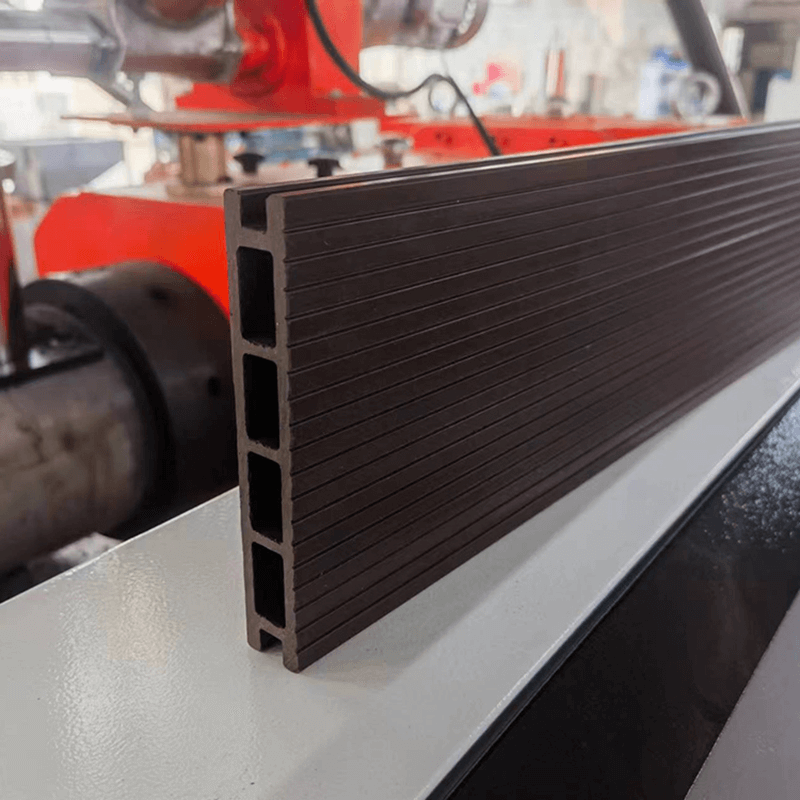
Wood-Plastic Composites introduce unique handling challenges. WPC materials are significantly heavier and more brittle than standard plastics. A WPC plastic profile production line requires highly stable pulling forces. Sudden jerks or speed variations will snap the brittle profile. The haul-off must deliver high torque at very low linear speeds. Specialized rubber pads are necessary to grip the textured surface without marring the finish. Multi-track pullers are often deployed to spread the load and prevent surface cracking during the pulling process.
WPC extrusion runs at much slower speeds than PVC. The puller must maintain absolute speed consistency at 0.5 to 2 meters per minute. Standard AC motors often struggle to maintain smooth rotation at these low speeds, causing a stuttering effect. This stuttering transfers directly to the WPC board, creating visible lines and weak points. Upgrading the mechanical transmission to handle low-RPM, high-torque loads is mandatory for composite materials.
Interdependent Variables: Calibration, Cooling, and Haul-Off Tension
Vacuum Calibration and Initial Sizing
The vacuum calibration table locks in the initial geometry of the melt. As the hot polymer enters the sizing sleeve, vacuum pressure pulls it against the chilled metal walls. This creates high friction. The haul-off must pull the material through this high-friction zone smoothly. You must calibrate the haul-off speed to match the vacuum pressure. If the puller runs too fast, the profile tears inside the sleeve. If it runs too slow, the material sticks and jams the entire line.
Operators must balance the vacuum level with the pulling force. High vacuum creates better dimensional accuracy but drastically increases friction. The haul-off must have enough torque to overcome this friction without slipping. Dry calibration blocks require even more pulling force than water-ring calibrators due to the lack of water lubrication on the metal surfaces.
Cooling Tank Length vs. Maximum Haul-Off Speed
Extrusion faces strict thermodynamic limits. Your haul-off speed can never exceed the cooling capacity of your line. The cooling tanks must remove enough heat to solidify the core of the profile. Pulling a profile out of the cooling bath before its core solidifies is a major error. The outer skin may feel hard, but the molten core will continue to shrink. This delayed shrinkage causes severe post-extrusion warping. You must match your pulling speed to the length and efficiency of your water cooling system.
If you want to increase line speed, you cannot simply turn up the extruder and the puller. You must add cooling capacity. This means installing longer water tanks, increasing water flow rates, or lowering the chilled water temperature using industrial chillers rather than standard cooling towers.
Process Temperature and Material Viscosity
Melt temperature directly affects polymer viscosity. Viscosity alters how the material responds to the pulling force. A hotter, less viscous melt stretches much easier under tension. If the melt temperature spikes, your standard haul-off speed might suddenly cause wall thinning. A colder, highly viscous melt resists stretching. This resistance increases the load on the haul-off motors and can cause the material to swell at the die. Operators must monitor melt temperature to keep the haul-off speed perfectly balanced.
Upgrading Your PVC Profile Production Line: Key Evaluation Criteria
Precision Drive Systems (Servo Motors vs. Standard AC Drives)
The drive system dictates the dimensional stability of your PVC profile production line. Traditional VFD-controlled AC motors are common but have limitations. They can hunt for the correct speed, causing minor tension fluctuations. Servo-driven haul-offs provide absolute precision. Servo motors offer micro-adjustments and zero-backlash performance. They hold an exact RPM regardless of the physical load applied by the profile. This rigid speed control translates directly into tighter dimensional tolerances and fewer rejected batches.
When evaluating an upgrade, consider the mechanical transmission as well. A servo motor is useless if connected to a sloppy gearbox. Direct-drive servo systems eliminate gearbox backlash entirely, providing the most accurate pulling force available. Tuning the PID loop on the servo drive ensures the motor reacts instantly to any changes in line tension.
Closed-Loop Control and Extruder Synchronization
Modern downstream equipment relies on closed-loop control systems. You cannot rely on manual speed adjustments. A PLC-based control system links the haul-off drive directly to the extruder screw speed and melt pressure sensors. If the melt pressure drops slightly, the PLC automatically slows the haul-off to prevent wall thinning. This automatic speed compensation ensures continuous dimensional accuracy. Upgrading to a closed-loop system removes human error from the synchronization process.
Assessing Customizable PVC Profile Machinery for Complex Shapes
Complex, multi-chambered window profiles require tailored downstream equipment. When evaluating machinery builders, focus on their ability to provide customizable PVC profile machinery. You need the ability to customize haul-off contact pads to match the exact contour of your product. Standard flat pads will crush intricate weather-seal channels. Assess the track lengths and pressure regulation systems. Independent pneumatic controls for different sections of the caterpillar track allow you to grip complex shapes without collapsing the internal walls.
Custom pads are typically milled from high-density rubber or polyurethane. They cradle the profile, applying pressure only to the strongest structural webs while leaving the delicate outer flanges untouched. Proportional pneumatic valves allow operators to dial in the exact clamping force required for each specific product run.
Implementation Risks and Mitigation in Wood Plastic Profile Machines
Handling Brittle Materials and High Friction
Operating a wood plastic profile machine involves significant handling risks. WPC materials lack the flexibility of pure PVC or PE. Applying excessive clamping pressure causes immediate micro-fractures in the wood-composite matrix. You must mitigate this risk by specifying multi-track caterpillar pullers. Using three or four tracks spreads the clamping force evenly around the perimeter of the decking board. Utilize pneumatic systems with independently adjustable pressure zones to secure the profile gently but firmly.
Maintenance Protocols to Prevent Slippage
Haul-off maintenance dictates long-term dimensional stability. You must establish strict operational protocols. Regularly inspect the rubber pads for durometer degradation. Hardened or glazed rubber loses its grip, leading to intermittent slippage. Check the belt wear and track alignment weekly. A misaligned track causes uneven pulling and lateral bowing in the final product. Keep the traction surfaces clean of dust and cooling water residue. Proactive maintenance prevents sudden dimensional shifts during long production runs.
Implement these maintenance steps to ensure consistent traction:
Wipe down all rubber contact pads with an approved solvent at the end of every shift to remove plasticizer buildup.
Measure the thickness of the belts or pads monthly to detect uneven wear side-to-side.
Lubricate the track chains and guide rails according to the manufacturer's schedule to prevent binding.
Calibrate the pneumatic pressure regulators quarterly to ensure the gauge reading matches the actual clamping force.
Conclusion
Install inline ultrasonic thickness gauges to monitor wall dimensions in real-time and link them to your haul-off PLC.
Replace standard flat rubber pads with custom-milled contoured pads designed specifically for your most complex hollow profiles.
Upgrade your downstream drive systems from standard AC motors to zero-backlash servo motors for precise speed synchronization.
Implement a weekly durometer check on all traction belts to identify and replace glazed rubber before slippage occurs.
FAQ
Q: How does haul-off speed affect the wall thickness of a plastic profile?
A: There is a direct inverse relationship. A higher haul-off speed decreases wall thickness by stretching the polymer melt before it cools. Conversely, a lower speed increases wall thickness and can cause the material to bunch up or swell at the die exit.
Q: Why is my plastic profile warping after it leaves the cooling tank?
A: Warping occurs when the haul-off speed exceeds the cooling capacity. If the profile is pulled out of the tank before its core fully solidifies, the internal material continues to shrink unevenly. This delayed shrinkage creates internal stresses that warp the cut pieces.
Q: What is the difference between a belt haul-off and a caterpillar haul-off?
A: Belt haul-offs provide continuous, high-speed contact ideal for lightweight or small-diameter profiles without crushing them. Caterpillar haul-offs use segmented tracks with high-torque rubber pads, providing the massive grip needed for large, heavy, or rigid structural profiles.
Q: Why is it important to right-size the pulling capacity of a haul-off?
A: Right-sizing ensures you have enough traction without applying destructive clamping force. Using extended track lengths distributes the pulling pressure over a larger surface area. This prevents the crushing of hollow chambers while maintaining a secure grip on the plastic.
Q: How does the haul-off interact with the cutting machine?
A: The haul-off maintains constant tension on the profile right up to the cutting unit. This tension holds the diameter and wall thickness to exact specifications. It absorbs the mechanical shock of the saw, preventing the cutting action from pushing back and deforming the profile.
Q: How do you synchronize an extruder with a haul-off machine?
A: Synchronization is achieved using closed-loop PLC systems. These systems use feedback from melt pressure sensors, dancer arms, or laser measurement tools. The PLC automatically adjusts the haul-off servo motors in real-time to perfectly match the volumetric output of the extruder.
Qingdao Zhongrui Plastic Machinery Co., Ltd. is located in Jiaozhou City, Qingdao City, Shandong Province. It is 30 kilometers away from Qingdao Port and only 20 kilometers away from the airport.



 +86-18561886575 (Mr.Wu)

 +8618561886575
 238 Yangzhou West Road, Jiaozhou City, Qingdao City, Shandong Province