Zhongrui's High-capacity PP Packaging Belt Production Line is engineered for efficiency and high output. This innovative machine produces durable, flexible, and cost-effective PP straps, replacing traditional steel straps across various industries. Ideal for manufacturers seeking quality and sustainability.
According to many years of plastic machinery development and design experience, in the introduction of foreign advanced technology and digestion and absorption, on the basis of self-developed PE pipe production line. Has the unique structure, the design is novel, the equipment entire line layout is reasonable, the control performance is strong and so on.
The PE/PPR Pipe Production Line delivers reliable and efficient manufacturing of various pipes for water supply and drainage in agriculture and construction. Experience advanced technology and precision for high-quality production.
Discover the Highly Cost Effective PVC Pipe Production Line from Zhongrui. Engineered for durability and efficiency, this advanced production line ensures high-quality PVC pipes suitable for a variety of applications. Experience seamless operation, reduced maintenance, and significant cost savings.
The Composite Infiltration Irrigation Pipe Production Line is a high-efficiency system designed to produce drip irrigation tape for agricultural applications. With precision control, energy-saving technology, and advanced automation, it ensures superior performance in greenhouse, field crop, and water conservation irrigation systems.
Discover the PVC Hose Production Line designed for efficient, high-speed manufacturing of PVC hoses. Our advanced system ensures precision, versatility, and durability, making it an ideal choice for various industrial applications.
The PVC Imitation Marble Sheet Slab Extruder Machine Production Line is designed for producing high-quality, durable, and visually appealing marble-like PVC sheets. Offering fire resistance, water resistance, and high-temperature durability, it’s ideal for a variety of interior decoration applications. This advanced extrusion line guarantees high efficiency and stable output, making it a top choice for businesses looking to scale up production.
Zhongrui's PMMA Board Production Line is designed for precision, high-output plastic sheet manufacturing. With advanced technology including a vertical three-roll calender, Siemens motor, and ABB inverter, it ensures high plasticizing ability and energy-efficient performance. Ideal for producing PMMA, PC, and ABS sheets for construction, packaging, and automotive industries.
0
0
How Does a PVC Foam Board Line Control Board Density?
Views: 0 Author: Site Editor Publish Time: 2026-08-05 Origin: Site
Controlling board density sits at the heart of PVC foam board manufacturing. It acts as the ultimate balancing act between raw material consumption and end-product quality. For technical buyers and plant managers evaluating machinery, this metric represents a clear dividing line. Consistent density control separates highly profitable operations from lines suffering from material waste and constant product defects. A slight deviation in density can severely disrupt profit margins over long continuous production runs. How do you master this delicate balance? You must understand the specific mechanics driving the entire extrusion process. In this guide, you will learn how extrusion systems physically manage chemical formulations. We explore melt pressure regulation within the die head in detail. You will also see how different calibration methods dictate final surface hardness and structural integrity. Finally, we provide a robust framework to help you evaluate automated dosing and closed-loop feedback systems for your next major machinery investment.
Key Takeaways
Density control is a synchronized balance of chemical formulation, extruder mechanics, and calibration cooling.
Precise temperature and melt pressure regulation within the extruder prevents premature foaming and uneven cell structures.
The choice between Celuka and Free Foaming calibration dictates surface hardness and core density limitations.
Evaluating a new production line requires scrutinizing its automated dosing capabilities, screw design, and closed-loop feedback systems.
The Business Reality: Why Density Control Dictates Profit Margins
Density control directly dictates the material economics of your factory. Resin consumption accounts for the largest ongoing expense in polymer manufacturing. Board density translates strictly to how much resin you use per cubic centimeter. A density variation of just 0.05 g/cm³ across high-volume production severely impacts unit economics. If your target density is 0.50 g/cm³ but your line drifts to 0.55 g/cm³, you consume ten percent more raw material per board. Over a standard annual run, this unseen waste easily consumes your entire profit margin.
Different markets demand highly specific density ranges. Lower densities ranging from 0.35 to 0.45 g/cm³ are strictly required for lightweight signage. You typically produce these on specialized PVC advertising board production machinery. These applications prioritize easy cutting, vibrant printing surfaces, and low transportation weight. Conversely, structural applications demand much higher densities. Construction panels and furniture boards require densities between 0.55 and 0.80 g/cm³. These higher figures are non-negotiable. They ensure high screw-holding strength, impact resistance, and rigid load-bearing capabilities.
Achieving a specific number on a scale is not the only success criteria. True consistent density means achieving a perfectly uniform cell structure throughout the entire board profile. Operators must maintain this uniformity without causing surface pitting. They must prevent thermal warping during the cooling phase. Unacceptable thickness variations often result from poor density control. If gas pockets merge into large voids, the structural integrity of the entire sheet collapses. You must lock in the correct micro-cellular structure consistently.
Application Density Requirements
Application Sector
Target Density Range (g/cm³)
Key Performance Priority
Advertising & Signage
0.35 - 0.45
Lightweight, smooth print surface
Cabinetry & Furniture
0.50 - 0.60
Screw-holding strength, moisture resistance
Construction & Formwork
0.65 - 0.80
High rigidity, impact resistance, load-bearing
Chemical vs. Mechanical Control: The Role of the Extrusion System
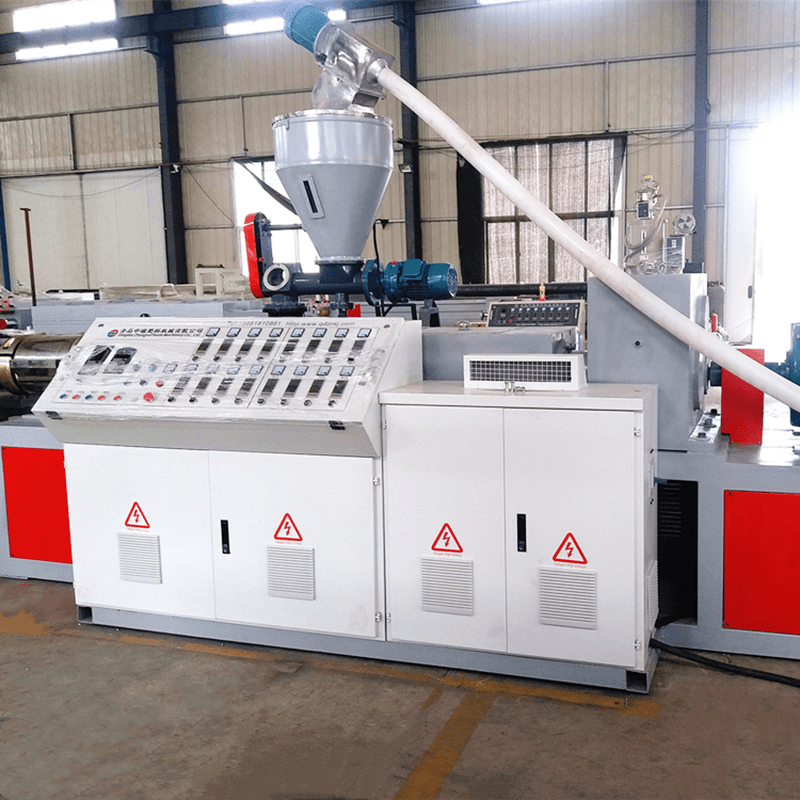
Density control begins long before the molten plastic exits the machine. It requires a synchronized dance between chemical formulations and precise mechanical forces. The hardware foundation dictates how well your chemical blowing agents perform. A modern PVC foam sheet board extrusion machine production line manages the intense physical processing of the raw polymer mix. It transforms a dry powder blend into a homogeneous, gas-filled melt.
Screw design plays the most fundamental role in plasticization. Most high-capacity lines utilize a conical or parallel twin-screw configuration. These twin screws dictate the specific shear rate applied to the PVC compound. They ensure chemical blowing agents (CBAs) are dispersed perfectly evenly before they ever reach the die head. If the shear rate is too low, the blowing agents clump together. This causes massive voids in the finished board. If the shear rate is too high, the material degrades. The screws must push the melt forward while gently mixing the expanding gases into a fine, microscopic froth.
Temperature profiling along the extruder barrel acts as the primary control dial for this chemical reaction. You must map out multi-zone temperature controls with extreme precision. Chemical blowing agents decompose and release gas at very specific thermal thresholds.
Feed Zone: Keep temperatures relatively low to prevent premature melting and bridging of the raw powder.
Compression Zone: Gradually increase heat to begin plasticization and initiate the chemical decomposition of the blowing agents.
Metering Zone: Stabilize the temperature to maintain melt viscosity and prevent the newly formed gas bubbles from escaping the polymer matrix.
A critical risk exists here. If barrel temperatures run too high too early in the process, the blowing gas escapes prematurely through the extruder vacuum vent. You lose your foaming agent. This inevitably results in an abnormally high-density board characterized by a very poor, collapsed cell structure.
Die Head and Melt Pressure Regulation
Once the PVC melt leaves the extruder barrel, it enters the die head. This component serves as the pressure vessel. Pressure dynamics within the die are crucial for maintaining the dissolved gases in a compressed state. The die lip design and its internal geometry work together to maintain intense melt pressure. You must sustain this high pressure constantly until the melt physically exits the die lips. Any sudden drop in pressure inside the die allows premature gas expansion. Premature expansion tears the internal polymer structure apart.
Flow distribution presents another complex engineering challenge. You must push a highly viscous, expanding liquid into a wide, flat sheet. Industry standards dictate the use of a coat-hanger type die. The internal channel resembles a triangular coat hanger. This specific geometry ensures uniform melt flow across the entire width of the extruded board. The material traveling to the far edges must exit at the exact same velocity and pressure as the material flowing down the center. If flow distribution fails, you experience severe edge-to-center density variations. The board might measure 0.50 g/cm³ in the middle but drop to 0.40 g/cm³ at the edges.
Operators rely heavily on mechanical adjustability to fight these variations. Modern die heads feature internal restrictor bars and flexible die lips. Operators use these tools to fine-tune thickness and density on the fly. By slightly tightening a specific die bolt, an operator locally increases pressure. This reduces the foam expansion in that exact zone. This dynamic adjustment process prevents costly line shutdowns when minor density drifts occur.
Calibration and Cooling: Free Foam vs. Celuka Processes
The moment the melt exits the die, it begins to expand rapidly. How you handle this expansion determines the final product type. The calibration and cooling phase physically locks in the density. Two distinct manufacturing processes dominate the industry: Free Foaming and the Celuka method.
Free Foaming calibration allows the melt to expand freely upon exiting the die. The material swells naturally before entering the sizing calibrator. This mechanism results in a highly uniform density throughout the entire cross-section of the board. The outcome is a product with a matte, slightly porous surface finish. These boards lack a hard outer crust. They are highly favored for printing applications because inks adhere easily to the micro-porous texture.
The Celuka calibration process operates entirely differently. It is also known as inward foaming. The die lips are positioned directly against the chilled calibration unit. The melt is immediately quenched by the cold metal upon exiting the die. This instantly freezes the outer layer of the plastic. Because the outer skin cannot expand, the trapped gas forces the core to expand inward. This mechanism produces a very rigid, high-density outer skin alongside a lower-density inner core. The outcome is ideal for premium structural boards. Furniture makers prefer Celuka boards because the hard surface resists scratching and holds screws tightly.
Cooling parameters dictate the success of both methods. Cooling water temperature must remain absolutely stable. Vacuum pressure inside the calibrator unit pulls the soft board against the metal sizing plates. This vacuum pulls the board to its final dimensions. It extracts excess heat and permanently locks in the final density structure. If the cooling water fluctuates, the board will warp, and the density profile will collapse.
Comparison Chart: Free Foam vs. Celuka
Feature
Free Foaming Process
Celuka Process
Expansion Direction
Outward, unrestricted
Inward, restricted outer skin
Surface Hardness
Low to Medium (Matte)
High (Glossy, hard crust)
Density Distribution
Uniform throughout profile
High density skin, low density core
Primary Applications
Signage, printing, displays
Cabinetry, construction, flooring
Buyer’s Framework: Evaluating a PVC Foam Board Production Line
Purchasing capital equipment requires a strategic evaluation framework. You cannot judge a machine solely on its maximum output speed. You must assess how well a plastic sheet production line integrates scalability and automation. Manual mixing and dosing lead to disastrous density fluctuations. Modern lines must feature gravimetric dosing systems. These automated systems weigh every single ingredient continuously. They ensure exact raw material ratios enter the extruder. You should also look for closed-loop thickness gauges. These ultrasonic or radiometric sensors scan the finished board automatically. They send real-time feedback to the die head and haul-off speed controllers. This eliminates human error.
Tolerance and stability serve as the true markers of quality. When reviewing equipment, demand verifiable production data. Look for the line's proven ability to hold tight density tolerances over long periods. A premier PVC foam board production line should easily maintain a tolerance of ±0.02 g/cm³ during a 24-hour continuous run. If a manufacturer cannot provide this stability data, their machinery likely suffers from poor temperature control or inferior screw metallurgy.
You must also address critical implementation risks. Even the most advanced machinery cannot operate itself autonomously. Operator expertise remains a vital component of density control.
Evaluate the level of commissioning support offered by the manufacturer.
Ensure the vendor provides deep assistance with initial chemical formulation tuning.
Demand comprehensive OEM training for your floor operators during the rollout phase.
Verify availability of fast spare parts delivery for critical wear components like extruder screws.
Conclusion
Density control is never a single setting on a control panel. It represents a complex, holistic process managed carefully across the extruder, die head, and calibration units. From the precise shear applied by twin screws to the sudden thermal shock of a Celuka calibrator, every step dictates your final product quality. Master these interconnected variables, and you secure consistent profitability and market-leading board quality.
Before moving forward with procurement, request rigorous material testing from potential machinery vendors. Review specific component brands utilized in their lines, paying close attention to screw metallurgy and PLC automation systems. Finally, consult directly with engineering teams to align their hardware configurations with your specific density targets and application requirements.
FAQ
Q: What causes density fluctuations during a continuous PVC foam board production run?
A: Density fluctuations typically stem from three core issues. Ambient temperature changes in the factory can alter the cooling rate of the calibration unit. Inconsistent raw material mixing, especially with chemical blowing agents, creates uneven gas distribution. Finally, worn extruder screws fail to provide consistent melt pressure, causing unpredictable foaming behavior inside the die.
Q: Can the same machine produce both high-density and low-density PVC boards?
A: Yes, a single machine can produce varying densities, but it requires significant adjustments. You must completely alter the chemical formulation, adjusting the ratio of blowing agents. Additionally, moving between extreme density ranges often necessitates swapping the die head lips and the calibration unit to accommodate different expansion rates.
Q: How does the choice of chemical blowing agent interact with machine settings?
A: Chemical blowing agents trigger either endothermic (absorbing heat) or exothermic (releasing heat) reactions. Endothermic agents require higher, sustained barrel temperatures to decompose smoothly. Exothermic agents release their own heat, requiring aggressive cooling in the final extruder zones to prevent runaway gas expansion. Machine temperature profiles must match the agent's specific decomposition threshold.
Q: What is the standard density range a commercial extrusion line should support?
A: A high-quality commercial extrusion line typically supports a broad density range from 0.35 to 0.85 g/cm³. However, reaching the extreme ends of this spectrum depends entirely on the specific tooling installed, the motor torque available, and whether the line utilizes a Free Foaming or Celuka calibration setup.
Qingdao Zhongrui Plastic Machinery Co., Ltd. is located in Jiaozhou City, Qingdao City, Shandong Province. It is 30 kilometers away from Qingdao Port and only 20 kilometers away from the airport.



 +86-18561886575 (Mr.Wu)
 +8618561886575
 238 Yangzhou West Road, Jiaozhou City, Qingdao City, Shandong Province