Material preparation goes far beyond following a basic chemical recipe. It acts as the foundational variable driving profitability, defect rates, and overall output quality in any facility. Plant managers frequently overlook this critical pre-extrusion phase. They focus heavily on purchasing the main extruder instead. However, improper resin and additive preparation will bottleneck even the most advanced extrusion machinery. Poorly mixed compounds cause irregular feed rates and structural defects. They undermine equipment performance and waste expensive raw materials. We aim to provide an evidence-based framework for your operations. You will learn how to balance formulations and execute the essential hot and cold mixing processes. We also explain how to perfectly match these preparation requirements to the right production equipment. This ensures a stable, high-margin manufacturing environment from the very first batch.
Key Takeaways
- Formulation precision (especially the balance of blowing agents and stabilizers) directly impacts the density and structural integrity of the final PVC foam board.
- Strict temperature control during the hot (approx. 120°C) and cold (approx. 40°C) mixing stages is non-negotiable for preventing premature foaming and ensuring material flowability.
- Investing in automated dosing and high-speed mixing systems reduces batch-to-batch inconsistencies, directly improving the ROI of your plastic sheet production line.
- The physical and chemical properties of the prepared dry blend must dictate the screw design and degassing capabilities of your chosen extrusion machinery.
The Business Impact of Material Preparation on Production Scalability
Poor material preparation drives specific business losses. You will experience high scrap rates. Uneven board thickness becomes a common issue. Machine wear accelerates rapidly under poor lubrication. Material waste destroys your profit margins. Many operators blame the extruder for these faults. In reality, the root cause almost always lies in the mixing silo. Inconsistent blends force operators to constantly adjust machine parameters. This prevents true continuous manufacturing.
Successful preparation creates a homogenous, free-flowing dry blend. It features consistent bulk density. The material feeds predictably into the extruder hopper. Particles must remain separate without clumping. Additives must uniformly coat each resin particle. When you achieve this standard, production becomes highly predictable. You eliminate sudden pressure spikes in the barrel.
Stable material preparation allows manufacturers to confidently scale operations. You can target high-margin markets rather than competing solely on low-end commodity pricing. For instance, creating precise structural panels requires flawless density control. The same applies when supplying rigid sheets for PVC advertising board production machinery outputs. High-end clients demand perfect surface finishes. Your mixing process directly guarantees this surface quality.
Core Evaluation: Balancing PVC Resin with Critical Additives
Formulating a dry blend requires precise chemical balancing. You must select the right base materials and pair them with compatible additives. This synergy determines your final product quality.
You must specify low K-value resin for foam boards. K57 to K60 resins perform best. They provide optimal melt strength and viscosity during foaming. Lower molecular weight allows the polymer chains to stretch. They accommodate the expanding gas bubbles without tearing. Higher K-value resins prove too stiff. They restrict cell expansion and cause heavy, dense boards.
Stabilizers provide essential heat resistance. Polyvinyl chloride degrades rapidly under high heat. Extruders generate massive shear friction. You strictly require lead-based or calcium-zinc stabilizers. They absorb the hydrochloric acid released during heating. This prevents runaway thermal degradation. Calcium-zinc offers an eco-friendly alternative for strict regulatory markets.
Blowing agents control the foaming process. You must balance endothermic and exothermic agents. Azodicarbonamide (AC) acts exothermically. It releases large volumes of gas and generates heat. Sodium bicarbonate (NC) acts endothermically. It absorbs heat and releases gas slowly. Their ratio dictates the cellular structure. A balanced ratio creates uniform micro-cells and smooth board surfaces.
Processing aids and lubricants fine-tune the melt behavior. Acrylic processing aids promote early gelation. They increase melt elasticity to lock in gas bubbles. Lubricants regulate melt flow. Internal lubricants reduce friction between polymer chains. External lubricants prevent the melt from sticking to the barrel wall. They prevent dangerous plate-out on the extrusion die.
Remember there is no universal recipe. You must continuously adjust formulations. Ambient humidity changes the moisture content of additives. Regrind ratios alter the baseline stability. Specific machine outputs demand customized lubrication packages.
Table 1: Critical Additives and Their Primary Functions in PVC Foam
| Additive Category | Primary Function | Process Impact |
| Low K-Value Resin | Base structural polymer | Enables lower melt viscosity for bubble expansion. |
| Thermal Stabilizers | Prevent polymer breakdown | Stops burning and yellowing under high shear heat. |
| Blowing Agents (AC/NC) | Generate nitrogen/CO2 gas | Determines core density and cell structure. |
| Acrylic Processing Aids | Enhance melt elasticity | Promotes early gelation and prevents cell collapse. |
| Lubricants (Internal/External) | Reduce friction and sticking | Prevents die plate-out and controls material flow rate. |
![PVC foam board production mixing process]()
The Two-Stage Process: Hot Compounding and Cold Cooling
Creating the perfect dry blend requires a strict thermal journey. The two-stage hot and cold mixing process binds the chemicals physically. It prepares them for the intense environment of the extruder barrel.
Stage one involves high-speed hot mixing. You must follow a precise sequence for adding materials. Dumping everything in at once ruins the batch. Follow this sequential order to guarantee chemical bonding:
- Load base resin into the mixing chamber.
- Add thermal stabilizers around 80°C to protect polymer chains.
- Introduce internal and external lubricants at 90°C.
- Mix in acrylic processing aids to begin integration.
- Include pigments for the desired board color.
- Blend blowing agents last at 100°C.
High-speed blades rely on the friction-heating principle. They whip the particles to reach temperatures between 115°C and 125°C. This mechanical friction opens the pores of the resin. The melted additives fully coat the resin particles. The intense heat simultaneously expels trapped moisture. Moisture acts as a destructive secondary blowing agent if left unchecked.
Stage two executes the cold mixing phase. You execute a critical drop into the cooling mixer. The water-jacketed chamber rapidly brings the blend down to 40°C–45°C. Implementation reality shows the severe risk of skipping this step. Operators sometimes rush the cooling phase to save time. Residual heat will cause premature decomposition of your blowing agents. The hot material will sweat and lead to massive caking in the feed hopper.
Following the cold mix, you must enforce a resting period. Allow the mixed compound to mature for 12 to 24 hours in storage silos. This resting phase eliminates static electricity generated during high-speed friction. It also stabilizes the bulk density. Consistent bulk density guarantees stable volumetric feeding into the extruder.
Matching Material Prep to Your PVC Foam Board Production Line
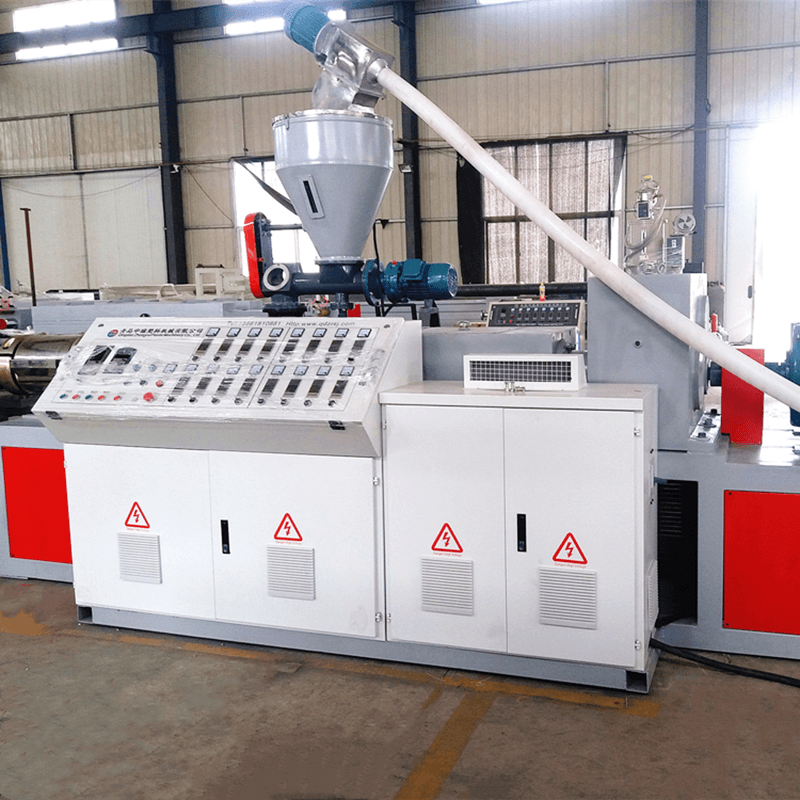
Your preparation strategy must seamlessly integrate into your extrusion hardware. Equipment synchronization ensures continuous output. The output capacity of your mixer unit must perfectly align with the consumption rate of the PVC foam sheet board extrusion machine production line. An undersized mixer forces the extruder to wait. An oversized mixer leaves material sitting too long, inviting moisture absorption.
Dosing automation drastically improves blend accuracy. Manual batching introduces daily human error. Operators misread scales or skip ingredients entirely. We strongly argue the case for gravimetric dosing systems. Loss-in-weight feeders ensure strict compliance. They provide digital traceability. They guarantee strict adherence to your fragile formulation. Automated dosing protects your profit margins from wasteful overdosing of expensive additives.
You must evaluate your screw and barrel configuration against your material blend. Highly filled or aggressively foamed formulations require specific twin-screw designs. Conical twin screws provide the necessary compression and early melting zones. Decomposing additives create a highly corrosive environment. You need bimetallic coatings on your barrel to withstand this chemical attack. An improper screw design will sheer the material too early or fail to mix the melt homogeneously.
We advise buyers to apply strict shortlisting logic. Demand real-world material trials from machinery OEMs. Do not accept generic testing data. Send your exact resin and additive formulation to the manufacturer. Force them to run your specific blend through their proposed PVC foam board production line before signing purchase agreements. This proves the machine's degassing capabilities handle your exact gas yield.
Implementation Risks: Troubleshooting Formulation Failures
Even highly controlled environments face occasional defects. You must trace visual board defects back to their chemical roots in the mixing phase. Operators often tweak extruder temperatures blindly. They should instead audit the silo.
- Cell Collapse / Large Voids: Trace this back to an imbalance of processing aids. Low melt strength fails to encapsulate the expanding gas. Excessive blowing agents will violently rupture the cell walls. Lower your AC blowing agent ratio or increase your acrylic processing aid.
- Surface Roughness or "Yellowing": Link this to inadequate external lubrication. The hot melt sticks to the die wall. Insufficient thermal stabilizers during the hot mixing phase also cause yellowing. The core begins to burn before exiting the die lips.
- Inconsistent Board Density: Explain this through poor cooling processes. Residual heat causes static buildup in the hopper. The material forms bridges. This leads to uneven feed rates. Uneven feeding directly impacts the final gauge and weight of the board.
Your ultimate mitigation strategy requires a mindset shift. Sophisticated PLC controls on modern extrusion lines can only compensate for so much. Advanced software cannot fix a chemically imbalanced compound. Quality control must begin at the mixing silo. Routine calibration of your dosing scales prevents the majority of downstream defects.
Conclusion
Premium PVC foam board is made in the mixer just as much as it is in the extruder. Precise chemical balancing dictates your product density. Strict thermal control during compounding prevents catastrophic feeding issues. High-speed mixing determines your final surface quality. Upgrading your mixing systems will secure the longevity of your PVC foam board and plastic sheet production line.
We advise procurement and engineering teams to aggressively audit current mixing protocols. Identify manual bottlenecks. Upgrade to automated, tightly controlled prep equipment immediately. Gravimetric feeding eliminates the guesswork from your daily operations.
Consult with technical sales engineers to assess your current formulations. Request a detailed ROI analysis on automated dosing systems. Schedule a custom trial run on a commercial production line using your proprietary recipe. Taking these steps guarantees a profitable, highly stable manufacturing floor.
FAQ
Q: Can I use recycled PVC (regrind) in the foam board formulation?
A: Yes, but you must typically limit it to a specific percentage. Manufacturers safely use 10-30% depending on core layer requirements. Regrind alters the necessary stabilizer and blowing agent ratios. You must carefully adjust your lubrication package to handle the varied melt flow. Ensure superior degassing capabilities on your extrusion line to remove trapped moisture from the regrind.
Q: Why is my PVC blend caking in the extruder hopper?
A: This problem points directly to inadequate cold mixing. You likely discharged the batch from the cooling mixer at too high a temperature. Excessive residual heat causes additives to sweat. Excessive moisture in your additives also causes clumping. Ensure proper cooling down to 40°C before transferring the material to your storage silos.
Q: What is the ideal K-value for PVC foam board extrusion?
A: The ideal range is K57-K60. These lower molecular weight resins provide the lower melt viscosity required during processing. This optimal viscosity allows the foaming agents to expand evenly. The cell walls stretch smoothly without rupturing under internal gas pressure. Higher K-values create rigid melts that suppress foaming.
Q: How crucial is automated dosing for a plastic sheet production line?
A: It remains absolutely essential for commercial scale. Manual weighing introduces dangerous human error into highly sensitive chemical recipes. This leads to unpredictable density variations. You will end up rejecting entire production batches due to poor thickness control. Automated gravimetric dosing guarantees absolute consistency across continuous runs.



 +86-18561886575 (Mr.Wu)
 +8618561886575
 238 Yangzhou West Road, Jiaozhou City, Qingdao City, Shandong Province