Producing a flawless dome-shaped plastic profile is one of the most deceptively difficult challenges in extrusion manufacturing. Unlike flat strips or simple tubes, where gravity and cooling forces are predictable, a domed surface introduces complex variables like non-uniform cooling rates and significant die swell. Engineers often find that a design appearing perfect in CAD fails miserably on the production floor, collapsing into an oval or warping due to internal stress during the cooling phase.
Achieving the "Gold Standard" in dome-shaped extrusion requires bridging the gap between artistic surface modeling and industrial physics. It demands a hybrid approach: utilizing advanced surfacing logic—similar to MatrixGold or Rhino workflows—integrated with high-precision custom plastic extrusion machines. This article serves as a technical guide for engineers and procurement officers. We move beyond basic theory to explain how digital precision translates into physical production, ensuring your complex profiles hold their shape from the die lip to the final cut.
Key Takeaways
Design-to-Production Continuity: Why standard CAD tools fail at complex curves and how advanced surfacing (like Matrix/Rhino techniques) prevents die failure.
Machinery Matters: The role of the plastic extruder screw design and cooling calibration in maintaining dome structural integrity.
Vendor Evaluation: Criteria for selecting a plastic extruder manufacturer capable of handling non-flat, complex geometries.
ROI Focus: How precision die design reduces scrap rates compared to trial-and-error methods.
The Geometry of the "Matrix": Designing the Dome
The foundation of a successful extruded dome lies in the "Matrix"—the industry term for the steel die. However, treating the die design as a simple 2D shape extrusion often leads to failure. Plastic does not flow like water; it exhibits viscoelastic behavior. It remembers its previous shape and swells upon exiting the die. To counteract this, manufacturers must employ "Class A" surface modeling logic often found in high-end jewelry or automotive design.
Surface Modeling Logic and Flow Prediction
In standard engineering CAD, a designer might simply draw an arch and extrude it. In high-precision die manufacturing, this approach creates a product with sagging shoulders and a flattened top. We must use advanced techniques comparable to "Smart Flow" or "Auto Base" workflows used in MatrixGold. These methodologies prioritize surface continuity and curvature flow over simple geometric dimensions.
Designers must calculate the "land length"—the distance the plastic travels inside the steel die—differently for the center of the dome versus the edges. The material at the center of a thick dome flows faster than the material at the thin edges due to drag against the steel walls. To balance this, we utilize CAD commands similar to Extrude Normal to Surface to visualize the pressure gradient. This ensures the die geometry restricts flow in the center while encouraging flow at the edges, resulting in a uniform exit velocity.
The "Patch Trick" for Die Correction
Even the best simulations require physical tuning. Experienced manufacturers use what we call the "Patch Trick." In digital modeling, a "Patch Command" fills a hole or corrects a complex surface intersection. In physical die engineering, this translates to modifying the die lips to counteract plastic memory.
If a dome creates a "sharkskin" effect or waviness at the edges, it indicates unstable flow. A standard vendor might increase the heat, degrading the polymer. A specialist modifies the steel geometry. They slightly curve the bottom of the die—making it concave—so that when the plastic swells and cools, it settles into a perfectly flat base. This counter-distortion is calculated using the same logic as the Orient 2 Points command, aligning the theoretical flow with the physical reality of the cooling tank.
From Digital to Steel
The transition from a digital model to a physical tool is critical. We export the compensated surface geometry directly to Wire EDM (Electrical Discharge Machining) or high-speed CNC centers. This direct data transfer minimizes human error. The result is a physical "Matrix" that mirrors the digital intent, capable of guiding the molten polymer into a precise arch that holds its structure under pressure.
![How To Make A Extruded Surface Dome Shape Matrix Gold]()
Hardware Requirements: The Role of the Plastic Extruder
Design is only half the battle. You cannot produce a "Gold Standard" dome on a generic machine. The hardware must deliver melt stability that exceeds standard requirements. A standard off-the-shelf plastic extruder often pulses, creating minute pressure fluctuations. On a flat profile, these are invisible. On a domed surface, every pressure spike appears as a visual ripple or a variation in the dome’s height.
Machine Stability and Pressure Control
Maintaining the arch of a dome requires a screw design that ensures perfect melt homogeneity. If the plastic is not mixed thoroughly, temperature variations occur within the melt stream. Cooler spots are more viscous and will distort the dome shape, while hotter spots may sag.
We utilize specialized screw geometries with barrier flights and distributive mixing sections. These features shear the material gently but thoroughly, ensuring a uniform melt temperature. Furthermore, the extruder must be equipped with a melt pump. This gear pump acts as a pressure regulator, isolating the die from any surging in the screw. It delivers a volumetric consistency that is absolutely critical for maintaining the tight tolerances of a complex curved profile.
Cooling and Calibration: The Vacuum Factor
Once the plastic leaves the die, it is soft and vulnerable. Gravity immediately tries to flatten the dome. This is where the distinction between a generic line and a specialized line becomes obvious. Air cooling is rarely sufficient for high-precision domes.
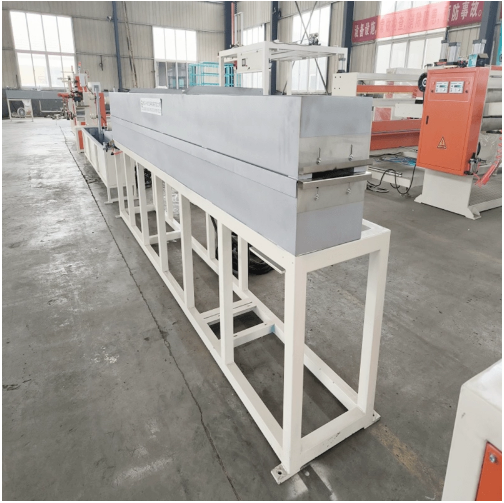
We employ vacuum sizing tanks equipped with precision-machined brass calibration sleeves. These sleeves act as a secondary mold. The vacuum pulls the soft plastic skin against the cool metal of the calibrator, freezing the dome shape instantly. The level of vacuum must be adjustable; too high, and the friction causes drag marks; too low, and the dome collapses. This sophisticated downstream setup is significantly more complex than what you would find on a standard PET strapping production line, where the profile is flat and tension creates the linearity.
Complexity Comparison: Domes vs. Standard Strapping
To understand the manufacturing tier required for domed profiles, it helps to compare them with a common industrial staple: packaging straps. This comparison highlights why specific expertise is needed for 3D geometries.
The Flat vs. Curved Debate
A packaging straps production line operates on 2D principles. The product is flat, and the primary goal is tensile strength and linearity. Cooling is straightforward because the surface area is uniform, and water can be sprayed directly onto the strip. If the strap warps slightly, it is often corrected by the haul-off tensioners.
In contrast, a domed profile presents a 3D cooling challenge. The thickest part of the dome (the center) retains heat much longer than the thin edges. If you quench it too fast, the outside creates a hard skin while the inside remains molten. As the core eventually cools and shrinks, it pulls the surface inward, creating sink marks or a concave center. The process requires "annealing" logic—cooling the profile in stages to allow internal heat to dissipate without deforming the outer geometry.
Comparative Analysis: Dome vs. Flat Extrusion
| Feature | Standard Packaging Strap | Precision Domed Profile |
| Geometry | 2D Flat Rectangular | 3D Arched/Curved |
| Die Design Focus | Flow volume & Orientation | Flow balancing & Swell compensation |
| Cooling Challenge | Low (Uniform thickness) | High (Differential cooling rates) |
| Calibration | Water Bath / Chill Rolls | Vacuum Sizing / Dry Calibration |
| Tolerance Sensitivity | Moderate (+/- 0.1mm) | Critical (+/- 0.03mm) |
Material Behavior (PET/PVC/ABS)
Different polymers react differently when forced into a dome. Rigid PVC is excellent for maintaining shape but burns easily if the die design creates too much friction. ABS offers high impact strength but is prone to significant die swell. While a manufacturer might be an expert in running a PET strapping production line, PET is a crystalline polymer with a very sharp melting point. Adapting that experience to an amorphous material like ABS in a thick dome shape requires a completely different understanding of rheology (the study of flow).
Evaluating Manufacturers for Complex Profiles
When sourcing a partner for these components, you cannot rely on general capabilities. You need to audit their specific technical competence regarding complex geometries. Here is a checklist to guide your vendor evaluation.
Technical Capability Checklist
Design Stack: Ask specifically what software they use for die design. Do they use advanced surfacing tools (SolidWorks, Rhino, or specialized flow simulation software) to simulate plastic behavior before cutting steel? If they rely solely on 2D AutoCAD, they may struggle with complex curves.
Tooling Capability: Ideally, the plastic extruder manufacturer should produce the "Matrix" (Die) in-house. Outsourcing the die adds weeks to the lead time if corrections are needed. In-house tooling allows for rapid iteration—cutting steel, testing, and modifying the lips within hours rather than days.
Equipment Customization: Can they modify the haul-off speed with precision? Preventing the dome from stretching into an oval requires a delicate balance between the extruder RPM and the puller speed. This requires vector-controlled drives that synchronize perfectly.
Red Flags to Watch For
Be cautious of vendors who promise perfect curves without discussing "draw down" ratios. The draw down ratio is the difference between the die size and the final product size. For domes, this ratio must be kept low to preserve the shape. If a vendor plans to use a generic large die and "stretch" it down to size, the dome will distort. Additionally, if they do not mention vacuum calibration tooling and suggest simple water bath cooling, it is highly likely the final product will suffer from dimensional instability.
Cost Analysis & Time-to-Market (TCO)
Investing in high-precision extrusion involves a different cost structure than purchasing standard commodity parts. Understanding this Total Cost of Ownership (TCO) is vital for project approval.
The Cost of Precision
It is true that dome-shaped dies carry a higher upfront tooling cost (NRE). The design time is longer due to the flow simulation requirements, and the manufacturing of the die involves complex 3D machining rather than simple wire cutting. However, this cost is an investment in reliability. A cheap die requires constant manual adjustment, slowing down the production line and producing inconsistent parts.
Long-term Savings
The return on investment becomes clear once production begins. Proper die design significantly reduces "start-up scrap." In a trial-and-error approach, a factory might waste hundreds of kilograms of plastic attempting to stabilize the profile every time they start the machine. With a scientifically designed matrix and a precision extruder, the profile stabilizes within minutes. Furthermore, consistent wall thickness control saves raw material. Over a production run of 100,000 meters, saving just 2 grams per meter through precise control adds up to massive material cost savings.
Conclusion
Successfully extruding a dome shape is not just about melting plastic; it is about controlling the "Matrix" and mastering the forces of flow and cooling. It requires a synergy between advanced digital design logic and robust industrial hardware. The die defines the potential, but the machine delivers the reality.
For buyers and engineers, the "Gold Standard" is finding a partner who understands this duality—one who bridges the gap between artistic surface modeling and industrial manufacturing rigor. Do not settle for "close enough" when physics allows for perfection.
We encourage you to submit your 3D CAD files for a comprehensive feasibility review. Let us analyze your geometry and demonstrate how our precision machinery can bring your complex profiles to life.
FAQ
Q: Can any plastic extruder machine produce a dome shape?
A: Not efficiently. While basic extruders push plastic, maintaining a consistent dome shape requires custom plastic extrusion machines with precise vacuum calibration tables. Without vacuum sizing, the semi-molten plastic will sag due to gravity or distort during cooling, resulting in a flat or irregular profile rather than a perfect arch.
Q: Why is designing a dome die (matrix) more expensive than a flat die?
A: A flat die, like those used in a packaging straps production line, operates in 2D. A dome die requires 3D flow balancing to ensure the thick center and thin edges flow at the exact same speed. This requires complex simulation and CNC machining, increasing the upfront engineering time and cost.
Q: What is the "Matrix" in plastic extrusion?
A: In this context, the "Matrix" refers to the extrusion die—the specialized metal tool the plastic is pushed through to give it shape. High-precision dies are often designed using advanced CAD software similar to MatrixGold to ensure perfect surface continuity and correct for "die swell" (the expansion of plastic as it exits the tool).
Q: How does material selection affect dome extrusion?
A: Rigid materials (like rigid PVC) hold dome shapes better than softer materials (like LDPE). If you are adapting a line used for packaging straps (often PET or PP), the cooling setup must be completely reconfigured. Crystalline materials like PET require rapid cooling to set properties, while amorphous materials may need gradual cooling to prevent warping in a 3D dome profile.



 +86-18561886575 (Mr.Wu)
 +8618561886575
 238 Yangzhou West Road, Jiaozhou City, Qingdao City, Shandong Province