Profit margins in manufacturing rigid substrates for the signage and furniture industries rely entirely on precise equipment configuration. You cannot simply buy a standard machine and expect to dominate both markets. A generic setup leads to inconsistent board density, poor surface finish, and high scrap rates. Configuring a targeted production line requires balancing output capacity alongside exact market specifications. You must meet strict CNC routing tolerances and ensure perfect lamination readiness.
This guide provides an evidence-based framework for evaluating and selecting the right extrusion and calibration equipment. We base these recommendations on specific end-product demands. You will discover how different die heads, cooling systems, and extruder types directly shape your material's physical properties. By understanding these mechanical variables, you can confidently specify machinery tailored to your primary revenue drivers.
Key Takeaways
- Application Dictates Configuration: Signage requires high surface smoothness and lower density (0.4–0.5 g/cm³) for printing, while furniture demands structural integrity, screw-holding strength, and higher density (0.55–0.7 g/cm³).
- Process Technology Matters: Free-foam configurations suit standard advertising boards, whereas Celuka (crust foam) or co-extrusion (ABA/multi-layer) setups are non-negotiable for premium furniture and durable outdoor signage.
- Vendor Evaluation Focus: Shortlisting a machinery partner must prioritize downstream capabilities—specifically die-head precision, calibration table cooling efficiency, and post-processing integration.
Defining Baseline Requirements: Signage vs. Furniture Production
You must understand your target market before selecting equipment. Signage applications and furniture manufacturing require vastly different physical board properties. You cannot effectively produce both on a basic single-layer machine without substantial hardware modifications.
Signage Market Demands
The advertising and display sectors prioritize printability and weight reduction. Manufacturers utilizing specialized PVC advertising board production machinery focus heavily on surface consistency. The surface finish must accept UV digital printing directly. It also needs to support vinyl adhesion without requiring a primer coat. Any surface pits or ripples will immediately ruin high-resolution prints.
Machinability represents another critical factor. Signage shops frequently use CNC routers and die-cutting presses to shape the material. The board requires clean edges during these processes. Chipping or crumbling along the cut line results in rejected parts. To achieve this, the boards typically feature a 2mm to 10mm thickness. They maintain a lightweight profile, generally targeting a density between 0.4 and 0.5 g/cm³.
Furniture & Cabinetry Demands
Furniture manufacturing presents much harsher structural demands. Cabinetry requires mechanical strength, moisture resistance, and load-bearing rigidity. High screw-holding capacity is non-negotiable. If a cabinet hinge rips out under stress, the board fails its primary purpose.
Finishing readiness also separates furniture-grade boards from basic signage substrates. The material must support secondary decorative finishes seamlessly. These finishes include PVC film lamination, acrylic capping, and hot-melt edge banding. Boards designed for furniture usually range from 12mm to 18mm or thicker. They demand a dense, hard-crust surface with an overall density between 0.55 and 0.7 g/cm³.
The BoFu Decision
You must determine your primary revenue driver before specifying the line. A dual-purpose line is possible. However, it requires a significant investment in variable die heads and advanced multi-layer capabilities. Attempting to force one simple machine to do both jobs compromises quality across both product lines.
Baseline Specifications Comparison
| Parameter | Signage Boards | Furniture Boards |
| Typical Thickness | 2mm – 10mm | 12mm – 18mm+ |
| Target Density | 0.4 – 0.5 g/cm³ | 0.55 – 0.7 g/cm³ |
| Key Surface Trait | Matte, highly smooth for ink | Hard crust, scratch resistant |
| Machining Focus | Die-cutting, light CNC routing | Heavy routing, edge banding, screw retention |
![PVC Foam Board Line Configuration]()
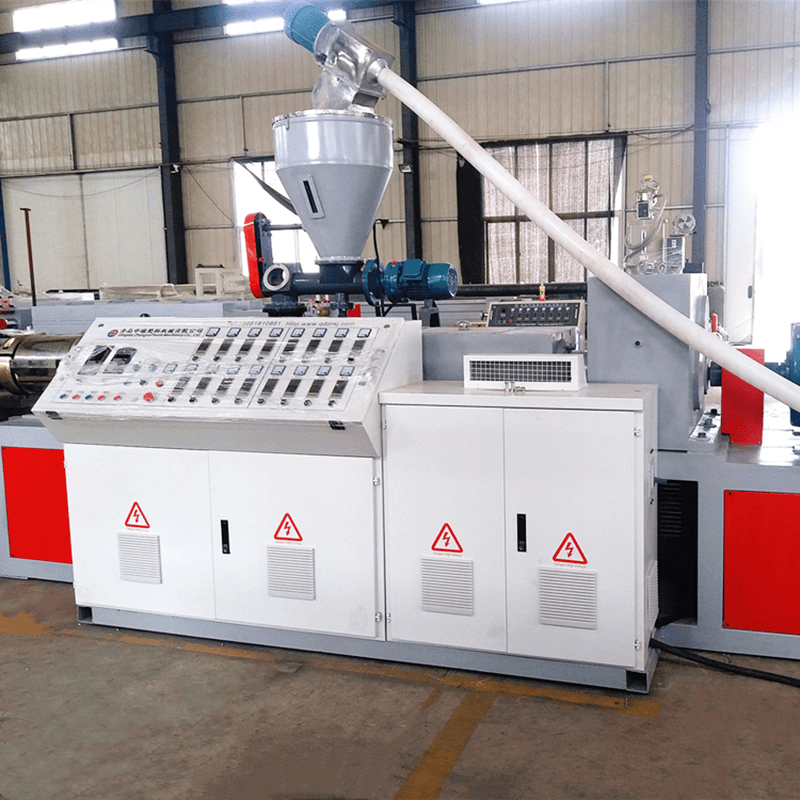
Core Architecture of a PVC Foam Board Production Line
The mechanical architecture determines your operational success. Every module must synchronize perfectly to maintain continuous production. We will break down the fundamental units required to process raw resin into a finished, saleable board.
Extrusion Unit Selection
The extruder acts as the heart of your operation. You generally choose between two primary designs. We evaluate them based on melt pressure generation, plasticization consistency, and additive dispersion.
- Conical Twin-Screw Extruders: These machines excel at building high melt pressure quickly. They handle heavy calcium carbonate loads efficiently. Manufacturers often prefer them for high-density furniture boards because they provide aggressive shearing and mixing.
- Parallel Twin-Screw Extruders: These units offer a longer processing zone. They provide gentle, highly consistent plasticization. This gentler processing makes them ideal for lighter-density signage boards where maintaining delicate cell structure matters most.
Regardless of screw design, you need a gravimetric dosing system. This technology ensures strict formula control. It constantly weighs raw materials as they enter the extruder, minimizing raw material waste and preventing density fluctuations.
Die Head and Foaming Technology
Your die head selection directly limits what products you can manufacture. Free foam die heads allow the PVC melt to expand freely upon exiting the die lip. This creates a uniform cell structure from core to surface. It produces a slightly softer surface, which suits standard advertising boards perfectly.
In contrast, Celuka die heads are mandatory for furniture-grade PVC foam board. The Celuka process forces the outer layers of the melt to cool instantly upon entering the calibrator. This suppresses foaming at the surface, creating a tough, rigid crust while the inner core foams normally.
For premium applications, manufacturers use co-extrusion blocks. An A-B-A setup combines two extruders into one die head. This allows you to create rigid multi-layer sheets utilizing recycled cores and virgin outer crusts.
Calibration and Cooling
Once the material leaves the die, it enters the vacuum calibration table. The length and zone configuration of this table dictate your maximum line speed. Proper calibration locks the board's dimensions in place before the plastic solidifies entirely.
Water temperature control directly impacts sheet flatness and surface hardness. If the cooling water is too warm, the board will warp. If it is too cold at the entry point, it can cause thermal shock and internal stress fractures. Multi-zone temperature regulation is critical.
Downstream Haul-off and Cutting
The downstream equipment manages the physical handling of the continuous board. Rubber-roller haul-off units pull the material at a precise, synchronized speed. Any surging here will cause thickness variations.
You must integrate dust-free automatic cutters and robotic stackers to achieve a seamless PVC foam sheet board extrusion machine production line. Dust-free cutting protects the factory environment and keeps the board surfaces clean for downstream printing or lamination.
Evaluating Multi-Layer and Co-Extrusion Upgrades
Many manufacturers eventually face the decision to upgrade from single-layer setups. Adding a secondary extruder fundamentally changes your market positioning. We need to evaluate the business case for adopting A-B-A co-extrusion technology.
The Business Case for Co-Extrusion
Analyzing the ROI of adding a secondary extruder requires looking closely at material economics. Standard single-layer boards use one homogenous mixture. If you want a pristine, bright-white surface, you must use expensive virgin resin and high-grade titanium dioxide throughout the entire core. Co-extrusion solves this expensive problem.
Cost Efficiency
An A-B-A setup creates immense cost efficiency. You can use highly filled or recycled PVC in the thick core layer (the "B" layer). Meanwhile, you maintain premium surface characteristics on the thin outer layers (the "A" layers). This strategy drastically lowers your average raw material cost per square meter without sacrificing visual quality.
Performance Output
Co-extruded boards deliver exceptional performance output. By combining a dense, hard outer skin with a lightweight foamed core, you achieve the rigidity of solid plastics at the weight and cost of foam. This unique strength-to-weight ratio helps capture high-end architectural and retail display markets that reject flimsy single-layer alternatives.
Risk Assessment
However, co-extrusion carries notable operational risks. You face a higher initial CAPEX because you are purchasing two extruders, a complex combining block, and a specialized die. Furthermore, operators face a steeper operational learning curve compared to standard single-layer lines. Synchronizing the output of two separate extruders requires advanced control systems and experienced technicians.
Implementation Realities and Operational Risks
Paper specifications only tell half the story. Running a continuous extrusion facility involves significant daily challenges. Recognizing these hurdles early prevents catastrophic downtime during your first year of operation.
Formulation Sensitivity
The machine is only as good as the recipe. You cannot run a generic PVC formulation and expect premium results. The precise balance of stabilizers, foaming agents, and lubricants heavily impacts the extruder's torque. If your lubrication is off, the melt will stick to the barrel, causing material degradation. Minor formulation changes drastically alter the board's internal cell structure.
Energy Consumption and Utility Constraints
You must carefully audit your factory's infrastructure. Real-world power requirements often exceed initial estimates. Extruders draw massive amperage during startup to heat the barrels. Beyond electricity, you must account for chilled water system necessities.
Setting up a complete plastic sheet production line requires robust factory footprint planning. You need adequate space for raw material silos, mixing towers, extrusion lengths, and large staging areas for cooling finished pallets.
Yield Rate Drop-offs
Expect common bottlenecks during your startup phase. These issues temporarily destroy your yield rates. Prepare to troubleshoot the following typical problems:
- Die-lip buildup: Also known as "plate-out," where additives separate and burn onto the die exit, causing deep scratches on the board surface.
- Uneven cooling: Poor water distribution in the calibration table causes the board to warp or bow after stacking.
- Edge-trimming waste: Improper haul-off alignment forces operators to trim larger margins, increasing material waste.
Vendor Shortlisting Logic & Next Steps
Selecting a machinery supplier requires rigorous scrutiny. Marketing brochures often exaggerate capabilities. You need a structured approach to evaluate potential manufacturing partners before signing purchase agreements.
Evidence-Based Vetting
Demand verifiable production data from prospective vendors. Do not accept theoretical machine capacity based on motor sizes alone. Request exact figures comparing kg/hour output versus actual saleable board yield. A high-speed PVC foam board production line is worthless if 15% of the output fails quality control due to dimensional instability.
Testing Requirements
Require a factory acceptance test (FAT) prior to shipment. You should use your specific material formulation during this test. The vendor must verify targeted density ranges and prove the material hits your required surface hardness (measured in Shore D). Do not rely on their optimized "demo" formulation to prove the machine's capability.
After-Sales and Tooling Support
Assess the manufacturer’s ability to supply custom die heads promptly. High-mineral formulations wear down internal machinery rapidly. Evaluate their lead times for the prompt replacement of wear parts, specifically screws and barrels. Extended downtime waiting for a replacement screw destroys your annual profitability.
Next Action
Your next step involves building a comprehensive Request for Proposal (RFP). This document must specify exact end-product tolerances. Define your acceptable thickness variance (e.g., +/- 0.15mm) and strict density ranges. Force vendors to quote machinery guaranteed to meet these precise metrics rather than just quoting standard motor and heater sizes.
Conclusion
Aligning machinery specifications with your specific market-entry strategies defines your operational success. Producing high-margin substrates requires deep technical alignment between your raw material formulation, die head selection, and cooling infrastructure.
We strongly recommend investing heavily in high-quality die heads and precise vacuum calibration systems. Upfront capital allocated to these critical components yields long-term profitability through dramatically lower scrap rates. It also provides higher material versatility when market demands shift.
Promptly finalize your primary application target—whether signage, furniture, or a strategic hybrid—before initiating detailed vendor negotiations. Approaching suppliers with concrete dimensional tolerances and defined material properties ensures you purchase a tailored solution, not just an off-the-shelf machine.
FAQ
Q: What is the typical ROI timeline for a standard PVC foam board extrusion line?
A: A standard line typically achieves ROI within 18 to 24 months. This timeline depends heavily on maintaining a high capacity utilization rate, usually operating 24 hours a day. Effective scrap recycling systems also accelerate ROI by significantly reducing material cost variances over the year.
Q: Can a single production line produce both 3mm advertising boards and 18mm furniture boards?
A: Yes, but it is highly complex. Producing this range requires swapping different die lips and adjusting calibration plates. The cooling capacities needed for an 18mm crust board far exceed those for a 3mm free foam board. Process shifts between these extremes cause significant material waste during transition periods.
Q: How does Celuka foaming differ from free foaming in actual production?
A: Celuka foaming forces the extruded melt into a calibrated cooling sleeve immediately. This rapid chilling stops surface expansion, forming a hard, dense outer crust. Free foaming allows the melt to expand naturally in the air before calibration, resulting in uniform density and a softer, matte surface.
Q: What are the common CNC machining parameters for boards produced on these lines?
A: For 18mm furniture-grade boards, operators typically use single-flute up-cut bits. Spindle speeds range from 16,000 to 18,000 RPM. Feed rates generally sit between 150 to 250 inches per minute. These parameters prevent heat buildup, ensuring clean edges without melting the PVC substrate.



 +86-18561886575 (Mr.Wu)
 +8618561886575
 238 Yangzhou West Road, Jiaozhou City, Qingdao City, Shandong Province