Zhongrui's High-capacity PP Packaging Belt Production Line is engineered for efficiency and high output. This innovative machine produces durable, flexible, and cost-effective PP straps, replacing traditional steel straps across various industries. Ideal for manufacturers seeking quality and sustainability.
According to many years of plastic machinery development and design experience, in the introduction of foreign advanced technology and digestion and absorption, on the basis of self-developed PE pipe production line. Has the unique structure, the design is novel, the equipment entire line layout is reasonable, the control performance is strong and so on.
The PE/PPR Pipe Production Line delivers reliable and efficient manufacturing of various pipes for water supply and drainage in agriculture and construction. Experience advanced technology and precision for high-quality production.
Discover the Highly Cost Effective PVC Pipe Production Line from Zhongrui. Engineered for durability and efficiency, this advanced production line ensures high-quality PVC pipes suitable for a variety of applications. Experience seamless operation, reduced maintenance, and significant cost savings.
The Composite Infiltration Irrigation Pipe Production Line is a high-efficiency system designed to produce drip irrigation tape for agricultural applications. With precision control, energy-saving technology, and advanced automation, it ensures superior performance in greenhouse, field crop, and water conservation irrigation systems.
Discover the PVC Hose Production Line designed for efficient, high-speed manufacturing of PVC hoses. Our advanced system ensures precision, versatility, and durability, making it an ideal choice for various industrial applications.
The PVC Imitation Marble Sheet Slab Extruder Machine Production Line is designed for producing high-quality, durable, and visually appealing marble-like PVC sheets. Offering fire resistance, water resistance, and high-temperature durability, it’s ideal for a variety of interior decoration applications. This advanced extrusion line guarantees high efficiency and stable output, making it a top choice for businesses looking to scale up production.
Zhongrui's PMMA Board Production Line is designed for precision, high-output plastic sheet manufacturing. With advanced technology including a vertical three-roll calender, Siemens motor, and ABB inverter, it ensures high plasticizing ability and energy-efficient performance. Ideal for producing PMMA, PC, and ABS sheets for construction, packaging, and automotive industries.
0
0
Plastic Pipe Production Line Installation Steps Explained Clearly
Views: 0 Author: Site Editor Publish Time: 2026-06-01 Origin: Site
Deploying extrusion machinery represents a high-stakes capital expenditure where theoretical return on investment meets operational reality. The transition from equipment delivery to commercial-grade manufacturing requires absolute precision. Post-purchase installation dictates whether a facility achieves immediate profitability or suffers from chronic production bottlenecks. Improper installation introduces severe operational risks. Misalignment between the extruder and downstream equipment leads to uneven wall thickness and excessive scrap rates. Inadequate cooling infrastructure causes material deformation and ovality, while poor dry-blend preparation compromises polymer integrity. Furthermore, a delayed commissioning phase extends time-to-market, directly impacting revenue projections and operational efficiency. To mitigate these deployment risks, plant managers and engineers must rely on a standardized, phase-by-phase installation framework. This systematic approach ensures structural integrity, aligns mechanical and electrical systems with exact tolerances, and accelerates the path to stable, high-yield production across any Plastic Pipe Production Line deployment.
Site Readiness Dictates Timeline: Proper foundation leveling, utility routing (power, chilled water, compressed air), and material feeding preparation must precede machinery delivery to prevent costly delays.
Precision Alignment is Non-Negotiable: The optical or laser alignment of the extruder, die head, and downstream equipment directly impacts pipe concentricity and material yield.
Material-Specific Configurations Matter: Installation parameters shift significantly depending on the polymer; a PVC setup requires different blending, thermal, and anti-corrosion handling compared to a PE/PPR configuration.
Phase 1: Pre-Installation Site Preparation and Infrastructure
Foundation and Spatial Requirements
Heavy extrusion machinery demands rigorous foundation preparation to prevent long-term settling and structural fatigue. The main extruder, particularly the motor and gearbox assembly, generates substantial dynamic loads. Concrete floors must meet specific load-bearing capacities, often requiring reinforced pads isolated from the main facility floor to dampen vibration. When you pour the pad, ensure a minimum of 3000 PSI concrete, cured for at least 28 days before anchoring the machine.
Spatial footprint planning extends beyond the machinery dimensions. Facilities must allocate adequate space for maintenance clearances, allowing technicians to safely extract the screw or service the die head. Raw material staging areas need proximity to feeding systems, while finished product run-out zones must accommodate the maximum cut length of the pipe, plus packaging and forklift maneuvering space. Vibration isolation pads or specialized leveling mounts are mandatory under the main extruder to protect sensitive gearbox bearings and maintain alignment over time.
Raw Material Processing Footprint
Efficient material handling dictates the layout of the upstream processing footprint. Heavy-duty material storage silos require dedicated structural supports and weatherproofing if located externally. Inside the facility, space must be allocated for pneumatic conveying piping, ensuring sweeping bends to prevent material degradation or plugging. Sharp 90-degree elbows will cause material impact degradation and frequent blockages.
Automated batching and mixing stations demand vertical clearance for gravity feeding into hoppers. Dust control is paramount in these zones. Exhaust ventilation and dust collection systems must be installed directly above raw material dumping stations and dry-blending units to maintain a safe working environment and prevent particulate contamination of the extrusion process.
Utility Mapping and Capacity Planning
Extrusion lines consume massive amounts of energy and water. Utility infrastructure must be mapped and installed prior to equipment arrival. Never underestimate the peak load requirements during startup.
Utility Type
Critical Requirements
Implementation Focus
Electrical
Industrial voltage, high-capacity transformers
Dedicated grounding for PLC panels to prevent signal interference. Separate high and low voltage trays.
Cooling Water
High flow rate, stable pressure, low temperature
Closed-loop chilled water systems sized for vacuum calibration tanks. Minimum 3 bar pressure.
Pneumatics
Clean, dry compressed air
Consistent pressure for haul-off units, cutting saws, and belling machines. Install inline desiccant dryers.
Phase 2: Core Machinery Positioning and Sequential Assembly
Raw Material Conveying and Blending Station Setup
The installation sequence begins with the raw material handling systems. Vacuum loaders, hopper loaders, and conveying pipelines must be securely mounted and routed from the storage silos directly to the extruder hopper. Pipeline joints require airtight seals to maintain vacuum pressure and prevent material leakage. Use heavy-duty clamps and inspect every gasket.
For operations utilizing PVC powder, the positioning and calibration of vertical and horizontal high-speed mixers are critical. These hot and cold mixer units homogenize PVC powder with stabilizers and lubricants. The mixers must be perfectly leveled, and their cooling jackets connected to the chilled water supply to rapidly drop the temperature of the dry blend before it enters the extruder. A poorly leveled mixer will vibrate violently and destroy its main bearings within months.
Extruder and Die Head Installation
Positioning the main extruder requires specialized rigging and lifting protocols. Cranes or heavy-duty forklifts must lift the unit using designated factory lifting points to prevent frame distortion. Once positioned over the foundation pad, the extruder is leveled using precision machinist levels on the barrel and gearbox. Tolerance should be within 0.05mm per meter.
Mounting the extrusion die head is a highly sensitive procedure. Technicians must adhere strictly to torque specifications when tightening flange bolts to ensure a leak-proof seal under high melt pressure. Use a star pattern when torquing bolts. Thermal expansion allowances must be calculated, as the metal components will expand significantly when heated to operational temperatures. Finally, the gravimetric dosing system is integrated above the feed throat, requiring precise calibration to ensure accurate raw material feed rates based on the line speed.
Downstream Equipment Alignment and Belling Machine Integration
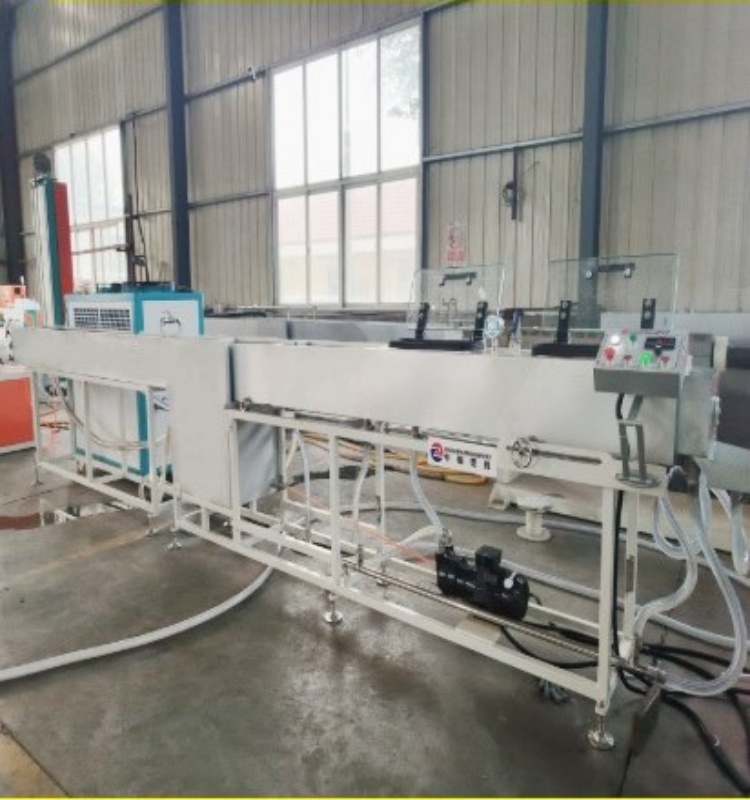
Downstream alignment dictates the final quality of the pipe. The vacuum calibration tank must be aligned with the die head using laser alignment tools. Even a millimeter of deviation can cause uneven cooling and pipe ovality. The tank is mounted on adjustable tracks to allow longitudinal movement during startup. Do not eyeball this step; use a proper laser transit.
The haul-off (puller) unit is positioned next, requiring exact centerline alignment to maintain consistent line tension without crushing or deforming the semi-molten pipe. Following the puller, the planetary or chipless cutter is installed, synchronized to the line speed to ensure clean, square cuts. Finally, the inline pipe belling (socketing) machine is aligned and integrated. This unit must synchronize seamlessly with the cutting unit, receiving the cut pipe, heating the end, and forming the socket joint automatically.
Phase 3: Material-Specific Configuration Nuances
PVC Pipe Production Line Setup
Installing a PVC Pipe Production Line involves specific mechanical configurations due to the material's thermal sensitivity and high viscosity. These lines typically utilize conical or parallel twin-screw extruders, which require precise gearbox alignment to handle immense torque. Because PVC releases corrosive gases when heated, the screw and barrel must feature specialized bimetallic or nitride treatments. Inspect these coatings upon delivery.
Furthermore, the vacuum degassing venting setup on the extruder barrel must be meticulously installed to extract moisture and volatiles, preventing porosity in the final pipe. The die head calibration involves connecting multiple independent heating zones, allowing operators to tightly control the melt rheology and prevent material degradation. Ensure all thermocouple wires are shielded and routed away from power cables.
PE/PPR Pipe Production Line Setup
A PE/PPR Pipe Production Line generally relies on high-speed single-screw extruders optimized for polyolefins. The installation focus shifts heavily toward the cooling infrastructure. Polyolefins have a high specific heat capacity, meaning they retain heat longer than PVC. If you shortchange the cooling length, you will pull oval pipes all day.
This requires the installation of extended cooling tanks, often utilizing high-volume spray baths rather than full immersion. Internal pipe cooling systems may also be installed for thick-walled pipes. Additionally, co-extrusion utility setups are integrated at the die head to apply color-stripe markings, requiring the installation of a secondary, smaller extruder mounted alongside the main unit. Aligning the co-extruder requires the same precision as the main barrel.
Specialty Extrusion Lines
Specialty applications demand unique installation protocols. A Bellows Production Line requires the precise installation and synchronization of corrugator blocks. These mold blocks must cycle seamlessly on a track, integrating with vacuum forming systems to shape the corrugated profile without trapping air. Lubrication systems for the block tracks must be primed and tested before the first run.
For agricultural applications, a Composite Infiltration Irrigation Pipe Production Line involves complex co-extrusion setups and multi-layer die heads. The critical installation step here is the integration of automated dripper insertion mechanisms, which must punch and insert emitters at exact intervals while the pipe is still in a semi-molten state. Timing is everything; calibrate the insertion sensors with a high-speed oscilloscope if necessary.
Conversely, a pu pipe production line focuses on tension control. Polyurethane is highly flexible and lightweight, requiring specialized haul-off belts that apply minimal pressure, combined with precision winding and coiling mechanisms that prevent stretching or flattening of the tubing during packaging. Set the dancer arm tensions to the lowest possible functional setting during initial calibration.
Phase 4: Systems Integration and Control Automation
Electrical and Sensor Wiring
Modern extrusion lines rely heavily on sensor data and automated controls. The routing of power cables and signal wires must be physically separated in different cable trays to minimize electromagnetic interference (EMI). High-voltage lines powering the main extruder motor can easily disrupt the low-voltage signals from sensitive instrumentation if routed together. Maintain at least 300mm of separation between high and low voltage trays.
Technicians must carefully install and calibrate melt pressure transducers and thermocouples along the barrel and die head. Apply anti-seize compound to transducer threads to prevent galling. Infrared wall-thickness monitors and line speed encoders are mounted on the downstream equipment, requiring precise optical alignment to provide accurate, real-time feedback to the central control system.
PLC and HMI Configuration
The central nervous system of the line is the Programmable Logic Controller (PLC) and Human-Machine Interface (HMI). Booting the control system involves establishing robust communication protocols between the main extruder and all downstream components. Verify IP addresses and subnet masks for all nodes on the machine network.
Engineers must configure safety interlocks and emergency stop (E-stop) loops, ensuring that a fault in the haul-off unit immediately halts the extruder to prevent material buildup. Automated fault detection parameters are programmed into the HMI, setting acceptable tolerance bands for temperature, pressure, and line speed, triggering alarms if the process deviates. Test every single E-stop button physically before signing off on the electrical installation.
Phase 5: Commissioning, Calibration, and Testing
The Dry Run (Mechanical & Electrical Validation)
Before any polymer is introduced, a comprehensive dry run is mandatory. This phase validates mechanical and electrical integrity. Technicians execute motor rotation checks to ensure the screw turns in the correct direction. Heater bands are powered on to verify they reach setpoint temperatures, and vacuum pumps are tested for suction capacity. Check for cold spots on the barrel using a thermal imaging camera.
Pneumatic pressure validation ensures the cutter and belling machine actuate correctly. A critical step during the dry run is verifying the synchronization of the haul-off speed with the extruder screw RPM, ensuring the control system accurately scales the speeds of both units simultaneously. Run the line empty for at least four hours to monitor gearbox temperatures and listen for abnormal bearing noise.
The Wet Run (Polymer Extrusion & Optimization)
The wet run introduces raw material into the system. The barrel is purged, and the first semi-molten pipe is manually pulled through the calibration sleeve and into the haul-off unit. This requires coordinated teamwork to maintain tension and prevent the pipe from snapping or jamming. Wear heavy heat-resistant gloves and use proper pulling grips.
Once the line is pulling continuously, operators adjust water flow, vacuum pressure, and die centering bolts to achieve the target wall thickness and outer diameter (OD) tolerances. Post-commissioning product testing protocols are immediately implemented. Samples are cut and tested to verify compliance with industry standards for dimensional accuracy, hydrostatic pressure resistance, and joint integrity. Adjust the die bolts in small increments—no more than a quarter turn at a time—and wait for the change to propagate down the line.
Phase 6: Implementation Risks and Mitigation Strategies
Common Installation Failures
Recognizing frequent installation pitfalls allows project managers to proactively mitigate risks. Inadequate foundation leveling is a primary cause of premature gearbox wear and screw-to-barrel friction. Insufficient cooling water pressure or elevated water temperatures inevitably lead to pipe ovality and dimensional failure. Always install pressure gauges on both the supply and return manifolds of the cooling tanks.
Poor raw material blending, often resulting from improperly calibrated mixers, causes structural weakness and brittle pipes. Additionally, poor electrical grounding frequently causes erratic PLC behavior, leading to phantom alarms and unexpected line shutdowns. Drive a dedicated grounding rod for the machine if the facility ground is noisy.
Failure Mode
Root Cause
Field Mitigation Strategy
Pipe Ovality
Misaligned calibration tank or low vacuum
Re-shoot centerline with laser; check vacuum pump seals.
Uneven Wall Thickness
Die head not centered or uneven heating
Adjust die bolts; verify thermocouple seating and heater band continuity.
Gearbox Overheating
Improper leveling or low oil level
Re-level machine base; check lubrication pump and heat exchanger.
Thorough testing and training are the best defenses against operational failure. Factory acceptance testing (FAT) at the vendor's facility prior to shipment ensures the machinery meets baseline specifications. Site acceptance testing (SAT) post-installation validates performance in the actual production environment. Do not sign the final acceptance document until the line runs at rated capacity for 24 continuous hours.
A standard training curriculum for operators is essential. This training must cover safe startup and shutdown procedures, screen changer maintenance, feed-throat temperature management to prevent bridging, and basic troubleshooting for common extrusion defects like melt fracture or die lines. Hands-on training is far more effective than classroom lectures; get the operators turning wrenches and adjusting parameters under supervision.
Conclusion
Conduct a comprehensive facility utility audit to verify electrical, chilled water, and compressed air capacities before machinery arrives.
Pour and cure reinforced concrete foundation pads specifically designed for the dynamic loads of the main extruder and downstream equipment.
Execute a strict laser alignment protocol for the extruder, die head, and vacuum calibration tanks to guarantee pipe concentricity.
Perform a full mechanical and electrical dry run to test all safety interlocks, motor rotations, and heating zones prior to introducing polymer.
Establish a rigorous Site Acceptance Testing (SAT) parameter checklist to validate continuous production at rated capacity before final sign-off.
FAQ
Q: How long does it take to install and commission a standard plastic pipe production line?
A: A realistic timeline from machinery delivery to commercial production typically ranges from 2 to 4 weeks. This depends heavily on the complexity of the line, prior site preparation, and the successful completion of dry and wet commissioning runs.
Q: What are the power requirements for a commercial PVC pipe production line?
A: Total connected load is calculated by combining the kilowatt ratings of the main extruder motor, barrel heating zones, die head heaters, and all downstream equipment motors. Industrial voltage and a dedicated high-capacity transformer are required.
Q: Do I need a specialized foundation for a large-diameter PE pipe extrusion line?
A: Yes. Large single-screw extruders generate significant weight and dynamic vibration. Reinforced concrete pads, often isolated from the main floor slab, are necessary to handle these loads and prevent long-term alignment issues.
Q: How is the vacuum calibration tank aligned with the extruder die?
A: Alignment is achieved using precision optical levels and laser alignment tools. The tank is mounted on heavy-duty, adjustable leveling mounts and lateral tracks, allowing technicians to dial in the exact centerline to match the die head output.
Q: What is the difference in installing a single-screw vs. twin-screw extruder?
A: Single-screw extruders have a smaller footprint and simpler feeding mechanisms. Twin-screw extruders require larger gearboxes, handle immense torque, and require specialized gravimetric dosing and vacuum degassing integrations.
Q: Why is closed-loop chilled water necessary for pipe extrusion?
A: Consistent, low-temperature water is critical for rapidly cooling the molten polymer as it passes through the sizing sleeve. A closed-loop chilled system maintains exact temperatures, preventing pipe shrinkage, ovality, and dimensional variations.
Qingdao Zhongrui Plastic Machinery Co., Ltd. is located in Jiaozhou City, Qingdao City, Shandong Province. It is 30 kilometers away from Qingdao Port and only 20 kilometers away from the airport.



 +86-18561886575 (Mr.Wu)
 +8618561886575
 238 Yangzhou West Road, Jiaozhou City, Qingdao City, Shandong Province