Zhongrui's High-capacity PP Packaging Belt Production Line is engineered for efficiency and high output. This innovative machine produces durable, flexible, and cost-effective PP straps, replacing traditional steel straps across various industries. Ideal for manufacturers seeking quality and sustainability.
According to many years of plastic machinery development and design experience, in the introduction of foreign advanced technology and digestion and absorption, on the basis of self-developed PE pipe production line. Has the unique structure, the design is novel, the equipment entire line layout is reasonable, the control performance is strong and so on.
The PE/PPR Pipe Production Line delivers reliable and efficient manufacturing of various pipes for water supply and drainage in agriculture and construction. Experience advanced technology and precision for high-quality production.
Discover the Highly Cost Effective PVC Pipe Production Line from Zhongrui. Engineered for durability and efficiency, this advanced production line ensures high-quality PVC pipes suitable for a variety of applications. Experience seamless operation, reduced maintenance, and significant cost savings.
The Composite Infiltration Irrigation Pipe Production Line is a high-efficiency system designed to produce drip irrigation tape for agricultural applications. With precision control, energy-saving technology, and advanced automation, it ensures superior performance in greenhouse, field crop, and water conservation irrigation systems.
Discover the PVC Hose Production Line designed for efficient, high-speed manufacturing of PVC hoses. Our advanced system ensures precision, versatility, and durability, making it an ideal choice for various industrial applications.
The PVC Imitation Marble Sheet Slab Extruder Machine Production Line is designed for producing high-quality, durable, and visually appealing marble-like PVC sheets. Offering fire resistance, water resistance, and high-temperature durability, it’s ideal for a variety of interior decoration applications. This advanced extrusion line guarantees high efficiency and stable output, making it a top choice for businesses looking to scale up production.
Zhongrui's PMMA Board Production Line is designed for precision, high-output plastic sheet manufacturing. With advanced technology including a vertical three-roll calender, Siemens motor, and ABB inverter, it ensures high plasticizing ability and energy-efficient performance. Ideal for producing PMMA, PC, and ABS sheets for construction, packaging, and automotive industries.
0
0
Plastic Profile Line Setup for Construction and Furniture Products
Views: 0 Author: Site Editor Publish Time: 2026-10-27 Origin: Site
The increasing reliance on extruded polymers in construction—such as window frames, doors, decking, and pipes—and furniture components like edge banding demands manufacturing setups capable of high precision. Investing in extrusion machinery carries significant capital risk. Selecting the wrong extruder type, inadequate cooling systems, or incompatible tooling leads to high scrap rates and dimensional instability. This holds true whether you manufacture standalone trims or complex multi-part assemblies. To establish a profitable extrusion operation, plant managers must evaluate equipment specifications and material compatibility. You need to understand the distinct processing differences between PVC and WPC. You must also assess vendor customization capabilities based on strict end-product requirements. Success requires matching the machinery precisely to the physical properties of your chosen polymers. Proper alignment between raw materials and hardware prevents warping, ensures structural integrity, and maintains consistent output across long production runs.
Material Dictates Machinery: The physical properties of the raw material require specific screw designs and barrel configurations (e.g., abrasive wood fibers require specialized metallurgy, while interior fit-outs may require specific polymer blends).
Tooling is the Bottleneck: Precision in die design and vacuum calibration tables directly determines the dimensional accuracy of complex geometries, especially for interlocking assembly parts.
Downstream Integration: A high-output extruder is only as effective as its haul-off, cutting, and stacking equipment; synchronization is critical for yield across diverse profiles.
Defining Success Criteria for Plastic Profile Extrusion
Dimensional Stability and Tolerance Requirements
Extrusion success begins with strict dimensional control. You must differentiate baseline acceptable tolerances between standalone products and complex assembly components. Simple retail trims tolerate minor variations because they do not mate with other parts. Interlocking window sashes and door frames demand absolute precision. A deviation of a fraction of a millimeter ruins the assembly process on the construction site. When parts fail to click together, the entire batch becomes scrap.
Thermal expansion and shrinkage heavily impact post-extrusion assembly. Polymers naturally expand when heated in the barrel and shrink during cooling on the calibration table. You must account for this behavior in your die design. If you ignore thermal dynamics, the final product will warp. Structural integrity suffers when interlocking parts fail to align properly. Consistent melt temperatures prevent unpredictable shrinkage rates. If the water in the first calibration tank exceeds 18°C, the outer skin of a thick profile will not freeze fast enough. The residual core heat will cause the profile to bow once it hits the cutting saw.
Application Type
Typical Material
Acceptable Tolerance
Primary Extrusion Challenge
Retail Edge Banding
Flexible PVC (F/PVC)
+/- 0.5mm
Maintaining consistent thickness at high line speeds
Window Sashes
Rigid PVC (U/PVC)
+/- 0.1mm
Aligning internal interlocking chambers perfectly
Outdoor Decking
Wood-Plastic Composite (WPC)
+/- 0.3mm
Managing thermal expansion and core cooling
Structural Supports
High-Density Polyethylene (HDPE)
+/- 0.2mm
Preventing post-extrusion warping under load
Surface Finish and Aesthetic Standards
Consumer-facing furniture components require flawless visual output. Interior fit-outs and retail store fixtures demand consistent color and texture across thousands of meters of product. Surface defects lead to immediate product rejection by quality control teams. You must define the required aesthetic standards before configuring the extrusion line. The machinery must deliver a smooth, uniform finish consistently, regardless of ambient factory conditions.
Many applications require inline embossing or lamination. Co-extruded capping layers provide necessary UV resistance. They also enhance texture and colorfastness for outdoor products. Adding a protective outer layer improves durability without increasing core material costs. You need specific downstream equipment to handle these secondary aesthetic processes seamlessly. Running an inline embossing roller requires exact speed synchronization with the haul-off unit. If the roller spins even 1% faster than the line speed, it will stretch the hot polymer, causing micro-tears on the surface.
Production Volume and Cycle Time Expectations
You must calculate the required throughput in kilograms per hour. This metric ensures you meet market demand efficiently. However, pushing an extruder beyond its optimal capacity compromises melt quality. Unmelted particles or degraded polymers ruin the structural integrity of the profile. Balance speed with consistent material plasticization. A standard 65/132 conical twin-screw extruder might push 250 kg/hr of rigid PVC comfortably. Pushing it to 280 kg/hr by simply increasing screw RPM often results in shear degradation. The material burns, leaving yellow streaks in white window profiles.
Assess the trade-off between high-speed extrusion and surface defects. Running the line too fast causes melt fracture. This creates a rough, unacceptable surface on highly visible OEM parts. You must find the sweet spot where throughput maximizes yield without sacrificing aesthetics. Proper screw design helps maintain melt quality at higher speeds. The compression ratio of the screw must match the bulk density of your specific resin blend to prevent surging at the die head.
Core Machinery: Evaluating the Production Line
The Standard PVC Profile Production Line
Choosing the right extruder is the foundation of a reliable PVC profile production line. You must compare single-screw versus conical twin-screw extruders. Single-screw machines work well for flexible PVC pellets. Conical twin-screw extruders dominate rigid PVC powder processing. They provide the necessary shear and mixing for dry blends directly from the high-speed mixer.
Map your machinery capabilities to diverse end-products. The line should handle everything from heavy-duty construction pipes to lightweight retail displays. Versatility requires robust motor drives and adaptable temperature control zones along the barrel. You also need to evaluate degassing and venting requirements. Vacuum venting removes moisture and trapped gases from the melt. This prevents porosity and structural weakness in the final plastic profile.
Verify barrel zone temperatures match the specific resin batch requirements before starting the main motor.
Engage the vacuum degassing unit only after the melt seal forms to prevent pulling raw powder into the vacuum pump.
Monitor the main motor load during the first 15 minutes of extrusion to ensure stable plasticization.
Adjust the die head bolts in small increments to balance the wall thickness of the exiting melt.
The WPC Plastic Profile Production Line
Processing wood-plastic composites introduces unique challenges. A dedicated WPC plastic profile production line must handle high moisture content. Wood fibers absorb water rapidly from the air. Wood flour holds up to 8% moisture by weight. You must dry it down to below 1% before it enters the extruder. If moisture hits the heated barrel, it turns to steam. This steam creates voids inside the profile walls, destroying its load-bearing capacity.
Gravimetric dosing systems are absolutely necessary for WPC. They ensure consistent wood-to-polymer ratios. Volumetric feeders cannot account for variations in bulk density. Consistent material ratios are required to meet strict construction codes for decking and cladding. Any fluctuation in the blend compromises the mechanical strength of the final product. A drop in polymer content makes the board brittle, while excess polymer reduces its stiffness.
Wood Plastic Profile Machine Considerations
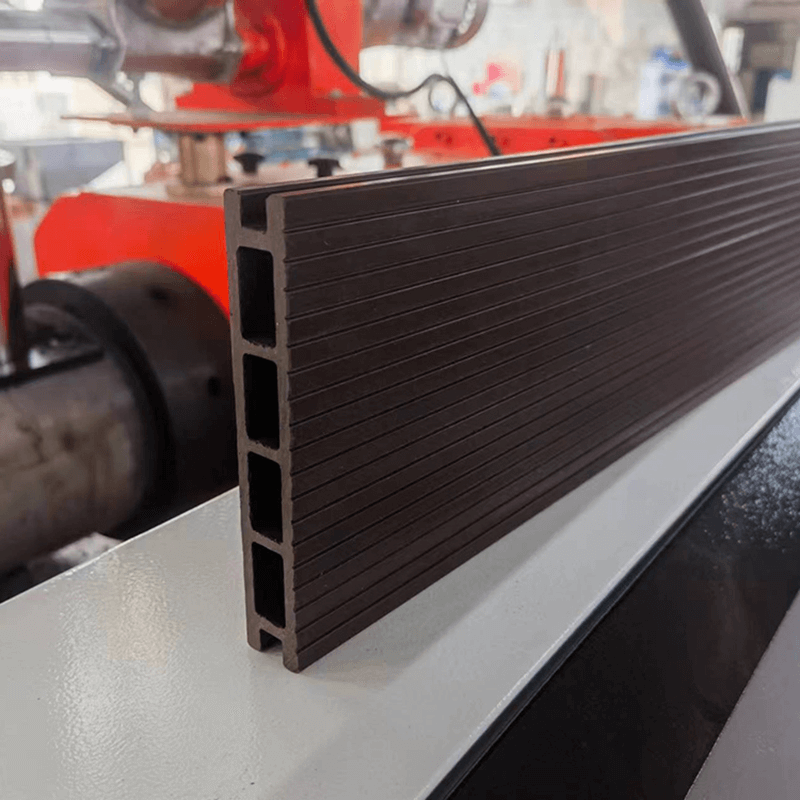
Wood fibers are highly abrasive. A reliable wood plastic profile machine requires specialized metallurgy. You must specify bimetallic screws and barrels. Standard nitrided steel wears out quickly when processing wood flour and mineral additives. The silica and impurities in the wood act like sandpaper against the screw flights. Investing in wear-resistant alloys—specifically tungsten carbide coatings—prevents premature equipment failure and maintains output consistency past 18 months of continuous operation.
Evaluate torque requirements carefully. WPC melts have very high viscosity. Pushing this dense material through a complex die demands immense power. Gearbox durability is a critical factor for heavy decking and structural profiles. An undersized gearbox will overheat and fail under continuous heavy loads. Always specify a high-torque gearbox with an independent oil cooling and filtration system to handle the backpressure generated by WPC dies.
Evaluation Dimensions: Features-to-Outcomes in Extrusion
Co-Extrusion Capabilities
Co-extrusion offers a powerful cost reduction strategy. You can combine recycled core materials with virgin outer layers. Using a co-extrusion block allows you to run 80% regrind material in the core while capping it with 20% virgin material. This maintains the required surface finish and UV resistance while dropping raw material costs significantly. This setup requires precise synchronization between the main and secondary extruders. The melt flows must merge smoothly within the die without mixing.
Evaluate the integration of secondary extruders for simultaneous U/PVC and F/PVC processing. This allows you to apply flexible weather seals directly onto rigid profiles. It eliminates the need for manual gasket insertion during assembly. The secondary extruder must have precise speed control to match the main line speed exactly. If the secondary extruder surges, the weather seal will detach from the rigid core during the cooling phase.
Tooling, Die Design, and Calibration
Die flow dynamics directly impact internal stress and profile warping. The polymer melt must exit the die at a uniform velocity. Uneven flow causes the profile to twist during cooling. A poorly balanced die forces material out the center faster than the edges. Operators try to fix this by adjusting heater bands, but that just degrades the polymer. The die channels must be wire-EDM cut to balance the flow naturally. Good die design minimizes post-extrusion dimensional changes.
Vacuum calibration tables are critical for freezing the profile shape instantly. You must evaluate the table length, water temperature control, and vacuum pump capacity. Complex geometries require strong vacuum forces to hold the walls against the sizing sleeves. Adequate cooling water flow ensures exact dimensions for interlocking assembly parts. Insufficient cooling leads to immediate deformation. When pulling a heavy WPC deck board through the calibrator, your haul-off needs sufficient contact area to prevent slippage without crushing the hollow chambers.
Customizable PVC Profile Machinery
Different industries require vastly different profile shapes. You must assess vendor capabilities to engineer bespoke dies. A reliable partner providing customizable PVC profile machinery supports diverse applications. This includes OEM furniture components, architectural trims, and custom store fixtures. The machinery must adapt to varying cross-sectional areas and wall thicknesses without requiring a complete line rebuild.
Evaluate quick-change tooling systems carefully. Product changeovers cause significant downtime. Swapping a window profile die and calibrator setup takes two operators four hours on older machines. Modern setups use centralized water manifolds and quick-release clamps, cutting that downtime to under 45 minutes. Minimizing downtime during changeovers directly improves your production margins on short-run custom orders.
Overall Value Influencing Factors and Conceptual Trade-offs
Initial CapEx vs. Long-Term Energy Efficiency
Extrusion lines consume massive amounts of electricity. You must compare the upfront cost of standard AC motors versus permanent magnet synchronous motors (PMSM). PMSM technology requires a higher initial investment. However, it significantly reduces long-term power consumption. A 75kW standard AC motor running at 80% load wastes significant energy as heat. Replacing it with a PMSM cuts power draw by up to 15%. These motors maintain high efficiency across varying load conditions.
Evaluate the efficiency of barrel heating and cooling systems. Air cooling uses fans and is cheaper to install. Water cooling provides faster, more precise temperature control. For high-shear applications, water cooling prevents polymer degradation more effectively. The choice impacts both energy usage and melt stability over long production runs. Insulated heater bands also prevent heat loss into the factory environment, reducing the load on your facility's HVAC system.
Automation vs. Manual Intervention
Analyze the return on investment for automated downstream equipment. Caterpillar haul-offs need servo motors for precise speed control. If the haul-off surges, the profile thickness fluctuates. Planetary saws must track the line speed perfectly to make a square cut without jamming the blade. Robotic stacking eliminates manual labor and reduces handling damage. Automation requires higher upfront capital but lowers ongoing operational expenses by reducing scrap and labor requirements.
Assess the value of PLC control systems. Advanced PLCs offer remote diagnostics and recipe storage. Recipe storage ensures repeatable quality across varied production runs. Operators simply load the saved parameters for a specific profile. This eliminates trial-and-error adjustments during startup. Remote diagnostics allow machinery builders to troubleshoot software issues without visiting your facility, getting you back online faster after a fault.
Dedicated Lines vs. Multi-Material Flexibility
Weigh the operational efficiency of a dedicated line against a flexible one. A line dedicated to a single high-volume profile runs continuously with minimal adjustments. A dedicated line running a single 110mm pipe profile runs 24/7 with zero die changes. It maximizes output and minimizes scrap. However, it lacks the ability to adapt to changing market demands quickly.
A flexible line handles frequent die and material changes. A custom shop running furniture edge banding might change dies three times a shift. Flexible lines need adjustable calibration tables and versatile haul-off cleats. The custom shop needs extruders with shorter L/D ratios to purge material faster between color changes. The trade-off is lower overall throughput due to changeover downtime. Choose the configuration that aligns with your specific customer base and order volumes.
Implementation Risks and Mitigation Strategies
Raw Material Inconsistencies
Variations in bulk density, moisture, or regrind quality cause severe extrusion problems. Inconsistent materials lead to surging at the die. This creates dimensional fluctuations and surface defects. Using post-industrial regrind introduces varying melt flow indices. A batch of regrind from window frames melts differently than regrind from pipes. Poor regrind quality introduces contaminants that block die channels and tear the profile surface.
Implement strict upstream material drying protocols. Ensure all polymers reach the correct moisture level before entering the hopper. You must blend regrind with virgin resin in a high-speed mixer to homogenize the batch before extrusion. Utilize continuous melt pressure monitoring at the extruder head. Pressure spikes indicate material inconsistencies or screen pack blockages. Early detection allows operators to adjust parameters before producing large amounts of scrap.
Calibration and Cooling Bottlenecks
Inadequate cooling capacity leads to profile deformation post-calibration. If the core of the profile remains hot, it will shrink unevenly after cutting. This ruins interlocking assembly tolerances. Cooling bottlenecks severely limit your maximum line speed. You cannot extrude faster than you can cool the material. A plastic profile production line relies entirely on its water system to hold shape.
Size the chilled water system for peak summer ambient temperatures. A 20-ton chiller might handle your cooling load in December. In August, when ambient temperatures hit 35°C, that same chiller will fail to drop the process water below 15°C. The profile will exit the tank soft and deform on the stacking rack. Ensure turbulent flow in calibration tanks. Turbulent water removes heat much faster than stagnant or slow-moving water. Properly designed spray nozzles maximize heat transfer away from the thickest sections of the profile.
Operator Training and Maintenance Protocols
Premature equipment failure often results from improper startup or shutdown sequences. Cold starting an extruder is the fastest way to snap a screw. Operators must let the barrel soak at the set temperature for at least 45 minutes after the controllers show they have reached the target. The core of the steel barrel takes much longer to heat than the surface. Neglected lubrication destroys bearings rapidly. Unskilled operators cause unnecessary downtime and expensive repairs.
Mandate vendor-led operational training for all shift leaders. Establish strict predictive maintenance schedules for wear parts. Monitor gearbox vibration and oil temperatures continuously. Replace worn barrel heaters before they fail completely. Clean the vacuum pump filters daily to maintain strong suction in the calibration table. Proactive maintenance prevents catastrophic breakdowns and extends the lifespan of your extrusion machinery.
Conclusion
The viability of an in-house plastic profile operation hinges on precise equipment matching. You must align extruder geometry and downstream cooling capacity to the specific thermal and physical properties of your target material. The end-use application dictates the required tolerances. Standalone trims allow more flexibility than complex interlocking assemblies. Prioritize machinery partners who offer transparent performance data. Demand verifiable material trials using your exact polymer blends. Look for robust engineering support for custom die creation across diverse industries. A strong vendor partnership ensures you can adapt to future product demands efficiently.
Audit your current product portfolio to determine the exact maximum cross-sectional area and wall thickness required.
Calculate your facility's available cooling water capacity in liters per minute to ensure it can support a new calibration table.
Specify the exact polymer blends and regrind ratios you intend to use before requesting machinery quotes.
Require equipment vendors to run a 500-kilogram material trial using your specific resin formulation to verify output quality.
FAQ
Q: What is the standard footprint required for a commercial plastic profile production line?
A: A standard line typically requires a linear footprint of 20 to 30 meters. This includes the extruder, calibration table, haul-off, cutter, and stacking rack. You also need adequate side clearance for maintenance, material handling, and die changes. Always factor in space for upstream mixers and downstream packaging.
Q: How does a WPC plastic profile production line differ technically from a standard PVC line?
A: WPC lines require specialized bimetallic screws and barrels to withstand abrasive wood fibers. They feature enhanced degassing systems to remove high moisture content. WPC extruders also utilize higher torque gearboxes to push highly viscous wood-polymer melts. Gravimetric dosing is mandatory for WPC to maintain consistent material ratios.
Q: What are the typical maintenance intervals and wear parts for a wood plastic profile machine?
A: Screws and barrels require inspection every 6 to 12 months due to wood fiber abrasion. Heater bands and thermocouples should be checked quarterly. Gearbox oil needs replacement every 2,000 to 4,000 operating hours. Vacuum pump seals and haul-off cleats are common wear parts requiring frequent monitoring.
Q: Can customizable PVC profile machinery handle both rigid and flexible co-extrusion simultaneously?
A: Yes, co-extrusion setups use a main conical twin-screw extruder for the rigid core. A secondary single-screw extruder simultaneously processes the flexible material. The melts merge inside a specialized co-extrusion die. This setup frequently produces window profiles with integrated weather seals, eliminating manual gasket insertion during assembly.
Q: How do tolerance requirements differ when extruding standalone trims versus interlocking assembly profiles?
A: Standalone trims tolerate wider dimensional variations, often +/- 0.5mm, as they do not mate with other parts. Interlocking assembly profiles, like window sashes, require strict tolerances of +/- 0.1mm or less. Any deviation prevents proper assembly, compromises weatherproofing, and ruins the structural integrity of the final product.
Q: How do you control dimensional shrinkage and warping in extruded plastic profiles?
A: Control shrinkage by optimizing die flow dynamics to minimize internal stress. Ensure the vacuum calibration table provides instant, uniform cooling. Use turbulent chilled water to extract heat rapidly. Maintain consistent melt temperatures and avoid stretching the profile excessively with the haul-off unit during the cooling phase.
Qingdao Zhongrui Plastic Machinery Co., Ltd. is located in Jiaozhou City, Qingdao City, Shandong Province. It is 30 kilometers away from Qingdao Port and only 20 kilometers away from the airport.



 +86-18561886575 (Mr.Wu)

 +8618561886575
 238 Yangzhou West Road, Jiaozhou City, Qingdao City, Shandong Province