Zhongrui's High-capacity PP Packaging Belt Production Line is engineered for efficiency and high output. This innovative machine produces durable, flexible, and cost-effective PP straps, replacing traditional steel straps across various industries. Ideal for manufacturers seeking quality and sustainability.
According to many years of plastic machinery development and design experience, in the introduction of foreign advanced technology and digestion and absorption, on the basis of self-developed PE pipe production line. Has the unique structure, the design is novel, the equipment entire line layout is reasonable, the control performance is strong and so on.
The PE/PPR Pipe Production Line delivers reliable and efficient manufacturing of various pipes for water supply and drainage in agriculture and construction. Experience advanced technology and precision for high-quality production.
Discover the Highly Cost Effective PVC Pipe Production Line from Zhongrui. Engineered for durability and efficiency, this advanced production line ensures high-quality PVC pipes suitable for a variety of applications. Experience seamless operation, reduced maintenance, and significant cost savings.
The Composite Infiltration Irrigation Pipe Production Line is a high-efficiency system designed to produce drip irrigation tape for agricultural applications. With precision control, energy-saving technology, and advanced automation, it ensures superior performance in greenhouse, field crop, and water conservation irrigation systems.
Discover the PVC Hose Production Line designed for efficient, high-speed manufacturing of PVC hoses. Our advanced system ensures precision, versatility, and durability, making it an ideal choice for various industrial applications.
The PVC Imitation Marble Sheet Slab Extruder Machine Production Line is designed for producing high-quality, durable, and visually appealing marble-like PVC sheets. Offering fire resistance, water resistance, and high-temperature durability, it’s ideal for a variety of interior decoration applications. This advanced extrusion line guarantees high efficiency and stable output, making it a top choice for businesses looking to scale up production.
Zhongrui's PMMA Board Production Line is designed for precision, high-output plastic sheet manufacturing. With advanced technology including a vertical three-roll calender, Siemens motor, and ABB inverter, it ensures high plasticizing ability and energy-efficient performance. Ideal for producing PMMA, PC, and ABS sheets for construction, packaging, and automotive industries.
0
0
Plastic Sheet Production Line: Complete Buying Guide 2026
Views: 0 Author: Site Editor Publish Time: 2026-06-08 Origin: Site
Plastics manufacturers face compounding pressures in 2026. Rising resin costs, stricter energy compliance mandates, and the demand for higher-yield extrusion processes require immediate operational upgrades. Relying on legacy machinery erodes margins. The global plastic sheet extrusion line market is expanding rapidly, projected to reach $8.1 billion by 2034. This growth forces facilities to adopt high-efficiency, adaptable manufacturing systems. Capital expenditure in heavy machinery carries high stakes. Selecting an under-specced or inflexible Plastic Sheet Production Line causes excessive scrap rates and limits your ability to pivot toward high-demand materials. Plant managers and procurement directors need a reliable evaluation framework. This guide provides technical and operational criteria to assess equipment capabilities and implementation realities effectively.
Material Flexibility is Critical: Modern lines must accommodate volatile resin markets by supporting multi-material runs (e.g., switching between PET, PE, PP, and PS) with minimal downtime.
Application-Specific Configurations: Purchasing decisions must align with end-product requirements, whether producing 150-micron thermoforming foils or rigid construction boards.
Implementation Realities: Factory footprint, utility infrastructure, and operator training timelines are primary bottlenecks that must be factored into the procurement schedule.
2026 Market Realities & Success Criteria
Raw material costs remain highly volatile across global markets. Fluctuating prices for thermoforming packaging resins like PET, PP, and PS dictate new operational strategies on the factory floor. Extrusion lines must deliver exceptional material yield to maintain profitability. Advanced scrap-recycling integration is now a standard requirement rather than an optional upgrade. Facilities must process regrind efficiently without compromising the structural integrity of the final sheet. When you run high percentages of recycled flake, melt filtration becomes a primary concern. Continuous screen changers prevent pressure spikes and keep the line running without manual intervention.
Regulatory compliance regarding power consumption is tightening globally. Strict energy mandates force manufacturers to evaluate power draw across the entire extrusion process. Legacy machinery with outdated drive systems struggles to meet these new efficiency standards. Upgrading to modern lines with optimized heating and cooling profiles ensures compliance while reducing daily operational overhead. Insulated heater bands and optimized barrel designs prevent heat loss. You need to measure energy consumption per kilogram of processed material to understand true operational efficiency.
A successful procurement decision relies on measurable outcomes. Overall Equipment Effectiveness (OEE) serves as the primary metric for operational success. Precise gauge control minimizes material giveaway and ensures consistent product quality. Adaptability to shifting market demands allows facilities to switch production profiles quickly. You maintain high utilization rates across different product campaigns when your equipment handles rapid recipe changes. Operators need intuitive control interfaces to minimize transition times between different polymer runs.
Core Categories of Plastic Sheet Production Lines
Thermoplastic and Co-Extrusion Systems
Processing engineering plastics requires specific technical configurations. A modern PC/PMMA/PE/PP/PS/ABS Sheet Production Line must feature advanced venting systems to remove moisture and volatiles. Screw design plays a critical role in achieving proper melt homogeneity. For PET processing, integrated crystallization and dehumidification systems are mandatory. You must prevent intrinsic viscosity degradation during extrusion to maintain sheet clarity and impact strength. Without proper drying, PET becomes brittle and unusable for thermoforming applications.
End-use applications dictate the required machine specifications. Optical grade sheets made from PC or PMMA demand pristine roller surfaces and cleanroom-level dust control. Thermoforming packaging utilizes PET, PP, and PS for their clarity and formability. Automotive and industrial components rely on ABS and PE for high impact resistance and durability. Each material requires specific cooling profiles on the calender stack to prevent internal stress and warping.
Multi-layer co-extrusion capabilities maximize material efficiency. A/B/A or A/B/C structural configurations allow manufacturers to utilize recycled regrind in the core layer. Virgin resin is applied to the outer layers to maintain surface finish and food-contact compliance. This approach significantly reduces raw material expenses while maintaining premium product aesthetics. Feedblock design determines the layer distribution accuracy. You need precise melt pumps to ensure consistent layer ratios across the entire sheet width.
Decorative Surface Extrusion
Architectural and interior design markets demand durable, high-quality finishes. A PVC Imitation Marble Slab Production Line handles high-filler PVC formulations. These systems require specialized twin-screw extruders capable of processing heavy calcium carbonate loads without excessive wear. Bimetallic barrels and coated screws extend the lifespan of the plasticizing unit. Calendering units must apply immense pressure to ensure high density and dimensional stability.
Inline surface treatment processes transform raw slabs into commercial-grade products. Hot stamping transfers intricate marble or wood grain patterns directly onto the hot sheet. UV coating stations apply a protective, high-gloss layer that cures instantly. This continuous process produces aesthetic finishes suitable for high-end interior decor panels. Tension control through the lamination and coating stations prevents sheet distortion. You must maintain exact line speeds to ensure uniform UV curing.
Structural Board Manufacturing
Construction and signage industries rely heavily on lightweight, rigid materials. A PVC Foam Board Production Line utilizes either the Celuka or free-foam extrusion process. The Celuka method cools the surface rapidly upon exiting the die, creating a hard, solid outer skin with a foamed core. Free-foam processes allow the melt to expand freely, resulting in a uniform density throughout the board. The choice depends entirely on the required surface hardness of the final product.
Critical components determine the final board quality. Precise temperature control in the die ensures uniform foaming agent activation. Cooling calibrators dictate surface hardness and thickness uniformity. Accurate haul-off speeds prevent internal stress, ensuring the boards remain flat and stable for printing or lamination applications. Vacuum calibration tables must provide consistent suction to hold the board against the cooling plates. Any variation in vacuum pressure leads to thickness inconsistencies and rejected boards.
Technical Evaluation Dimensions: Features to Outcomes
Extruder Configurations & Screw Design
Selecting the right extruder depends entirely on the input material. Twin-screw extruders, available in conical and parallel designs, excel at processing PVC powder blends. They provide the necessary shear and mixing for high-filler formulations. Single-screw extruders are optimal for processing pre-compounded pellets like PET, PP, and PS, offering high output rates and stable melt pressure. You must match the screw geometry to the specific polymer rheology to avoid material degradation.
The Length to Diameter (L/D) ratio impacts processing capabilities significantly. Higher L/D ratios increase residence time, improving melt homogeneity. This is crucial for processing recycled materials or complex blends. Extended barrels also provide superior degassing performance, removing trapped air and moisture before the melt reaches the die. A standard L/D ratio of 33:1 works well for general polyolefins, but PET often requires 36:1 or higher for optimal plasticization.
Extruder Type
Optimal Material
Primary Advantage
Common Application
Single Screw
Pellets (PET, PP, PS, PE)
High output, stable pressure
Thermoforming sheets, packaging
Conical Twin Screw
PVC Powder Blends
High shear, excellent mixing
Foam boards, rigid PVC panels
Parallel Twin Screw
High-Filler Formulations
Consistent output, low wear
Imitation marble slabs, thick plates
Dimensional Capacities & Tolerances
Standard nominal width ranges typically span from 400mm to 3300mm. The calender roll width must exceed the target sheet dimensions to account for edge trimming. Matching the downstream equipment to the maximum required width ensures flexibility for various customer orders. You cannot easily retrofit a wider calender stack onto an existing line, so initial sizing is critical.
Thickness capabilities define the machine's versatility. Lines can produce 150-micron thermoforming foils or thick structural plates. Automatic T-dies equipped with thermal expansion bolts adjust the lip gap in real-time. Integrated thickness scanners provide closed-loop feedback, maintaining tight tolerances and minimizing material waste. Beta-ray or X-ray scanners measure the sheet profile continuously. The control system automatically adjusts the die bolts to correct any deviations from the target gauge.
Downstream Equipment Integration
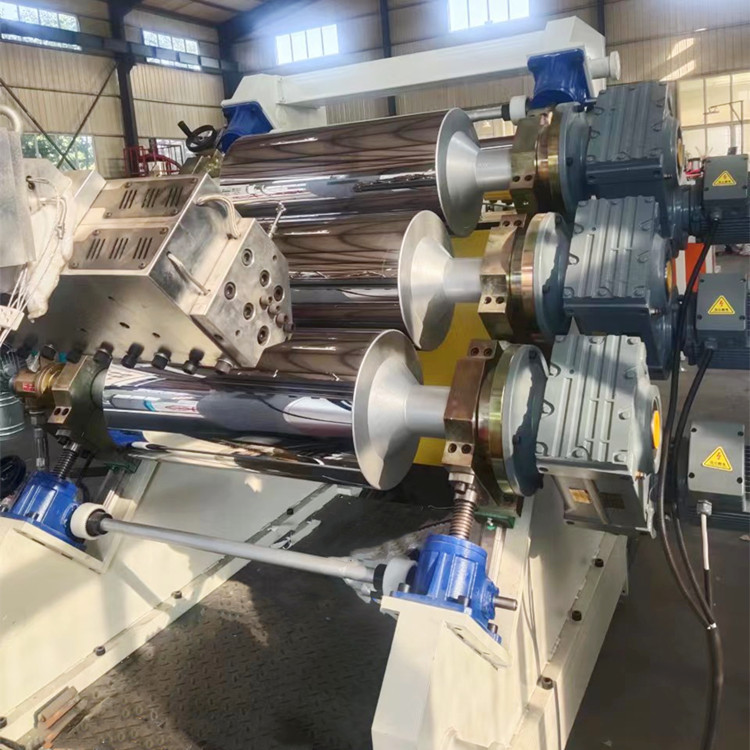
Precision three-roll calenders dictate the final surface finish. The rollers must maintain uniform temperature across their entire width. Independent servo drives for each roll prevent tension buildup. Proper cooling brackets and haul-off units support the sheet as it transitions from a melt to a solid state, preventing internal stress and warping. Roller gap adjustment must be precise to the micron level to ensure consistent sheet thickness.
Automated winding and cutting systems reduce labor requirements. Inline slitting trims the edges cleanly, feeding the scrap directly back into the extruder. Fully automated winding stations handle large roll diameters without interrupting the continuous extrusion process. Precision guillotines or saw saws cut thick plates to exact lengths. Accumulators allow for continuous line operation during roll changes. You eliminate the need to slow down the extruder when switching winding shafts.
Global Manufacturer Landscapes: Evaluating Top Extruder Factories
Tier 1 Global Manufacturers vs. Emerging Suppliers
The global market features a mix of established industry giants and emerging equipment builders. Tier 1 manufacturers offer decades of proven reliability and extensive global support networks. Emerging suppliers often provide cost-competitive alternatives with flexible customization options. Evaluating these suppliers requires a strict vetting process to ensure long-term operational success. You must look beyond the initial equipment specifications and assess the builder's manufacturing infrastructure.
Engineering capabilities separate premium builders from basic assemblers. Suppliers must demonstrate expertise in handling specific material blends and complex co-extrusion layers. The quality of in-house manufacturing is paramount. Machining tolerances for barrels, screws, and calender rolls directly impact the final product quality. Always request reference checks and verify their track record in high-output industrial environments. Visit their machining centers to inspect how they manufacture critical components like T-dies and feedblocks.
Verify the supplier's in-house machining capabilities for critical components.
Request case studies of similar lines operating in high-demand environments.
Evaluate the availability of local service technicians and spare parts.
Assess the control system architecture for open-source compatibility.
Implementation Risks & Mitigation Strategies
Factory Infrastructure & Footprint
Physical plant requirements demand careful planning. Extrusion lines require significant floor space for the machinery, downstream equipment, and material handling systems. Foundation load-bearing capacity must support heavy calender stacks. Adequate ceiling height is necessary for material silos, dosing units, and overhead crane access during maintenance. You must map out the entire material flow from resin delivery to finished roll storage.
Utility prerequisites are extensive. Chilled water systems must deliver consistent flow and temperature to the calender rolls. Compressed air systems power pneumatic controls and cutting units. A stable, high-voltage power supply is critical to prevent voltage drops during startup, which can damage sensitive drive components. Install dedicated transformers for the extrusion line to isolate it from other plant equipment. Voltage fluctuations cause inconsistent extruder RPM and sheet thickness variations.
Commissioning & Operator Training
Extended ramp-up times drain profitability. Negotiate comprehensive Factory Acceptance Testing (FAT) before the equipment ships. Conduct rigorous Site Acceptance Testing (SAT) upon installation to verify output rates and tolerances. Vendor-provided, hands-on training is essential. Operators and maintenance personnel must understand recipe management, troubleshooting, and routine calibration procedures. Do not sign off on the SAT until your operators can run the line independently at full capacity.
Supply Chain & After-Sales Support
Proprietary components introduce significant downtime risks. Source machines that utilize globally available, standardized parts. Standardized motors, drives, and bearings from reputable brands ensure quick replacements. Establish a clear service level agreement for technical support and spare parts availability to minimize production interruptions. Keep critical spare parts like heater bands, thermocouples, and screen changer seals in your local inventory.
Conclusion
The optimal extrusion line balances immediate application needs with long-term flexibility. Adapting to future material shifts and regulatory changes ensures sustained profitability. Focus on equipment that delivers precise tolerances, high material yield, and reliable continuous operation. Upgrading your facility requires careful planning and rigorous vendor evaluation.
Audit your current production capacity to identify specific bottleneck areas.
Define exact material scopes and dimensional requirements before contacting vendors.
Draft a comprehensive Request for Proposal detailing output requirements and acceptable tolerances.
Schedule physical or virtual factory audits of shortlisted machinery manufacturers.
Standardize utility infrastructure preparations to align with the equipment delivery schedule.
FAQ
Q: What is the average lifespan of a commercial plastic sheet extrusion line?
A: A well-maintained commercial extrusion line typically operates efficiently for 10 to 15 years. Regular maintenance of screws, barrels, and drive systems, along with timely software updates, extends this lifespan while maintaining acceptable output quality.
Q: How do I choose between a single-screw and twin-screw extruder for my application?
A: Single-screw extruders are best for processing pre-compounded pellets like PET, PP, and PS. Twin-screw extruders provide the high shear and mixing required for processing powder blends, such as highly filled PVC formulations.
Q: Can a single production line handle both PE and PP materials efficiently?
A: Yes, PE and PP have similar processing profiles. A properly configured line with adaptable screw designs and adjustable cooling calenders can switch between these polyolefins with minimal downtime and parameter adjustments.
Q: What are the standard pre-treatment requirements for processing PET?
A: PET requires thorough crystallization and dehumidification before extrusion. Moisture content must be reduced to less than 50 ppm to prevent hydrolytic degradation, which causes a loss of intrinsic viscosity and makes the final sheet brittle.
Q: How do automatic T-dies improve material yield compared to manual dies?
A: Automatic T-dies use thermal expansion bolts linked to a thickness scanner. They adjust the die lip gap in real-time, maintaining extremely tight gauge tolerances. This eliminates manual guesswork, reduces edge trim waste, and significantly improves overall material yield.
Qingdao Zhongrui Plastic Machinery Co., Ltd. is located in Jiaozhou City, Qingdao City, Shandong Province. It is 30 kilometers away from Qingdao Port and only 20 kilometers away from the airport.



 +86-18561886575 (Mr.Wu)
 +8618561886575
 238 Yangzhou West Road, Jiaozhou City, Qingdao City, Shandong Province