For manufacturers evaluating heavy capital investments, unlocking maximum performance from your facility stands as the primary driver of profitability. When operating a commercial plant, producing every possible square meter of PVC foam board directly influences your bottom line. However, a major disconnect exists between theoretical performance and daily reality. Nameplate capacity rarely matches your true operational yield on the factory floor. Buyers frequently overestimate output because they evaluate the extruder in isolation, entirely missing the fact that real production relies on a finely synchronized system.
This guide tackles those hidden constraints head-on. We provide a rigorous framework to help you evaluate machinery quotes accurately. You will learn to identify the exact technical bottlenecks limiting your true production speeds. Armed with these insights, you can confidently make a thoroughly evidence-based purchasing decision.
Key Takeaways
- Theoretical extrusion speed is only one factor; overall output is governed by the slowest downstream component, typically cooling and calibration.
- Raw material formulation and chemical synergy directly dictate the maximum running speed of any PVC foam sheet board extrusion machine production line.
- Reliable output claims from manufacturers must specify board thickness, density, and scrap rates to be credible.
- Procurement evaluation should prioritize Overall Equipment Effectiveness (OEE) and continuous run stability over peak theoretical kg/hr metrics.
Defining True Output: Nameplate Capacity vs. Usable Yield
Factory managers often face a frustrating business problem. They buy equipment promising high yields, but their daily production numbers fall short. You must clearly distinguish between a machine’s peak theoretical output and your actual saleable yield. Theoretical output refers to the maximum raw material an extruder can process per hour, usually measured in kilograms per hour (kg/hr). Usable yield measures the number of perfect, finished boards produced per shift.
You cannot achieve business success by simply running an extruder at maximum RPM. We define true output through three strict success criteria. First, the machine must maintain perfect dimensional stability across the entire board. Second, the product must exhibit uniform density from edge to edge. Third, the system must keep scrap rates near zero. If you increase linear speed but produce defective boards, your usable yield actually drops.
Focusing purely on extruder capacity introduces massive operational risk. A common pitfall involves buying an oversized, high-capacity extruder. If this extruder outpaces the downstream equipment, the system fails. The hot plastic will not cool fast enough. You will end up producing warped boards, causing high rejection rates and wasted resin. A balanced system always outperforms an unbalanced, high-speed extruder.
Best Practices for Output Measurement
- Track your yield based on "A-grade" boards per shift, not raw kg/hr.
- Monitor edge trim waste continuously.
- Calculate your true yield after a minimum continuous run time of eight hours.
The Role of the Twin-Screw Extruder in Maximizing Throughput
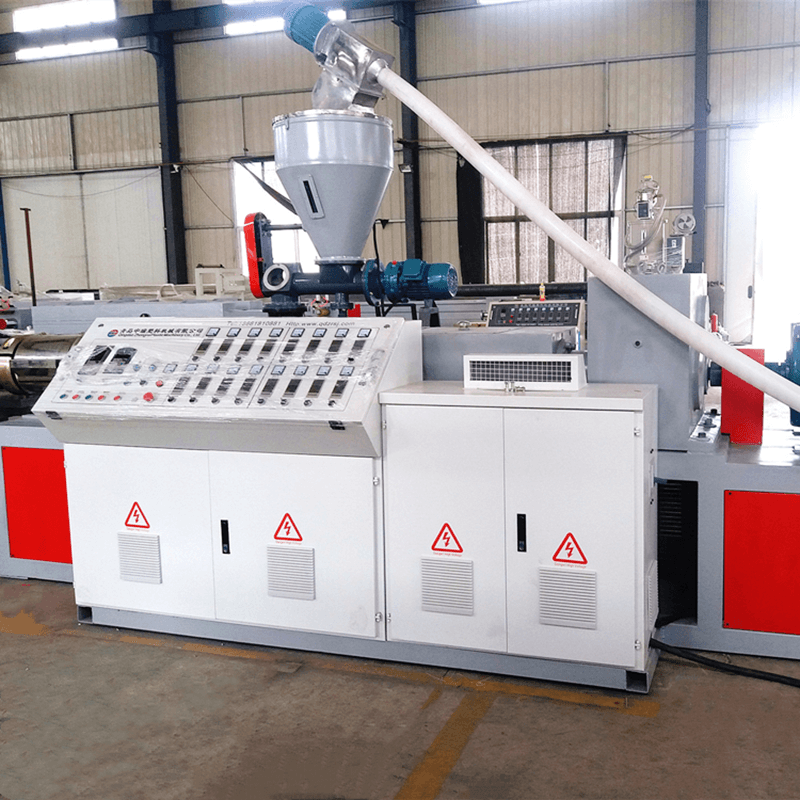
The twin-screw extruder acts as the heart of your operation. Manufacturers primarily choose between conical and parallel twin-screw extruders. Both designs impact capacity differently. Conical extruders provide excellent shear and high pressure, making them ideal for high-calcium formulations. Parallel extruders offer superior output stability at very high capacities. Selecting the right solution category determines your baseline production limits.
Extruder Design Comparison Chart
| Extruder Type | Optimal Filler Load | Melt Pressure Control | Output Characteristics |
| Conical Twin-Screw | High (e.g., heavy calcium carbonate) | Excellent shear and mixing | Highly stable for mid-to-high capacity |
| Parallel Twin-Screw | Low to Medium | Gentle plasticization | Best for massive, high-volume production |
Proper screw design and the Length-to-Diameter (L/D) ratio directly influence your outcome. A well-engineered screw geometry ensures uniform plasticization. It melts the PVC evenly without burning the delicate polymers. This geometry determines the maximum safe RPM you can run. If you spin a poorly designed screw too fast, friction creates excessive heat. This burns the material and destroys your production run.
Torque and motor power play equally critical roles. Running high-filler formulations, like those heavy in calcium carbonate, demands immense rotational force. High-torque gearboxes are absolutely mandatory here. They maintain a steady output rate against massive barrel pressure. Without sufficient torque, the motor will stall or fluctuate. These fluctuations ruin board density.
Finally, you must scrutinize the temperature control zones. Modern extruders feature precision barrel heating and cooling jackets. The exact moment of foaming occurs as the melt exits the die. Precise temperature control dictates this expansion. If your barrel cooling fails to remove excess shear heat, the foaming agents trigger prematurely. This destroys the cellular structure before the plastic even reaches the calibration mold.
![PVC foam board production line cooling and calibration section]()
Downstream Bottlenecks: Calibration, Cooling, and Haul-Off
Many buyers ignore downstream equipment during the purchasing process. This is a costly mistake. Downstream equipment is usually the true governor of output in any PVC foam board and plastic sheet production line. You can melt plastic quickly, but you must cool it precisely. If the downstream units lack capacity, your high-speed extruder becomes useless.
The calibration die and vacuum sizing table perform heavy lifting. The cooling capacity of the calibration table strictly dictates your linear pulling speed. As the hot, foaming plastic enters the sizing blocks, chilled water rapidly freezes the outer skin. This freezing action traps the expanding gas inside, forming the foam core. Insufficient chilling limits linear speed entirely. If you pull the board too fast, the core remains molten. The board will warp or collapse as soon as it leaves the table. Extruder power means nothing without massive chilling capacity.
Haul-off synchronization ensures product consistency. The haul-off unit uses rubberized rollers or caterpillars to pull the board through the cooling zones. Minor fluctuations in haul-off speed cause severe defects. If the pulling speed drops slightly, the board becomes momentarily thicker and denser. If the speed surges, the board stretches, causing thin spots and density variations. Precision servo motors must synchronize exactly with the extruder RPM.
When implementing these systems, reality dictates rigorous evaluation. Scrutinize every machinery quote carefully. Look specifically at the length of the cooling table. Check the rated capacity of the water chillers. Longer cooling tables allow faster linear speeds because they provide more time for heat transfer. Never accept a quote lacking detailed specifications regarding chiller tonnage and vacuum pump capacity.
Formulation and Chemical Synergy
Machine output heavily depends on your specific PVC formulation. You must view the equipment and the chemistry as one unified system. A standard recipe includes PVC resins, foaming agents, heat stabilizers, and varying lubricants. Each component affects how fast the material travels through the barrel. A poor formulation will choke the best machinery in the world.
Process dynamics change rapidly at high speeds. Higher outputs require faster chemical reactions. The foaming agents must decompose at the exact microsecond the melt exits the die lip. If you run the machine faster, the formulation's melt strength must increase accordingly. If the melt strength cannot withstand high-speed extrusion forces, the delicate cellular structure collapses. You will produce heavy, brittle plastic instead of lightweight foam.
End-use requirements introduce another massive variable. Board density dictates your maximum running speed. Producing low-density boards, such as 0.4 g/cm³, requires slower linear speeds. The hot melt needs extra time to expand fully before the vacuum blocks freeze its shape. Conversely, you can often run high-density boards much faster. When evaluating machine capacity, you must link output claims to specific board densities. Do not trust generic output numbers.
Common Formulation Mistakes
- Using insufficient external lubricants, causing material to stick to the sizing die and tear the board skin.
- Mismatching the decomposition temperature of the foaming agent with the extruder barrel zones.
- Adding too much calcium carbonate filler without upgrading to a high-torque gearbox.
Automation and Scrap Reduction for High OEE
Modern factories thrive on Overall Equipment Effectiveness (OEE). High OEE requires robust automation. PLC control systems, like Siemens units utilizing advanced PLC touch screens, dramatically improve scalability and control. They automate complex temperature profiles and synchronize motor speeds instantly. This reduces manual start-up times. It also minimizes costly operator errors during shift changes. A stable PLC system keeps the line running at optimal speeds without constant human intervention.
Inline trimming and cutting mechanisms prevent physical bottlenecks. Continuous production means the board never stops moving. Automated, dust-free cutting saws perform precise cross-cuts on the fly. If your cutting unit jams or operates too slowly, you must stop the entire PVC advertising board production machinery. High-speed servo cutters keep continuous production moving perfectly, completely eliminating manual handling delays.
Yield optimization directly boosts profitability. High-quality production lines incorporate sophisticated edge-trim recycling systems. The saws trim the rough edges of the board to ensure perfect dimensions. Instead of throwing this scrap away, a crusher immediately grinds the edge trim. An automated vacuum loader then feeds this regrind directly back into the extruder hopper. This closed-loop system directly improves the net output of raw material to finished product.
How to Evaluate Manufacturer Claims and Quotes
Comparing machinery proposals requires a disciplined, critical approach. Many suppliers inflate their technical capabilities on paper. You need a reliable shortlisting logic to filter out exaggerated claims. Follow a strict evaluation protocol to protect your investment.
- Demand Transparent Assumptions: Insist suppliers provide output data based on your specific operational parameters. Ask for guarantees tied to exact board dimensions, such as 1220x2440mm sheets at an 18mm thickness.
- Verify Downstream Capacity: Cross-check the extruder output against the cooling table length and vacuum pump power.
- Review the Automation Package: Ensure the quote lists reputable brands for servo motors, PLCs, and contactors.
Watch out for obvious red flags during procurement. Discount any suppliers who promise maximum kg/hr without specifying the required cooling water temperature. A machine might hit 800 kg/hr using 10°C chilled water, but fail miserably at your factory's 25°C ambient water temperature. Similarly, beware of quotes lacking formulation constraints. If a supplier says their machine runs perfectly on any recipe, they are not telling the truth.
Your immediate next-step action involves strict testing protocols. Require a pilot test or a Factory Acceptance Test (FAT) before signing off on final payment. Demand a demonstration of continuous stable output. The manufacturer must run the PVC foam board production line for a minimum of 4 to 8 hours without stopping. Short 30-minute runs hide long-term overheating issues. Only a sustained run proves true operational capability.
Conclusion
Achieving maximum true output involves balancing complex variables. It requires a delicate harmony between extruder power, downstream cooling capacity, and precise chemical formulation. Pushing one variable beyond the system's limit only results in wasted material and defective boards. Real success comes from treating the entire line as one synchronized, interdependent organism.
We strongly recommend shifting your procurement focus away from the cheapest cost per kg/hr. Instead, prioritize continuous run stability and high OEE. A stable machine producing usable boards continuously will out-earn an erratic, high-speed machine every single month. Invest in downstream cooling and precision automation to secure your daily yield.
Take action before finalizing any machine specifications. Consult with your technical engineering teams immediately. Audit your current utility infrastructure thoroughly. Ensure your facility possesses adequate electrical power and sufficient chilled water capacity to support a modern PVC foam sheet board extrusion machine production line. Proper preparation guarantees long-term operational success.
FAQ
Q: What is the standard output range for a commercial PVC foam board line?
A: Output heavily depends on machine size and specific board dimensions. Standard commercial lines typically produce between 300 kg/hr and 800+ kg/hr. Smaller conical twin-screw setups usually handle around 300-400 kg/hr. Large-scale parallel twin-screw machines can push beyond 800 kg/hr, provided the factory supplies adequate downstream cooling to match.
Q: Why does board thickness affect the production line speed?
A: Board thickness alters heat transfer physics. Thicker boards trap heat deep inside the core. They require exponentially more time inside the calibration unit to cool down completely. If you run a thick board too fast, the outer skin freezes but the core remains molten, causing the board to balloon or warp upon exiting the sizing table.
Q: Can I increase the output of an existing plastic sheet production line?
A: Yes, but retrofitting has strict limitations. Upgrading the extruder motor alone usually fails. You must first upgrade your chiller capacities and lengthen your calibration table. Once downstream cooling is maximized, you can explore upgrading screw designs for better plasticization before replacing the entire production line.
Q: How does the choice of foaming agent impact machine throughput?
A: Foaming agents directly govern extrusion speed. Exothermic agents release heat during decomposition, potentially overheating the barrel at high speeds. Endothermic agents absorb heat, helping to cool the melt. Balancing these agents controls the decomposition rate. A precise chemical balance prevents cellular collapse and enables higher continuous running speeds.



 +86-18561886575 (Mr.Wu)
 +8618561886575
 238 Yangzhou West Road, Jiaozhou City, Qingdao City, Shandong Province