Introduction
How are long plastic pipes made so evenly and quickly? Many people see the final products, but rarely think about the process behind them. This is where plastic extrusion processing plays a key role in modern manufacturing. Plastic extrusion processing is widely used to create continuous plastic products across many industries. From packaging films to construction pipes, it supports efficient and scalable production. It helps manufacturers maintain consistent quality while meeting large demand.
In this article, we will explore what plastic extrusion processing is and how it works step by step. You will also learn why it remains a preferred solution worldwide. Companies like Zhongrui continue advancing this technology, improving performance and production reliability across global markets.
What is Plastic Extrusion Processing?
Plastic extrusion processing is a manufacturing technique in which thermoplastic materials are melted and continuously pushed through a shaped die to create products with a fixed cross-section.
Unlike molding methods that produce individual parts, extrusion operates as a continuous process. This allows manufacturers to produce long lengths of material that can be cut or rolled as needed.
Core Concept of Plastic Extrusion
At its core, plastic extrusion processing transforms raw plastic into a usable shape through heat and pressure. The material, usually in pellet form, is melted inside a heated barrel and then forced through a die.
As the molten plastic exits the die, it adopts the die’s shape. This makes it possible to produce consistent products like pipes, tubing, sheets, and window profiles. Because the process is continuous, it supports high output with stable quality.
Key Characteristics of Plastic Extrusion Processing
Plastic extrusion processing offers several defining features. It runs continuously, so production rarely stops. This allows us to produce large volumes efficiently.
It also ensures uniform thickness and shape across the entire product. We can adjust materials, temperature, and speed to meet different requirements. This flexibility makes it suitable for many industries and applications.
Feature | Description |
Continuous Output | Produces long, uninterrupted products efficiently |
Uniform Shape | Maintains consistent cross-section throughout |
Flexible Design | Supports various shapes and material combinations |
High Efficiency | Reduces downtime and increases production speed |
These characteristics make plastic extrusion processing a practical choice for manufacturers who need stable quality and strong output. They also explain why it remains widely used in construction, packaging, and many other industries.

How Does Plastic Extrusion Processing Work?
Step 1 – Feeding Raw Materials
The process begins by feeding raw plastic materials into a hopper. These materials are usually pellets or granules, which flow into the extruder barrel at a controlled rate.
In many cases, additives such as colorants or stabilizers are mixed before feeding. This ensures consistent product properties. Proper feeding is essential because it directly affects melting efficiency and final product quality.
Step 2 – Melting and Plasticizing
Once inside the barrel, the material is gradually heated. External heaters raise the temperature, while a rotating screw pushes the material forward.
Friction between the screw and plastic also generates heat. Together, these forces melt the plastic into a viscous fluid. Careful temperature control ensures the material melts evenly without degrading.
Step 3 – Filtering and Pressure Stabilization
Before shaping, the molten plastic passes through a screen pack and breaker plate. This stage removes contaminants and improves material consistency.
It also builds pressure inside the system. This pressure ensures smooth flow through the die and helps achieve uniform product dimensions. Without this step, defects could appear in the final output.
Step 4 – Shaping Through the Die
The molten plastic is then forced through a die, which defines the product’s shape. The die is custom-designed based on the desired profile.
For example, a circular die produces pipes, while a flat die creates sheets. Precision at this stage is critical because even small variations can affect the final dimensions and performance.
Step 5 – Cooling and Solidification
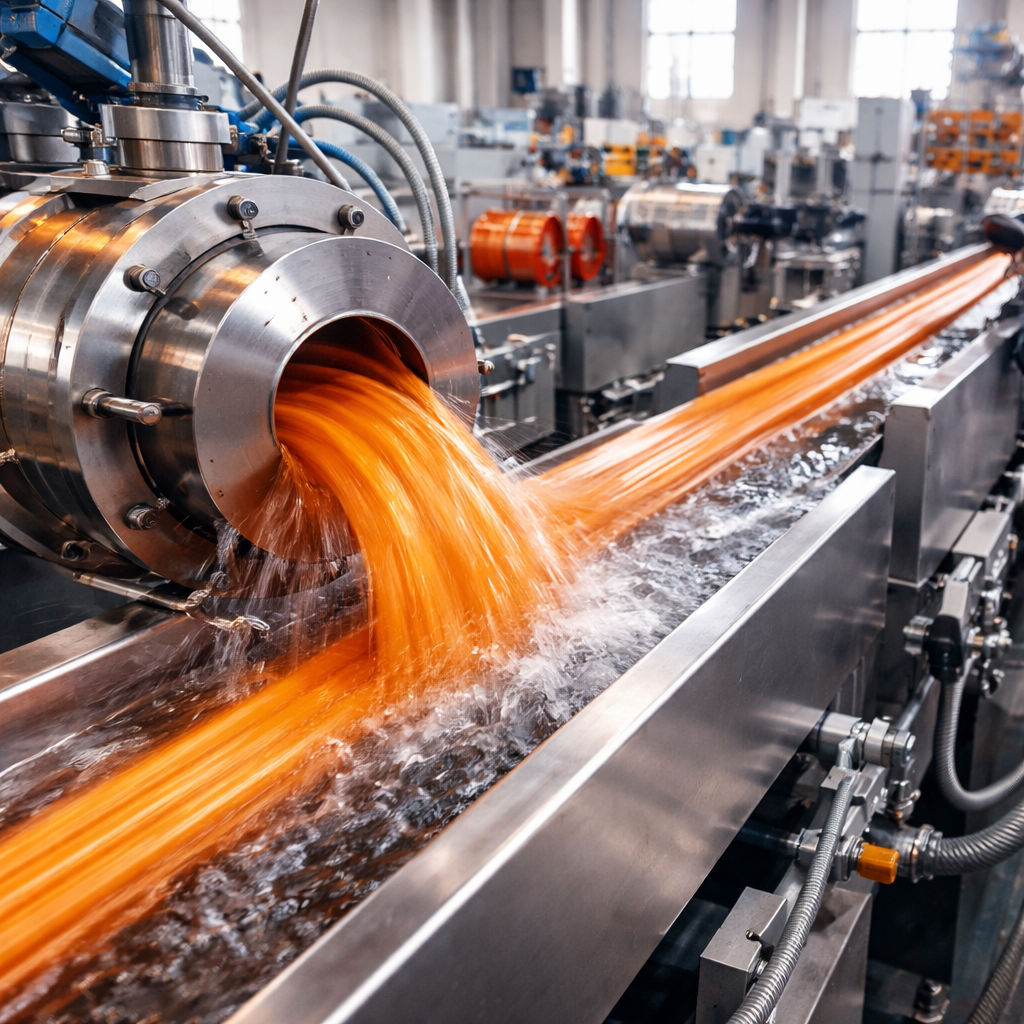
After exiting the die, the material is still soft. It must be cooled quickly to retain its shape. This is usually done using water baths, air cooling, or rollers.
Controlled cooling prevents deformation and ensures dimensional accuracy. Different products require different cooling methods, depending on thickness and material type.
Step 6 – Pulling and Cutting
Finally, the solidified product is pulled at a consistent speed. This maintains uniform thickness and shape.
The product is then cut into specific lengths or wound onto rolls. At this stage, it is ready for packaging or further processing.
Tip: Maintaining stable temperature and pulling speed is key to achieving consistent product quality in plastic extrusion processing.
Key Components in Plastic Extrusion Processing Systems
Hopper and Feeding System
The hopper is the entry point for raw materials. It stores pellets and feeds them into the extruder at a controlled rate. Modern systems may include drying or mixing functions. These features ensure the material is properly prepared before entering the extrusion process.
Barrel and Screw Mechanism
The barrel houses the rotating screw, which plays a central role in melting and transporting the plastic. As the screw rotates, it moves the material forward while compressing and heating it. The design of the screw affects mixing efficiency and overall process performance.
Die and Shaping Tools
The die is one of the most critical components. It determines the final shape of the extruded product. Precision engineering ensures that the material flows evenly through the die. This results in smooth surfaces and accurate dimensions.
Cooling and Downstream Equipment
Cooling systems solidify the product after extrusion. Downstream equipment such as pullers and cutters complete the process.
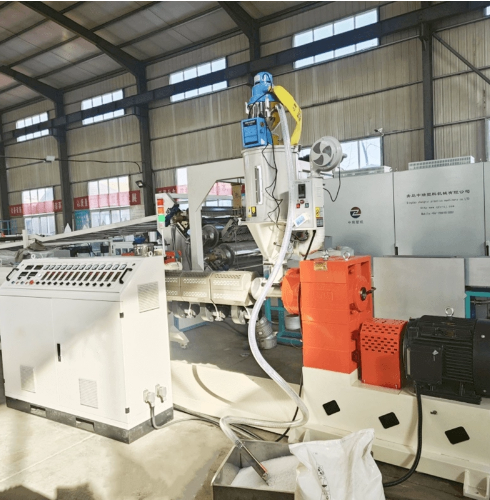
Advanced extrusion lines, including those developed by Zhongrui, often integrate auxiliary equipment like mixers and crushers. These additions improve workflow efficiency and support consistent production performance.
Types of Plastic Extrusion Processing Methods
Tubing Extrusion
Tubing extrusion is used to produce hollow products such as pipes and medical tubes. A mandrel inside the die creates the internal cavity.
This method requires precise control to ensure uniform wall thickness. It is widely used in plumbing, healthcare, and industrial applications.
Blown Film Extrusion
Blown film extrusion is commonly used in packaging. In this process, molten plastic is inflated into a bubble and then flattened into film.
This technique produces thin, flexible materials such as plastic bags and wraps. It allows manufacturers to control thickness and strength.
Sheet Extrusion
Sheet extrusion creates flat plastic sheets used in packaging, automotive parts, and construction materials.
The molten plastic passes through a flat die and then over cooling rollers. These rollers define thickness and surface quality, making the process highly customizable.
Co-Extrusion
Co-extrusion combines multiple materials into one product. Each layer can have different properties. This improves performance and functionality. It is commonly used in packaging and specialized tubing.
Method | Main Output | Key Benefit |
Tubing Extrusion | Pipes, tubes | Hollow structure control |
Blown Film | Plastic films | Thin, flexible materials |
Sheet Extrusion | Flat sheets | Smooth surfaces, uniform thickness |
Co-Extrusion | Multi-layer products | Enhanced material performance |
This variety allows manufacturers to choose the most suitable extrusion method for different product goals and material needs. It also shows how plastic extrusion processing can support both simple shapes and more advanced multi-layer applications.

Applications of Plastic Extrusion Processing Across Industries
Construction and Infrastructure
Plastic extrusion processing is widely used in construction. It produces pipes, window frames, insulation materials, and protective profiles for building systems. These products offer durability, weather resistance, and cost efficiency. As a result, they play an important role in modern infrastructure and long-term building performance.
Packaging Industry
In packaging, extrusion is used to create films, sheets, and containers. These materials protect products while remaining lightweight, flexible, and easy to handle in large-scale production. The ability to produce high volumes quickly makes extrusion ideal for packaging applications across food, retail, and industrial markets.
Electrical and Automotive Uses
Extrusion is also used in electrical and automotive industries. It produces cable coatings, seals, trims, and other functional plastic components. These parts require precision, consistency, and dependable performance. Plastic extrusion processing meets these needs efficiently in both standard and specialized applications.
Global Manufacturing and Export Use Cases
Plastic extrusion processing supports global manufacturing needs. It is widely used across Asia, Europe, and the Middle East. Companies like Zhongrui supply extrusion production lines to international markets, helping manufacturers achieve reliable, scalable, and efficient production across different regions and application demands.
Benefits of Plastic Extrusion Processing in Manufacturing
Continuous High-Volume Production
One of the biggest advantages of plastic extrusion processing is its ability to run continuously. This allows manufacturers to produce large quantities efficiently and maintain steady output over long production cycles. It reduces downtime and increases productivity, making it ideal for industrial-scale operations where consistency and speed both matter.
Design Flexibility and Custom Profiles
Extrusion allows for a wide range of shapes and designs. Manufacturers can create complex profiles with consistent quality and adapt product dimensions to specific application needs. This flexibility supports innovation and customization in product development, especially for industries that require both performance and design precision.
Cost Efficiency and Automation
The process is highly automated, which reduces labor costs and improves consistency. Once the system is set up, it can run continuously with minimal intervention and stable production control. This leads to lower production costs, reliable output, and better efficiency for long-term manufacturing projects.
Note: Choosing the right extruder type and die design can significantly improve efficiency and product quality.
Conclusion
Plastic extrusion processing remains a reliable method in modern manufacturing. It turns raw plastic into continuous, high-quality products through a controlled and efficient flow. Each stage, from feeding to cooling, works together to ensure stable results and consistent performance. This process supports large-scale production while allowing flexible designs for different industries.
It continues to serve construction, packaging, and automotive fields with strong efficiency and precision. Qingdao Zhongrui Plastic Machinery Co., Ltd. provides advanced extrusion equipment designed for stable output, flexible applications, and long-term reliability. Their solutions help manufacturers improve productivity, maintain product consistency, and meet global production demands with confidence.
FAQ
Q: What is plastic extrusion processing?
A: Plastic extrusion processing is a manufacturing method where melted plastic is pushed through a die to create continuous shapes like pipes, sheets, or films. It allows consistent production with uniform cross-sections.
Q: How does plastic extrusion processing work?
A: Plastic extrusion processing works by feeding raw plastic into a heated barrel, melting it, and forcing it through a shaped die. The material is then cooled and cut into the desired form.
Q: Why is plastic extrusion processing widely used?
A: Plastic extrusion processing is popular because it supports continuous production, delivers consistent quality, and works well for high-volume manufacturing across many industries.
Q: What products can be made using plastic extrusion processing?
A: Plastic extrusion processing can produce pipes, tubing, plastic films, sheets, window frames, and cable coatings. It is ideal for products with a uniform shape.
Q: How much does plastic extrusion processing cost?
A: Costs depend on material type, machine setup, and production scale. Plastic extrusion processing is generally cost-effective because it runs continuously and reduces labor needs.
Q: What are the advantages of plastic extrusion processing?
A: Plastic extrusion processing offers high efficiency, design flexibility, and consistent output. It also supports automation, which helps improve productivity and reduce production costs.



 +86-18561886575 (Mr.Wu)
 +8618561886575
 238 Yangzhou West Road, Jiaozhou City, Qingdao City, Shandong Province