Producing a high-capacity drainage core solves only half the manufacturing equation. Preventing soil intrusion ultimately dictates actual field performance for these geosynthetic materials. Without proper filtration, soil particles inevitably clog the hollow core over time. This clogging leads to catastrophic hydrostatic pressure buildup and systemic drainage failure.
Nonwoven geotextile lamination serves as this critical filtration layer. By securely bonding a permeable fabric to the dimpled plastic core, manufacturers create a highly reliable root barrier and soil filter. This crucial processing step transforms basic plastic sheets into high-performance structural drainage solutions demanded by modern civil engineering.
This article evaluates how inline lamination technology integrates smoothly into modern extrusion workflows. We will explore the specific equipment needed to achieve seamless bonding at high production speeds. You will also learn how to assess machinery effectively. This operational knowledge helps secure scalable, defect-free manufacturing capabilities for your facility.
Key Takeaways
- Filtration & Function: Nonwoven fabric lamination transforms a basic plastic dimpled sheet into a composite drainage board by acting as a root barrier and soil filter.
- Inline Efficiency: Modern manufacturing integrates lamination directly within the plastic sheet production line, eliminating secondary processing and reducing overhead.
- Thermal vs. Adhesive Bonding: Equipment selection dictates the bonding method, heavily impacting line speed, dimple integrity, and long-term delamination resistance.
- Customization is Key: Investing in a customizable drainage board production line allows facilities to seamlessly swap fabric weights and plastic sheet thicknesses to meet varied compliance and project specs.
The Business Case for Integrated Lamination in Drainage Board Manufacturing
Un-laminated drainage sheets remain basic commodities in the construction sector. They typically yield lower profit margins. They also face heavily restricted field applications. You will mostly see them utilized for basic indoor moisture control or blindside waterproofing. This commodity trap severely limits market reach and operational growth potential for manufacturers.
Adding a nonwoven fabric layer completely changes the product trajectory. It shifts the output from a simple moisture barrier into a high-value composite material. Construction firms heavily rely on these composites for demanding environments. They install them in civil engineering projects, extensive green roofs, and deep retaining walls. The laminated fabric actively prevents soil from washing into the drainage channels, ensuring decades of reliable water flow.
Facilities must carefully consider the upfront capital expenditure of adding inline lamination units. Purchasing specialized winding and pressing stations requires strategic budgeting. However, this investment directly unlocks expanded market access. It guarantees significantly higher per-square-meter revenue for finished composite boards. The return on investment often materializes rapidly as production scales to meet higher-tier contractor demands.
Integrated continuous lamination offers a major operational advantage over manual or offline methods. Evidence shows it reduces material handling defects by up to 30%. You achieve this efficiency by eliminating the need to transport bulk rolls between batch processes. When you run a continuous drainage board production line, you bypass the secondary bonding stations. This consolidation prevents core crushing, misalignment, and accidental surface contamination.
- Un-laminated Output: Low margin, high competition, restricted strictly to closed-system waterproofing.
- Laminated Composite Output: Premium pricing, specialized civil applications, built-in root and soil filtration.
- Integrated Processing: Eliminates intermediary warehouse storage, reduces forklift damage, and lowers labor overhead.
![Drainage board production equipment showing inline processing]()
Core Workflows Within a Plastic Sheet Production Line
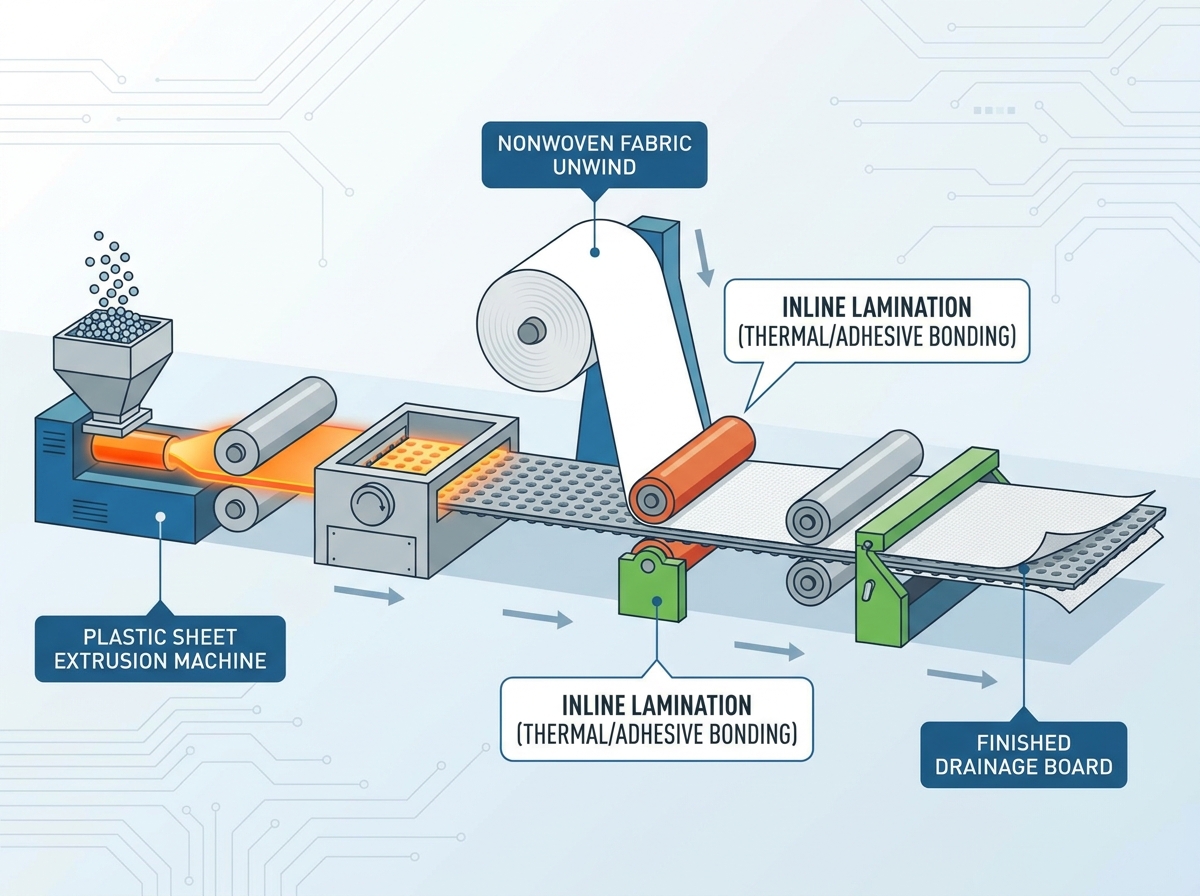
Every drainage board and plastic sheet production line begins with foundational extrusion. The system melts raw polymer pellets, usually High-Density Polyethylene (HDPE) or High-Impact Polystyrene (HIPS). The extruder feeds this molten polymer through a flat sheet die. Vacuum-forming rollers immediately grab this hot, flat sheet. They utilize negative air pressure to pull the plastic into specific molds, shaping the essential dimpled structure.
The lamination integration point proves critical to the entire operation. You must introduce the nonwoven fabric immediately after dimple formation occurs. At this exact moment, the plastic substrate still retains optimal thermal properties from the extrusion die. The residual heat creates an ideal window for mechanical or chemical adhesion. It facilitates a permanent bond without requiring you to apply excessive secondary heating systems.
If you delay the introduction of the fabric, the dimples cool and harden prematurely. You would then need to reheat the peaks of the dimples, which risks collapsing their structural integrity. By integrating lamination immediately downstream of the forming roller, manufacturers preserve both the compressive strength of the core and the permeability of the geotextile.
Synchronized tension control mechanics dictate the ultimate success of this continuous workflow. A reliable plastic drainage sheet extrusion machine must communicate flawlessly with the fabric unwinder. The web tension must remain perfectly balanced across the entire width of the line.
If web tension drops unexpectedly, the fabric bunches and wrinkles before entering the nip rollers. If tension spikes too high, the nonwoven material stretches unnaturally. This stretching stores kinetic energy in the fabric. Once the finished product cools and the tension releases, the fabric aggressively contracts. This contraction inevitably shears the bond, causing severe delamination before the product even reaches the job site.
Evaluating HDPE Drainage Board Equipment: Features vs. Production Outcomes
When selecting your HDPE drainage board equipment, bonding methods matter immensely. Decision-makers generally choose between thermal calendering and hot melt adhesive application. Each approach offers distinct advantages depending on your target market.
Thermal calendering relies strictly on heat and mechanical pressure. It fuses the synthetic fabric directly to the semi-molten polymer dimples. This method offers noticeably lower consumable costs since you do not purchase bulk adhesives. However, it requires highly precise temperature control. A few degrees too hot will melt the structural dimples, destroying the board's compressive strength. A few degrees too cold prevents adherence, leading to failed batch runs.
Adhesive bonding provides significantly higher initial bond strength. It works exceptionally well for thick, heavy geotextiles that resist thermal bonding. The machinery utilizes a slot-die or spray hot melt glue applicator. You achieve excellent adhesion across widely varying fabric textures. The primary tradeoff involves increased routine maintenance. Operators must regularly clean glue applicators, purge nozzles, and monitor adhesive viscosity.
Cooling and calibration stages must immediately follow these lamination nip rollers. The machinery stabilizes the hot composite board using extensive water-cooled traction rollers. This rapid, controlled temperature drop prevents the composite from bowing. It locks the polymer matrix into place and eliminates structural memory loss. Without rapid cooling, the flat board may warp into a curved shape during palletization.
Edge trimming and slitting refine the final physical output. High-speed inline finishing tools ensure clean, straight edges across the entire roll. Manufacturers often configure these rotary slitters to trim the plastic core while leaving a precise nonwoven overhang. Installers highly value this specific feature. They use this extra fabric lap joint to overlap adjacent sheets in the field, ensuring continuous filtration without soil leakage between panels.
Comparison of Bonding Configurations in Drainage Composites
| Processing Feature | Thermal Calendering Method | Hot Melt Adhesive Method |
| Primary Bonding Agent | Residual polymer heat and mechanical pressure | Applied EVA, PUR, or pressure-sensitive adhesives |
| Consumable Expense | Very low (no ongoing adhesive costs) | Moderate to high (requires bulk glue purchasing) |
| Fabric Compatibility | Best for lighter synthetic fabrics (100g - 150g) | Excellent for heavy or blended fabrics (200g - 300g+) |
| Maintenance Burden | Requires strict thermal sensor calibration | Requires routine nozzle purging and line cleaning |
Implementation Realities and Defect Mitigation
Operating heavy extrusion equipment carries inherent daily production risks. Active risk mitigation separates highly profitable manufacturing runs from costly scrap generation. Facilities must establish robust protocols to catch defects before they multiply across hundreds of meters of rolled product.
Delamination in the field represents a catastrophic product failure. The primary root cause typically points back to inadequate roller pressure or incorrect thermal thresholds during the initial bonding phase. Operators must routinely calibrate pneumatic nip rollers to ensure uniform pressure across the entire web width. Uneven pressure leaves microscopic gaps where the fabric fails to bite into the plastic substrate.
Fabric wrinkling presents another painfully common visual and structural defect. Poor raw material alignment and failures in automated web guiding systems cause this issue. To combat this, modern lines utilize Edge Position Control (EPC) technology. A responsive EPC system continuously scans the edge of the fabric. It micro-adjusts the unwinder position laterally to keep the fabric perfectly centered over the dimpled core.
Leading manufacturing facilities actively shift their reliance from operator guesswork to strict digital automation. Integrated Programmable Logic Controller (PLC) systems serve as the brain of the operation. They monitor line speed, zone temperatures, and tension feedback in real time.
If a thermal sensor detects a temperature drop at the extrusion die, the PLC auto-corrects the heaters instantly. It also adjusts the nip roller speed to compensate for slight material expansions. This deep automation drastically reduces the dependency on specialized manual interventions. It maintains high throughput consistency across multiple rotating operator shifts.
Securing a Customizable Drainage Board Production Line
Plant managers and procurement teams require modular equipment that scales effortlessly. Product specifications evolve quickly based on regional building codes. Investing in a customizable drainage board production line provides this necessary operational agility. Modular unwinding stations allow operators to execute rapid roll changes. Adjustable nip rollers accommodate variable core depths seamlessly without rebuilding the pressing station.
A versatile production line must handle wildly varying material specifications. Commercial projects may demand lightweight 100-gram filtration fabrics. Heavy-duty civil retaining walls might specify robust 300-gram geotextiles. Furthermore, engineers specify different core thicknesses ranging from 8mm up to 30mm. You need machinery capable of shifting between these diverse parameters smoothly. Extensive mechanical changeovers waste valuable production hours and eat into operational margins.
Evaluating Original Equipment Manufacturers requires a highly systematic approach. Avoid selecting vendors based solely on baseline pricing. Use this strategic shortlisting logic to secure reliable machinery:
- Evaluate specific composite experience: Verify their track record specifically with inline composite bonding. Do not accept a history of basic flat sheet extrusion as proof of competence in complex lamination.
- Demand operational transparency: Ask for guaranteed energy consumption rates. Request verified line-speed benchmarks while the machine operates under full lamination load.
- Confirm technical infrastructure: Ensure the availability of local or regional technical support. Verify that they utilize standard, easily obtainable spare parts (like universal PLC modules and standard bearings) to prevent extended downtime.
Conclusion
Nonwoven fabric lamination is never merely an optional add-on feature. It stands as a foundational requirement for producing true commercial-grade drainage composites. By actively filtering out soil and debris, the fabric ensures the underlying dimpled core functions exactly as engineers intended. Lamination turns a vulnerable plastic shell into a resilient, long-lasting civil engineering asset.
Production engineers and facility managers should audit their current extrusion capabilities immediately. Identify your existing bottlenecks in web tension control, thermal heating consistency, or edge trimming precision. Determine if your current scrap rates stem from outdated offline bonding practices.
When sourcing a new complete line, request targeted throughput data from prospective vendors. Ask for specific kilogram-per-hour extrusion metrics alongside maximum line speeds for laminated outputs. Prioritize robust PLC automation and modular unwinding stations. By demanding these features, you secure a competitive, future-proof manufacturing workflow that meets rigorous global construction standards.
FAQ
Q: Can an existing plastic sheet production line be retrofitted for nonwoven lamination?
A: Yes, but it requires carefully evaluating your factory floor's spatial footprint. You must install new fabric unwinding stations and tension controllers. You must match line speeds precisely between old extruders and new components. It also involves physically integrating thermal or adhesive laminating nip rollers into the existing PLC framework for synchronized master control.
Q: What is the standard line speed for a modern drainage board production line with integrated lamination?
A: Modern integrated lines typically operate at continuous speeds ranging between 5 to 15 meters per minute. Actual throughput relies heavily on the system's downstream cooling capacity, the bonding method utilized, and the overall thickness of the polymer core being processed.
Q: How does a plastic drainage sheet extrusion machine handle different polymer grades during lamination?
A: Operators must adapt screw design and temperature profiling for different raw materials. HDPE is highly crystalline and requires distinct thermal bonding parameters compared to recycled HIPS blends. Precision heating control ensures the nonwoven fabric adheres firmly without degrading or melting the structural core.



 +86-18561886575 (Mr.Wu)
 +8618561886575
 238 Yangzhou West Road, Jiaozhou City, Qingdao City, Shandong Province