Manufacturers often search for maximum flexibility when investing in heavy extrusion equipment. You want a versatile machine capable of producing every possible market size. Capturing diverse market demands seems like the logical path to growth. However, pushing a single line to manufacture vastly different dimensions creates significant engineering hurdles.
Balancing this desire for a highly versatile machine against the realities of extrusion physics is a core conflict. Frequent dimensional changeovers inevitably lead to unwanted downtime. They also generate excessive material waste during the transition phases. Understanding exactly what a single setup can handle efficiently is critical for your capital expenditure decisions.
We will provide a transparent, engineering-based framework to clarify these machine capabilities. You will learn the exact width, thickness, and length ranges one setup can realistically produce. This guide helps you match machine specifications directly to your most profitable business goals without falling victim to unrealistic versatility claims.
Key Takeaways
- Width is hardware-bound: Maximum width is strictly limited by the T-die and calibration unit; smaller widths are achieved via edge trimming, which increases scrap.
- Thickness is adjustable: A single line can typically adjust thickness within a defined range (e.g., 5mm–20mm or 12mm–30mm) by adjusting the die lip and calibration gaps.
- Length is theoretically infinite: Inline cutting saws dictate length, making custom lengths the easiest dimension to adjust on the fly.
- Frequent changeovers kill ROI: While a single line can produce multiple sizes, frequent adjustments lead to significant material waste and operational downtime.
Baseline Size Capabilities of a Single PVC Foam Board Production Line
Standard Width Constraints
Extrusion lines group into distinct categories based on their maximum output width. The most common standard is 1220mm, equivalent to 4 feet. This specific size perfectly accommodates the globally recognized 4x8 ft sheet standard used in construction and advertising. You cannot easily cheat this maximum boundary.
If you want wider formats like 1560mm or 2050mm, you require completely different hardware configurations. You cannot simply stretch a 1220mm polymer melt web to fit a 1560mm profile. Producing these wider boards requires specific hardware upgrades:
- Wider T-dies designed to distribute the polymer melt evenly across a broader span.
- Larger downstream calibration tables capable of cooling a massive surface area.
- Higher extruder output capacities to push the increased material volume required for wider boards.
The Operating Thickness Range
One machine cannot efficiently produce both 1mm and 30mm boards. Thickness strictly dictates the required cooling capacity and processing speed. Polymer acts as a thermal insulator. Thick boards trap immense heat in their core. This requires aggressive, prolonged cooling to prevent secondary expansion. Conversely, thin boards cool almost instantly.
We break down standard production into two practical ranges. Thin boards usually span 1mm to 8mm. Medium to thick boards span 5mm to 20mm, or 12mm to 30mm. These distinct ranges require vastly different cooling water flow rates. They also require drastically different line haul-off speeds. Attempting to run a 30mm board on a machine optimized for 3mm will result in severe core warping. You must choose a PVC foam board production line specifically tuned for your core thickness range to ensure stable density.
Length Customization
Length acts as the most flexible dimension in the entire extrusion process. The haul-off speed and the automatic PLC-controlled transverse cutter manage board length directly. They accomplish this without ever stopping the continuous extrusion line.
Modern inline saws track the moving board continuously. The saw unit clamps onto the moving sheet, travels alongside it, and cuts at precise intervals. You can switch from producing 2440mm sheets to 3000mm sheets in mere seconds. Operators simply input the new length parameters directly into the digital control panel. Length customization incurs zero downtime and zero material waste.
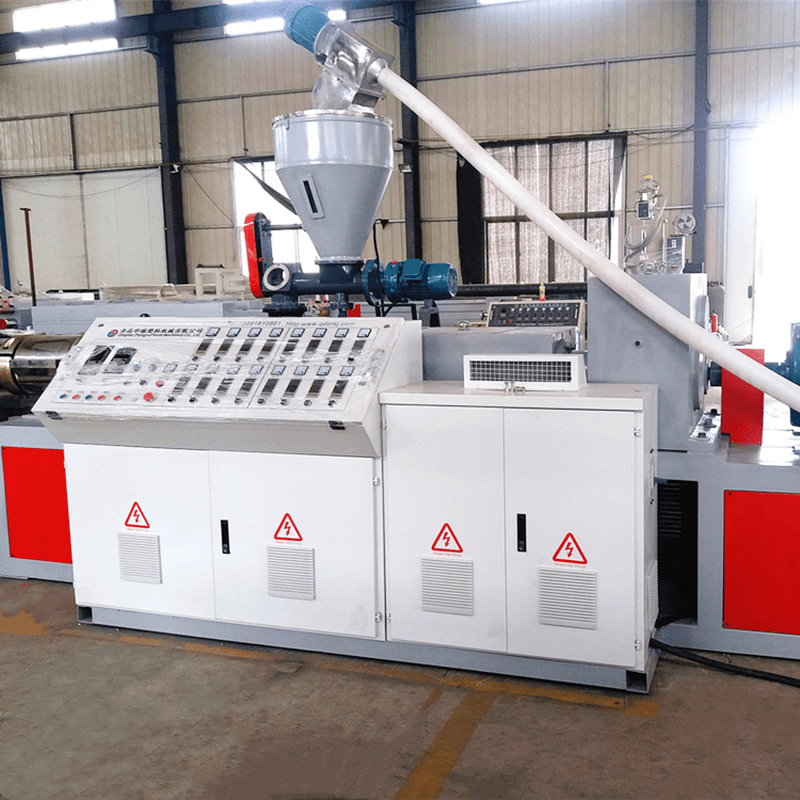
![PVC Foam Board Production Line Factory Floor]()
The Mechanics of Size Adjustment: What Happens on the Factory Floor?
Adjusting Thickness
Changing board thickness is a highly technical process requiring mechanical precision. Operators must physically alter the equipment settings while managing the thermal profile of the molten polymer. This process requires a systematic approach to ensure product stability.
- Operators adjust the T-die lip manually or via motorized controls to change the initial melt thickness.
- The extruded melt enters the calibration plates, which handle primary cooling and shaping.
- Operators carefully adjust the vertical gap between these water-cooled plates.
- This gap stabilization controls the final foam expansion and locks in the target density.
Best Practice: Always allow the extruder temperatures to stabilize for at least 15 minutes before fine-tuning the calibration gap. Rushing this step causes uneven surface tension.
Adjusting Width (The Trimming Reality)
You cannot shrink the physical width of a steel T-die on demand. Producing a 1000mm board on a 1220mm die means extruding the full 1220mm width first. You must then use inline edge saws to trim the excess 220mm away. This physical reality makes producing narrow boards on wide dies highly inefficient.
This trimming reality demands a robust inline recycling system. Without it, you bleed raw material costs. You need powerful crushers and millers sitting beside the line. These machines instantly grind the hot edge trim into fine powder. High-pressure blowers then shoot this recycled powder straight back into the main extruder hopper. This closed-loop system prevents massive profit loss when running narrow dimensions.
Implementation Risks: The Cost of Excessive Versatility
The "One Machine Does All" Myth
Many buyers believe a single PVC foam board and plastic sheet production line can jump seamlessly between completely different product dimensions daily. This is a dangerous industry myth. Seamless transitions do not exist in continuous plastic extrusion. Physics dictates that melt pressure, internal temperatures, and mechanical pulling forces take significant time to balance.
Material Waste & Downtime
Changing thickness forces a complete system recalibration. You must adjust extruder barrel zone temperatures. You must alter screw rotation speeds and modify haul-off pull rates. All these variables interact heavily with one another.
Stabilizing a completely new size often results in 30 to 60 minutes of uninterrupted scrap production. During this transition phase, the machine spits out boards exhibiting off-spec density or severe surface defects. You only reach market-grade quality once total thermal equilibrium returns to the die and calibration unit. Common Mistake: Scheduling three different thickness runs in a single shift. This guarantees massive daily material loss.
Operator Expertise Dependency
Complex, multi-size production schedules demand highly skilled operators. Managing unique chemical formulations and intricate machine settings for a dozen different sizes increases your labor risks significantly. Novice operators will struggle to stabilize the melt profile quickly after a size changeover.
This dependency severely limits your operational agility. If your master operator calls in sick, your complex changeover schedule collapses. High-versatility production environments require extensive, continuous staff training to minimize transition scrap.
Matching Equipment Specs to End-Use Applications
Choosing the right machinery requires aligning your hardware directly with your target market. Use the decision matrix chart below to match primary applications with ideal machine specifications.
Application and Equipment Decision Matrix
| Target Application | Optimal Thickness Range | Primary Equipment Priority | Foaming Technology |
| Advertising & Signage | 1mm – 5mm | High line speed, surface finish | Free Foam or Co-extrusion |
| Furniture & Cabinetry | 12mm – 18mm | High crust density, nail-holding | Celuka Process |
| Construction Formwork | 15mm – 20mm+ | High torque, aggressive cooling | Celuka Process |
Advertising Board Focus
If you target the printing and signage market, your board thickness will typically range from 1mm to 5mm. Standard global dimensions are rigidly set at 1220x2440mm. When investing in PVC advertising board production machinery, you must prioritize high continuous line speeds.
You also need superior, flawless surface finishes to ensure ink adhesion. Manufacturers often achieve this via co-extrusion technology. Minimal thickness variance across the board's width is absolutely critical. Even a 0.2mm variance can cause expensive flat-bed UV printers to jam or smudge.
Furniture & Cabinetry Board Focus
The furniture sector requires target sizes sitting primarily between 12mm and 18mm. Here, your equipment priority must shift dramatically toward generating high crust density. The Celuka foaming process becomes mandatory.
Furniture builders need strong nail-holding strength for cabinet assembly. Screws must bite into a hard, rigid outer shell. Stable, highly controlled calibration cooling is vital to prevent these thick boards from warping days after production. You sacrifice raw line speed for structural integrity.
Construction & Formwork Focus
Construction target sizes are heavy-duty, usually demanding 15mm to 20mm and beyond. Contractors often require custom long lengths tailored for specific building sites. Equipment priority shifts entirely to high torque extrusion power.
You need highly robust, extended cooling systems. Extracting heat from the center of a 20mm polymer profile requires massive water circulation. Without it, the board core will continue foaming on the pallet, ruining the dimensional tolerance.
CAPEX Strategy: One Versatile Line vs. Multiple Specialized Lines
When to Buy One Highly Adjustable Line
You might cautiously invest in a single, highly adjustable PVC foam sheet board extrusion machine production line under specific business scenarios. This strategy works best for new market entrants testing regional demand. It also suits geographic regions experiencing low overall volume but requiring a high variety of product sizes.
Bespoke custom-order manufacturers also benefit from a versatile setup. If your customers pay a premium for short-run, highly specific board sizes, the transition downtime becomes a billable cost rather than a pure loss. However, you must factor higher scrap rates into your pricing model.
When to Invest in Multiple Specialized Lines
High-volume producers must aggressively focus on economies of scale. Dedicating Line A purely to 5mm boards and Line B strictly to 15mm boards changes your operational reality. It drastically reduces your daily maintenance downtime.
This dedication heavily lowers your scrap rates because the machines run continuously in thermal equilibrium. Ultimately, this specialized strategy yields a faster return on investment. The higher initial equipment purchase price easily pays for itself through uninterrupted efficiency, lower labor costs, and zero transition waste.
Conclusion
A single PVC foam board line handles length variations effortlessly without interrupting production. It manages moderate thickness adjustments well, provided operators allow time for thermal stabilization. However, its maximum die width strictly restricts its overall capability. You cannot magically stretch a narrow machine to meet wide-format market demands.
Define your highest-volume core product before buying any equipment. Identify the specific dimension that constitutes 80% of your projected sales volume. Spec your machine to run that exact size flawlessly at maximum speed. Treat all other dimensional sizes as secondary capabilities, not as equal engineering priorities.
We encourage buyers to request a tailored material test run before finalizing equipment specifications. Ask your machine supplier to calculate the exact transition downtime based on your specific dimension matrix. This data prevents costly surprises on the factory floor.
FAQ
Q: Can I produce custom-shaped PVC foam boards directly on the extrusion line?
A: No. Extrusion only produces continuous rectangular sheets. Custom shapes require post-production CNC routing or die-cutting equipment. The extrusion line simply outputs the raw rectangular canvas.
Q: Is it possible to change the T-die to produce wider boards on my existing line?
A: Generally, no. Upgrading to a wider die usually exceeds the extruder's melt capacity. It also exceeds the physical width limits of the downstream calibration, haul-off, and cutting units. You must buy a line spec'd for your absolute maximum width initially.
Q: How much edge scrap is normal when producing narrower boards on a standard line?
A: Standard edge trimming usually generates 2% to 5% scrap, which is instantly recycled inline. However, deliberately running a significantly narrower board (e.g., 900mm on a 1220mm line) increases scrap handling burdens and heavily reduces your overall energy efficiency.
Q: Can one line produce both Free Foam and Celuka (crust) foam boards?
A: Usually not efficiently without completely changing the die and calibration setup. Buyers should commit to the specific foaming technology that aligns perfectly with their target application, such as Celuka for rigid furniture boards or free foam for advertising.



 +86-18561886575 (Mr.Wu)
 +8618561886575
 238 Yangzhou West Road, Jiaozhou City, Qingdao City, Shandong Province