Zhongrui's High-capacity PP Packaging Belt Production Line is engineered for efficiency and high output. This innovative machine produces durable, flexible, and cost-effective PP straps, replacing traditional steel straps across various industries. Ideal for manufacturers seeking quality and sustainability.
According to many years of plastic machinery development and design experience, in the introduction of foreign advanced technology and digestion and absorption, on the basis of self-developed PE pipe production line. Has the unique structure, the design is novel, the equipment entire line layout is reasonable, the control performance is strong and so on.
The PE/PPR Pipe Production Line delivers reliable and efficient manufacturing of various pipes for water supply and drainage in agriculture and construction. Experience advanced technology and precision for high-quality production.
Discover the Highly Cost Effective PVC Pipe Production Line from Zhongrui. Engineered for durability and efficiency, this advanced production line ensures high-quality PVC pipes suitable for a variety of applications. Experience seamless operation, reduced maintenance, and significant cost savings.
The Composite Infiltration Irrigation Pipe Production Line is a high-efficiency system designed to produce drip irrigation tape for agricultural applications. With precision control, energy-saving technology, and advanced automation, it ensures superior performance in greenhouse, field crop, and water conservation irrigation systems.
Discover the PVC Hose Production Line designed for efficient, high-speed manufacturing of PVC hoses. Our advanced system ensures precision, versatility, and durability, making it an ideal choice for various industrial applications.
The PVC Imitation Marble Sheet Slab Extruder Machine Production Line is designed for producing high-quality, durable, and visually appealing marble-like PVC sheets. Offering fire resistance, water resistance, and high-temperature durability, it’s ideal for a variety of interior decoration applications. This advanced extrusion line guarantees high efficiency and stable output, making it a top choice for businesses looking to scale up production.
Zhongrui's PMMA Board Production Line is designed for precision, high-output plastic sheet manufacturing. With advanced technology including a vertical three-roll calender, Siemens motor, and ABB inverter, it ensures high plasticizing ability and energy-efficient performance. Ideal for producing PMMA, PC, and ABS sheets for construction, packaging, and automotive industries.
0
0
Which Plastic Profile Lines Process PVC, PE, PP, and WPC?
Views: 0 Author: Site Editor Publish Time: 2026-10-24 Origin: Site
Mismatching extrusion machinery to target polymers drives massive capital expenditure waste. When plant managers run the wrong materials through an incompatible setup, they immediately face high scrap rates, accelerated equipment wear, and compromised structural integrity in the final product. Thermoplastics like PVC, PE, and PP, along with composites like WPC, possess fundamentally different rheological properties. They exhibit distinct thermal sensitivities, shear tolerances, and volumetric shrinkage rates during the cooling phase. Decision-makers face a strict technical fork in the road. You must determine whether to invest in dedicated lines optimized for maximum throughput of a single polymer, or specify highly configurable lines to meet shifting market demands for fireproof, anti-aging, and weather-resistant materials. This breakdown evaluates how to specify and select the correct extrusion architecture based on material science, machine configuration, strict quality control requirements, and long-term operational efficiency.
Key Takeaways
Screw Configuration is the Primary Constraint: PVC and WPC typically require conical or parallel twin-screw extruders for proper plasticization of powders, whereas PE and PP are optimally processed using single-screw systems for granules.
The WPC Base Polymer Divide: A wood plastic profile machine must be specified according to its base thermoplastic; WPC-PVC blends require different screw geometries and thermal management than WPC-PE or WPC-PP blends used in outdoor decking.
WPC Demands Specialized Metallurgy: Processing wood-plastic composites introduces high abrasion and moisture; bimetallic screws and advanced vacuum venting are non-negotiable.
Customization Drives ROI: Customizable PVC profile machinery allows manufacturers to adapt to both rigid (uPVC) and flexible (pPVC) demands, provided the downstream calibration equipment is modular and supports co-extrusion (e.g., TPE/TPU seals).
The Core Challenge: Matching Machinery to Material Rheology
Establishing baseline requirements for a plastic profile production line starts with understanding polymer melt behavior. Success on the factory floor depends on maintaining strict melt temperature control, managing shear sensitivity, and ensuring output stability across different polymer matrices. If the melt temperature fluctuates even slightly, the viscosity changes. This leads to surging at the die, resulting in uneven wall thicknesses and out-of-tolerance final products.
Heat-sensitive materials like PVC require low-shear, highly controlled environments. PVC degrades rapidly when exposed to excessive thermal or mechanical stress, releasing corrosive hydrochloric acid gas that damages equipment and ruins the product. This degradation risk mandates specific screw geometries that limit residence time and control shear heating. Conversely, polyolefins like PE and PP have much higher thermal tolerance. They require higher processing temperatures and longer residence times to achieve a homogeneous melt, allowing for different barrel designs and higher screw RPMs.
The raw material state dictates the fundamental architecture of the entire line. Powders require forced feeding systems, specialized hopper designs with agitators to prevent bridging, and twin-screw configurations to generate the necessary pressure and mixing without excessive heat. Granules flow easily and melt predictably, making them ideal for standard single-screw architectures.
Baseline Extrusion Requirements
Melt Homogeneity: The extruder must deliver a completely uniform melt to the die without unmelted particles or degraded material.
Pressure Stability: Head pressure must remain constant to prevent dimensional variations in the profile.
Thermal Management: Barrel cooling systems (fans or oil/water jackets) must accurately remove excess shear heat generated by the screw.
Volumetric Efficiency: The feeding system must match the output capacity of the screw to prevent starving or overfeeding.
Polymer Type
Raw Material State
Optimal Extruder Type
Thermal Sensitivity
Primary Application
PVC (Rigid/Flexible)
Dry Blend Powder
Conical / Parallel Twin-Screw
High (Prone to degradation)
Window frames, technical profiles, conduits
PE / PP
Granules / Pellets
Single-Screw
Low (High thermal tolerance)
Industrial channels, structural components
WPC (PVC Base)
Powder + Wood Flour
Conical Twin-Screw
High (Moisture & heat sensitive)
Indoor structural profiles, door frames
WPC (PE/PP Base)
Pelletized Compound
Parallel Twin-Screw / Single-Screw
Medium
Outdoor decking, fencing, cladding
Technical Evaluation: PVC Profile Production Line
Screw and Barrel Architecture for PVC
A dedicated PVC profile production line relies heavily on the extruder's mechanical design to handle dry blend powders. Conical twin-screw extruders are the industry standard for processing high-calcium PVC formulations. The conical design provides a large feed volume at the hopper, compressing the powder efficiently as the screw diameter decreases toward the die. This generates the necessary head pressure while keeping shear rates low enough to prevent burning.
For high-speed, large-volume production of window and door profiles, manufacturers often evaluate parallel twin-screw options. Parallel screws offer longer L/D (Length-to-Diameter) ratios, providing extended mixing zones for complex formulations. Regardless of the twin-screw type, managing shear rates remains the primary operational focus. Operators must balance screw speed and barrel zone temperatures to ensure the PVC plasticizes fully without crossing its degradation threshold. If the material burns, the entire line must be shut down, purged, and cleaned, resulting in hours of lost production.
Precision Dosing for Material Performance
Meeting strict fireproof and anti-aging building codes requires exact formulation control. Integrating gravimetric dosing systems ensures that flame retardants, impact modifiers, titanium dioxide, and UV stabilizers are fed into the main polymer matrix with extreme accuracy. Loss-in-weight feeders continuously monitor the mass of additives entering the extruder, compensating for bulk density variations in the raw powder. This precision prevents weak spots in the profile and ensures consistent mechanical properties across long production runs. Volumetric feeders, while cheaper, cannot account for changes in powder density, leading to inconsistent product quality.
Downstream Calibration and Cooling Systems
Once the PVC melt exits the die, it must be frozen into its final shape immediately. Vacuum calibration tables are sized specifically for rigid PVC profiles to ensure dimensional stability. The profile passes through dry calibration blocks where vacuum slots pull the hot plastic against the chilled metal walls, setting the outer dimensions. These blocks are typically machined from phosphor bronze or stainless steel for optimal heat transfer and wear resistance.
Water temperature control and flow rate requirements are highly specific. Chilling units must maintain water temperatures between 12°C and 15°C to facilitate rapid heat extraction without inducing internal stress. If the water is too cold, the profile surface cools too quickly while the core remains hot, leading to bowing and warpage after the product is cut.
Haul-Off, Cutting, and Inline Quality Control
Pulling the profile through the calibration table requires consistent, slip-free tension. Caterpillar haul-off configurations utilize shaped rubber pads that grip the profile evenly, preventing deformation or surface marring. Servo-driven haul-offs synchronize exactly with the extruder speed to prevent surging. A mismatch in speed between the extruder and the haul-off will cause the profile to stretch or bunch up, ruining the dimensional tolerances.
Implementing inline laser dimension measurement and surface defect detection systems allows operators to monitor quality in real time. If the profile deviates from the programmed tolerances, the system triggers an alert, reducing scrap generation. Finally, dust-free cutting units equipped with planetary saws or heated blades ensure clean edges while maintaining workplace compliance regarding airborne particulates. Swarf extraction systems must be integrated directly into the saw housing to prevent PVC dust from contaminating the factory floor.
Assessing PE and PP Extrusion Capabilities
Single-Screw Extruder Optimization
Processing polyolefins requires a different mechanical approach. Single-screw systems are the industry standard for PE and PP granules because these materials do not require the aggressive pumping action of a twin-screw setup. Instead, they rely on conductive heat from the barrel and frictional heat generated by the screw flights. The feed zone conveys the solid pellets, the compression zone melts them, and the metering zone pumps the homogeneous melt to the die.
Evaluating Length-to-Diameter (L/D) ratios is a primary step for polyolefin extrusion. Modern PE and PP lines often utilize L/D ratios of 30:1 or 33:1 to provide adequate residence time for melting. Barrier flight designs separate the solid bed from the melt pool, ensuring optimal melt homogeneity before the polymer reaches the die. This prevents unmelted particles from causing surface defects or structural weaknesses. Grooved feed bushes are frequently used in the feed throat to increase the conveying efficiency and boost overall output rates.
Managing Shrinkage Rates in Semi-Crystalline Polymers
PE and PP are semi-crystalline polymers, meaning they experience high volumetric shrinkage during the cooling phase. If cooling is applied too rapidly or unevenly, the profile will warp, bow, or fail dimensional inspections. The polymer chains need time to fold into crystalline structures.
Addressing this shrinkage requires designing extended cooling baths and specialized sizing dies. Unlike PVC, which sets quickly in a short vacuum calibrator, PE and PP profiles often require long water immersion tanks with graduated temperature zones. The first tank might use warm water (e.g., 40°C) to prevent shock cooling, while subsequent tanks gradually lower the temperature. This controlled cooling process allows the polymer chains to crystallize uniformly, maintaining tight tolerances on complex geometries.
Advanced Co-Extrusion and Market Fit
PE and PP lines are highly capable of producing structural components and industrial channels. Evaluating the line's capability often involves looking at its co-extrusion potential. Manufacturers frequently integrate secondary extruders to apply soft-touch TPE or TPU sealing lips directly onto rigid PP or PE profiles. This inline process creates weather stripping or acoustic seals in a single pass, eliminating the need for downstream assembly and adhesives. The secondary extruder is typically a smaller single-screw machine (e.g., 30mm or 45mm) mounted on a flexible pedestal, allowing it to inject the soft material directly into the main die head.
Technical Evaluation: WPC Plastic Profile Production Line
Navigating the WPC Polymer Base
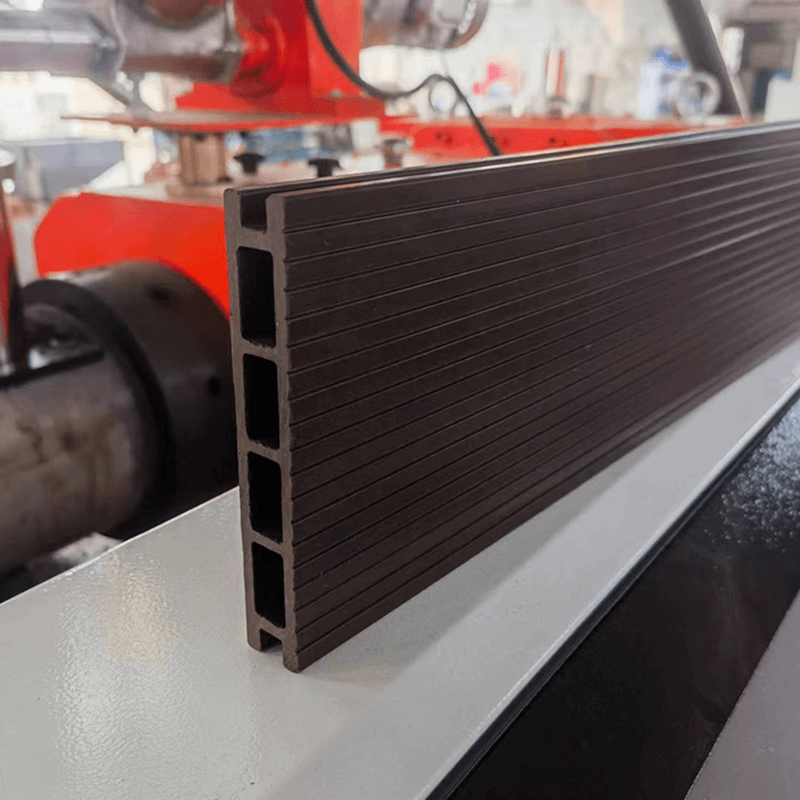
A WPC plastic profile production line faces unique rheological challenges because it processes a composite of thermoplastic resin and organic fibers. The engineering differences depend heavily on the base polymer. Processing WPC-PVC, typically used for indoor structural profiles or door frames, requires low processing temperatures to prevent both the PVC from degrading and the wood flour from burning. The wood flour must be dried to a moisture content of less than 1% before compounding.
Conversely, processing WPC-PE or WPC-PP, which dominates the high-intensity, erosion-resistant outdoor decking market, allows for slightly higher processing temperatures. However, the melt viscosity of WPC-PE/PP is exceptionally high. The extruder must generate immense torque to push the dense, fiber-filled compound through the die. Gearboxes must be oversized, and thrust bearings must be rated for extreme continuous loads to prevent mechanical failure.
Moisture Extraction and Venting Systems
Wood and bamboo fibers naturally retain moisture. If this moisture turns to steam inside the barrel, it causes severe surface defects, foaming, and blistering on the final profile. The steam creates voids within the polymer matrix, destroying the structural integrity of the board.
A high-performance wood plastic profile machine utilizes aggressive vacuum degassing zones along the barrel. These systems extract moisture and volatile organic compounds before the melt reaches the die compression zone. Double-vented barrels connected to high-capacity liquid ring vacuum pumps are standard. Proper venting ensures a dense, void-free core, which is essential for the load-bearing capacity of WPC profiles.
Combating Abrasion in a Wood Plastic Profile Machine
Wood flour is highly abrasive. Pushing a highly filled WPC compound (often 60% to 70% wood fiber by weight) through an extruder acts like liquid sandpaper on the internal components. Standard nitrided screws and barrels will wear out in a matter of months under continuous WPC production, leading to a loss of compression and a drastic drop in output.
Specifying bimetallic alloys and specialized tungsten carbide coatings for screws and barrels is necessary to withstand this abrasion. The barrel is typically lined with a centrifugally cast nickel-cobalt alloy, while the screw flights are hard-faced with a compatible wear-resistant material. While these metallurgical upgrades increase the initial capital outlay, they drastically extend the expected component lifespan and stretch out maintenance intervals, keeping the line operational and profitable.
Tooling and Co-Extrusion (Capping) Capabilities
Evaluating die design for WPC involves managing the uniform flow of highly viscous melts. The die must balance the flow velocity so the edges and the core of the profile exit at the exact same speed, preventing internal stress and bowing. Flow channels must be highly polished and streamlined to prevent wood fibers from stagnating and burning.
Modern WPC lines heavily utilize co-extrusion layers. Secondary extruders apply weather-resistant, UV-stable polymer caps over the WPC core. This capping layer, often made from modified PE or ASA (Acrylonitrile Styrene Acrylate), protects the wood fibers from moisture ingress, fungal decay, and UV fading, ensuring long-term erosion resistance for outdoor decking applications. The capping layer is typically 0.5mm to 1.5mm thick and must bond perfectly with the core material to prevent delamination.
Features-to-Outcomes: Can One Line Process Multiple Materials?
Manufacturers often ask if one line can process PVC, PE, and WPC. While technically possible, the engineering realities of swapping screws, barrels, and dies to switch between powder-based PVC and fiber-filled WPC are complex. Customizable PVC profile machinery offers flexibility, but it requires modular components and a highly trained maintenance crew.
Assess the downtime and yield losses associated with material changeovers. Purging the barrel, pulling the screw, cleaning the flights, and installing a different screw geometry takes an entire shift. The die head must be completely disassembled, cleaned, and replaced. For operations running high volumes of a single material, dedicated lines are far more efficient. However, for custom extrusion shops handling diverse, low-volume orders, a highly configurable line with interchangeable twin and single-screw modules provides necessary agility.
Scalability and Modular Upgrades
Evaluating the ease of retrofitting downstream equipment ensures the line remains relevant as market demands shift. Customizable lines should support inline lamination, hot stamping, or embossing units for aesthetic wood-grain finishes. These units must integrate seamlessly with the main line speed to prevent tension issues.
Future-proofing the line requires modular downstream calibration and cooling tables that can handle varying profile widths and complexities. The haul-off and cutting units must also feature adjustable heights and variable speed drives to accommodate everything from small window glazing beads to massive structural door frames. Quick-change tooling systems on the calibration table drastically reduce setup times between different profile runs.
Implementation Risks and Mitigation Strategies
Tooling and Mold Calibration Risks
Poorly designed dies lead to uneven wall thickness, internal stress, and premature product failure in the field. When the melt flow is unbalanced, the profile warps as it cools, leading to massive scrap rates during startup. Adjusting a poorly balanced die on the factory floor is time-consuming and wastes expensive raw materials.
Mitigate this risk by mandating rigorous Factory Acceptance Testing (FAT) with the equipment manufacturer. The FAT must use your exact material formulation and base polymer prior to shipment. Do not accept generic test runs with standard factory resins. The die and calibration blocks must be tuned to your specific shrinkage rates, viscosity, and output requirements. Verify the dimensional stability, surface finish, and mechanical properties of the profile during the FAT.
Operator Adoption and Process Repeatability
Manual adjustments to barrel temperatures, haul-off speeds, and vacuum pressure often lead to high scrap rates during material transitions. Extrusion relies heavily on process stability, and human error introduces unacceptable variables. An operator tweaking a temperature zone by a few degrees can alter the melt viscosity enough to push the profile out of tolerance.
Specify advanced PLC control systems from reputable brands. These systems provide automated recipe management, precise temperature zoning, and real-time data logging. When an operator switches from a rigid PVC profile to a flexible one, they simply load the saved recipe, and the PLC automatically adjusts the line parameters to the established baseline. This eliminates guesswork and ensures process repeatability across different shifts.
Compliance and Safety Standards
Industrial extrusion lines feature high-voltage heating elements, massive rotational torque, and fast-moving cutting saws. Ensuring the line meets CE or UL certifications is non-negotiable. Pay strict attention to electrical enclosures, emergency stop placements, and physical guarding on moving downstream components like the haul-off caterpillars and the crosscut saws. Interlocked safety gates must be installed around the cutting unit to immediately shut down the saw if opened during operation.
Conclusion
Base your primary extruder specification on the highest-volume material in your production forecast to maximize overall equipment effectiveness.
Request detailed technical proposals from vendors that include guaranteed output rates in kilograms per hour for your specific polymer formulations.
Demand comprehensive mold testing protocols and mandate a Factory Acceptance Test using your exact raw materials before authorizing equipment shipment.
Specify bimetallic screws and barrels if your production schedule includes abrasive compounds like WPC or highly filled PVC.
Integrate advanced PLC control systems to automate recipe management and eliminate manual parameter adjustments on the factory floor.
FAQ
Q: What is the primary difference between a PVC and WPC plastic profile production line?
A: The primary difference lies in torque requirements, venting, and metallurgy. WPC lines must handle highly viscous, abrasive wood-filled melts, requiring bimetallic screws and aggressive multi-stage vacuum venting to remove moisture. PVC lines focus on precise shear management and temperature control to prevent thermal degradation of the powder blend.
Q: How does the base polymer change the requirements for a wood plastic profile machine?
A: WPC-PVC blends are heat-sensitive and typically processed on conical twin-screw extruders at lower temperatures. WPC-PE/PP blends are highly viscous and require massive torque, often processed on parallel twin-screws or specialized single-screws with extended cooling baths to manage volumetric shrinkage.
Q: Can a single-screw extruder efficiently process a plastic profile made of PVC?
A: Generally, no. Single-screw extruders lack the positive pumping characteristics required to process PVC dry blend powders efficiently. They generate too much shear heat, which degrades the PVC. Single-screws are only used for PVC if the material has been pre-compounded into pellets.
Q: What is the expected lifespan of the screw and barrel when extruding abrasive WPC materials?
A: Standard nitrided screws may wear out in 3 to 6 months when processing highly abrasive wood flour. By specifying bimetallic alloys and tungsten carbide coatings, manufacturers can extend the lifespan of the screw and barrel to 18 to 24 months under continuous operation.
Q: How does customizable PVC profile machinery improve a manufacturer's operational flexibility?
A: Customizable machinery improves flexibility by allowing a single facility to adapt to shifting market demands. By utilizing modular downstream equipment and interchangeable die heads, manufacturers can switch between rigid structural profiles and flexible co-extruded seals without investing in entirely separate production lines.
Q: What are the specific cooling requirements for PE and PP profiles compared to rigid PVC?
A: Rigid PVC sets quickly and relies on short, dry vacuum calibration blocks. PE and PP are semi-crystalline and experience high shrinkage, requiring extended water immersion tanks with graduated temperature zones to ensure uniform crystallization and prevent warping during the cooling phase.
Qingdao Zhongrui Plastic Machinery Co., Ltd. is located in Jiaozhou City, Qingdao City, Shandong Province. It is 30 kilometers away from Qingdao Port and only 20 kilometers away from the airport.



 +86-18561886575 (Mr.Wu)

 +8618561886575
 238 Yangzhou West Road, Jiaozhou City, Qingdao City, Shandong Province