The profitability of a PVC foam board manufacturing facility relies heavily on the precise balance of its raw material formulation. You cannot achieve optimal output without mastering this delicate chemical equation. Material selection directly impacts extrusion speed, product density, surface finish, and the lifespan of extruder screws. If you compromise on material quality, you risk frequent downtimes and subpar end products that fail market standards. We designed this guide specifically for production managers and plant investors. You need to evaluate raw material requirements thoroughly before finalizing capital investments in heavy extrusion machinery and customized tooling. Understanding these core components helps you avoid costly operational errors. In the following sections, we will explore the core base materials, essential additives, and critical fillers used daily in the industry. You will learn how to match your chemical formulation to mechanical processes, ensuring high-quality product output and sustained profitability for your plant.
Key Takeaways
- The base formulation dictates the mechanical properties of the board and the specific torque requirements of the extruder.
- Over-reliance on inexpensive fillers (like Calcium Carbonate) reduces upfront costs but increases machine wear and compromises structural integrity.
- Specialized additives (foaming agents, stabilizers, and lubricants) are non-negotiable for maintaining continuous operation without thermal degradation.
- Matching your chemical formulation to the exact specifications of your PVC foam board production line is critical for minimizing scrap rates and achieving ROI.
1. Core Base Materials: The Foundation of PVC Extrusion
To manufacture high-quality boards, you must start with the correct base polymers. The primary ingredient is always Polyvinyl Chloride (PVC) resin. Industry standards dictate using specific grades of resin to achieve the right balance of flexibility, rigidity, and processing speed.
PVC Resin (SG-5 or SG-7)
Manufacturers rely heavily on suspension-grade PVC resin for foam board extrusion. This specific grade offers a porous particle structure. A porous structure absorbs liquid chemical additives rapidly, ensuring uniform mixing in your facility. When sourcing resin, you must evaluate the K-value closely. The K-value indicates the molecular weight and degree of polymerization of the base resin. For rigid foam boards, industry experts strongly recommend maintaining a K-value between 55 and 65.
Typically, factories utilize SG-5 or SG-7 grade resins. SG-5 provides excellent mechanical strength. It works perfectly for thicker, denser construction boards that bear heavy loads. Conversely, SG-7 features a lower overall molecular weight. This lower weight allows it to melt faster and flow much easier through the die. You should choose SG-7 when producing thin, lightweight panels. Matching the K-value to your desired product density remains a fundamental best practice.
Foaming Agents (Blowing Agents)
Foaming agents create the internal cellular structure inside the board. They decompose under high heat, releasing expanding gases. This gas expands the polymer melt, reducing the final physical weight of the panel. You have two main categories of blowing agents to consider: endothermic and exothermic.
Exothermic agents, like Azodicarbonamide (AC), release heat when they decompose. They generate a massive volume of nitrogen gas extremely quickly. This rapid expansion creates a highly lightweight core. However, managing this excess heat requires robust cooling systems on your extrusion line.
Endothermic agents, like Sodium Bicarbonate, absorb heat during decomposition. They release carbon dioxide slowly and steadily. This slow release creates a much finer, smoother cellular structure. Most modern facilities blend both types together. A balanced combination gives you the rapid expansion of AC alongside the precise structural control of Sodium Bicarbonate. This exact blend dictates the core density and directly influences final structural integrity.
2. Essential Additives for Stability and Processability
Raw PVC resin degrades rapidly when exposed to the intense high temperatures of an extruder barrel. To process it safely and efficiently, you must incorporate several specialized chemical additives into the mix.
Heat Stabilizers (Lead-based vs. Calcium-Zinc)
Heat stabilizers prevent the polymer chains from breaking down during active extrusion. Without them, the PVC will burn, turning yellow or dark brown inside the machine. Historically, manufacturers relied heavily on lead-based stabilizers. Lead provides exceptional thermal stability at a very low cost. However, lead remains highly toxic and poses severe health risks.
Global environmental standards now heavily restrict lead usage across the industry. Modern manufacturing facilities have shifted toward Calcium-Zinc (Ca-Zn) stabilizers. Ca-Zn is eco-friendly and fully complies with stringent environmental regulations. While Ca-Zn requires more precise temperature control during processing, it ensures your final product remains completely non-toxic and safe for consumer use.
Foaming Regulators (Acrylic Processing Aids)
When blowing agents release expanding gas, the polymer melt must stretch adequately to contain the newly formed bubbles. If the melt lacks elasticity, the bubbles will pop instantly. This collapse creates hollow voids and weak spots inside the panel. Foaming regulators solve this precise problem.
We typically use high-molecular-weight acrylic processing aids. These chemical regulators increase melt strength and elasticity significantly. They wrap securely around the gas bubbles, preventing them from escaping or collapsing entirely. A proper dose of acrylic regulator guarantees a uniform, closed-cell structure throughout the entire board.
Internal and External Lubricants
Lubrication is a critical balancing act in daily extrusion operations. You need lubricants to reduce friction, but applying the wrong amount ruins the product entirely.
- Internal Lubricants: Chemicals like Stearic Acid reduce friction between the PVC molecules themselves. This lowers the melt viscosity and prevents thermal burning deep inside the barrel.
- External Lubricants: Additives like PE Waxes reduce friction between the polymer melt and the metal surfaces of the extruder. They prevent the plastic from sticking aggressively to the screws and the die head.
Balance is absolutely key. If you use excessive external lubricant, it migrates to the surface of the board. This migration causes a poor, slippery surface finish that cannot hold ink or paint. If you use insufficient internal lubricant, the material overheats due to internal molecular friction. This directly leads to thermal degradation, burnt edges, and massive volumes of scrap material.
Table 1: Common Extrusion Additives and Their Primary Functions | Additive Category | Primary Function | Common Examples | Consequence of Improper Dosing |
| Heat Stabilizer | Prevents thermal polymer degradation | Calcium-Zinc, Lead | Severe yellowing, burnt materials, toxic emissions |
| Foaming Regulator | Enhances polymer melt elasticity | Acrylic Processing Aids | Collapsed bubbles, irregular internal voids |
| External Lubricant | Prevents metal surface adhesion | PE Wax, Paraffin Wax | Slippery surfaces, poor paint adhesion |
| Internal Lubricant | Reduces molecular friction | Stearic Acid | Premature melting in the hopper feed zone |
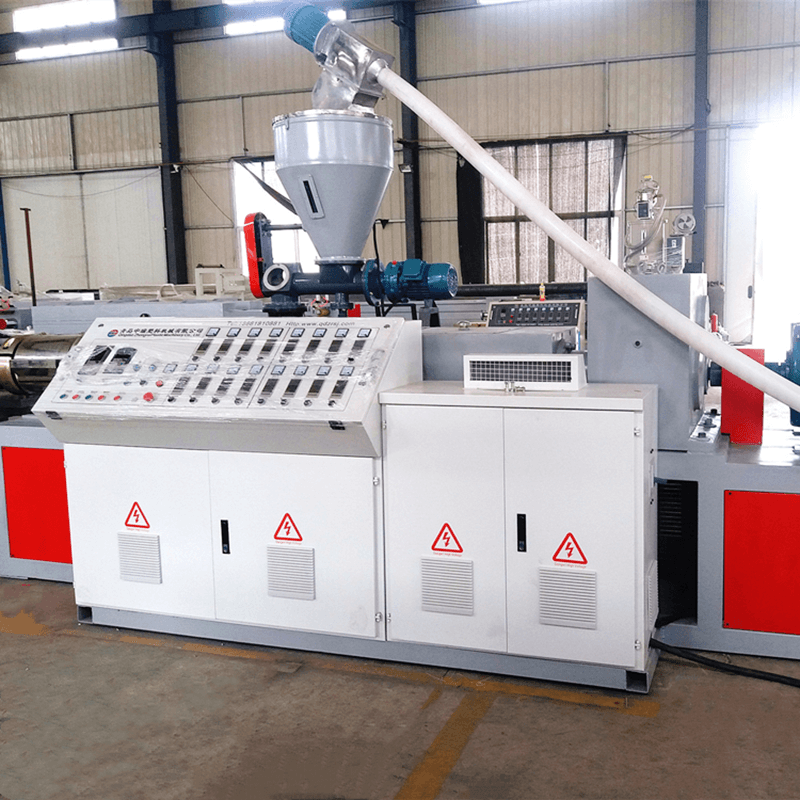
![PVC Foam Board Extrusion Machinery and Raw Material Process]()
3. Fillers and Modifiers: Balancing Cost, Weight, and Impact
Fillers and modifiers allow you to customize the physical properties of the finished board. They also help control your overall formulation costs significantly during large production runs.
Calcium Carbonate (CaCO3)
Calcium Carbonate serves as the primary cost-optimization lever in most factories. It is significantly cheaper than raw PVC resin. Adding CaCO3 reduces the volume of polymer needed, lowering your overall raw material expenses immediately. It also increases the physical rigidity of the final panel.
However, you must avoid the dangerous "over-filling" threshold. While adding more filler saves money upfront, it drastically increases the board's density and weight. Furthermore, coarse Calcium Carbonate acts as a highly abrasive agent. Excessive filler causes severe wear and tear on your plastic sheet production line screws and barrels. This accelerated metal wear quickly negates any initial cost savings by forcing premature, expensive equipment replacement.
Impact Modifiers (CPE or MBS)
Rigid PVC is naturally brittle. If you drop a pure PVC board, it might shatter upon impact. Impact modifiers solve this brittleness issue effectively. Additives like Chlorinated Polyethylene (CPE) or Methacrylate-Butadiene-Styrene (MBS) absorb mechanical shock efficiently.
These modifiers embed themselves deep within the polymer matrix. When the board receives an impact, the modifiers disperse the energy outward safely. This specific additive is particularly crucial for applications like custom cabinetry, structural signage, or heavy-duty furniture construction where durability matters most.
Pigments and UV Absorbers (Titanium Dioxide - TiO2)
Visual appeal is critical for commercial success in competitive markets. Customers expect a stark, bright white finish. Titanium Dioxide (TiO2) acts as the premium whitening pigment utilized across the industry.
TiO2 also functions as a powerful, necessary UV absorber. It protects the sensitive polymer chains from degrading under direct sunlight. This weather resistance is absolutely essential when outputting products via PVC advertising board production machinery. Without adequate TiO2 levels, outdoor display signage will turn yellow, crack, and become brittle within a few short months.
4. Synergy Between Raw Materials and Your Extrusion Equipment
Your chemical formulation does not operate in a vacuum. The raw materials must interact perfectly with your mechanical hardware. A slight change in material viscosity requires a corresponding adjustment in your machine parameters.
Twin-Screw Extruder Calibration
The viscosity of your mixed formulation dictates your required motor power and specific screw design. Extruders generally use either conical or parallel twin-screws to process material.
Conical twin-screws provide high shear and intense mixing at lower speeds. They work exceptionally well for high-filler, dense formulations. Parallel twin-screws offer gentler processing and longer residence times in the barrel. You must calibrate your extruder's torque limits strictly to match the specific resistance created by your chosen foaming regulators and lubricants.
Die Head and Calibrator Requirements
As the molten polymer exits the die head, the foaming agents activate rapidly. The expansion rate of your chosen blowing agents requires highly specific die lip gaps. If the gap is too tight, the bubbles burst before forming a protective outer crust.
After expansion, the continuous board enters the vacuum calibration table. Here, rapid water cooling freezes the cellular structure permanently in place. High-expansion formulations demand intense cooling capacities from your chillers. If your water system cannot remove the thermal heat fast enough, the board will warp and distort before it reaches the cutting saw.
System Integration
Evaluating a complete PVC foam sheet board extrusion machine production line requires looking at the entire workflow end-to-end. You must align your material feeding and mixing systems directly with your chemical formulation.
Hot mixers blend the PVC resin and chemical additives at high friction speeds. Cold mixers then rapidly cool the resulting powder to prevent premature gas release. The seamless automation of this mixing sequence guarantees that every batch maintains identical chemical properties before entering the extruder hopper.
5. Quality Control, Compliance, and Sourcing Risks
Even with the perfect recipe, poor chemical sourcing and lax quality control will ruin production runs. You must implement strict oversight protocols across the board.
Batch Consistency Issues
Moisture content remains the hidden enemy of smooth extrusion. Fillers like Calcium Carbonate naturally absorb ambient moisture from the air. If damp raw materials enter the heated extruder, the trapped water instantly turns to steam.
This steam creates unpredictable, chaotic foaming behavior. It blows large, irregular holes inside the core and causes rough surface defects. You must store all resins and fillers in climate-controlled silos. Always test raw material moisture levels diligently before initiating a mixing cycle.
Regulatory and Environmental Compliance
The global chemical landscape changes constantly. You must navigate complex regulatory frameworks like REACH and RoHS. Many regions completely mandate phasing out lead stabilizers due to severe heavy metal toxicity concerns.
Staying compliant requires constant formulation updates. Transitioning from traditional lead to Calcium-Zinc often demands recalibrating your entire temperature profile on the machine. You must audit your chemical inventory regularly to ensure all additives meet local environmental mandates securely.
Vendor Selection Criteria
Never buy raw materials based on initial price alone. You must establish strict shortlisting logic for chemical suppliers.
Always demand comprehensive Technical Data Sheets (TDS) for every single delivery. Verify the raw material purity, especially for expensive components like Titanium Dioxide and PVC resin. Partner closely with suppliers who offer reliable, redundant supply chains. A delayed shipment of a minor additive like Stearic Acid will cause complete, costly production downtime.
Conclusion
A successful manufacturing operation requires a highly balanced approach. Your final product represents a perfect 50/50 split between a stable chemical formulation and robust mechanical processing. You cannot fix a bad chemical mix with advanced machinery, nor can perfect raw materials overcome faulty extruder screws.
Moving forward, decision-makers must lock in their target product specifications early. Define your required density, board thickness, and exact end-use application. Next, test your formulations thoroughly in laboratory settings. Validate the melt viscosity and foaming behavior fully before you commission a full-scale commercial production line. This proactive testing approach ensures a smooth launch and rapid, sustainable profitability.
FAQ
Q: What is the typical ratio of PVC resin to Calcium Carbonate in foam board extrusion?
A: Standard industry ratios range from 1:0.3 to 1:0.8. The exact ratio shifts based on target applications. High-density furniture boards tolerate higher filler ratios, pushing toward 1:0.8. Conversely, low-density advertising boards require lower filler volumes to remain lightweight and maintain a smooth printing surface.
Q: Why is my PVC foam board coming out with a yellow tint?
A: A yellow tint indicates severe thermal degradation. This typically occurs due to insufficient heat stabilizers in the mix. It can also stem from excessive friction caused by poor external lubrication. Running the extruder at overly high temperature profiles will also burn the polymer.
Q: Can I use recycled PVC in a foam board production line?
A: Yes, you can use regrind or recycled PVC, but it carries distinct risks. While recycled material reduces raw costs, it often contains degraded polymer chains. You will require advanced processing aids and impact modifiers to maintain cellular consistency and ensure the board retains its structural integrity.
Q: How do raw material choices affect the wear and tear on the extrusion machine?
A: There is a direct correlation between high-abrasion fillers and equipment lifespan. Using large volumes of coarse Calcium Carbonate acts like sandpaper inside the barrel. This accelerates the degradation of screw flights and barrel linings, eventually causing pressure loss and reduced output.



 +86-18561886575 (Mr.Wu)
 +8618561886575
 238 Yangzhou West Road, Jiaozhou City, Qingdao City, Shandong Province