In polypropylene (PP) strapping manufacturing, the stretch ratio dictates the final product's molecular orientation, tensile strength, final dimensions, and elongation characteristics. Manufacturers must balance the demand for high tensile strength to secure light to medium loads with the need for sufficient elongation to absorb impact. You also have to prevent fibrillation, which causes longitudinal splitting on the line. Achieving this balance consistently requires precise coordination of temperature, speed, tension, and stretching ratio. Legacy extrusion equipment often fails to deliver these tight tolerances.
Determining the optimal stretch ratio—typically ranging between 1:5 and 1:8—requires aligning target market specifications with the technical capabilities of your extrusion machinery. This guide breaks down the physics of PP stretching, the performance trade-offs, and the evaluation criteria for selecting extrusion equipment capable of holding strict production tolerances.
Key Takeaways
- Standard Ratio Ranges: The industry-standard stretch ratio for PP strapping falls between 1:5 and 1:8, with specific targets depending on whether the end-product is intended for manual application or high-speed automated packaging.
- The Strength-Elongation Trade-off: Higher stretch ratios increase linear tensile strength but reduce elongation and increase the risk of splitting; optimal working range elongation should remain between 40-60% of ultimate break strength to safely accommodate load shifts.
- Equipment Dependency: Consistent stretch ratios require a PP strapping production line with highly synchronized godet rollers, precise hot air oven temperature controls, and effective annealing sections to lock in molecular memory and coordinate speed with tension.
- Material Variables: The optimal stretch ratio must be dynamically adjusted based on the polymer blend, specifically the ratio of virgin resin to recycled PP flakes, which alters the material's melt flow index and stretching tolerance.
The Physics of Stretching in PP Strapping
Raw polypropylene exits the die head in an amorphous state. The polymer chains resemble a tangled, random web. This unoriented structure offers minimal linear strength. Before the strap enters the stretching oven, it passes through a primary water cooling bath. This bath quenches the molten polymer, solidifying it into a workable state. The temperature of this water bath, typically kept between 30°C and 40°C, sets the baseline for the stretching phase. If the strap cools too rapidly, the outer skin hardens while the core remains soft, leading to uneven stretching later in the process.
The stretching process physically pulls these chains. They align parallel to the extrusion direction. This alignment creates a highly crystalline structure. The transformation exponentially increases the longitudinal tensile strength of the band.
Operators define the stretch ratio through a simple calculation. It is the ratio of the speed of the slow drawing rollers to the fast drawing rollers. If the pre-stretch godet runs at 20 meters per minute and the post-stretch godet runs at 120 meters per minute, the stretch ratio is 1:6. This mechanical differential forces the polymer to elongate within the heated oven. You must maintain the oven temperature precisely between 150°C and 160°C. If the temperature drops, the material resists stretching and snaps. If it runs too hot, the polymer melts and loses orientation.
This precise combination of line speed and stretching ratio directly dictates the final dimensions. As the strap stretches longitudinally, it shrinks laterally. The width and thickness decrease proportionally. This phenomenon is known as neck-in. Operators must calculate the initial die lip opening and primary cooling dimensions based on the target stretch ratio. A slight deviation in roller speed alters the final strap thickness. This causes feeding issues in automated packaging tools.
The industry relies on specific standard ratios based on the application:
- 1:5 to 1:6 Ratio: Manufacturers use this range for hand-grade strapping. It produces a band with higher elasticity. The strap offers excellent impact resistance. Manual tensioning tools require this flexibility to grip and seal the band without snapping it.
- 1:6 to 1:8 Ratio: This range produces machine-grade strapping. The higher ratio creates high stiffness and dimensional stability. It maximizes tensile strength for securing loads up to 200 Kgf. Automated arch machines require this rigidity to shoot the strap through the track without buckling.
Pushing the stretch ratio too high introduces severe production risks. Every polymer blend has a fibrillation threshold. This is the breaking point where over-stretching causes the polymer chains to separate laterally. The strap becomes highly brittle. It splits lengthwise down the middle during tensioning or friction welding. Operators must identify this threshold during trial runs to establish safe operating limits.
Performance Metrics Dictated by the Stretch Ratio
The stretch ratio directly correlates to the maximum load the strap can bear before failure. Higher orientation yields higher linear strength. Industry standards utilize a 5:1 ratio of strap break strength to load weight. If a carton weighs 40 Kgf, the strap must possess a minimum break strength of 200 Kgf. Adjusting the stretch ratio allows manufacturers to hit these specific break strength targets without adding excess raw material.
Understanding these metrics helps set the application boundary between different materials. The stretch ratio optimizes polypropylene for light to medium load packaging. This includes cartons and fast-moving consumer goods under 200 Kgf. Heavy rigid loads, construction materials, and pallets ranging from 200 to 1,400 Kgf exceed these limits. These heavier applications necessitate a transition to PET strapping, which possesses a naturally higher tensile capacity.
Elongation and impact recovery represent the other side of the performance trade-off. While a high stretch ratio increases strength, it decreases the strap's ability to stretch under sudden load shifts. A properly manufactured strap should maintain a working range elongation of 40-60%. This means the strap can stretch slightly when a box drops, absorbing the kinetic energy. It then recovers its tension to keep the package secure. Over-stretched bands snap upon impact because they lack this residual elasticity.
Dimensional stability relies entirely on uniform stretching across the width of the strap. Uneven tension or inconsistent oven temperatures cause camber and bow. Camber is a lateral curve in the strap. It acts like a boomerang. Industry tolerance for camber is typically less than 50mm over a 2-meter length. Even a minor camber causes catastrophic jams in high-speed automated packaging lines running at 60 or more straps per minute. The stretch ratio must apply equally to every millimeter of the strap's profile.
The degree of molecular orientation also affects surface embossing compatibility. Embossing provides the necessary friction for strapping tools and automated feed wheels to grip the band. A strap with a very high stretch ratio becomes extremely dense and hard. This makes it difficult for the post-stretch embossing rollers to penetrate the surface. The pattern may lack depth or wear away quickly. Manufacturers must balance the stretch ratio with the required embossing depth for the target packaging machine.
When securing a load, automated machines use friction welding to fuse the strap ends together. The stretch ratio directly impacts the quality of this weld. A strap stretched beyond 1:8 loses too much of its amorphous material, which is necessary for melting and bonding during the friction process. Consequently, an over-stretched strap will yield a weak joint that pops open during transit, even if the linear tensile strength remains high.
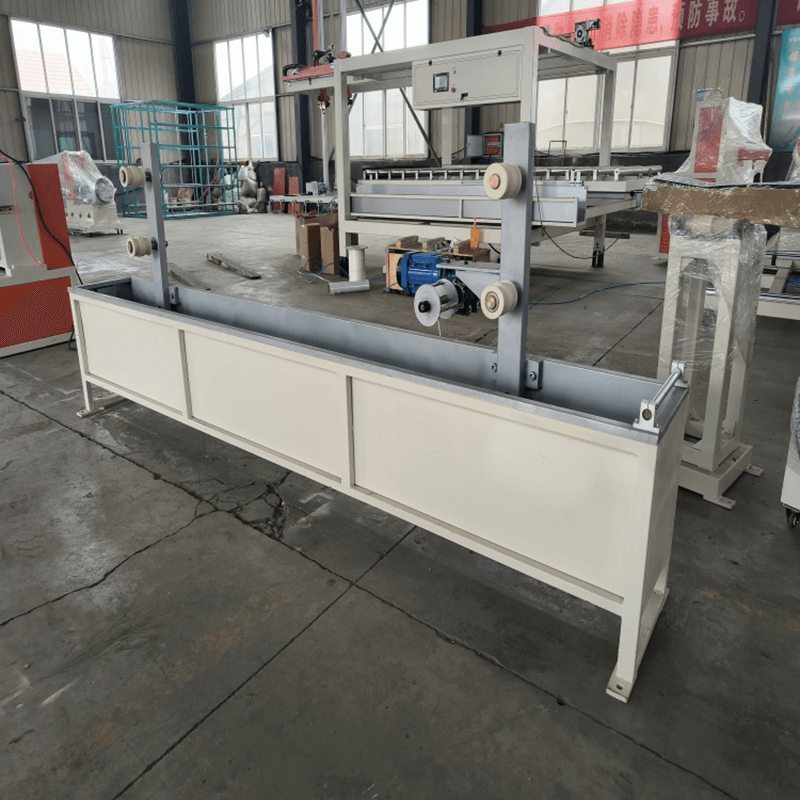
![PP Strapping Production Line]()
Evaluating a PP Strapping Production Line for Stretch Control
Consistent production requires a PP strapping production line engineered for absolute precision. The stretching hot air oven acts as the heart of this process. It must provide uniform heat distribution. The oven brings the polymer to its exact orientation temperature without creating hot or cold spots.
Engineers evaluate ovens based on forced air circulation design and insulation quality. Multi-zone temperature control capabilities are mandatory. If the left side of the oven runs two degrees hotter than the right side, the strap will stretch unevenly. This temperature variance directly causes camber. The oven must allow for the perfect coordination of temperature, speed, tension, and stretching ratio across the entire heating chamber.
Roller synchronization and tension control determine the actual mechanical stretch. The success criteria here is zero slippage. The line must maintain absolute speed consistency between the pre-stretch and post-stretch godet units. Legacy machines using basic AC motors and chain drives suffer from micro-fluctuations in speed. These fluctuations cause the stretch ratio to pulse, resulting in inconsistent strap thickness.
Godet rollers endure immense friction and pressure. Over time, the surface of these rollers wears down, altering their effective diameter. A reduction in roller diameter changes the surface speed, which inadvertently alters the stretch ratio. Maintenance teams must regularly measure roller wear and recalibrate the variable frequency drives to compensate. High-quality production lines utilize hardened steel rollers with specialized plasma coatings to resist wear and maintain consistent stretch ratios over years of continuous operation.
Modern evaluation requires looking for the integration of servo motors and variable frequency drives. The best systems utilize closed-loop tension feedback. Load cells monitor the tension on the strap in real-time. They send data back to the PLC. The drives instantly adjust motor speeds to maintain the exact programmed stretch ratio. This prevents slippage and ensures dimensional uniformity.
The annealing phase locks in the molecular memory. After stretching, the polymer chains want to snap back to their original amorphous state. The annealing oven or heated rollers relax these internal stresses post-stretch. This prevents shrinkage and warping after the strap cools and winds onto the paper core. Buyers must evaluate the length and thermal control of the annealing section relative to the maximum line speed. A short annealing section at high speeds results in unstable strapping that shrinks in the warehouse.
| Application Grade | Typical Stretch Ratio | Primary Characteristic | Target Load Limit | Required Equipment Precision |
| Hand-Grade Manual | 1:5 to 1:6 | High Elasticity / Impact Resistance | Up to 100 Kgf | Standard VFD Control |
| Semi-Auto Machine | 1:6 to 1:7 | Balanced Strength and Flexibility | Up to 150 Kgf | Closed-Loop Tension Feedback |
| Fully-Auto High Speed | 1:7 to 1:8 | Maximum Stiffness / Zero Camber | Up to 200 Kgf | Full Servo Motor Synchronization |
Machinery Configurations: Choosing the Right Extrusion Architecture
Selecting the correct machinery architecture depends on production volume and product mix. Manufacturers must evaluate single versus multi-strap extrusion lines. A single-strap line offers easy control. High-volume producers often require 2, 4, or 8-strap configurations to meet throughput demands. The complexity of maintaining uniform stretch ratios multiplies with each additional strap. The oven airflow and roller pressure must remain perfectly balanced across a much wider web.
The extrusion die head dictates the initial profile of the strap. When running multi-strap configurations, the die must distribute the molten polymer evenly across all channels. Advanced coat-hanger die designs ensure uniform pressure and flow rates. If the die fails to distribute the melt evenly, the outer straps will have a different initial thickness than the inner straps. Once they pass through the stretching oven, this initial variance multiplies, resulting in completely different stretch ratios and final dimensions across the same production run.
Upgrading to a computerized PP strapping strap band belt machine provides significant operational advantages. Programmable Logic Controller integration transforms the production floor. It enables automated recipe management. Operators can switch stretch ratios, tension settings, and temperature profiles instantly based on the specific SKU. This eliminates manual dial adjustments and reduces changeover scrap. You see the return on investment through reduced resin waste and faster setup times.
Material flexibility dictates the design of the extrusion components. Assessing a packaging belt production line requires a close look at the screw design and melt filtration systems. Running high percentages of recycled PP flakes introduces impurities and varying melt flow indices. The screw must feature an optimal length-to-diameter ratio, typically 30:1 or 32:1, to homogenize the melt. Continuous screen changers are necessary to filter out contaminants without stopping the line. Recycled material requires dynamic adjustments to the stretch ratio to prevent breakage in the oven.
Niche markets require specific equipment modifications. A PP fibre packing strapping tape production line often includes specialized features. Producing highly embossed tapes or fibrillated tying twine requires specialized die heads. The post-stretch embossing rollers must apply massive hydraulic pressure to imprint patterns into the highly oriented polymer. The line architecture must support these heavy-duty downstream components without introducing vibration that could disrupt the stretch ratio.
Implementation Realities and Production Risks
Theoretical stretch ratios often clash with factory floor realities. Material formulation inconsistencies present the highest daily risk. Variations in recycled PP flake quality lead to frequent strap breakage inside the stretching oven. A batch of flakes with a degraded molecular weight cannot survive a 1:8 stretch ratio. It will snap, causing costly downtime to re-thread the line.
Manufacturers mitigate this risk by implementing strict melt flow index testing on all incoming raw materials. Utilizing a PP packing strap extrusion machine equipped with advanced melt pumps ensures consistent die pressure. The melt pump isolates the die from pressure surges in the extruder. This creates a uniform initial strap profile, which is essential for surviving the high-tension stretching phase.
Factory floor environments rarely remain static. Ambient temperature and humidity fluctuations impact the stretching process. A draft of cold air hitting the stretching oven can cause localized temperature drops, leading to sudden web breaks. Manufacturers must isolate the extrusion line from external environmental factors. Installing climate-controlled enclosures around the stretching and annealing zones ensures the polymer experiences a consistent thermal profile, regardless of the season or factory conditions.
The conflict between operator skill and machine automation causes significant quality drift. Manual adjustment of stretch ratios often leads to out-of-spec production runs. An operator might tweak a roller speed to fix a temporary issue, inadvertently altering the final dimensions and wasting expensive resin. The strap may look fine but fail in the field under load.
Standardizing operational procedures solves this issue. Management must invest in human-machine interface systems with locked parameter tolerances. Engineers set the upper and lower limits for the stretch ratio, oven temperatures, and line speeds. Operators can only make micro-adjustments within this safe window. Password protection prevents unauthorized changes to the core recipes.
High-ratio stretching introduces energy consumption trade-offs. Achieving a 1:8 ratio requires longer stretching ovens to heat the material thoroughly at high line speeds. It also demands more energy-intensive heating and cooling cycles. The chill tank must remove heat faster, and the annealing oven requires precise thermal energy to relax the highly stressed chains.
Plant managers must evaluate the insulation efficiency of shortlisted extrusion lines. Look for double-walled oven construction and high-density mineral wool insulation. Heat recovery systems can capture exhaust heat and route it back into the pre-heating zones. Modeling the true cost per kilogram of production requires factoring in these energy demands against the throughput gains of high-speed, high-ratio manufacturing. You must ensure your PP strapping meets quality standards without inflating utility bills.
Conclusion
- Audit your current load requirements to establish a baseline break strength target before adjusting your stretch ratio parameters.
- Install closed-loop tension controllers on your godet rollers to eliminate micro-slippage during high-speed extrusion runs.
- Implement a strict melt flow index testing protocol for all incoming recycled flakes to prevent sudden web breaks in the stretching oven.
- Run physical trials with your machinery OEM using your exact resin blend to map the fibrillation threshold of your specific product.
FAQ
Q: What is the standard stretch ratio for machine-grade PP strapping?
A: The standard stretch ratio for machine-grade PP strapping ranges from 1:6 to 1:8. This higher ratio maximizes molecular orientation. It creates a stiff, dimensionally stable band required for high-speed automated packaging machines to feed the strap without buckling.
Q: How does the stretch ratio affect the elongation and load shift accommodation of PP strapping?
A: A higher stretch ratio decreases the strap's overall elongation. While it increases tensile strength, it reduces elasticity. An optimal stretch ratio maintains a working range elongation of 40-60%. This allows the strap to stretch slightly during sudden load shifts and recover its tension without snapping.
Q: Why does PP strapping split lengthwise (fibrillate) during production?
A: Fibrillation occurs when the stretch ratio exceeds the polymer's physical limits. Over-stretching breaks the lateral bonds between the aligned polymer chains. This makes the band highly brittle, causing it to split lengthwise down the center during tensioning, embossing, or friction welding.
Q: How do line speed and stretch ratio impact the final dimensions of the strapping band?
A: As the strap undergoes longitudinal stretching, it proportionally shrinks in width and thickness. The stretch ratio directly dictates this reduction. Any fluctuation in roller speed alters the stretch ratio, which instantly causes inconsistent thickness and width in the final product.
Q: What is the role of the annealing oven in a PP strapping production line?
A: The annealing oven applies controlled heat to the strap immediately after the stretching phase. This process relaxes the internal molecular stresses created during orientation. Proper annealing locks in the strap's memory, preventing it from shrinking, warping, or losing dimensional stability after cooling.
Q: Can the same PP packing strap extrusion machine produce both hand-grade and machine-grade strapping?
A: Yes, a modern extrusion machine can produce both grades. Operators achieve this by adjusting the PLC recipes. They lower the stretch ratio for flexible hand-grade straps and increase it for rigid machine-grade straps, alongside adjusting die lips and temperatures.
Q: How do recycled materials affect the maximum stretch ratio of PP strapping?
A: Recycled PP flakes often contain impurities and have degraded molecular weights. This lowers the material's overall tensile tolerance. High percentages of recycled material require a lower maximum stretch ratio to prevent the band from snapping inside the hot air stretching oven.



 +86-18561886575 (Mr.Wu)
 +8618561886575
 238 Yangzhou West Road, Jiaozhou City, Qingdao City, Shandong Province