Raw material costs account for the vast majority of ongoing expenses in packaging manufacturing today. Profit margins shrink quickly when factories rely solely on expensive virgin plastics. Replacing virgin PET pellets with recycled bottle flakes offers massive margin improvements for competitive businesses. However, processing 100% recycled flakes is not a plug-and-play scenario for standard equipment. Manufacturers cannot simply swap materials and expect identical strap performance.
Transforming post-consumer bottle flakes into high-tensile PET strapping requires specific engineering modifications. Modern machinery must actively manage severe moisture levels. These systems must also filter complex impurities and prevent intrinsic viscosity (IV) degradation. In this guide, you will discover why standard extruders fail under these conditions. We will also explore the essential hardware upgrades, process controls, and implementation strategies necessary to produce premium strapping from recycled flakes.
Key Takeaways
- Yes, a properly configured PET strapping production line can process up to 100% recycled bottle flakes.
- Success depends entirely on upstream moisture removal (crystallization and dehumidification) to prevent severe IV loss during extrusion.
- Standard extruders will fail; customized screw designs and continuous melt filtration are mandatory for consistent tensile strength.
- Buyers must evaluate equipment based on its ability to handle inconsistent flake quality without compromising the strapping's split resistance or break strength.
The Business Case: Cost Reduction vs. Processing Risks
Virgin PET pellets often track closely to global crude oil prices. This exposes packaging manufacturers to volatile market swings. Hot-washed rPET bottle flakes offer a highly attractive alternative. They cost significantly less than virgin materials in most regional markets. This price delta forms the primary financial driver for upgrading your extrusion lines.
We must define a successful rollout carefully. A true success means achieving deep raw material cost savings. However, you must achieve this without increasing line downtime. You also cannot accept higher scrap rates or fail your customer’s tensile-strength requirements. Cheaper raw materials always introduce variability into the production cycle.
This reality introduces a critical trade-off for business owners. Utilizing cheaper raw materials necessitates a higher initial capital expenditure (CapEx) for advanced machinery. Cutting corners on equipment limits your financial benefits. If you buy a substandard machine, you will face constant web breaks. High scrap rates will quickly erase the savings gained from buying cheaper flakes. Investing in robust technology upfront guarantees long-term profitability.
![PET Strapping Production Extrusion System]()
Technical Realities: Why Standard Machines Fail with rPET
Polyethylene terephthalate (PET) is inherently hygroscopic. It absorbs moisture directly from the surrounding air. Post-consumer flakes contain even higher moisture levels from the washing process. Operators must dry these flakes to below 40-50 ppm moisture before melting. If you skip this step, the material undergoes severe hydrolysis during extrusion.
Hydrolysis destroys the polymer chains under high heat. This reaction drastically drops the material’s Intrinsic Viscosity (IV). High IV is non-negotiable for industrial packaging. Low IV results in brittle strapping. The final product will split laterally or snap violently under tension. Standard equipment cannot remove enough moisture to prevent this chemical breakdown.
Impurity contamination poses another massive hurdle. Post-consumer flakes inevitably contain trace amounts of PVC, paper, glue, and aluminum dust. PVC is particularly dangerous. It degrades at PET melting temperatures and creates black carbon specks. A basic PET strapping and packaging belt production line lacks adequate filtration. These impurities will pass directly into the melt stream. They form catastrophic weak points in the finished strap, leading to load failure during transport.
Essential Hardware for a Recycled PET Strapping Production Line
Buyers must scrutinize several evaluation dimensions when shortlisting a customizable PET strapping production machine. Processing flakes requires heavy-duty modifications across three critical zones.
Crystallization and Dehumidification Systems
Amorphous PET flakes become sticky when heated. They will clump together and block material flow if not processed correctly. You need specialized upstream equipment to handle this behavior.
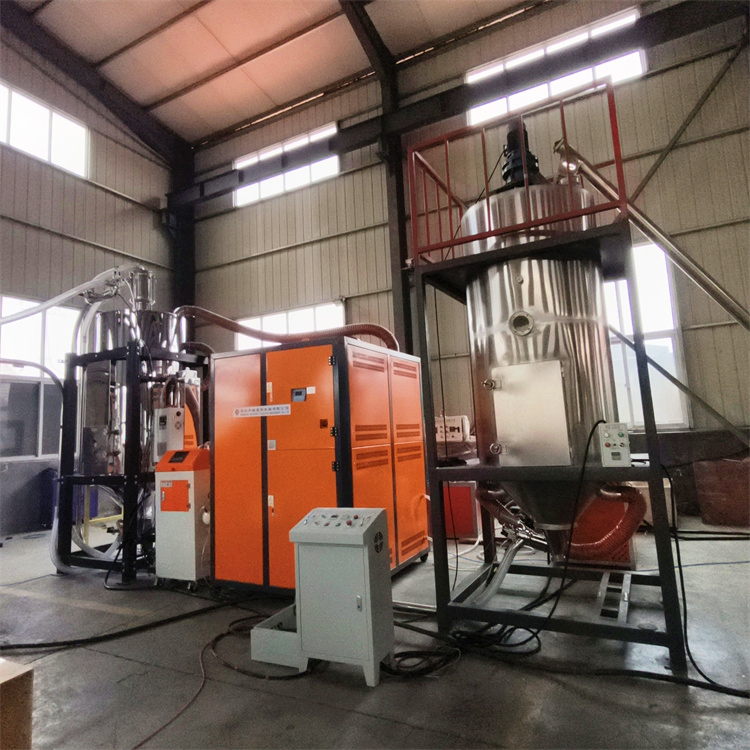
- Agitated Crystallizers: These units feature mechanical agitators. They stir the flakes continuously during the heating phase. This prevents clumping and prepares the material for deep drying.
- Advanced Drying Technology: High-efficiency desiccant dryers are mandatory. Some newer lines utilize advanced infrared or vacuum drying technologies. These systems aggressively pull moisture out of the flakes, achieving the strict sub-50 ppm requirement.
Specialized Extrusion Systems
Extruding recycled material requires aggressive volatile extraction. We highly recommend twin-screw extruders for flake processing. Twin-screw systems feature high-vacuum degassing zones along the barrel. These vacuum ports extract remaining moisture, spinning oils, and volatile gases directly from the melt.
If you prefer a single-screw system, it must be highly optimized. The OEM must design the screw geometry specifically for rPET. It needs specialized compression zones to handle the lower bulk density of ground flakes.
Melt Filtration Technology
Your filtration system dictates your line's uptime. Recycled plastics demand continuous, double-piston screen changers. These advanced filters feature massive surface areas. They allow operators to replace dirty screens without halting the extrusion process. If you have to stop the line for every screen change, your scrap rates will offset your material savings entirely.
Evaluating Line Scalability and Output Performance
You need an objective lens for assessing an innovative PET packaging belt production line. Beyond simply melting the plastic, the machine must form it perfectly.
Melt Pump Precision
Recycled flakes have fluctuating bulk densities. Some batches are heavy, while others are light and fluffy. This causes pressure surges inside the extruder. A high-precision melt pump sits between the extruder and the die. It ensures consistent pressure and volume flow regardless of upstream fluctuations. This component is critical for maintaining precise strap width and thickness.
Stretching and Annealing Capacity
Recycled PET usually starts with a lower IV than virgin resin. To compensate, the line requires highly controlled Machine Direction Orientation (MDO) stretching ovens. You must stretch the hot strap to align its molecular chains. This intensive alignment offsets the lower starting IV and generates the required break strength.
Embossing Quality Control
Proper embossing gives the strap grip for sealing tools. It also reduces longitudinal splitting. Recycled melt often behaves stiffer than virgin melt. You must assess the structural rigidity of the embossing rollers. They must apply immense, uniform pressure without deflecting.
System Capability Comparison: Virgin vs. Flake Processing
| Production Component | Standard Line (Virgin Pellets) | Advanced Line (Recycled Flakes) |
| Material Pre-Treatment | Simple hot air drying hopper | Agitated crystallizer + vacuum/desiccant dryer |
| Extruder Design | Standard single screw, no venting | Twin-screw or specialized single screw with vacuum degassing |
| Filtration System | Manual or simple hydraulic screen changer | Continuous double-piston, large-area screen changer |
| Melt Stabilization | Often relies on extruder pressure alone | High-precision gear melt pump mandatory |
Implementation Risks and Rollout Considerations
Integrating a PET strapping production line into your factory requires careful planning. Hardware is only part of the equation. Operational realities dictate your ultimate success.
- Flake Sourcing Consistency: Many buyers assume all flakes are equal. This is a dangerous assumption. IV levels and PVC contamination vary wildly by supplier. You must secure reliable, hot-washed flake sources. Test incoming material batches rigorously before loading them into your hoppers.
- Operator Training Requirements: Shifting from virgin pellets to flakes changes the thermal profile completely. The melt flows differently. The troubleshooting processes also change. Require comprehensive OEM training programs as part of your procurement contract. Your team must know how to adjust temperatures when flake density fluctuates.
- Energy Consumption: Running continuous crystallizers and high-vacuum degassing systems naturally increases your electrical power usage. You must calculate these higher operating loads against your factory's grid capacity. Factor these utility costs into your daily operational budget to ensure accurate margin forecasting.
Conclusion
Standard lines advertised merely as "flake-capable" often disappoint buyers. They usually lack the heavy-duty filtration, precise melt pumps, and deep vacuum systems necessary for profitable operation. Shortlisting equipment requires strict attention to these specific engineering details. You cannot compromise on moisture management or continuous filtration.
We advise taking actionable next steps before finalizing any machinery purchase. Contact your top OEM candidates. Request rigorous material trials using the exact grade of bottle flakes you intend to source. Review the test strap's break strength, split resistance, and dimensional stability. Taking these precautions ensures your investment yields strong, consistent returns in the competitive packaging market.
FAQ
Q: Does strapping made from recycled flakes have the same tensile strength as virgin PET?
A: Yes, it can absolutely match virgin strap performance. You must process the flakes through a line equipped with proper IV-preservation technology. Adequate moisture removal and aggressive stretching ratios realign the polymer chains, restoring the necessary tensile strength and impact resistance.
Q: Can I upgrade my existing PET packaging belt production line to handle flakes?
A: Retrofitting is technically possible but frequently impractical. A standard PET packaging belt production line often features incompatible extruder screw designs. Furthermore, older factory layouts usually lack the physical overhead space required to install massive inline crystallizers and specialized desiccant drying towers.
Q: What is the maximum moisture content allowable for recycled flakes before extrusion?
A: The industry standard requires drying PET flakes to below 50 parts per million (ppm). Many high-performance lines target below 40 ppm. Exceeding this moisture limit triggers severe hydrolytic degradation during the melting phase, which permanently ruins the strapping's structural integrity.



 +86-18561886575 (Mr.Wu)
 +8618561886575
 238 Yangzhou West Road, Jiaozhou City, Qingdao City, Shandong Province