When procurement managers or business owners first search for industrial equipment, the price disparity can be jarring. You might see a listing for a basic import model priced under $20,000, only to receive a quote the next day for a high-output European system exceeding $250,000. This massive variance often leads to "sticker shock" and confusion regarding what a realistic budget actually looks like for a production-ready line.
A common pitfall for new buyers is the "Base Unit" trap. The advertised price frequently covers only the extruder itself—the motor, gearbox, and screw. However, without the essential downstream equipment like cooling tanks, pullers, and cutters, the machine cannot produce a single usable product. Budgeting based solely on the extruder cost often leads to under-funded projects and stalled production launches.
This guide moves beyond the vague answer of "it depends." We will provide concrete price brackets based on screw type, capacity, and origin. By understanding the cost drivers—from metallurgy to automation—you can build a realistic capital expenditure (CapEx) budget that accounts for the total cost of ownership rather than just the initial invoice.
Key Takeaways
Base Price Ranges: Single screw machines typically range from $15k–$60k, while twin-screw compounding lines often start at $50k and exceed $200k.
Configuration Drives Cost: Twin-screw architecture costs 3-4x more than single-screw due to gearbox complexity and mixing capabilities.
The "Hidden" 40%: Auxiliary equipment (dryers, chillers, dies) and installation often add 40%+ to the total project cost.
Used vs. New: Premium used brands (e.g., Krauss Maffei, Werner & Pfleiderer) often cost more than brand-new generic imports, retaining value due to metallurgy and reliability.
Estimated Price Brackets by Machine Type
The first step in determining cost is defining the architecture of the machinery. The physical design of the screw and barrel dictates not only the price but also the type of material the machine can process. Below, we break down the estimated costs for the three most common categories found in the market.
Single Screw Extruders (The Workhorses)
Price Range: $20,000 – $80,000 (New, Industrial Standard)
The single screw extruder remains the backbone of the plastics industry. These machines are designed for continuous extrusion of standard materials like Polyethylene (PE), Polypropylene (PP), and Polyvinyl Chloride (PVC). Because the design is relatively straightforward—consisting of one rotating screw inside a heated barrel—the manufacturing costs are lower than their multi-screw counterparts.
However, even within this category, prices fluctuate based on the machine's geometry. A standard plastic extrusion machine with a longer Length-to-Diameter (L/D) ratio, such as 30:1 or 33:1, will command a higher price than a shorter 24:1 model. The longer screw allows for better melt homogeneity and more consistent pressure, which is critical for high-quality pipe or sheet production. Additionally, the price scales linearly with motor size; a 75kW motor setup will cost significantly more than a 30kW setup due to the heavier gearbox required to handle the torque.
Decision Note: Buyers should be wary of low-end options priced under $20,000. These often lack bimetallic barrel linings. While they function initially, they wear out rapidly when processing abrasive fillers or recycled materials, leading to costly downtime.
Twin Screw Extruders (Compounding & Specialty)
Price Range: $50,000 – $300,000+
Twin screw extruders represent a significant leap in both capability and cost. These systems use two intermeshing screws to create intense shear and mixing, making them essential for compounding, masterbatch creation, and processing engineered plastics with high filler loads (such as calcium carbonate or glass fiber).
The primary cost driver here is the gearbox. Unlike a single screw unit, a twin-screw gearbox must split torque accurately between two shafts while withstanding immense backpressure. High-torque gearboxes designed for engineering plastics can account for nearly half the machine's total cost.
Buyers must also choose between conical and parallel designs. Conical twin screw extruders are generally cheaper and are the industry standard for PVC pipe extrusion due to their ability to generate high pressure at lower RPMs. Parallel twin screw extruders are pricier but offer better scalability and mixing for compounding applications. Investing in a high-quality twin screw system is often non-negotiable for specialized applications, as cheaper alternatives frequently suffer from gearbox failure under load.
Laboratory & R&D Extruders
Price Range: $20,000 – $100,000+
There is a common paradox in extrusion machinery: small size does not equate to a small price tag. Laboratory extruders are precision instruments designed to simulate production environments using minimal material.
The high cost per pound of output stems from the need for precision instrumentation and modularity. R&D machines often feature segmented barrels that allow technicians to change the screw profile and vent locations to test different formulations. Furthermore, these machines require sophisticated data logging systems to record melt temperature, pressure, and torque in real-time. This data is vital for scaling up recipes to industrial lines. Consequently, universities and corporate R&D labs should expect to pay a premium for this versatility.

Critical Factors That Influence the Final Quote
Once you have selected the type of machine, specific technical specifications will begin to inflate the invoice. Understanding these factors allows you to determine where to spend and where to save.
1. Throughput Capacity & Motor Specifications
Capacity is the most obvious influence on price. A machine designed to output 500kg per hour requires a larger screw diameter, a more massive barrel, more heating zones, and exponentially more powerful motors than a 100kg per hour line. The cost increase is roughly linear regarding steel and iron, but the electrical components jump in price tiers.
The type of motor also matters. Modern standards favor AC vector drives, which offer precise control and lower energy consumption. While some older or lower-cost models may utilize DC motors to keep the initial price down, these often incur higher maintenance costs over time due to brush wear and less efficient energy usage. For long-term operations, paying upfront for a high-efficiency AC system is usually the wiser choice.
2. Control Systems (PLC vs. Button)
The "brain" of the extruder is another major variable. Traditional relay-logic control panels with physical buttons and PID temperature controllers are the most affordable option. They are robust and easy to repair but rely heavily on operator skill to maintain consistency.
Upgrading to a fully integrated PLC (Programmable Logic Controller) system with a touchscreen HMI (Human Machine Interface) can add 15-25% to the base cost. Brands like Siemens, Omron, or B&R provide these advanced systems. Despite the premium, the Return on Investment (ROI) is significant. PLC systems allow for automated recipe storage, ensuring that machine settings are identical every time a specific product is run. This prevents human error and saves thousands of dollars in wasted scrap material during changeovers.
3. Screw & Barrel Metallurgy
The lifespan of your machine is dictated by the metallurgy of the screw and barrel. Standard nitrided steel is the baseline option and is perfectly suitable for processing virgin, unfilled polymers like unfilled PE or PP.
However, if your production involves abrasive materials—such as glass-fiber reinforced nylon or highly filled PVC—standard steel will degrade within months. Upgrading to a bimetallic barrel or a screw with tungsten carbide coating adds anywhere from $3,000 to $10,000 to the machine price. While this increases the initial CapEx, it is essential for specific applications. Running abrasive materials on standard steel is a false economy that leads to rapid performance drops and expensive replacements.
The "Total Cost of Ownership" (TCO) Equation
Novice buyers often exhaust their budget on the extruder itself, leaving no room for the equipment required to turn molten plastic into a salable product. A reliable plastic extrusion machine manufacturer will always advise clients to look at the full scope of the project.
Essential Downstream Equipment
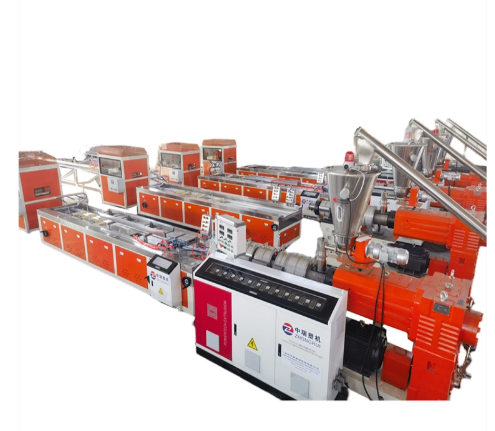
An extruder is rarely sold as a standalone unit; it is the heart of a "line." To get a functional production line, you must negotiate the cost of downstream components. These "add-ons" can easily equal the cost of the extruder itself.
Die & Tooling: The die shapes the plastic. A simple pipe die might cost $2,500, but complex window profile tooling requiring EDM machining can exceed $10,000.
Cooling Tanks: Once the plastic leaves the die, it must be cooled and sized. Vacuum sizing tanks and spray baths are critical for maintaining dimensional stability. These range from $5,000 to $20,000 depending on length and vacuum pump quality.
Haul-off & Cutting: The puller (haul-off) must match the line speed perfectly to prevent stretching or sagging. A planetary saw or guillotine cutter is then needed to cut the product to length.
If you are looking for a plastic extrusion machine for sale, ensure you are asking for a quote that includes these peripherals, or at least budget for them separately.
Installation & Commissioning
The physical act of getting the machine into your facility and running is a major sunk cost. International freight for heavy machinery is volatile and can cost between $2,000 and $20,000 depending on container availability and distance.
Furthermore, industrial extruders typically require 380V or 480V 3-phase power. Many facilities require significant electrical infrastructure upgrades to handle the load. Finally, consider energy consumption. An inefficient heater band system or motor can cost more in electricity over a 5-year period than the original purchase price of the machine. Energy-efficient ceramic heaters and servo motors reduce this TCO significantly.
Hypothetical Project Budget Comparison
| Cost Item | Budget Entry-Level Project | High-End Production Project |
| Extruder (Base Unit) | $25,000 (Single Screw) | $150,000 (Twin Screw) |
| Dies & Tooling | $3,000 | $15,000 |
| Downstream (Cooling/Pulling) | $15,000 | $80,000 |
| Shipping & Install | $5,000 | $25,000 |
| TOTAL ESTIMATED CAPEX | $48,000 | $270,000 |
New vs. Used: Evaluating the Risk-Reward
When budgets are tight, the debate often centers on whether to buy a new import machine or a used machine from a premium legacy brand. Both paths have distinct pros and cons.
The Case for Used Equipment
The used market is populated by dealers like Revelation Machinery or PlastiWin. Here, you will find high-value brands such as Cincinnati, Davis-Standard, Krauss Maffei, and Werner & Pfleiderer. The primary advantage of buying used is availability; there is no 3-6 month lead time for manufacturing. Additionally, the heavy-duty gearboxes on these legacy machines are legendary for their reliability.
However, the risks are significant. Electronic controls from the 1990s or early 2000s are often obsolete. Finding replacement boards for a 20-year-old PLC can be impossible, necessitating a full control system retrofit that can cost upwards of $20,000. Furthermore, screws and barrels are consumables; a used machine will likely require a $5,000+ refurbishment to restore tolerance.
The Case for New (Import vs. Domestic)
Buying new gives you the advantage of modern technology and warranties. Domestic machines (US/EU) come with high CapEx but guarantee local support and compliance with safety standards like UL or CE.
Asian imports offer a cost reduction of 30-50%, making market entry easier. The risks involve non-compliant electrical components, potential language barriers in documentation, and longer shipping times for spare parts. When vetting an import manufacturer, it is crucial to verify if they produce their own gearboxes or merely assemble third-party parts. Manufacturers who machine their own components generally offer higher quality control and better long-term support.
Evaluation Criteria for Shortlisting Manufacturers
Before signing a purchase order, your procurement team should run through a strict evaluation checklist to ensure the investment is secure.
Compliance Check: Does the machine meet your local safety standards (OSHA in the US, CE in Europe)? Non-compliant cheap imports may be uninsurable or red-flagged during safety inspections.
Trial Runs: Will the manufacturer run your specific material formulation before purchase? This is crucial for twin-screw compounding to prove that the screw design provides adequate mixing without degrading the material.
Component Transparency: Open the electrical cabinet. Are the inverter, motor, and PLC from global brands like ABB, Siemens, and Schneider? Or are they proprietary "black box" brands? Using global components ensures that if a part fails in five years, you can source a replacement locally rather than waiting for a shipment from overseas.
Conclusion
Ultimately, the cost of a plastic extrusion machine is a reflection of its capabilities and longevity. The extruder is the "heart" of the line, pumping material, but your budget must also account for the "lungs" (auxiliary cooling) and the "brain" (control systems). A balanced budget allocates funds across the entire line rather than dumping everything into the extruder itself.
For standard production runs of pipes or profiles, a mid-range single screw extruder typically offers the best Return on Investment. However, for specialty compounding or high-precision medical tubing, investing heavily in a high-torque twin screw system or a precision R&D line is necessary to avoid motor burnout and quality issues.
We advise all buyers to request detailed Bill of Materials (BOM) quotes. These should clearly separate the extruder price from the downstream peripherals, giving you the transparency needed to make an informed decision.
FAQ
Q: What is the cheapest plastic extrusion machine?
A: The absolute cheapest options are DIY filament extruders for 3D printing, which can cost between $200 and $500. However, for industrial production, an entry-level single screw extruder from an import brand typically starts around $15,000. Be aware that these "bare bones" prices usually exclude necessary cooling and pulling equipment.
Q: How much does an extrusion die cost?
A: Extrusion dies vary wildly in price based on complexity. A simple round pipe die may cost around $2,000 to $3,000. In contrast, a complex window profile die or a multi-layer co-extrusion die requires precision EDM machining and can easily exceed $15,000.
Q: Does a higher price guarantee better output?
A: Not necessarily higher volume, but usually better quality. Output volume is physics-based, determined by RPM and screw diameter. A higher price tag generally correlates with better melt consistency, higher-grade metallurgy (longer lifespan), and more stable control systems, which results in less scrap and higher overall efficiency.
Q: What is the lifespan of a plastic extruder?
A: A high-quality industrial extruder frame and gearbox can last 10 to 20 years with proper maintenance. However, the screw and barrel are wear components. Depending on the abrasiveness of the materials being processed, the screw and barrel typically need refurbishment or replacement every 1 to 3 years.



 +86-18561886575 (Mr.Wu)
 +8618561886575
 238 Yangzhou West Road, Jiaozhou City, Qingdao City, Shandong Province